(HEANEY, Seamus, Samuel Beckett, Marie Curie, Albert Einstein, Pablo Neruda, William Butler Yeats)ABAA

215 resultados
2001ref. 541251Gambier Ohio: Kenyon College 2001. Softcover. Fine. First edition. Special collaborative issue two magazines in one volume. Tall Octavo. 285pp. Fine in pictorial wrappers. Includes contributions from: Seamus Heaney Samuel Beckett Marie Curie Albert Einstein Pablo Neruda William Butler Yeats Joseph Brodsky Robert Hass and many more. Cultures of Creativity: The Centennial Celebration of the Nobel Prizes. Kenyon College unknown books
1956ref. 65595NY: Dell 1956. Mass market paperback. Very good. Mass market paperback. Spine lightly creased wraps lightly rubbed else very good. Dell First Edition A-121. Cover art by John Fernie. Dell unknown books
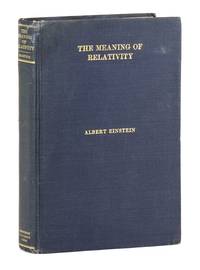
1923ref. 32639Princeton NJ: Princeton University Press 1923. Very Good. Princeton NJ: Princeton University Press 1923. First U.S. Edition. Octavo 18 cm; publisher's gilt-lettered navy cloth; 123pp. Boards bumped at corners spine ends scuffed. Water staining to spine crown bleeding into upper cover minor separation of head of spine material from book block. Last free endsheet creased. Endsheets toned. Endsheets first few pages last few pages and pages 106-112 show water staining at top margin but bulk of text block is clean and bright. Starting slightly after first free endsheet. A Very Good example overall. Collection of four lectures delivered by Einstein at Princeton for the Stafford Little Lectures in 1921. The majority of the lectures are an attempt to reconcile issues with his theory of relativity and defend it as well as give a comprehensive overview of the physics and math involved in the theory in an accessible way. Princeton University Press unknown books
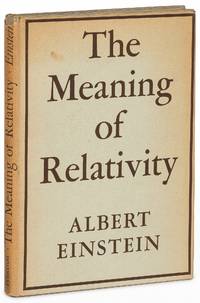
1945ref. 617621Princeton New Jersey: Princeton University Press 1945. Hardcover. Near Fine/Very Good. Second edition with a new appendix by Einstein and translated by Ernst G. Straus. Octavo. 135pp. Tiny owner name on front fly else fine in uniformly and modestly spine-toned very good dust jacket with nominal soiling. Princeton University Press hardcover books
1923ref. 2203024Princeton University Press 1923. first. hardcover. very good. First edition with 1923 stated on title page. Book in very good condition minor rubbing at corners and spine ends rear end paper detached from binding but not loose and is attached to rear paste-down along gutter with small tear at bottom of paper. Princeton University Press unknown books
1923ref. 171111001Princeton: Princeton University Press 1923. First Edition. Hardcover. Very Good. First American edition first printing. Near Fine with slight fade to spine cloth gilt stamping very sharp on front cover. Previous owner bookplate to front paste down with patch of abrasion at nearby gutter. Pages toned with several hinges just slightly over-opened. In a Very Good dust jacket with a large chip and tear at the top of the spine toning to spine and edges and several small edge tears. A very nice copy in the scarce dust jacket. Princeton University Press hardcover books
1923ref. 108095Princeton University Press 1923. 1st Edition. Hardcover. Very Good/Very Good. First edition with Published 1922 on copyright page and 1923 on title page very good in the very rare dust jacket which has some wear and chips and a big tear at rear panel. Previous owner's bookplate attached to front paste-down. Housed in a custom-made collector's slipcase. Princeton University Press hardcover books
ref. 1412611Norwalk: The Easton Press CT. First Edition. Hardcover. Octavo xii 166 pages. In Very Good condition. Bound in publisher's brown leather with paneling and gilt lettering to spine. Edges of text block gilt. Mild general shelf wear. Shelved in Easton Press. 1412611. Shelved Dupont Bookstore. The Easton Press hardcover books
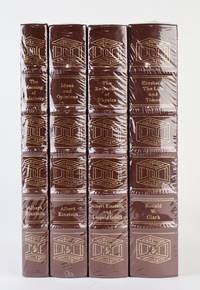
2004ref. 1393704Norwalk CT: The Easton Press 2004. Collector's Editions. Hardcover. Octavos Four Volumes. Bound in brown genuine leather with bright gilt spine titles and gilt motifs on covers. Gilt text blocks. Paper endpapers silk ribbons. In publisher's shrinkwrap. MA consignment. Shelved above Easton Press. 1393704. Shelved Dupont Bookstore. The Easton Press hardcover books
1950ref. 134020Princeton NJ: Princeton University Press 1950. Hardbound. VG exlibrary with minimal marks slighly soiled with signs of use perforation stamp to first page. Greyish cloth boards sideways title on spine. 162 3 pp index. A well-used copy but lacking the errata slip so don't use it to build anything! Princeton University Press hardcover books
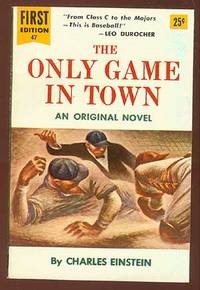
1955ref. 65597NY: Dell 1955. Mass market paperback. Very good. Mass market paperback. Slight spine lean wraps creased and rubbed pen markings on the front and back else very good. Dell First Edition 47. Cover art by Fletcher Martin. Dell unknown books
1955ref. 23282New York: Dell First Edition 1955. Softcover. Fine. Paperback original. Pages slightly yellowed else a fine unread copy. Leo Durocher blurb. Novel by the compiler of The Fireside Book of Baseball about an aging player-manager taking one last shot at the big time. McCue p.38. Dell First Edition unknown books
1958ref. 188282New York: Dover 1958. Near Fine. Reprint. Near fine. Dover unknown books
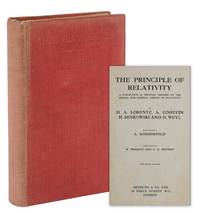
1923ref. 140949178London: Methuen & Co 1923. First Edition. Very Good. First British edition first printing. viii 216 8 ads pp. Bound in publisher's red cloth lettered in blind on front board and in gilt on spine; lacking the dust jacket. Very Good with fading light wear and soiling to covers. Evidence of bookplate removal to front pastedown offsetting to free endpapers rear hinge starting. Contents lightly toned with foxing to first and last few pages and textblock edges. An influential collection of eleven papers on relativity. Seven are authored by Einstein two by Henrik Lorentz and one each by Hermann Minkowski and Hermann Weyl. The first edition of this translation of Das Relativitaetsprinzip taken from the fourth German edition. Methuen & Co unknown books
1975ref. 161331Burbank CA: NBC 1975. Final Draft script for the twelfth episode of the thirteen episode 1975 comedy and variety show television series SIGNED on the front wrapper "Tom & Dick" by Tom and Dick Smothers with an inscription on the top left partially lost due to dampstaining "illegible Wishes from the Smothers Brothers." Copy belonging to uncredited cast or crew member David Carroll with manuscript marker and pencil annotations of his name or partial name "David C." on the top of the title page and two other pages with manuscript ink and marker annotations on 32 pages marking music cues. NBC's tamer and largely unsuccessful revival of CBS's 1967-1969 variety series "The Smothers Brothers Comedy Hour" which aired for thirteen episodes January 13 through May 19 1975. The episode on offer here was the penultimate episode which was taped on March 28 1975 and aired on May 12 1975 featuring guests Florence Henderson and David Gates. Of note the script is labeled as "Production #011 / Air Sequence #11" with a manuscript marker annotation of "12" over the air date of "May 5 1975." The May 5 episode of the series featured guests Kris Kristofferson Rita Coolidge and Arlo Guthrie and the episode found here featuring Henderson and Gates was aired as the twelfth episode on May 12 1975. Front wrapper integral with title page dated March 26 1975 noted as FINAL DRAFT. 90 leaves with last page of text numbered 77. Mimeograph duplication rectos only with blue pink yellow and green revision pages throughout undated. Pages Very Good with dampstaining throughout and silverfish damage to the extremities of the first three leaves. NBC unknown books
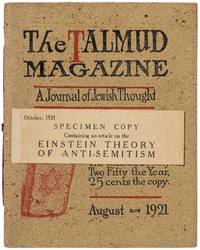
1921ref. 553355Boston: Talmud Society 1921. Softcover. Fine. First edition. 12mo. 64pp. Original cord-tied wrappers printed in red and black. The first and last leaf toned from interaction with the wrappers else about fine. An August issue of the magazine apparently used in October to promote the short-lived magazine this copy with a printed slip affixed to the front wrap: “October 1921. Specimen Copy. Containing an article on the Einstein Theory of Anti-Semitism.” Photographic portrait of Einstein on page 14; along with an English translation of his essay: "Jewish Nationalism and Anti-Semitism: Their Relativity" which originally appeared in the London Jewish Chronicle. Talmud Society unknown books
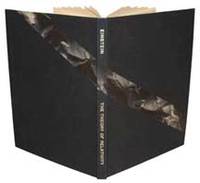
2005ref. CNAP071San Francisco: The Arion Press 2005. Hardcover. New. 10-1/2 by 8 inches eighty pages. Printed by letterpress from lead-alloy type cast in the Mackenzie & Harris typefoundry the formulas were set by hand as was the display type while the prose was composed and cast in Monotype. The types are Modern for the text with special characters as needed for mathematical symbols; Egyptian for the interspersed annotations printed in blue; and Lining Gothic for display. The paper is Schiller a German mouldmade sheet. A pixelated portrait of Einstein is the frontispiece. This image is based on a photograph taken about 1910 rendered as a coarse halftone for reference then handset in units of six-point type: three sizes of solid squares and one centered dot. Over 4000 pieces of type make up the picture. The portrait is printed in gray as is the famous equation: E=mc2 which appears on the flyleaves. The binding is dark blue cloth over boards with a band of tie-dyed Thai paper to create an unusual spatial effect spanning the cover diagonally. The titling on the spine is stamped in silver foil. The edition is limited to 400 numbered copies for sale. One of the great achievements in science Albert Einstein's Theory of Relativity was set forth in two papers published in the Leipzig physics journal Annalen der Physik in 1905. The German text was translated into English in 1923 by W. Perrett and G. B. Jeffrey and this is the version with some later corrections that is presented in this book. The Einstein papers are annotated by Richard Muller who has also provided a foreword and afterword. The foreword gives a general overview of the problems Einstein addressed against the background of nineteenth-century physics. The afterword carries the story from the miraculous year of 1905 when Einstein was only twenty-six through the effects of the theory on twentieth-century science. Muller conjectures on the progress of physics had Einstein not appeared and considers his career as a whole its last thirty-five years devoted mainly to an unsuccessful attempt to create a unified field theory. ___POSTAGE: International customers please note that additional postage may apply as the standard does not always cover costs; please inquire for details. ___Swan's Fine Books is pleased to be a member of the ABAA ILAB and IOBA and we stand behind every book we sell. Please contact us with any questions you may have we are here to help. The Arion Press hardcover books
1907ref. 433121907. Offprint from "Zeitschrift für Elektrochemie" 1907. Single sheet pp. 41-42. 287 x 206 mm. Chipped several marginal tears some toning. Fair. First edition offprint issue. "In 1907 Einstein published a paper entitled 'Theoretical Observations on the Brownian Motion' in which he considered the instantaneous velocity of a Brownian particle. Einstein showed that by measuring this quantity one could prove that 'the kinetic energy of the motion of the center of gravity of a particle is independent of the size and nature of the particle and independent of the nature of its environment.' This is one of the basic tenets of statistical mechanics known as the equipartition theorem. However Einstein concluded that due to the very rapid randomization of the motion the instantaneous velocity of a Brownian particle would be impossible to measure in practice. "Einstein: The Formative Years. unknown books
1912ref. 50337Leipzig: Johann Ambrosius Barth 1912. Einstein Albert 1879-1955. Thermodynamische Begründung des photochemischen Äquivalentgesetzes. In Annalen der Physik 37 832-838 pp. Red cloth with gilt lettering on the spine. Whole volume: 1048 pp. 5 plates 4 folding 1 b/w silver photograph w/ small fold at foot. Figs. Text-illust. 210 x 130 mm. Very good copy. "A supplement published in vol. 38 1912: 881-884 See Book ID: 50338. Einstein presents a continuation of his earlier work on the interaction between light matter and on photochemical processes. It contrasts with earlier work in that it makes no use of the quantum hypothesis. He demonstrates how what he calls 'the law of photochemical equivalence' is deducible by purely thermodynamical arguments if one makes certain plausible assumptions. He wrote a supplement to the paper in five months later in the same journal." p. 291-2. Calaprice Kennefick & Shulmann. An Einstein Encyclopedia. 2015. Weil's Bibliography of Einstein's Papers no. 46. Boni's Bibliographical Checklist no. 42. . Johann Ambrosius Barth unknown books
1930ref. 510131930. Einstein Albert 1879-1955. Théorie unitaire du champ physique. In Annales de l'Institut Henri Poincaré 1 fasc. 1 1930: 1-24. With: Fermi Enrico 1901-54. La théorie du rayonnement. In ibid.: 25-52. Whole number. 2 74 2pp. 285 x 197 mm. uncut and unopened. Original printed wrappers a bit sunned lower corner of front wrapper chipped and creased. Very good. First Edition. This issue of the Annales de l'Institut Henri Poincaré contains the texts of Einstein's lecture on unified field theory and Fermi's lecture on the theory of radiation both delivered at the Institut in 1929. Weil Albert Einstein Bibliography 174. Not in Fermi Collected Papers. . unknown books
1921ref. 611480New York: Harcourt Brace and Company 1921. Hardcover. Very Good. First edition. Octavo. xiii 366pp. Dark blue cloth with spine gilt several foredges unopened. Boards with modest wear and a bit of light discoloration page edges foxed very good. Harcourt, Brace and Company hardcover books
1921ref. 450858New York: Harcourt Brace and Company 1921. Hardcover. Very Good. First edition. Octavo. Owner's pencil name a few easily erasable pencil notes in text small spots on front board and a little wear at the spine ends very good. Harcourt, Brace and Company hardcover books
1921ref. 37862New York: Harcourt Brace. Very Good. 1921. Hardcover. Good. No dust jacket. Ex-library copy with all the usual stamps etc. suitable for reading or reference not a collector's copy.; Xiii 366 p. 23 cm. . Harcourt, Brace hardcover books
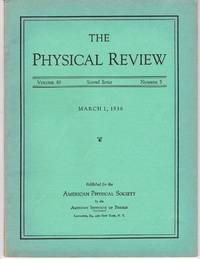
1936ref. 6550Lancaster PA: American Physical Society 1 March 1936. Second series volume 49 number 5. Very Good. ppl 341-422. Original green wraps. Slight nick at bottom edge of lower wrap else better than very good. Includes the retort by Einstein and Rosen originators of speculation on the existence of "worm-holes" in spacetime to objections made to the general theory of relativity. According to Galina Weinstein: "Between 1935 and 1936 Einstein was occupied with the Schwarzschild solution and the singularity within it while working in Princeton on the unified field theory and with his assistant Nathan Rosen on the theory of the Einstein-Rosen bridges. He was also occupied with quantum theory. He believed that quantum theory was an incomplete representation of real things. Together with Rosen and Boris Podolsky he invented the EPR paradox. I demonstrate that the two-body problem in general relativity was a heuristic guide in Einstein's and collaborators' 1935 work on the Einstein-Rosen bridge and EPR paradox." Also articles by notable physicists on radioactivity electron mobility quantum-mechanical measurement and so on. American Physical Society paperback books
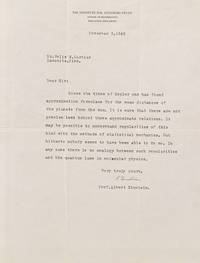
1942ref. 1265881942. Signed. EINSTEIN Albert. Typed letter signed. Princeton November 3 1942. One sheet measuring 8-1/2 by 11 inches typing on recto only; matted and framed with a portrait of Einstein entire piece measures 21 by 17 inches. $38000.An exceptional typed letter signed by Einstein on precursors like Johannes Kepler's work to his Special and General Theories of Relativity beautifully framed.The letter on letterhead from the Institute for Advanced Study in Princeton reads in full: ""November 3 1942. Mr. Felix W. Cartier. Laconite Minn. Dear Sir: Since the times of Kepler one has found approximation formulaes for the mean distances of the planets from the sun. It is sure that there are not precise laws behind those approximate relations. It may be possible to understand the irregularities of this kind with the methods of statistical mechanics. But hitherto nobody seems to have been able to do so. In any case there is no analogy between such regularities and the quantum laws in molecular physics. Very truly yours signed A. Einstein. Prof. Albert Einstein.""Early in the 17th century Johannes Kepler 1571-1630 discovered that planets orbit the sun in ellipses rather than perfect circles. This great discovery paved the way for Isaac Newton's laws of gravity and for Albert Einstein's general and special theories of relativity. Previous to Einstein's time people believed in real distances and absolute time and showed that instruments could not objectively measure the distances between planets. Einstein's theories which hypothesized that light and space curve near a massive object revolutionized scientific thought and gave man an exciting new perspective of his universe.Einstein's letter reflects on some of the most important scientific revelations in the history of physics and astronomy. Kepler defined three laws of planetary motion; however the one specifically referred to in this letter is that all planets move about the Sun in elliptical orbits having the Sun as one of the foci. If the Universe then consisted only of two point massesÑthe Sun and a planetÑthe orbit of that planet would make a perfect closed ellipse that returned the world to its starting location with each trip around the Sun. But in a Universe governed by Newtonian gravity with a plethora of massive bodies in our Solar System that ellipse will precess or rotate slightly in its orbit.In the mid-1800s orbital deviations of Uranus from its predicted motions led to the discovery of Neptune as the outermost world's gravitational influence accounted for the excess motion. But in the inner Solar System the nearest planet to the Sun Mercury was experiencing a similar problem. With detailed accurate observations going back to the late 1500s thanks to astronomer Tycho Brahe we could measure how Mercury's perihelion its closest orbital point to the Sun was advancing. The number we came up with was 5600"" per century just over 1.5 degrees over a 100 year period. But of that 5025"" came from the precession of Earth's equinoxes a well-known phenomenon while 532"" was due to Newtonian gravity.But 5025"" plus 532"" comes up short by a small but significant amount. Attempts at explanationÑincluding the existence of an unknown inner planet interior to MercuryÑall failed. But after Einstein's special theory of relativity came out in 1905 mathematician Henri Poincare showed that the phenomena of length contraction and time dilation contributed a fraction between 15-25% of the needed amount towards the solution dependent on the error. That plus Minkowski's formalization of space and time as not separate entities but as a single structure bound together by their union spacetime led Einstein to develop the general theory of relativity. On November 25 1915 he presented his results computing the spectacular figure that the contribution of the extra curvature of space predicted an additional precession of 43"" per century exactly the right figure needed to explain this observation sending shockwaves through the astronomy and physics communities. Less than two months after this Karl Schwarzschild found an exact solution predicting the existence of black holes. The deflection of starlight and gravitational redshifts/blueshifts were realized as possible tests and finally the solar eclipse of 1919 validated general relativity as superseding Newtonian gravity. Expected fold lines. An incredible letter scarce in its important content. unknown books