2 535 résultats
1905réf. 19259Leipzig: Johann Ambrosius Barth 1905. FIRST EDITION. Line-block and halftone text illustrations one folding table 3 halftone plates 1 collotype plate. Contemporary cloth-backed marbled boards title and date in gilt on spine; an excellent copy with the small stamp of the University of Basel on the fly-leaf preserved in a clamshell box. First edition journal issues of three important early papers by Einstein. In the first paper “Einstein suggested that light be considered a collection of independent particles of energy which he called ‘light quanta.’ Such a hypothesis he argued would provide an answer to the problem of black-body radiation where classical theories had failed and would also explain several puzzling properties of fluorescence photoionization and the photoelectric effect” Norman. It was for this paper together with one of the photoelectric effect “Zur theorie der Lichterzeugung und Lichtabsorption” published in 1906 that Einstein was awarded the Nobel Prize in Physics in 1921. The second paper proved according to Einstein himself that “according to the molecular theory of heat bodies of dimensions of the order of 1/1000 mm. suspended in liquid experience apparent random movement due to the thermal Brownian molecular movement quoted by R.W. Clark Einstein New York 1984 p. 87. Experimental verification of the predictions made in this paper contributed to proving the physical reality of molecules. The third paper on the electodynamics of moving bodies was Einstein’s first statement of the special theory of relativity. In it he argued that all motion is relative to the inertial system in which it is measured and that matter and energy are equivalent. As he himself remarked “it modifies the theory of space and time.” I: Weil 6; Norman 689; II: Weil 8 Norman 690; III: Weil 9 Dibner Heralds of Science 167; Grolier/Horblit 26b Norman 691A. Johann Ambrosius Barth unknown books
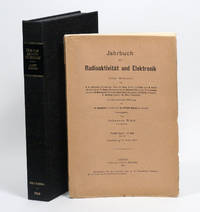
1908réf. 2507Leipzig: S. Hirzel 1908. First edition. original wrappers. Very Good. THE BIRTH OF GENERAL RELATIVITY: FIRST PRINTING IN RARE ORIGINAL WRAPPERS OF ONE ONE EINSTEIN'S MOST IMPORTANT PAPERS; containing the beginning of general relativity the derivations of the equivalence principle gravitational redshift and the gravitational bending of light. "Einstein's road to general relativity began in November 1907 when he was struggling against a deadline to finish an article for a science yearbook explaining his special theory of relativity. Two limitations of that theory still bothered him: it applied only to uniform constant-velocity motion. and it did not incorporate Newton's theory of gravity. "'I was sitting in a chair in the patent office at Bern when all of a sudden a thought occurred to me' he recalled. 'If a person falls freely he will not feel his own weight.' That realization which 'startled' him launched him on an arduous eight-year effort to generalize his special theory of relativity and 'impelled me toward a theory of gravitation.' Later he would call it 'the happiest though in my life.' "The tale of the falling man has become an iconic one and in some accounts it actually involves a painter who fell from the roof of an apartment building near the patent office. Einstein refined his thought experiment so that the falling man was in an enclosed chamber such as an elevator in free fall above the earth. In this falling chamber at least until it crashed the man would feel weightless. Any objects he emptied from his pocket and let loose would float alongside him. "Looking at it another way Einstein imagined a man in an enclosed chamber floating in deep space 'far removed from stars and other appreciable masses.' He would experience the same perceptions of weightlessness. 'Gravitation naturally does not exist for this observer. He must fasten himself with strings to the floor otherwise the slightest impact against the floor will cause him to rise slowly towards the ceiling.' "Then Einstein imagined that a rope was hooked onto the roof of the chamber and pulled up with a constant force. 'The chamber together with the observer then begin to move "upwards" with a uniformly accelerated motion.' The man inside will feel himself pressed to the floor. 'He is then standing in the chest in exactly the same way as anyone stands in a room of a house on our earth. The man in the chamber will come to the conclusion that he and the chest are in a gravitational field. Just then however he discovers the hook in the middle of the lid of the chest and the rope which is attached to it and he consequently comes to the conclusion that the chamber is suspended at rest in the gravitational field.' Einstein observed that inertial mass always equals gravitational mass and through his thought experiments concluded that "From this correspondence it follows that it is impossible to discover by experiment whether a given system of coordinates is accelerated or whether. the observed effects are due to a gravitational field." "Einstein called this 'the equivalence principle.' The local effects of gravity and of acceleration are equivalent. "In 1907 working against the deadline imposed by the Yearbook of Radioactivity and Electronics Einstein tacked on a fifth section to his article on relativity that sketched out his new ideas. He also came up with many predictions that could be tested including that light should be bent by gravity and that the wavelength of light emitted from a source with a large mass such as the sun should increase slightly in what has become known as the gravitational redshift. "It would take Einstein another eight years until November 1915 to work out the fundamentals of this theory and find the math to express it. Then it would take another four years before the most vivid of his predictions the extent to which gravity would bend light was verified by dramatic observations. But at least Einstein now had a vision one that started him on the road toward one of the most elegant and impressive achievements in the history of physics: the general theory of relativity" Isaacson Einstein 145-49. Weil in his bibliography also notes that "On p.443 are probably the first explicit statements both of the equivalence of inertial and gravitational mass and of the equation for mass in terms of energy now regarded as the theoretical basis for the release of atomic energy." Weil 21. Although Einstein submitted the paper on 4 December 1907 it wasn't published until the January 22 issue of the Jarbuch. Note: There was a very short "Correction" in a subsequent issue not included here. IN: Jahrbuch der Radioactivität under Electronik Vierter Band - 4. Heft No. 16 pp. 411-462. Leipzig: S. Hirzel 1908. Octavo original wrappers; handsome custom box. Light wear to wrappers and split to spine; text fine with Einstein paper largely unopened. AN EXTREMELY RARE COPY IN ORIGINAL WRAPPERS OF ONE OF EINSTEIN'S MOST IMPORTANT PAPERS. S. Hirzel unknown books
1911réf. 50424Leipzig: Johann Ambrosius Barth 1911. The Genesis of General Relativity Einstein Albert 1879-1955. 1 Elementare betrachtungen über die thermische molekularbewengung in festen Körpern. In Annalen der Physik 35 9: 679-94 pp. Weil 42. 2 Über den Einfluß der Schwerkraft auf die Ausbreitung des lichtes. In Annalen der Physik 35 10: 898-908 pp. Weil 43. Red cloth gilt spine lettering. Figs. Text-illust. 214 x 140 mm. Whole volume: viii 1040 pp. 6 plates 3 b/w silver photos 1 colorized 2 folding. Very good. Approximate English translations of titles: 1 "Elementary considerations about thermal molecular motion in solid bodies" and 2 "On the influence of gravity on the propagation of light." "Einstein returns to his thoughts on gravitation and discusses his ideas on the static gravitational field no. 1 above advancing the "half-shift" prediction of the deflection of light by a massive body such as the Sun. In his early papers on the subject . . . he used two important features: the principle of equivalence and the role of the speed of light. In this paper he takes a broader perspective saying that if a light beam is bent in an accelerating frame of reference then if the theory is correct it must also be besnt by gravity by exactly the equivalent amount." Calaprice An Einstein Encyclopedia. "An important conclusion of this paper is that the velocity of light in a gravitational field is a function of the place. The equation: c = c01 / c2 signifies that there exists a relationship between the velocity of light and the gravitational potential; the latter influences the first." Weinstein Einstein's 1912-1913 struggles with Gravitation Theory: Importance of Static Gravitational Fields Theory. "Here no. 2 above Einstein continues the work he had begun in 1907 on the specific heat of solids where the heat agitation of solids was reduced to a monochromatic oscillation of the atom and the specific heat was determined based on the quantum treatment of an oscillator in a radiation field. He explains the discrepencies between his formula and the measurements at low temperatures" Calaprice An Einstein Encyclopedia. Weil's Einstein Bibliography nos. 42 and 43. Boni's Einstein Checklist nos. 38 39. . Johann Ambrosius Barth unknown books
1908réf. 432171908. Einstein Albert 1879-1955 and Jakob Johann Laub 1884-1962. Über die elektromagnetischen Grundgleichungen für bewegter Körper. Offprint from Annalen der Physik 4th series 26 1908. 532-540pp. 225 x 146 mm. Original printed wrappers. Fine. First Edition Offprint Issue. Einstein's first paper written jointly with a collaborator on the relativistic electrodynamics of ponderable media. "In 1908 Laub wrote works together with Einstein on the basic electromagnetic equations which was aimed to replace the four-dimensional formulation of the electrodynamics by Minkowski by a simpler classical formulation. Both Laub and Einstein discounted the spacetime formalism as too complicated. However it turned out that Minkowski's spacetime formalism was fundamental for the further development of special relativity" Wikipedia. Pais Subtle is the Lord pp. 151 154. Shields 23. Weil 23. . unknown books
1907réf. 50420Leipzig: Johann Ambrosius Barth 1907. Einstein explicitly establishes E=mc2. Einstein Albert 1879-1955. 1 Über die Möglichkeit einer neuen Prüfung des Relativitätsprinzips. In Annalen der Physik 23 6: pp. 197-8. 2 Bemerkungen zu der Notiz von Hrn. Paul Ehrenfest: "Die translation deformierbarer Elektronen und der Flächensatz." In Annalen der Physik 23 6: pp. 206-8. 3 Über die vom relativitätsprinzip geforderte Trägheit der Energie. In Annalen der Physik 23 7: pp. 371-384. 8vo. Red cloth gilt lettering on spine. 214 x 140 mm. Whole volume: viii 1000 pp. 4 plates numbered Taf. I - IV. Tafs. I II and IV are folding Taf. III is b/w silver photograph tipped to sheet. Foot of the spine is repaired. Very good. Approximate English translations of titles: 1 "On the possibility of a new test of the principle of relativity." 2 "Remarks on Mr. Paul Ehrenfest's note: 'The translation of deformable electrons and the surface theorem.'" 3 "On the inertia of energy required by the principle of relativity." In "On the inertia of energy required by the relativity principle" May 1907 "Using rather than m V rather than c and 0 rather than E0 Einstein wrote his famous equation for the first time as V2= 0 and he did it in a footnote. At the end of that paper he introduced the symbol E0 to denote energy in the rest frame and wrote the famous expression again this time as =E0/V2." -Eugene Hecht How Einstein confirmed E0 = mc2 In the third paper Einstein explicitly establishes his famous equation E=mc2 although with different symbols. In this paper Einstein discussed the relationship between inertial mass and energy arguing for their complete equivalence namely that every mass has an equivalent energy just as every form of energy has an equivalent mass. This relation says that a photon can convert for the equivalence of mass and energy his celebrated equation E = mc2 Calaprice The Einstein Almanac. Weil's Einstein Bibliography nos. 17 18 and 19 respectively. Boni's Einstein Checklist nos. 17 18 and 19 respectively. . Johann Ambrosius Barth unknown books
1922réf. 792Berlin: Springer 1922. First Edition. Wrappers. Near fine. 2 vols. in German the first appearance of 2 distinct papers in 2 separate periodical issues September 13 and November 17. Both are complete in original wrappers. Near fine small pencil name on the Nov. cover. Seems to be surprisingly rare. RBH lists no auction sales of Friedmann's article title and date since 1975 and only one copy of it is listed by OCLC but copies of the bound annual Zeitschrift für Physik are regularly available and should not in this case be considered in any way equivalent to our set in publisher's wrappers. 1. Friedmann's pioneering paper the first to seriously apply general relativity to cosmology without the stabilizing cosmological constant theorizing and mathematically formularizing an expanding universe dragging cosmology into a branch of physics. In Zeitschrift für Physik Band 10 He 16 September 13 1922 pages 377-386 "Here we have for the first time the idea of an expanding universe originating in a singularity-a big-bang." -Helge Kragh Cosmology and Controversy page 24. 2. Einstein's critical remarks on Friedmann's paper that he retracted in 1923. In Zeitschrift für Physik Band 11 He 4/5 November 17 1922 page 326. Springer unknown books
1917réf. 6547Braunschweig: Friedrich Vieweg 1917. Ninth printing. Acceptable. 23 cm; iv. 79 pages. Three figures in text along with numerous equations. In original printed wraps. Acceptable only with paper peeling from the spine and sewing tender. Paper cover is completely detached in front and hanging by a thread in back. The pages are yellowed. There is an ownership autograph of one E. Bodländer. That said a clean unmarked copy in original state. The original German edition of Einstein's epoch-making "On the Special and General Theory of Relativity. Friedrich Vieweg paperback books
1921réf. 433161921. Offprint from Sitzungsberichte der preussischen Akademie der Wissenschaften 1921. Single sheet pp. 882-883. 256 x 184 mm. Minor marginal tears one corner chipped but very good. First ediiton offprint issue. "Since after 1917 Einstein firmly believed that light-quanta were here to stay it is not surprising that he would look for new ways in which the existence of photons might lead to observable devations from the classical picture. In this he did not succeed. At one point in 1921 he thought he had found a new quantum criterion published in the present paper but it soon turned out to be a false lead" Pais Subtle is the Lord pp. 412-413. Weil Albert Einstein Bibliography 118. unknown books
1906réf. 432891906. Einstein Albert 1879-1955. Über eine Methode zur Bestimmung des Verhältnisses der transversalen und longitudinalen Masse des Elektrons. Offprint from Annalen der Physik 21 1906. 583-586pp. 223 x 145 mm. Original printed wrappers chipped spine splitting minor spotting. Light toning but very good. First Edition Rare Offprint Issue. In his landmark 1905 paper on special relativity Einstein used the velocity-dependent concepts of transverse and longitudinal mass for the moving electron these terms have now been replaced with the concept of relativistic mass first defined by Lewis and Tolman in 1909. In the present paper Einstein proposed an experimental method for determining the ratio of the transverse to the longitudinal mass and invited experimentalists to verify his special theory of relativity. Einstein later abandoned velocity-dependent mass concepts stating in 1948 that "it is better to introduce no other mass concept than the 'rest mass' m" quoted in L. B. Okun "The concept of mass" Physics Today 1989: 31-36. Lavenda A New Perspective on Relativity pp. 7-8. Weil Albert Einstein Bibliography 14. . unknown books
1910réf. 50336Leipzig: Johann Ambrosius Barth 1910. Einstein Albert 1879-1955. 1 Uber einen Satz der Wahrscheinlichkeitsrechnung und seine Anwendung in der Strahlungstheorie with L. Hopf. pp. 1096-1104. Weil 34 Boni 29. 2 Statistiche Untersuchung der Bewegung eines Resonators in einem Strahlungsfeld with L. Hopf. pp. 1105-1115. Weil 35 Boni 30. 3 Theorie der Opaleszens von homogenen Flüssigkeiten und Flüssigkeitsgemischen in der Nähe des kritischen Zustandes. pp. 1275-1298. Weil 36. In Annalen der Physik und Chemie 33. Red cloth with gilt lettering on the spine. Whole volume: viii 1584 pp. 6 plates. Text-figs. 210 x 130 mm. Very good copy. Approximate English translations of titles and brief explanations of papers: 1 "On a theorem of probability calculus and its application in the radiation theory." "Einstein and Hopf wrote this paper to show that the failure of statistical mechanics vis-a-vis the radiation law cannot be ameliorated by proposing that individual statistical events in the emission of light from different points on the surface of a luminous body are not actually independent but instead are interdependent with each other. Even if one assumes a failure to be statistically independent one derives the same usual form of the radiation law as Fourier sum." p. 290. Calaprice Kennefick & Shulmann. An Einstein Encyclopedia. 2015. 2 "Statistical investigation of the movement of a resonator in a radiation field." With: L. Hopf. "The authors make use of the results in no. 1 above demonstrating that the Rayleigh-Jeans law of radiation is an unavoidable consequence of statistics even if we avoid assumptions that we may think need correction. In other words we cannot blame statistics for a faulty result." p. 290. Calaprice Kennefick & Shulmann. An Einstein Encyclopedia. 2015. 3 "Theory of the opalescence of homogenous liquids and liquid mixtures near the critical state"."Einstein explains the optical effects that occur near the critical point of a fluid at which liquid gas phases can coexist and of a binary mixture of liquids that can also explain the blue color of the sky. It adds to earlier stuidies that provided evidence for the atomistic constitution of matter and is one of the most difficult papers to understand." p. 290. Calaprice Kennefick & Shulmann. An Einstein Encyclopedia. 2015. "October 1910. E. completes a paper on critical opalescence his last major work in classical statistical physics." Pais Subtle is the Lord. 523. Weil's Einstein Bibliography nos. 34 35 and 36 respectively. Boni's Einstein Checklist nos. 29 30 and 31 respectively. . Johann Ambrosius Barth unknown books
1916réf. 50341Leipzig: Johann Ambrosius Barth 1916. Einstein Albert 1879-1955. Über Friedrich Kottlers Abhandlung "Über Einsteins Äquivalenzhypothese und die Gravitation." In Annalen der Physik 51 638-642 pp. Red cloth with gilt lettering on the spine. Whole volume: 883 pp. 4 plates. Figs. Text-illust. 210 x 130 mm. A very good copy. Weil's Einstein Bibliography no. 81. Boni's Einstein Checklist no. 79. . Johann Ambrosius Barth unknown books
1920réf. 29309Berlin, Julius Springer, 1920. Clothbacked boards. Bound with orig. printed wrappers. Small inkspots in inner margins of wrappers. 15 pp.
1920réf. 29310Berlin, Julius Springer, 1920. Uncut in orig. printed wrappers. 15 pp.
1920réf. 38643Berlin, Julius Springer, 1920. Uncut in orig. printed wrappers. 15, (1) pp. Clean and fine, near mint condition.
1920réf. 88490Berlin, Julius Springer, 1920, in-8, 15 pp, Broché, couverture agrafée de l'éditeur, Édition originale de ce discours prononcé par Einstein (1879-1955) le 5 mai 1920 à la Reichsuniversität de Leyde, à l'occasion de son entrée en fonction en tant que professeur invité. Le savant y expose comment la conception ancienne de l'éther a laissé la place à la notion de gravitation. Cachet ex-libris du révolutionnaire Russe et bibliophile Marcel Bekus (1888-1939). Bon exemplaire. Couverture insolée, agrafes oxydées. Hans-Josef Küpper, Verzeichnis Der Wissenschaftlichen Publikationen Albert Einsteins von 1901-1922 [en ligne]. Weil, 111. Couverture rigide
1920réf. 7913FB1920. Berlin Springer 1920. 8°. 15 1 S. Unbeschnittene Original-Broschur gebräunt leicht fleckig. Durchgehend mäßig braunfleckig. Sonst gut. unknown
1920réf. 29309Berlin Julius Springer 1920. Clothbacked boards. Bound with orig. printed wrappers. Small inkspots in inner margins of wrappers. 15 pp. First edition. - Weil No. 111. hardcover
1920réf. 29310Berlin Julius Springer 1920. Uncut in orig. printed wrappers. 15 pp. First edition. - Weil No. 111. unknown
1920réf. 38643Berlin Julius Springer 1920. Uncut in orig. printed wrappers. 15 1 pp. Clean and fine near mint condition. First edition. - Weil: 111. unknown
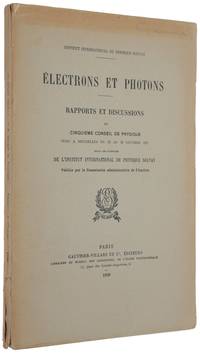
1928réf. 6594Paris: Gauthier Villars 1928. First edition. First edition rare in the original printed wrappers of the proceedings of the Fifth Solvay Congress 1927-the most celebrated of the Solvay conferences and the setting in which the Bohr-Einstein debate over the consistency and completeness of quantum mechanics first took public programmatic form. Convened under the banner "Electrons and Photons" the meeting brought together nearly all the principal architects of the old and the new quantum theory; seventeen of the twenty-nine participants were or became Nobel Prize laureates. . The Bohr-Einstein Debate Begins. First edition rare in the original printed wrappers of the proceedings of the fifth Solvay Congress where the debate between Bohr and Einstein on the consistency and completeness of quantum mechanics began. It was at this the most famous of the Solvay conferences that Einstein disenchanted with Heisenberg's uncertainly principle made his famous remark that "God does not play dice" to which Niels Bohr replied "Einstein stop telling God what to do!" Seventeen of the twenty-nine attendees which included nearly all the principal architects of the old and the new quantum theory were or became Nobel Prize winners. "The three and a half years since the fourth Solvay Conference . were marked by enormous progress in quantum physics. Partly based on discoveries and ideas that had been available already before 1924 − such as the Compton effect and matter waves − the new atomic theory had arisen which did more than throw new light on the difficulties discussed at the 1924 conference: quantum or wave mechanics went right to the heart of the problems posed by atomic phenomena. The two subjects put programmatically into the title of the fifth Solvay Conference − electrons and photons − designated the crucial points of interest because 'electrons' also stood for the smallest massive constituents of matter and they now became associated with waves and 'photons' a name given only recently in October 1926 by the physical chemist Gilbert N. Lewis to Einstein's light-quanta characterized the quantum-theoretical aspect of electromagnetic radiation. It was the declared intention of the Scientific Committee of the Institut International dePhysique Solvay to contribute by scientific reports and discussions about them to the clarification of the scientific concepts in the physics of the day. In retrospect one may indeed attribute an important success to the 1927 Solvay Conference in marking the completion of the ideas that had first been discussed in the international physics community sixteen years previously at the first Solvay Conference of 1911" Mehra & Rechenberg pp. 233-4. Following a 'Notice nécrologique' by Lorentz the present volume contains the following reports and discussions about them by the participants all articles in French: 'The Intensity of the Reflection of X-rays' by Bragg; 'Disagreement between Experience and the Electromagnetic Theory of Radiation' by Compton; 'The New Dynamics of Quanta' by de Broglie; 'The Mechanics of Quanta' by Born and Heisenberg; 'The Mechanics of Waves' by Schrödinger; 'The Quantum Postulate and the New Development of Atomic Theory' by Bohr. No copies located in auction records. In 1911 the Belgian industrialist Ernest Solvay invited a group of the world's most prominent physicists including Einstein Planck Lorentz Sommerfeld Rutherford and Marie Curie to participate in a scientific conference on the difficulties of reconciling classical physics with quantum theory. The conference "set the style for a new type of scientific meetings in which a select group of the most well informed experts in a given field would meet to discuss the problems at its frontiers and would seek to define the steps for their solution" Mehra Solvay Conferences p. xv. The first Solvay Conference-widely considered a turning point in the history of modern physics-was so successful that in the following year Solvay established a foundation now known as the International Solvay Institutes for Physics and Chemistry "to encourage the researches which would extend and deepen the knowledge of natural phenomena" ibid. and to sponsor further conferences. The next two Solvay Conferences met in 1913 and 1921; subsequent conferences have been held every three years except during wartime. "From amongst the members of the Scientific Committee of the 1927 Congress two had already played a leading role in 1911: the Chairman Hendrik Lorentz and Albert Einstein; the latter had presented then the most revolutionary report on the light quantum. In spring 1926 in the early stage of preparing for the new conference Lorentz again requested Einstein to write a report. The latter answered promptly: 'If you wish that I take over the report on quantum statistics I shall do so with pleasure; because without being in great difficulty I shall never say "no" to you' Einstein to Lorentz 1 May 1926 . On 17 June 1927 Einstein wrote to Lorentz: 'I recall having committed myself to you to give a report on quantum statistics at the Solvay Conference. After much reflection back and forth I came to the conclusion that I am not competent for giving such a report in a way which really corresponds to the state of the thing. The reason is that I have not been able to participate as intensively in the modern development of quantum theory as would be necessary for that purpose. This is in part because I have on the whole too little receptive talent for fully following the stormy developments in part also because I do not approve of the purely statistical way of thinking on which the new theory is founded .' As a substitute speaker for the topic assigned to him he proposed either Enrico Fermi from Italy or Paul Langevin from France. Ultimately however neither of them gave the report on Einstein's subject. Instead Niels Bohr agreed to contribute a report on a different topic: namely on his latest considerations on the problem of the interpretation of quantum mechanics. "The rapporteurs at the fifth Solvay Conference fell into three groups: the experimentalists Bragg and Compton; the theoreticians advocating the Gottingen-Cambridge-Copenhagen versions of quantum mechanics − Bohr Born and Heisenberg; and those of the wave-mechanical camp − de Broglie and Schrodinger. "The selection of Arthur Holly Compton seemed to be most appropriate because the Compton effect − discovered in late 1922 − had been one of the crucial results triggering the entire development which ended with the new atomic theory by providing Einstein's light-quantum hypothesis of 1905 a firm experimental foundation. Since its discovery and even more so after the refutation of the Bohr-Kramers-Slater theory of radiation . Einstein's fundamental light-quantum conception . became a physical reality. Compton's report dwelt on the conceptual consequences rather than on experimental details. In particular he addressed the questions of the aether and of electromagnetic waves on the one hand and the phenomena contradicting the classical wave concepts such as the photoelectric effect X-ray diffraction certain electron-recoil effects observed by C. T. R. Wilson and W. Bothe in 1923 and the individual interaction between radiation-quanta and electrons i.e. the Compton effect. Compton showed also in some detail how the Bohr-Kramers-Slater theory failed to account for these observations. "The report of William Lawrence Bragg a regular participant in the Solvay Conferences since 1913 appeared to address on first inspection less central points. However from his presentation of the material on reflection of X-rays one easily recognizes the strategy of the Scientific Committee of the Conference: Bragg had to take over the task of stressing those radiation phenomena that could be described by the wave theory namely the diffraction of X-rays by crystal lattices. Consequently he gave the story from Laue's discovery in 1912 over the subsequent work of his father William Henry Bragg and himself to the later investigations of Paul Ewald William Duane and others. Bragg demonstrated in detail how the old and the new wave theories worked to describe the phenomena of diffraction and refraction of X-rays. In the discussion of Bragg's report Hendrik Kramers presented at some length the recent development of the dispersion theory by himself and Ralph Kronig. "Both experimental reports served as a firm basis for the discussion of the theoretical concepts which provided the central theme of the conference. This significance was shown by the discussions immediately following them. Compton's talk especially gave rise to a lively exchange of ideas and arguments in which besides the experimentalists e.g. Bragg Madame Curie O. W. Richardson and C. T. R. Wilson almost all of the theoretical experts present participated i.e. Bohr Born Debye Dirac Ehrenfest Lorentz Pauli and Schrödinger − with one important exception: according to the published proceedings of the fifth Solvay Conference offered here Einstein remained silent after the presentations of Compton and Bragg . "The presentation of the theoretical reports at the Solvay Conference proceeded by following the historical order in which the ideas had been published between 1923 and 1926: thus de Broglie's talk came first then Born and Heisenberg's followed by Schrödinger's and finally Bohr's . "In the course of the year 1927 the Copenhagen physicists Heisenberg among them clarified their ideas on the interpretation of atomic phenomena. Although they admitted the existence and persistence of statistical relations in quantum mechanics they searched for − and succeeded in − formulating principles that in their opinion at least provided the deeper reason for these statistical features: the uncertainty relations and the complementarity principle. In spite of this difference in attitude toward what they regarded as truly fundamental and actually derived Heisenberg felt no difficulty in preparing a joint Solvay report together with his former teacher Max Born. Their report provided a view of the work performed in Göttingen and Cambridge in establishing quantum mechanics with chapters on matrix mechanics and its transformation into wave mechanics I the physical interpretation of the theory II and the uncertainty principle III. The balance in representing the main interests of the two authors was achieved insofar as Section II dealt with Born's statistical interpretation and Section III with Heisenberg's limitation on measurements in quantum mechanics. Moreover the Born-Heisenberg report also signaled the agreement reached by Heisenberg and Niels Bohr during the summer of 1927 . "Louis de Broglie entitled his report 'The new dynamics of quanta'; he covered the story from his first ideas on matter waves in 1923-24 to the advent of Schrödinger's equation in 1926 and on to the new pilot-wave theory in 1927. He further applied the pilot-wave theory to the problem of the hydrogen atom and claimed that the treatment yielded an easier understanding of the actual situation; finally he spoke about the experimental verification of matter waves obtained recently in the experiments of Clinton Joseph Davisson and Lester Halbert Germer and George Paget Thomson and Alexander Reid . Erwin Schrödinger on the other hand concentrated on the mathematical aspects of his wave-mechanical scheme the time-independent as well as the time-dependent equations the formal equivalence of wave mechanics to the Born-Heisenberg-Jordan matrix scheme and the relativistic wave equation. At the end of the conference Niels Bohr presented a modified version of his Como lecture under the title 'The Quantum Postulate and the New Development of Atomic Theory' . "Although the Born-Heisenberg and Schrödinger reports provoked only technical questions that of de Broglie and especially the one of Bohr stimulated some conceptual discussion. Thus Lorentz asked de Broglie how the old Sommerfeld quantum conditions could be obtained from the new matter-wave ideas and Pauli provided an appropriate calculation using the conservation law for the relativistic electric current; also Leon Brillouin illustrated some 'optical' applications of matter waves. Finally Bohr's report at the end provided the proper start for a very excited 'General Discussion of the New Ideas Put Forward.' "Upon an opening reflection of Hendrik Lorentz − who expressed some reservation with respect to the new pictures of electrons in quantum and wave-mechanics − and a technical illustration of Max Born for dealing with many-electron systems in the probability scheme Einstein addressed an elementary problem in the physical interpretation of the theory. He suggested in particular to consider an electron passing through a slit in a screen and to discuss the diffraction phenomena obtained. He claimed that 'with respect to quantum mechanics one can take two standpoints regarding its validity' namely: Interpretation I: The de Broglie-Schrodinger waves do not correspond to a single electron but to an electron cloud extended in space. The theory does not give then any information about an ensemble of an infinity of elementary processes. Interpretation II: The theory claims to be a complete theory of individual processes. Each particle which moves towards the screen as far as one can determine from its position and velocity is described by a de Broglie-Schrödinger wave packet of small length and small aperture. This wave packet is diffracted and after diffraction arrives partly at the film where it is registered in a resolved state Einstein in the present work pp. 254-5. "Evidently Interpretation II went beyond I and even included the latter; it also implied that the conservation laws especially for momentum were valid for individual atomic processes thus explaining the Bothe-Geiger experiment as well as other experiments. Still Einstein also objected to this interpretation because: 'If Ψ2 where Ψ is the wave function were simply considered as the probability for a particle to be at a place at the definite instant it might happen that one and the same elementary process would cause an action at two or more places on the screen' which would imply an action-at-a-distance hence a violation of the relativity postulate. The only way out of this difficulty had to be sought with de Broglie in further attempts to localize the microscopic particle. Einstein claimed further that the multidimensional phase space assumed for many-particle systems in quantum or wave mechanics and the corresponding permutation properties contradicted the new statistical results. "Although Lorentz tried to illuminate the statistical argument further Wolfgang Pauli contradicted Einstein by referring to the recent work of Paul Dirac Pascual Jordan and Oskar Klein on field quantization. He also refuted another argument of Einstein's that the range of forces in quantum mechanics might create problems by pointing to the work of Walter Heitler and Fritz London on molecular binding. Dirac at first supported Pauli's plea; then he stated his 'opinion about determinism and the significance of numbers which occur in the calculus of quantum theory' notably: 'In the classical theory one starts from certain numbers which completely specify the initial state of the system and one deduces certain numbers which specify the final state. This determination applies only to an isolated system' Dirac in the present work p. 261. "Now according to Bohr isolated systems are by definition unobservable because any observation must disturb the system; as a result already 'the classical deterministic theory cannot be defended.' Furthermore: 'In the quantum theory one starts from certain numbers from which one deduces certain other numbers . The perturbations which an observer inflicts on a system in order to observe it are directly subject to his control and are acts of his free will. It is exclusively the numbers which describe these acts of free choice that can be taken as initial numbers for a calculation in the quantum theory. Other numbers specifying the initial state of the system are fundamentally unobservable and do not appear in the quantum-theoretical treatment' Dirac loc. cit. . "After Dirac had illustrated his interpretation of the quantum-mechanical process and its observation in the case of a sample collision experiment Heisenberg remarked that he did 'not agree' with Dirac saying 'that in the experiment described nature makes a choice' because: 'Even if you place yourself very far from your scattering material and if you measure after a very long time you can obtain interference by taking two mirrors. If nature were to make a choice it would be difficult to imagine how the interference can be produced. Evidently we can say that nature's choice can never be known until the decisive experiment has been done; for this reason we cannot make any real objection to this choice because the expression "nature makes a choice" does not have any physical consequences. I would say as I have done in my latest paper that the observer himself makes the choice because it is not until the moment when the observation is made that the "choice" becomes a physical reality and that the phase relation in the waves i.e. the ability to interfere is destroyed' Heisenberg in the present work pp. 264-5 . "The differences in interpretation among the main pioneers of quantum mechanics that showed in this exchange notably between Bohr and Heisenberg and Dirac would become more pronounced in the future . "In the recollections of some participants of the fifth Solvay Conference the exchange between Bohr and Einstein on fundamental questions concerning the interpretation of quantum mechanics stands out vividly. Thus Bohr after more than twenty years wrote a detailed account of his 'Discussions with Einstein on Epistemological Problems in Atomic Theory' where he introduced the important part dealing with the 1927 exchange by saying: 'At the general discussions in Como we all missed the presence of Einstein but soon after in October 1927 I had the opportunity to meet him in Brussels at the Fifth Physical Conference of the Solvay Institute . At the Solvay meetings Einstein had from their beginning been a most prominent figure and several of us came to the Conference with great anticipations to learn his reaction to the latest stage of the development which to our view went far in clarifying the problems which he had himself from the outset elicited so ingeniously. During the discussions where the whole subject was reviewed by contributions from many sides Einstein expressed however a deep concern over the extent to which causal account in space and time was abandoned in quantum mechanics.' "The official discussions referred to above throw light on some of the exchanges on the questions that did interest Einstein although Bohr's participation in them does not seem to have been so active. For example no answer from Bohr to Einstein's analysis of the electron's passage through a slit or screen was recorded. Bohr just made some notes which are to be found in his files and as Louis de Broglie recalled: 'Also Einstein said hardly anything beyond presenting a very simple objection to the probability interpretation. Then he fell silent'. However Heisenberg took away quite a different impression from the conference and decades later he wrote enthusiastically: 'The discussions were soon focused upon a duel between Einstein and Bohr on the question as to what extent atomic theory in its present form could be considered to be the final solution of the difficulties which had been discussed for several decades. We generally met already at breakfast in the hotel and Einstein began to describe an ideal Gedanken experiment in which he thought the inner contradictions of the Copenhagen interpretation were especially clearly visible. Einstein Bohr and I walked together from the hotel to the conference building and I listened to the lively discussion between those two people whose philosophical attitudes were so different and from time to time I added a remark on the structure of the mathematical formalism. During the meeting and particularly in the pauses we younger people mostly Pauli and I tried to analyze Einstein's experiment and at lunch time the discussions continued between Bohr and the others from Copenhagen. Bohr had usually finished the complete analysis of the ideal experiment by late afternoon and would show it to Einstein at the supper table. Einstein had no good objection to this analysis but in his heart he was not convinced. Bohr's friend Ehrenfest who was also a close friend of Einstein said to him 'I am ashamed of you Einstein! You put yourself here just in the same position as your opponents in their futile attempts to refute your relativity theory." "Thus by piecing together the contemporary documents of 1927 with the later recollections of the participants a fairly consistent historical picture of the great epistemological debate between Bohr and Einstein has arisen. The fifth Solvay Conference would not end this debate however. Both participants returned to the problems involved again and again especially at the sixth Solvay Conference in 1930 and a few years later in 1935. Still quantum mechanics had already scored the main points in its favour. 'The most important success of the Brussels meeting was that we could see that against any objections against any attempts to disprove the theory we could get along with it' Heisenberg summarized the result in an interview in 1963 and added: 'At that time in 1927 it was practically Bohr Pauli and myself perhaps just the three of us. That very soon spread out'" Mehra & Rechenberg The Historical Development of Quantum Theory vol. 6 pp. 232-256. For an English translation and detailed analysis of the conference reports see Bacciagaluppi & Valentini Quantum Theory at the Crossroads. Reconsidering the 1927 Solvay Conference Cambridge 2009. 8vo 255 x 165 mm pp. viii 289 with frontispiece portrait of Lorentz. Original printed wrappers spine ends slightly chipped upper margin of front wrapper sunned. Gauthier Villars unknown
1917réf. 22780Braunschweig, Fridr. Vieweg. & Sohn, 1917. (""Heft 38 sammlung Vieweg""), 8vo. Orig. printed wrappers. Title page with ink note and owners name. Some underlinings in ink. IV,70 pp.
1907réf. 29338(Leipzig, Barth, 1907). 8vo. Extract from ""Annalen der Physik IV,23"", pp.197-198. Some slight browning to leaves.
1916réf. 38829Leipzig, J.A. Barth, 1916. Orig. printed wrappers. Frontwrapper lacking lower left coener. ""Annalenn der Physik. Vierte Folge. Band 51. 6. Heft."" (=1916 No. 22), pp. 577-684 and 3 plates. Einstein's paper: pp. 639-42. Internally clean and fine.
1906réf. 38833Leipzig, J. A. Barth, 1906. Contemp. hcloth. Light wear to edges. A small tear at upper part of fronthinge. ""Annalen der Physik. Vierte Folge. Band 21. Hrsg. von W.Wien und M. Planck"". VIII,1056 pp.and 9 plates. Einstein paper: pp. 583-86. Internally clean and fine. The whole volume offered.
1907réf. 41347(Leipzig, Barth, 1907). 8vo. Extract from ""Annalen der Physik IV,23"", pp.197-198.