3003 risultati
rif. 0821715283.Gpaperback. Good. Access codes and supplements are not guaranteed with used items. May be an ex-library book. paperback

rif. BOOK_0821715194New. unknown
rif. 0821717308.Gmass_market. Good. Access codes and supplements are not guaranteed with used items. May be an ex-library book. unknown
rif. 133031350X.Gpaperback. Good. Access codes and supplements are not guaranteed with used items. May be an ex-library book. paperback
rif. 1290381380.Gpaperback. Good. Access codes and supplements are not guaranteed with used items. May be an ex-library book. paperback
rif. 1163244317.Gpaperback. Good. Access codes and supplements are not guaranteed with used items. May be an ex-library book. paperback
rif. 1357100264.Ghardcover. Good. Access codes and supplements are not guaranteed with used items. May be an ex-library book. hardcover
rif. 1432543970.Gpaperback. Good. Access codes and supplements are not guaranteed with used items. May be an ex-library book. paperback
rif. 0666419604.Ghardcover. Good. Access codes and supplements are not guaranteed with used items. May be an ex-library book. hardcover
1921rif. 611480New York: Harcourt Brace and Company 1921. Hardcover. Very Good. First edition. Octavo. xiii 366pp. Dark blue cloth with spine gilt several foredges unopened. Boards with modest wear and a bit of light discoloration page edges foxed very good. Harcourt, Brace and Company hardcover books
1921rif. 450858New York: Harcourt Brace and Company 1921. Hardcover. Very Good. First edition. Octavo. Owner's pencil name a few easily erasable pencil notes in text small spots on front board and a little wear at the spine ends very good. Harcourt, Brace and Company hardcover books
1921rif. 37862New York: Harcourt Brace. Very Good. 1921. Hardcover. Good. No dust jacket. Ex-library copy with all the usual stamps etc. suitable for reading or reference not a collector's copy.; Xiii 366 p. 23 cm. . Harcourt, Brace hardcover books
2026rif. x-1032358459Taylor & Francis Ltd 2026. Paperback. New. 612 pages. 7.00x1.27x10.00 inches. Taylor & Francis Ltd paperback
2023rif. x-1032358440CRC Press 2023. Hardcover. New. 552 pages. 10.00x7.00x1.10 inches. CRC Press hardcover
rif. 2080202105400654Michi Koku N.A. Soft Cover. Fine. Number of pages: 456p Size: 20cm Michi Koku paperback
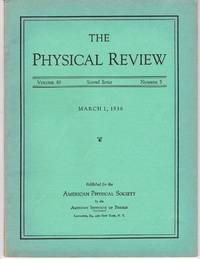
1936rif. 6550Lancaster PA: American Physical Society 1 March 1936. Second series volume 49 number 5. Very Good. ppl 341-422. Original green wraps. Slight nick at bottom edge of lower wrap else better than very good. Includes the retort by Einstein and Rosen originators of speculation on the existence of "worm-holes" in spacetime to objections made to the general theory of relativity. According to Galina Weinstein: "Between 1935 and 1936 Einstein was occupied with the Schwarzschild solution and the singularity within it while working in Princeton on the unified field theory and with his assistant Nathan Rosen on the theory of the Einstein-Rosen bridges. He was also occupied with quantum theory. He believed that quantum theory was an incomplete representation of real things. Together with Rosen and Boris Podolsky he invented the EPR paradox. I demonstrate that the two-body problem in general relativity was a heuristic guide in Einstein's and collaborators' 1935 work on the Einstein-Rosen bridge and EPR paradox." Also articles by notable physicists on radioactivity electron mobility quantum-mechanical measurement and so on. American Physical Society paperback
1936rif. 47073Lancaster American Physical Society 1936. 4to. In: "The Physical Review" Vol. 49 Second Series. X971 pp. Entire volume offered. Einstein & Rosen's paper: pp. 404-405. First printing of Einstein and Rosen's answer to Silberstein's critique of Einstein's Theory of Relativity ."Ludwik Silberstein who initially was a supporter of the special theory objected at different occasions against general relativity. In 1920 he argued that the deflection of light by the sun as observed by Arthur Eddington et al. 1919 is not necessarily a confirmation of general relativity but may also be explained by the Stokes-Planck theory of complete aether drag. However such models are in contradiction with the aberration of light and other experiments see "Alternative theories". And in 1935 Silberstein claimed to have found a contradiction in the Two-body problem in general relativity. However also this claim was refuted by Einstein and Rosen 1935 in the paper offered."Wikipedia. unknown
1936rif. 6550Lancaster PA: American Physical Society 1 March 1936. Second series volume 49 number 5. Very Good. ppl 341-422. Original green wraps. Slight nick at bottom edge of lower wrap else better than very good. Includes the retort by Einstein and Rosen originators of speculation on the existence of "worm-holes" in spacetime to objections made to the general theory of relativity. According to Galina Weinstein: "Between 1935 and 1936 Einstein was occupied with the Schwarzschild solution and the singularity within it while working in Princeton on the unified field theory and with his assistant Nathan Rosen on the theory of the Einstein-Rosen bridges. He was also occupied with quantum theory. He believed that quantum theory was an incomplete representation of real things. Together with Rosen and Boris Podolsky he invented the EPR paradox. I demonstrate that the two-body problem in general relativity was a heuristic guide in Einstein's and collaborators' 1935 work on the Einstein-Rosen bridge and EPR paradox." Also articles by notable physicists on radioactivity electron mobility quantum-mechanical measurement and so on. American Physical Society paperback books
1936rif. 47073Lancaster, American Physical Society, 1936. 4to. In: ""The Physical Review"", Vol. 49, Second Series. X,971 pp. (Entire volume offered). Einstein & Rosen's paper: pp. 404-405.
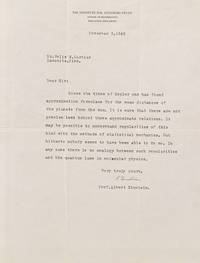
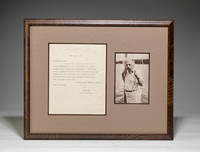
1942rif. 1265881942. Signed. EINSTEIN Albert. Typed letter signed. Princeton November 3 1942. One sheet measuring 8-1/2 by 11 inches typing on recto only; matted and framed with a portrait of Einstein entire piece measures 21 by 17 inches. $38000.An exceptional typed letter signed by Einstein on precursors like Johannes Kepler's work to his Special and General Theories of Relativity beautifully framed.The letter on letterhead from the Institute for Advanced Study in Princeton reads in full: ""November 3 1942. Mr. Felix W. Cartier. Laconite Minn. Dear Sir: Since the times of Kepler one has found approximation formulaes for the mean distances of the planets from the sun. It is sure that there are not precise laws behind those approximate relations. It may be possible to understand the irregularities of this kind with the methods of statistical mechanics. But hitherto nobody seems to have been able to do so. In any case there is no analogy between such regularities and the quantum laws in molecular physics. Very truly yours signed A. Einstein. Prof. Albert Einstein.""Early in the 17th century Johannes Kepler 1571-1630 discovered that planets orbit the sun in ellipses rather than perfect circles. This great discovery paved the way for Isaac Newton's laws of gravity and for Albert Einstein's general and special theories of relativity. Previous to Einstein's time people believed in real distances and absolute time and showed that instruments could not objectively measure the distances between planets. Einstein's theories which hypothesized that light and space curve near a massive object revolutionized scientific thought and gave man an exciting new perspective of his universe.Einstein's letter reflects on some of the most important scientific revelations in the history of physics and astronomy. Kepler defined three laws of planetary motion; however the one specifically referred to in this letter is that all planets move about the Sun in elliptical orbits having the Sun as one of the foci. If the Universe then consisted only of two point massesÑthe Sun and a planetÑthe orbit of that planet would make a perfect closed ellipse that returned the world to its starting location with each trip around the Sun. But in a Universe governed by Newtonian gravity with a plethora of massive bodies in our Solar System that ellipse will precess or rotate slightly in its orbit.In the mid-1800s orbital deviations of Uranus from its predicted motions led to the discovery of Neptune as the outermost world's gravitational influence accounted for the excess motion. But in the inner Solar System the nearest planet to the Sun Mercury was experiencing a similar problem. With detailed accurate observations going back to the late 1500s thanks to astronomer Tycho Brahe we could measure how Mercury's perihelion its closest orbital point to the Sun was advancing. The number we came up with was 5600"" per century just over 1.5 degrees over a 100 year period. But of that 5025"" came from the precession of Earth's equinoxes a well-known phenomenon while 532"" was due to Newtonian gravity.But 5025"" plus 532"" comes up short by a small but significant amount. Attempts at explanationÑincluding the existence of an unknown inner planet interior to MercuryÑall failed. But after Einstein's special theory of relativity came out in 1905 mathematician Henri Poincare showed that the phenomena of length contraction and time dilation contributed a fraction between 15-25% of the needed amount towards the solution dependent on the error. That plus Minkowski's formalization of space and time as not separate entities but as a single structure bound together by their union spacetime led Einstein to develop the general theory of relativity. On November 25 1915 he presented his results computing the spectacular figure that the contribution of the extra curvature of space predicted an additional precession of 43"" per century exactly the right figure needed to explain this observation sending shockwaves through the astronomy and physics communities. Less than two months after this Karl Schwarzschild found an exact solution predicting the existence of black holes. The deflection of starlight and gravitational redshifts/blueshifts were realized as possible tests and finally the solar eclipse of 1919 validated general relativity as superseding Newtonian gravity. Expected fold lines. An incredible letter scarce in its important content. unknown
1946rif. 1206241946. Signed. EINSTEIN Albert. Typed letter signed. Princeton April 3 1946. Single sheet of gray letterhead measuring 8-1/2 by 11 inches; p. 1. Matted and framed with a portrait entire piece measures 19 by 15-1/2 inches. $9500.Original typed letter signed by Albert Einstein thanking his friend Dr. Isadore Held for his birthday wishes as well as for sending a new book that Einstein found both ""extraordinarily enlightening"" and humorous. Text in German.The letter typed on Einstein's personal letterhead with his name and Princeton address blindstamped at the top reads in full translation: ""3 April 1946. Dear Mr. Held: I would like to express my sincere thanks for your birthday wishes and for the sending of the last work of this wonderful contemporary. I have already read quite a bit and find that it is extraordinarily enlightening. His penetration into the mentality of far-off times and attitudes toward thinking is most remarkable and his humor no less. With fond greetings to you and your dear wife. Yours signed Albert Einstein."" This letter was written to Austrian-American medical Dr. Isadore Held who was friends with Einstein since at least 1938. Held and Einstein shared numerous interests particularly related to Jewish humanitarian relief and Israel. At Held's death Einstein wrote to his widow that ""True goodness emanated from this man who alleviated the harshness of human relations and who understood and forgave all weaknessesÉ As a role model for his fellow men he was the best that a human being can be."" Einstein was not a huge fan of birthdays though he happily acknowledged well wishes from friends. Just before turning 65 Einstein crankily said to a New York Times interviewer: ""What is there to celebrate Birthdays are automatic things. Anyway birthdays are for children."" In a 1954 letter to physicist Hans Mhsam Einstein described his birthday as ""a natural disaster a shower of paper full of flattery under which one is drowned."" Einstein was generally quite shy and did not like to be the center of attention particularly from strangers obsessed with his accomplishments and fame. However well-meaning letters and small gifts like the book given by Held were always welcomed and graciously accepted by Einstein. Original mailing creases and a few pinpoint holes along top edge possibly from stapling. About-fine condition. unknown
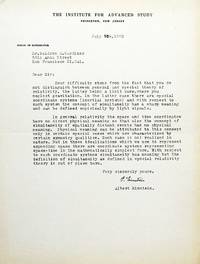
1952rif. 3091Princeton: np 1952. First edition. no binding. Very Good. EXTRAORDINARY EINSTEIN LETTER IN ENGLISH EXPLAINING SIMULTANEITY ONE OF THE CENTRAL TENETS OF RELATIVITY THEORY. Einstein's "1905 paper on special relativity is widely regarded as having destroyed the classical conceptions of absolute time and space along with absolute simultaneity and absolute length which had reigned in physics from the times of Galileo and Newton to the dawn of the twentieth century. The Special Theory teaches us that simultaneity is not as we supposed an absolute concept but is always relative to some inertial frame of reference. If we change the inertial frame of reference we change the events to be reckoned simultaneous." -Craig and Smith Einstein Relativity and Absolute Simultaneity The concept of simultaneity lies at the core of relativity theory. The very first sub-section of Einstein's legendary 1905 paper on Special Relativity is introduced by the title "Definition of Simultaneity" and "in the second paragraph of his 1905 relativity paper Einstein proved that simultaneity as defined in the first paragraph is a relative concept. This means as Einstein explained that 'we must not ascribe absolute meaning to the concept of simultaneity; instead two events that are simultaneous when observed from some particular coordinate system can no longer be considered simultaneous when observed from a system that is moving relative to that system.' In these words Einstein for the first time offered an explicit definition of what he means when he speaks of a relative concept. As we see it is a concept whose validity depends on the coordinate system chosen or in brief it is a frame-dependent concept. Simultaneity is no longer a binary relation depending also on the coordinate-frame involved. Furthermore Einstein's proof of the relativity of simultaneity in this paragraph is the first ever published rigorous proof of the relativity of a physical concept. The relativity of simultaneity became also the first major subject of dispute between proponents and opponents of the theory of relativity" Max Jammer Concepts of Simultaneity: From Antiquity to Einstein and Beyond. When Einstein expanded his relativity theory into his General Theory of 1916 the notion of simultaneity became less well-defined and more problematic and therefore much-debated. Einstein in the present letter is answering a question from Dr. Waldron Gardiner a physician apparently without any particular expertise in relativity theory about the concept of simultaneity in space the domain of general relativity. Dated July 10 1952 the letter reads in full: Dear Sir: "Your difficulty stems from the fact that you do not distinguish between general and special theory of relativity the latter being a limit case where you neglect gravitation. In the latter case there are special coordinate systems inertial systems and with respect to such system the concept of simultaneity has a sharp meaning and can be defined empirically by light signals. In general relativity the space and time coordinates have no direct physical meaning so that also the concept of simultaneity of spatially distant events has no physical meaning. Physical meaning can be attributed to this concept only in certain special cases which are characterized by certain symmetry qualities. Such case is not realized in nature. But in those idealizations which we use to represent expanding space there are coordinate systems representing space-time in the mathematically simplest form. With respect to such coordinate systems simultaneity has meaning but the definition of simultaneity as defined in special relativity theory is out of place here. Very sincerely yours SignedA. Einstein PrintedAlbert Einstein In short Einstein is explaining to Dr. Gardiner that since "space and time coordinates have no direct physical meaning" in cosmological terms i.e. there are no frames of reference that cover all of space his understanding of simultaneity in general relativity is flawed and based on the model of special relativity "a limit case" achieved only through a reductive and localized application of general relativity. Einstein concludes the letter with the provocative comment that in idealized systems representing expanding space simultaneity has meaning and in fact this "meaning" of simultaneity in general relativity has become a fertile area of exploration over the years see Jammer ibid. Note: A carbon of Dr. Gardiner's original letter to Einstein is included. Princeton: July 10 1952. One 8.5 x 11 inch page of Einstein's Institute for Advanced Study letterhead. Signed "A. Einstein" in ink. Date corrected from July 9th to July 10th. Usual but very light folds small spot of soiling at top left corner; a tiny bit of toning to extreme edges. Housed in custom presentation folder. LETTERS BY EINSTEIN DISCUSSING MAJOR ELEMENTS OF RELATIVITY PARTICULARLY IN ENGLISH ARE EXCEEDINGLY RARE. np unknown
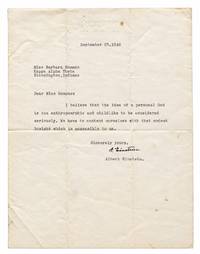
1948rif. 3094Princeton: np 1948. first edition. Very Good. ONE OF EINSTEIN'S MOST DIRECT STATEMENTS ON GOD: A POWERFUL AND CONCISE PRECURSOR TO HIS CELEBRATED "GOD LETTER". In the letter dated September 25 1948 and addressed to the Indiana University student Barbara Homans Einstein writes: "I believe that the idea of a personal God is too anthropomrphic sic and childlike to be considered seriously. We have to content ourselves with that modest insight which is accessible to us." The letter is a strikingly concentrated statement of Einstein's religious philosophy. In two sentences he rejects the notion of an anthropomorphic personal deity while setting against it a characteristically modest view of human knowledge: rather than claiming access to metaphysical certainty "we have to content ourselves" with the limited understanding available to us. That formulation places the letter squarely within one of the most important recurring themes of Einstein's later correspondence: his distinction between conventional belief in a personal God and his own sense of awe before the rational order of the universe. Six years later in his famous letter to the philosopher Eric Gutkind of 3 January 1954 Einstein would return to the same subject in far greater detail describing the word "God" as an expression of human weakness and rejecting traditional religious conceptions with exceptional directness. Christie's described the Gutkind letter as Einstein's most fully articulated statement of his religious and philosophical views; it sold in 2018 for $2892500 at Christie's. The present letter is remarkable because the essential position of the later "God Letter" is already present here in distilled form. The shared target is the anthropomorphic personal God: a conception Einstein repeatedly rejected while maintaining that a profound sense of wonder before the structure of nature could still be called religious. It is a direct statement of Einstein's mature religious philosophy anticipating the central argument of the 1954 "God Letter" by more than five years. Typed letter signed "A. Einstein" to Barbara Homans. Princeton 25 September 1948. One page 8 1/2 x 11 in typed on Einstein's Princeton stationery with embossed address at head; signed "A. Einstein" in ink. Folded for mailing with light toning and a few small stains. np unknown
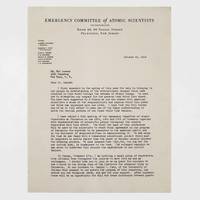
1946rif. 376560Princeton New Jersey 1946. 1 1/2 pages on recto and verso of quarto sheet of letterhead for the Emergency Committee of Atomic Scientists. Folded for mailing else Fine. Folding green cloth slipcase. 1 1/2 pages on recto and verso of quarto sheet of letterhead for the Emergency Committee of Atomic Scientists. An invitation written in Einstein's capacity as Chairman of the Trustees of the Committee to Lesser to attend a three day conference in Princeton the following month and asking him to be his special guest at a luncheon on the 17th of November. Einstein writes Lesser "as one who shares with American scientists a sense of the responsibility and urgency with which this great new force has impressed upon our lives ." and notes that one of the chief aims of the conference will be for "the scientists to reach final agreement on our program of education for survival ." Perhaps it was in his capacity as film producer that Lesser was considered a potential contributor beyond simple monetary help. The letter is addressed to Lesser at the Paramount Building 1501 Broadway NYC. Lesser 1890-1980 was a successful film producer a career that spanned the silent era up through such productions as THUNDER OVER MEXICO 1939 and OUR TOWN 1940 to the long string of post 1943 Tarzan films when he once again reacquired the rights after having produced the Buster Crabbe serial of 1933. He received the 1960 Jean Hersholt Humanitarian Award. unknown
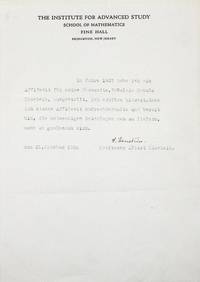
1938rif. 366717Princeton New Jersey 1938. 7 lines typed in German on letterhead of the Institute for Advanced Study School of Mathematics watermarked Chieftain Bond signed in ink. 4to 9-7/8 x 7-1/8 inches. Old folds. Fine. 7 lines typed in German on letterhead of the Institute for Advanced Study School of Mathematics watermarked Chieftain Bond signed in ink. 4to 9-7/8 x 7-1/8 inches. Im Jahre 1837 habe ich ein Affidavit für meine Verwandte Fräulein Ursula Einstein ausgestellt. Ich erkläre hiermit dass ich dieses Affidavit aufrechterhalte und bereit bin di notwendigen Unterlagen neu zi liefern wenn es gewünscht wird. den 31. Oktober 1938 signed Professor Albert Einstein. "In the year 1937 I signed an affidavit on behalf of my relative Miss Urusula Einstein. I hereby state that I continue to certify this affidavit is correct and am ready to submit the necessary documents anew if this is requested." Albert Einstein 1879-1955 German-born physicist renowned for developing the theory of relativity in papers published in 1905 and 1916 was awarded the Nobel Prize for Physics in 1921 and left Germany in 1933. He was associated with the Institute for Advanced Study at Princeton. This statement was almost certainly prepared in connection with efforts to assist his relative in emigrating. In a letter to his sister Maja Winteler-Einstein then resident in Switzerland dated December 1938 Einstein wrote "I am now working as some sort of itinerant relief committee and buckets of letters are coming in . I am helping the Ulm relatives with emigrating". Ursula Einstein born 1916 was able to get out; in 1940 she was a refugee in Port-au-Prince and later reached Brazil. Her younger sister Barbara was not so fortunate. Barbara Einstein born 1918 took her own life in March 1943 after her fiancé Harry Jacob was taken off to the concentration camps. A choice Einstein autograph. unknown