213 résultats
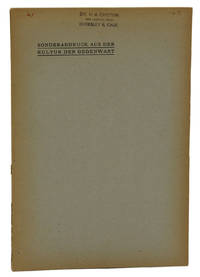
1925réf. 140941837Berlin: No Publisher 1925. Revised edition. 783-797 pp. Publisher's original printed wrappers. About Very Good with thin tear along front wrap fold near head a little chipping to wraps at spine front wrap hinge fragile contents toned with age. This copy belonged to Hans Albert Einstein Albert Einstein's oldest son with his inkstamp at top of front wrapper; likely a presentation copy from his father. Neatly written at top of front wrapper are "41" and 163." Very rare author's offprint from Die Kulture der Gegenwart of an essay on relativity theory which was first published in 1914 revised to incorporate Einstein's later research. OCLC/WorldCat locates no physical copies. Weil 71. [No Publisher] unknown books
1922réf. 139418Paris: Les Éditions G. Crès & Cie 1922. 32p. 48 b&w plates text in French pencil notes denoting country/region of origin of the artworks first edition in worn 10x7 inch paper boards with inkstains rough chipping to spine else good condition. Questo Volume è Apparso Nello Serie Orbis Pictus. Les Éditions G. Crès & Cie unknown books
1941réf. 2142520/12/1941. Brigitte Kaufmann was born in Germany but when the Nazis came to power in 1933 she fled to Paris. In France Kaufmann worked as an actress under the name of Brigitte Châtel and translated documents. She met her future husband Alfred Alexander-Katz in Paris and they married in 1939; the following day her husband was taken to an internment camp. He was given the choice of being interned in a labor camp or joining the Foreign Legion and chose the latter. Alexander was then sent to Clermont in Vichy France and the family relocated there. Dr. Walter Rudlin was a social science professor at Sarah Lawrence College in New York and actively involved in anti-fascist activities. He was the author of “The Growth of Fascism in Great Britain”. In September 1942 he left his position and joined the U.S. Board of Economic Welfare whose chair was Vice President Henry Wallace. His wife Eryl was interested in bringing Jews in Europe out of harm’s way and she knew the Alexander-Katz family. So Eryl sought to get Brigitte and her family safely out of Europe to Mexico and sought Einstein’s help. On March 12 1941 Einstein responded noting that Brigitte is his relative. “Thank you very much for your letter of March 11th. I am very gratified indeed to learn that our mutual friends Fred and Brigitte Alexander-Katz have some prospect to receive a visa into Mexico. I am certainly willing to vouch for their reliability and integrity both personal and political. I have known Mrs. Brigitte Alexander-Katz - whose family is related to mine - since she was a little girl. Her husband a very able engineer will certainly be useful to any country which receives him. If you will send me the address of the proper Mexican authority I shall gladly send any letter of recommendation desired.” This was a warm letter indeed expressing true concern and friendship for the Alexander-Katz family. On April 3 1941 Einstein again wrote Rudlin noting “Enclosed I am sending you the requested letters in the hope that they may be successful.” But there were delays and no visa so Rudlin wrote Einstein seven months later asking him to take the matter up with the Mexican government. Typed letter signed on his blind-embossed letterhead Princeton December 20 1941 to Mrs. Eryl Rudlin saying that he expects the visa to be granted but does not feel he ought to approach the Mexican government directly. “The Mexican authorities know that I am interested in the case of the Alexander-Katz family; they have kept me informed about the whole development of the matter. I have no doubt that admission to Mexico will be granted as it has been granted to hundreds of people in the same situation. I can give Mr. Alexander-Katz a recommendation but it is out of the question that I ask the Minister of Education to send him an official invitation. I have already done what could be done without intrusion.” Despite what he writes here to calm Mrs. Rudlin Einstein might have exerted some gentle pressure on Mexico by contacting the Mexican ambassador to the U.S. Gilberto Bosques; or the Alexander-Katz visas may have already being granted at that moment. The Einstein Archives is silent on this subject. But soon after Einstein soon wrote this letter in 1942 a telegram to the young Alexander-Katz family arrived stating that Einstein and Rudolph Uhlman a lawyer in New York had secured visas through Ambassador Bosques for them to escape to Veracruz Mexico aboard the ship San Thomé. In Mexico Brigitte she became a noted author actress director and translator. She became the first woman in Mexico to produce and direct television programs. Speaking five languages she also worked as a translator for UNESCO and Amnesty International. Her daughter Susana and granddaughter Sophie also became actors. unknown books
1906réf. 38892Leipzig 1906. Einstein Albert 1879-1955. 1 Eine neue Bestimmung der Molekuldimensionen. In Ann. d. Physik 4th series 19 1906: 289-306. 2 Zur Theorie der Brownschen Bewegung. In ibid.:371-381. Whole volume 8vo. viii 1080pp. 5 plates. 213 x 143 mm. Original cloth spine faded split in upper half of spine inner hinge cracking. Very good. 1 First Edition in Journal Form Revised of Einstein's doctoral thesis ranked by his biographer as being on the same level as his 1905 papers on relativity the light quanta and Brownian motion. In his thesis Einstein presented a new theoretical method for determining molecular radii and Avogadro's number the number of atoms or molecules needed to make up a mass equal to a substance's atomic or molecular weight in grams. The thesis appeared in print in the spring of 1905; in the journal version published at the beginning of 1906 Einstein added a brief appendix containing an improved value of Avogadro's number. Einstein's biographer Abraham Pais wrote of Einstein's thesis as follows: "It is not sufficiently realized that Einstein's thesis is one of his most fundamental papers. Histories and biographies invariably refer to 1905 as the miraculous year because of his article on relativity the light-quantum and Brownian motion. In my opinion the thesis is on a par with the Brownian motion article. In fact in some-not all-respects his results on Brownian motion are by-products of his thesis work emphasis ours. This goes a long way toward explaining why the paper on Brownian motion was received by the Annalen der Physik on May 11 1905 only eleven days after the thesis had been completed. "Three weeks after the thesis was accepted this same journal received a copy of the thesis for publication. It was published only after Einstein supplied a brief addendum in January 1906. . . . As a result of these various delays the thesis appeared as a paper in the Annalen der Physik only after the Brownian motion article had come out in the same journal. This may have helped create the impression in some quarters that the relation between diffusion and viscosity-a very important equation due to Einstein and Sutherland-was first obtained in Einstein's paper on Brownian motion. Actually it first appeared in his thesis . . . ." "Quite apart from the fundamental nature of some results obtained in the thesis there is another reason why this paper is of uncommon interest: it has had more widespread practical applications than any other paper Einstein ever wrote . . . . The thesis dealing with bulk rheological properties of particle suspensions contains results which have an extraordinarily wide range of applications. They are relevant to the construction industry the motion of sand particles in cement mixes to the dairy industry the motion of casein micelles in cow's milk and to ecology the motion of aerosol particles in clouds to mention but a few scattered examples. Einstein might have enjoyed hearing this since he was quite fond of applying physics to practical situations" Pais Subtle is the Lord pp. 89-90. Pais notes that during the period 1970-1974 the 1906 journal version of Einstein's thesis was cited four times more often than his 1916 paper on general relativity and eight times more often than his 1905 paper on light quanta. 2 First Edition of Einstein's second paper on Brownian motion containing two further methods for finding Avogadro's number. This was the first of his papers on the subject to include the term "Brownian motion" in the title. Pais pp. 95 98. . unknown books
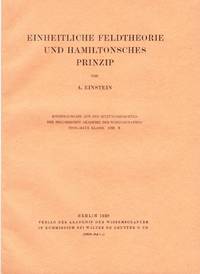
1929réf. 6551Berlin: Verlag der Akademie der Wissenschaften in Kommision bei Walter de Gruyter U. Co 1929. First separate edition. Fine. 6 pages in printed wraps. Not exactly an "offprint" since the pages are numbered from 1 and the pamphlet is given its own title page this is considered the first separate edition of a paper Einstein published in the periodical of the Prussian Academy. It is considered Einstein's initial effort having established general and special relativity to find a unified theory uniting gravity and electromagnetism a problem he struggled with for his remaining life. Verlag der Akademie der Wissenschaften in Kommision bei Walter de Gruyter U. Co paperback books
1913réf. 50339Leipzig: Johann Ambrosius Barth 1913. Einstein Albert 1879-1955. Einige argumente fur die annahme einer molekularen agitaation beim absoluten nullpunkt. In Annalen der Physik 40 pp.551-560. With: Otto Stern 1888-1969. Red cloth with gilt lettering on the spine. Whole volume: 1056 pp. 1 plate. 210 x 130 mm. A very good copy. "Some arguments for the assumption of molecular agitation at absolute zero." In this paper Einstein and Stern show that the quantum theory of solids to give the best agreement with experiments at normal temperatures seems to demand that at absolute zero a residual energy would remain in the solids which they term "zero-point energy." They thus introduced this important concept to physics." p. 292. Calaprice Kennefick & Shulmann. An Einstein Encyclopedia. 2015. Otto Stern was a German-American physicist and Nobel Laureate in Physics. He was the second most nominated person for a Nobel Prize with 82 nominations in the years 1925-1945 ultimately winning in 1943 "for his contribution to the development of the molecular rat method and his discovery of the magnetic moment of the proton". In 1912 Stern did his doctoral dissertation in concentrated solutions. After receiving his Ph.D. degree Stern took advantage of his economic independence to join Albert Einstein at Prague. Stern was with Einstein from the spring of 1912 until 1914. Weil's Bibliography no. 53. . Johann Ambrosius Barth unknown books
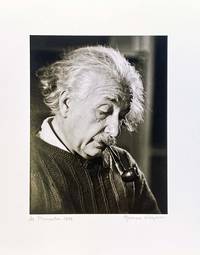
1980réf. 2611New York: np 1980. First edition. Clamshell box. Fine. EXTREMELY RARE COMPLETE SUITE OF SEVEN LARGE SILVER PRINTS FROM EINSTEIN'S FAMOUS PHOTO SHOOT AT PRINCETON WITH ROMAN VISHNIAC. Each print is signed by Vishniac and dated "At Princeton 1942" in his hand below the image and numbered on the back. "One day Vishniac decided to visit Albert Einstein at Princeton to offer greetings from mutual friends in Berlin. Uninvited he hoped Einstein would pose for a portrait but Einstein had little interest. Vishniac recalled: It was a singular experience. An idea had suddenly come to him and the room was filled with the movement of the great man's thought. I waited several minutes and then when I saw that he did not intend to say anything more to me and that he was off in a world of his own I started taking pictures. Einstein later admitted that a Vishniac photograph taken that day was his favorite portrait" Encyclopedia of Twentieth-Century Photography. Vishniac provided details about this portolfio in a letter to an original recipient the letter is not included here explaining: The size of the edition's limitation is uncertain due to my age and only spare time to make them. The most expensive portfolios - Ansel Adams Kertesz - are limited in large numbers I can never measure up - 999 1001 and similar. The originality of Portfolio "Einstein" consists of its special character. It is made not to get images but the feeling that you are present during the creativity by the Great Man. All pictures are made with "hidden camera" method. The value of this portfolio is great and can hardly be estimated today. Princeton/New York: 1942 negatives; 1980 silver prints. Elephant folio clamshell box approx. 17x21 in. housing seven silver prints. Image size: approx. 10.25 x 13.25 in.; with matte 16x20 in. A few minor blemishes to box. Photos in fine condition. RARE. np unknown books
1908réf. 50421Leipzig 1908. 1 Planck Max 1858-1947. Zur dynamik bewegter systeme. In Annalen der Physik 26 6: 1-34 pp. 2 Einstein Albert 1879-1965 and Jakob Laub 1882-1962. Über die elektromagnetischen grundgleichungen für bewegte Körper. In Annalen der Physik 26 8: 532-40 pp. Boni 22 Weil 22. 3 Einstein A. and J. Laub. Über die im elektromagnetischen felde auf ruhende Körper ausgeubten ponderomotorischen Krafte. In Annalen der Physik 26 8: 541-50 pp. Boni 23 Weil 23. Red cloth gilt lettering on spine. Figs. Text-illust. 230 x 141 mm. Whole volume: viii 1032 pp. 8 plates 3 folding 3 b/w silver photos. Spine a little worn but still Very Good. Approximate English translations of titles: 1 "On the dynamics of moving systems". 2 "On the fundamental electromagnetic equations for moving bodies;" and 3 "On the ponderomotive forces exerted on bodies at rest in the electromagnetic field." "Einstein wrote no. 2 above and "Elementary theory of Brownian motion" in Zeitschrift für Elektrochemie und angewandte physikalische Chemie 14 1908: 235-239 pp. in a three-week period with Jakob Laub his first scientific collaborator to address the problems of formulating relativistically invariant equations for electromagnetic fields in moving media first raised by Hermann Minowski the year before." Calaprice An Einstein Encyclopedia. 2015. A correction to this paper no. 2 was published later in the year in vol. 27 1908: 232 and a supplement for the following year in vol. 28 1909: 445-447. Elaborating on the relativistic transformation of Maxwell's vacuum equations . . . Einstein and Laub also consider the displacement vector D and the magnetic induction B. Weil's Einstein Bibliography nos. 22 23. Boni's Einstein Checklist nos. 22 23. Max Karl Ernst Ludwig Planck 1858-1947 was a German theoretical physicist who was awarded the 1918 Nobel Prize in Physics "in recognition of the services he rendered to the advancement of Physics by his discovery of energy quanta" nobelprize.org. Planck revolutionized human understanding of atomic and subatomic processes as the originator of the quantum theory. Jakob Laub 1882-1962 was a physicist who is best known for his work in the early period of special relativity having worked alongside Albert Einstein during that time. . unknown books
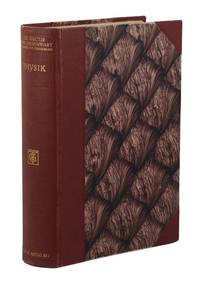
1915réf. 140945614Leipzig & Berlin: B.G. Teubner 1915. First edition. First edition. iv viii 762 8 pp. Bound in publisher's three quarter maroon cloth with marbled paper sides gilt spine lettering. Near Fine with rubbing along edges; a few marks to prelims text otherwise free of markings; hint of foxing to edges. Bookplate on paste down. A German-language physics review with the first book publication of two articles by Albert Einstein as well as work by a number of famous physicists of the early 20th century. B.G. Teubner unknown books
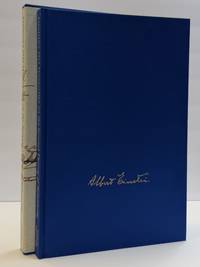
1996réf. 1418697New York: George Braziller 1996. First Edition. Hardcover. Quarto 92 pages. In Very Good condition and housed in publisher's Very Good blue cloth and tan paper slip case. Bound in publisher's blue cloth with tan lettering to spine. Minor shelf wear. Small indentations on top of first few pages. Shelved on the Front Table. 1418697. Shelved Dupont Bookstore. George Braziller hardcover books
1994réf. S11423New York:: Warner Books 1994. 1994. Small 8vo. 179 pp. Printed wrappers. Fine. ISBN: 0446670111 Warner Books, (1994). unknown books
1979réf. 311182Cambridge: Harvard University Press 1979. hardcover. fine/fine. Edited by A.P. French. Illustrated throughout with black and white photographs and diagrams. xx 332 pages. Tall 8vo red cloth d.w. Cambridge: Harvard University Press 1979. A fine copy in a fine dust wrapper. Harvard University Press unknown books
1958réf. 33773Sporosky 1958. Flexible Covers. Very Good. Flexible Covers. Flexible green cloth boards with gilt title in Japanese to spine. Creasing to covers and spine. Housed in a beige cardboard slipcase with Japanese titling to spine and front panels. Wear and browning to case. All text in Japanese with one page in Russian. Includes several photographic illustrations many equations and a few diagrams. Foxing to fore-edge of textblock. Clean interior overall; however some passages have been underlined in pen. 339 pages. SCI/010220. (Sporosky) unknown books
réf. 184029/9/54. The fullest summation we have seen by Einstein comparing relativity to Newtonian concepts of space and time Immanuel Kant took both Euclidean geometry and the Newtonian laws of motion to be synthetic a priori principles which from Kant’s point of view function as necessary presuppositions for applying our fundamental concepts of space time matter and motion to our sensible experience of the natural world meaning they are fixed necessary conditions. This idea rested on the absolute nature of space and time the work of Newton and the relationship between geometry and physics. In 1905 while a young patent clerk and physicist in Bern Switzerland Albert Einstein obtained his doctorate and published a paper that explained his newly developed Special Theory of Relativity. This unlocked many mysteries of the universe and introduced the world to ""e=mc2"" equating mass and the speed of light with energy. It established that time and space are not fixed and in fact change to maintain a constant speed of light regardless of the relative motions of sources and observers. Just 10 years later in 1915 Einstein published his General Theory of Relativity which described the universe as a four-dimensional continuum with time added as the fourth dimension where gravitational effects are explained by the warping of space-time. In this theory Einstein incorporated gravity as a geometric property of space-time. The impact of Einstein's work between 1905 and 1915 challenged many principles of physics that had been accepted for centuries. In 1921 he won the Nobel Prize for his work. Time Magazine named him the Person of the Century for the 20th century for his discoveries in relativity and space-time. Einstein is the most important scientist since Isaac Newton and probably the most famous in history. Space and time were considered relativistic more subjective and not the fixed a priori notions that had long permeated the mathematical and scientific worlds. Max Fischler was a California scientist who was interested in the implications of this distinction: were space and time now to be studied together in this context only or were the nature of space and the nature of time different In special relativity what appears simultaneous to one person might not to another - they are relative. You cannot separate space and time; they occur subjectively and semi-dependently but are not tied to the content of that space. With General Relativity space-time remains but matter warps it. It's a field like the sheet of a trampoline but reacts to matter. One needs all four dimensions of space-time and without them the others don't exist. You need matter for space. On September 5 1954 he wrote to Einstein: "".Can anything in your theory of Relativity be said to throw new light on the nature of space and time themselves Or must we rest satisfied with the purely new logical treatment of these conceptions In other words does the new view of space and time as space-time carry any new meaning ontologically beyond the purely mathematical and logical relationship between the two. Or to put it differently: When Minkowski in his famous words said 'Space by itself and time by itself must not sink into the mere shadows and only a kind of union of the two can preserve an independent existence' did he not attach some new real meaning to the 'spacetime' which the old independent notions of space and time could not convey If so in what does this new meaning consist."" Four days later Einstein replied in this letter: Typed letter signed in German on his personal blind embossed letterhead Princeton September 9 1954 to Max Fishler. ""The expression cited in the second paragraph only signifies the wish for logical clarity in the formal expressions. De facto the justification for concepts lies in their ability to comprehend the empirically given. ""In classical mechanics space and time were completed existences which had to be presupposed as real a priori in order to give meaning to the laws of motion. It was a reality in the same sense as the reality of matter; even governing the latter. In this sense Kant was entirely wrong. ""The case was the same as regards the Special Theory of Relativity only that an objective separation of space and time was abandoned in the sense that there could no longer be any objective simultaneity. Here too the four dimensional space is a reality independently of the physical content of space. ""Regarding the General Theory of Relativity however this is principally different. What we call ""space"" is here only an extension of a Field dimensionality hence no longer independent of the content of space. It is real in the same sense as matter but has no real existence independently of matter. When the field is taken away there does not remain any space but just nothing.” Letters of Einstein directly relating to relativity are increasingly uncommon and this is one of the finest such letters we have had. unknown books
1911réf. 50316Leipzig: Johann Ambrosius Barth 1911. Einstein Albert 1879-1955. Elementare Betrachtungen über die thermische Molekular bewegung in festen Körpern. In Annalen der Physik 35 9: 679-694 pp. Whole issue disbound from larger volume but still stitched together front wrapper detached chipped with loss and tears else very good. Whole issue: pp. 617-816 3 plates. First edition of Einstein's sequel and complement to his 1907 paper on Planck's theory of radiation and heat translated as Elementary Observations on Thermal Molecular Motion in Solids. Einstein tries to improve upon his model of specific heats after realizing the model was inocrrect at very low temperatures. The correct answer would come a year later with the Debye model. "Elementary observations on thermal molecular motion in solids. . . Here Einstein continues the work he had begun in 1907 on the specific heat of solids where the heat agitation of solids was reduced to a monochromatic oscillation of the atom and the specific heat was determined based on the quantum treatment of an oscillator in a radiation field. He explains the discrepancies between his formula and the measurements at low temperatures." p. 291. Calaprice Kennefick & Shulmann. An Einstein Encyclopedia. 2015. Weil's Einstein Bibliography no. 42. . Johann Ambrosius Barth unknown books
1949réf. 352406New York: Philosophical Library 1949. Hardcover. Near Fine. First edition. 427 pp. Near fine with light foxing to the top edge lacking the dust jacket. Philosophical Library hardcover books
1913réf. 43305Leipzig & Berlin: Teubner 1913. 38pp. 254 x 170 mm. Original printed wrappers chipped. Library stamps. Very good. First separate edition. "After his first discussions with Grossmann Einstein had found the correct starting point for general relativity. The real work could now begin . . . The Einstein-Grossmann paper published in 1913 contains profound physical insight into the nature of measurement some correct general relativistic equations some faulty reasoning and clumsy notation" Pais Subtle is the Lord p. 216. Weil Albert Einstein Bibliography 58. Teubner unknown books
1951réf. WB16897New York: Van Vechten Press 1951. Limited Edition. Hardcover. Fine. One of a total edition of 350. Full blue morocco binding by Suzanne Schrag; housed in clamshell box also by Schrag. With dedicatory essays by John Berryman Herman Broch Albert Einstein Ben Shahn Thomas Mann and others. Van Vechten Press hardcover books
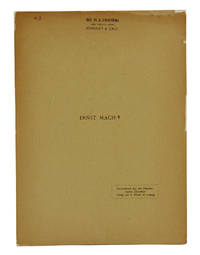
1916réf. 140941831Leipzig Germany: S. Hirzel 1916. First separate edition. First separate edition. 4 pp. Illustrated with portrait of August Mach from photograph. Publisher's original printed wrappers. Very Good with some small chips to fragile wrappers faint crease to top of front wrap contents toned with age. This copy belonged to Hans Albert Einstein Albert Einstein's oldest son with his inkstamp at top of front wrapper; likely a presentation copy from his father. Neatly written at top of front wrapper is "43" and date "14.III.16." OCLC/WorldCat locates four copies two at the University of Toronto one at the Smithsonian Institution and one at the American Philosophical Society. Weil 89. Very rare author's offprint stating "Uberreicht vom Verfasser" of the eulogy by Albert Einstein for fellow physicist Ernst Mach as first published in Physikalischen Zeitschrift. A noted scientist in his own right Mach is best known for the concept of "Mach's principle" which asserts that an entity's inertial mass is determined by all the other masses in the universe. Einstein in fact coined the phrase "Mach's principle" and his application of it had major ramifications for the development of his theory of general relativity Einstein in 1918 labeling it one of the "three pillars" of general relativity. S. Hirzel unknown books
1956réf. 37750New York: Norton 1956. Hardcover. Very Good. Octavo. Boards. 265 pp. In dustjacket. Norton hardcover books
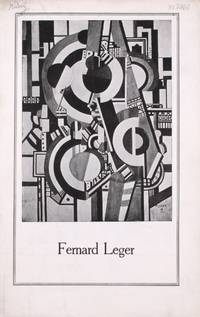
1925réf. 333269New York: Société Anonyme Inc 1925. First edition. 6 black and white illustrations 11 pp. 8vo. Side-stapled printed wrappers somewhat soiled. First edition. 6 black and white illustrations 11 pp. 8vo. Published in conjunction with an exhibition of Leger's work by the Société Anonyme from November 16th to the 28th 1925. Includes an introduction by Dreier a creative piece translated from the French of Karl Einstein and "Notations on Plastic Values" by Léger. Scarce OCLC only records a copy at Yale from the papers of Katherine S. Dreier. Collection of the Société Anonyme p. 218 Société Anonyme, Inc unknown books
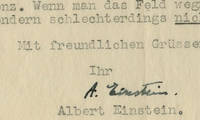
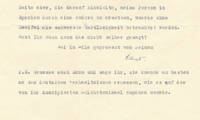
réf. 225685/5/33. Germany as an island of intellectuals is no longer possible he writes blaming the fall of his country and exile of his colleagues on poor education a vestige of Bismarck ""I am almost collapsing under all my responsibilities."" A glimpse into the tragic end to the scientific flowering of pre-Nazi Germany along with Einstein's explanation for why it all happened A rare letter from a brief but consequential period in Einstein's life: after he left Germany but before he arrived in America Einstein had long been a revered scientist and member of the Prussian Academy of Sciences and was employed by Berlin University. At the beginning of March 1932 he returned to Germany from a visit to the United States where he had discussed heading the soon-to-open Institute for Advanced Study in Princeton New Jersey. He determined to accept and to spend half the year in Berlin and half the year in Princeton. But that year the Nazis were on the rise. It was becoming increasingly obvious to Einstein that his life was in danger. A Nazi organization published a magazine with Einstein’s picture and the caption “Not Yet Hanged” on the cover. There was even a price on his head. In December 1932 Einstein again left Germany to be a visiting professor at CalTech in Pasadena California. When Hitler was appointed German chancellor on January 30 1933 the physicist had just arrived in New York on his way to California to lecture on his theory of relativity. Nazi persecution of Jews in Germany was now open swift and often violent. Prominent Jews were denounced by Nazi officials attacked in the media and subjected to violence and arrest. As a vocal opponent of Nazism and a staunch advocate of pacifism Einstein was a particularly attractive target. Fortunately at the time Hitler came to power Einstein was already in the United States. Nonetheless the Nazis publicly agitated against Einstein as a symbol of “Jewish degeneracy” and accused him of spreading “atrocity propaganda.” In February and March 1933 the Gestapo repeatedly raided his family’s apartment in Berlin. Despite his own March 15 1933 declaration of self-imposed exile from Nazi Germany as well as warnings from friends that it was too dangerous to return Einstein and his wife decided to travel back to Germany intending to visit their summer cottage. At the end of March they arrived in Antwerp on the SS Belgenland owned by the shipping company Red Star Line. There they learned that Nazis had ransacked their cottage in Caputh at which point they decided that re-entering Germany was unwise. In April 1933 Einstein discovered that the new German government had passed laws barring Jews from holding any official positions including teaching at universities. Thousands of Jewish scientists were suddenly forced to give up their university positions and their names were removed from the rolls of institutions where they were employed. Einstein was now without a permanent home unsure where he would live and work and equally worried about the fate of countless other scientists still in Germany. He rented a house in De Haan Belgium where he lived for a few months. In late July 1933 he went to England for about six weeks where he was introduced to Winston Churchill. Einstein asked Churchill to help bring Jewish scientists out of Germany. British historian Martin Gilbert notes that Churchill responded immediately and sent his friend physicist Frederick Lindemann to Germany to seek out Jewish scientists and place them in British universities. In October 1933 Einstein returned to the US and took up his position at the Institute for Advanced Study. He had already revoked his German citizenship in Brussels and handed in his notice at Berlin University. He would never return to Germany. Michele Angelo Besso was a Swiss/Italian engineer. A Sephardic Jew by birth he was a close friend of Einstein during his years at the Federal Polytechnic Institute in Zurich and then at the patent office in Bern where Einstein helped him to get a job. Einstein called Besso ""the best sounding board in Europe"" for scientific ideas. In Einstein's original paper on special relativity he ended the paper stating ""In conclusion let me note that my friend and colleague M. Besso steadfastly stood by me in my work on the problem here discussed and that I am indebted to him for many a valuable suggestion."" After his resignation in 1890 Otto von Bismarck was venerated as unified Germany’s founding father not only during the remaining twenty-eight years of the monarchy but also albeit less emphatically in the Weimar Republic in Nazi Germany and in the Federal Republic. Throughout Germany numerous Bismarck statues are testament to the admiration. Hamburg has three. His memorialisation even went beyond Germany; the capital of the US state of North Dakota for example is named after him. Einstein was evidently not a proponent of the erstwhile unifier of Germany. As Einstein wrote of Bismarck’s influence ""The characteristic feature of this mentality is that people place the importance of what Bertrand Russell so tellingly terms “naked power” far above all other factors which affect the relations between peoples. The Germans misled by Bismarck’s successes in particular underwent just such a transformation of their mentality—in consequence of which they were entirely ruined in less than a hundred years."" In this letter he encourages Besso to let him have his suggestions for saving Hermann Weyl from the regime – through substituting him for Einstein on a proposed trip to Spain would seem disastrously tactless. He sends his regards to Anna Besso with the rueful remark that the German example bodes ill for an intellectual utopia which she had proposed. Weyl would go on work with him at Princeton. These two men were among Einstein's closest friends and colleague - Jewish or closely tied to Jewish relatives. He is rushing to get them out. Typed letter signed in German Le Coq-sur-mer Belgium May 5th 1933 to Besso. ""Dear Michele! I was not affected personally but just about everybody else who is kind of close to me was. Bismarck’s dismal education policy is wreaking havoc again with the German people. ""I would love to follow your suggestion regarding Weyl if I saw any possibility at all especially since I am almost collapsing under all my responsibilities. Even the slightest attempt to replace me with someone else in Spain would without a doubt be perceived as extremely upsetting. Have you not thought of that ""Rushed greetings to you Albert."" He writes a postscript: ""Greetings to Anna from me and tell her she can judge herself based on the current German conditions what her concept of 'island of intellectuals' would look like."" In July 1933 upon Einstein’s request a committee of 51 American artists intellectuals and political leaders came together to form the International Relief Association. Among them were the philosopher John Dewey the writer John Dos Passos and the theologian Reinhold Niebuhr. Other prominent citizens including First Lady Eleanor Roosevelt soon joined the effort. Its mission as The New York Times reported on July 24 1933 was to “assist Germans suffering from the policies of the Hitler regime.” But Einstein did much more. He tried to persuade political leaders in the United States and Europe to take action to help the Jewish populations at risk particularly those of his colleagues in Germany's scientific community which was very hard hit. He worked tirelessly to help Jewish refugees escape the Nazis and to find them places of refuge and employment. Many immigrants to the United States during the mid to late 1930s were Jewish between 1939 and 1940 more than half of all immigrants were Jews most of them refugees fleeing persecution in Europe. <img class=""alignnone wp-image-22732 size-post-window"" src=""https://cdn.raabcollection.com/wp-content/uploads/20231204162353/Folder-site-1600x1327.jpg"" alt="""" width=""1600"" height=""1327"" /> unknown books
1946réf. 110238New York: Rudolf Schick Publishing Co 1946. Hardcover. Near Fine. First edition. Modest offsetting from front endpapers from a clipping else near fine without dustwrapper. Rudolf Schick Publishing Co hardcover books
1983réf. 310602San Francisco: Gay Atheist League of America 1983. Magazine. 20p. 5.5x8.5 inches very good digest-size booklet in stapled wraps. Gay and Lesbian Freethought journal. Gay Atheist League of America unknown books
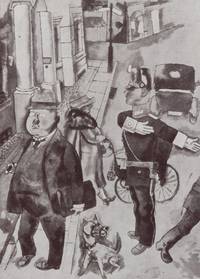
1926réf. 39022Berlin: Das Kunstarchiv Verlag 1926. First edition. Softcover. g. Quarto. 36pp. Original printed wrappers. Catalog published on the occasion of an exhibition of paintings and drawings by George Grosz held during the Spring of 1926 in Berlin at the Galerie Alfred Flechtheim. This catalog features 24 duo-tone and b/w photographic reproductions. Includes a poem by Gottfried Benn and four essay on the artist and his work by Carl Einstein Marc Neven Max Herrmann and Florent Fels. Some age-wear and moderate soiling on wrappers. Upper corners bumped thus slightly affecting pages throughout. Text in German gothic script with one of the four essays in French. Wrappers in overall good- to good interior in good to very good condition. Alfred Flechtheim 1878-1937 was a German art dealer art collector journalist and publisher. Flechtheim appeared in the art world shortly after 1900 with a collection of paintings by Vincent van Gogh and Paul Cézanne; French Avant garde early works of Pablo Picasso Georges Braque and André Derain; paintings of Wassily Kandinsky Maurice de Vlaminck Alexej von Jawlensky Gabriele Münter and the Rhein Expressionists Heinrich Campendonk August Macke Heinrich Nauen de and Paul Adolf Seehaus de. Flechtheim opened his first gallery in Düsseldorf in 1913 followed by galleries in Berlin Frankfurt Cologne and Vienna. Flechtheim served in the German Army during World War I but not at the front. His art business collapsed during the war but he re-opened in Düsseldorf in 1919. In 1921 he founded "Der Querschnitt" the Cross Section a cultural magazine. Legendary glamorous parties in Flechtheim's gallery overflowed with the glitterati of the new Berlin: movie stars titans of finance prizefighters and artists of every stripe. As Hitler rose to power in the late 1920s and early 1930s Flechtheim became a bête noire because of the art he espoused and championed. In 1933 Sturmabteilung men broke up an auction of Flechtheim's paintings. The Nazis aryanized Flechtheim's gallery as they would many other Jewish businesses and turned it over to Flechtheim's business manager Alex Vömel. After the war former party member Vömel said he didn't even remember who Flechtheim was. The Nazis seized and sold off Flechtheim's private collection as well as the contents of his gallery. Emigration and Death Six months after the Nazis came to power in 1933 Flechtheim penniless fled to Paris and tried to find work with his former business partner Daniel-Henry Kahnweiler. Flechtheim subsequently organized exhibits in London of the paintings of exiled German artists. In London Flechtheim slipped on a patch of ice was taken to a hospital punctured his leg on a rusty nail in his hospital bed developed septicemia leading to amputation of his leg and died. Das Kunstarchiv Verlag unknown books