Einstein, AlbertBiblio.com

1.997 Ergebnisse
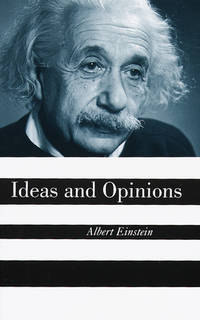
Best.-Nr. PrakashN-9780679601050RANDOM HOUSE. Paperback. New. ENGLISH RANDOM HOUSE paperback
Best.-Nr. PrakashN-9780679601050RANDOM HOUSE. Paperback. New. ENGLISH RANDOM HOUSE paperback
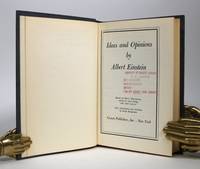
1954Best.-Nr. 016895New York: Crown Publishers Inc 1954. 1st Edition. Hardcover. Near Fine/No Jacket. 8vo. Second printing stated. Orig. blue cloth. v 377 pp. Ex libris stamp of R.A. Javitch with his gift inscription to his brother to ffep. Spine slightly sunned light age toning to interior about fine overall. This volume gathers some of Einstein's most influential writings and speeches across his career as a theoretical physicist. Crown Publishers, Inc hardcover
1968Best.-Nr. 019130Crown Publishers. First Printing. No Statement Of Printing DJ Price Clipped But Exactly Same As First And Came With This Book Publisher's Address As 419 Fourth Avenue On Front And Rear Flaps.Clipped DJ in archival cover edge wear small chips. . Fine. Hardcover. 1st Edition. 1968. Crown Publishers hardcover
2010Best.-Nr. 102564London:: Folio Society. Fine. 2010. Hardcover. Introduction by David Bodanis. First edition thus. Fine in a fine slipcase. ; 370 pages . Folio Society, hardcover
2010Best.-Nr. 51710London: The Folio Society. New. 2010. Hardcover in slipcase. B&W Photos; Large 8vo 9" - 10" tall; 400 pages; 2010 The Folio Society. Slipcased HC still sealed in publisher's shrink-wrap. Still sealed and essentially new; Fine in all respects. . The Folio Society hardcover
2010Best.-Nr. 46545London: Folio Society. 2010. Hardcover. Very Good-. Silver decorated hardback covers in slipcase. There is one page in the book that has some creases and wrinkles at the edges.; 370 pages . Folio Society hardcover
Best.-Nr. 0756762502.Ghardcover. Good. Access codes and supplements are not guaranteed with used items. May be an ex-library book. hardcover
1988Best.-Nr. Q-0517003937Bonanza Books 1988-12-12. Hardcover. New. New. In shrink wrap. Looks like an interesting title! Bonanza Books hardcover
1995Best.-Nr. Q-0517884402Crown 1995-06-06. Paperback. New. In shrink wrap. Looks like an interesting title! Crown paperback
1994Best.-Nr. Q-0679601058Modern Library 1994-06-21. Hardcover. New. In shrink wrap. Looks like an interesting title! Modern Library hardcover
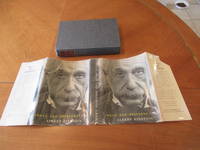
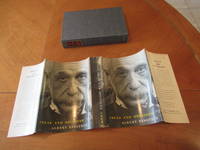
1954Best.-Nr. 044237New York: Crown Publishers 1954. 1st Edition 1st Printing. Hardcover. Near Fine/Very Good. Vii 377 Pp. Grey Cloth Spine Lettered In Gilt On Maroon Background. First Edition 1954 First Printing No Statement Of Printing Dj Price Clipped But Exactly Same As First And Came With This Book Publisher's Address As 419 Fourth Avenue On Front And Rear Flaps. Book Near Fine Spine Edges Bumped No Marks. Dj Good Rubbing At Corners With Small Losses 2 1/2" Closed Tear At Bottom Of Front Spine Edge 3 1/2" Tear Across Top Left Corner Of Rear Panel 1 1/4" Closed Tear Bottom Of Rear Panel No Loss Of Lettering Slight Fading Of Yellow Lettering On Spine Panel. Crown Publishers hardcover
1954Best.-Nr. 042205New York: Crown Publishers 1954. 1st Edition 1st Printing. Hardcover. Fine/Near Fine. Vii 377 Pp. Grey Cloth Spine Lettered In Gilt On Maroon Background. First Edition 1954 First Printing No Statement Of Printing Dj Priced $4.00 Publisher's Address As 49 Fourth Avenue On Front And Rear Flaps. Book Fine Spine Edges Crisp. Former Owner's Verified Signature With August 1954 Date No Other Marks. Dj Near Fine Touch Of Rubbing At Corners 1/4" Closed Tear At Bottom Of Front Spine Edge With Associated Rubbing And Another 1/4" Closed Tear At Top Of Rear Panel. Seldom Seen In This Condition Or Better. Crown Publishers hardcover
1954Best.-Nr. 042247New York: Crown Publishers 1954. 1st Edition 1st Printing. Hardcover. Very Good/Good. Vii 377 Pp. Grey Cloth Spine Lettered In Gilt On Maroon Background. First Edition 1954 First Printing No Statement Of Printing Dj Priced $4.00. Book With Gilt Bright Just Slight Wear At Corners But Fraying Along Top And Bottom Edges Of Spine No Marks Aging To Outer Edges Of Page Block. Dj Very Good Small Chips At Corners 1 1/4" V-Chip At Bottom Of Rear Panel Removing 4 Letters In Title And Author's Name No Browning. Crown Publishers hardcover
1977Best.-Nr. 18100501n.p.: Margaret Shepherd 1977. Limited Edition. No binding. Fine. One of 200 copies broadside inscribed by Margaret Shepherd. Margaret Shepherd is a prominent artist and teacher of calligraphy with a career spanning forty-five years; Shepherd has published numerous books about the history of calligraphy and correspondence as well as instructional books on the art form itself and has taught classes and workshops at the Rhode Island School of Design and Stanford University among others n. b. from the website of Margaret Shepherd. This broadside features her elegant lettering with the large "T" foil-stamped the text printed by photo-offset depicting a quote from Albert Einstein; per the artist about 200 were printed and were used as gifts and professional examples with "a few sold occasionally". ___DESCRIPTION: Broadside with photo-offset printed red and black calligraphy with a large initial "T" decorated wtih an acorn and oak leaf embossed and foil stamped in gilt bottom edge uncut; 15.5" by 11.5" one of 200 copies unnumbered inscribed in pencil "for Ruth Shelby" dated 2011 by Margaret Shepherd. ___CONDITION: Fine clean with bright colours without wear. ___POSTAGE: International customers please note that additional postage may apply as the standard does not always cover costs; please inquire for details. ___Swan's Fine Books is pleased to be a member of the ABAA ILAB and IOBA and we stand behind every book we sell. Please contact us with any questions you may have we are here to help. Margaret Shepherd unknown
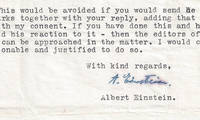
1702Best.-Nr. 1536217/02/1953. In this letter from Einstein to David Bohm Einstein discusses the importance of connecting a key principle of the relatively new theory of quantum mechanics the “Born interpretation” to physical quantities that can be measured in the real world. To him it is essential that mathematical theories be connected to measurable quantities. In this letter Einstein’s uneasiness with quantum mechanics is apparent saying that validation of the seemingly random quantum mechanics “…can only be done on the basis of classical mechanics.” Without this validation quantum theory has essentially “no controllable meaning.” <img class=""alignnone wp-image-22637 size-post-window"" src=""https://cdn.raabcollection.com/wp-content/uploads/20231204163327/Einstein-born-2-e1639117238988-1600x656.jpg"" alt="""" width=""1600"" height=""656"" /> Max Born was a renowned physicist who was crucial for the development of quantum mechanics and also the Ph.D. supervisor of many important physicists including J. Robert Oppenheimer. Quantum mechanics describes the weird behavior of tiny subatomic particles. It’s also the guiding theory that led to critical technologies like nuclear power MRI machines and transistors in computers and phones. One of Born’s biggest contributions to quantum mechanics was the interpretation of the probability density which is a mathematical operation performed on the “psi-function” in Einstein’s words to predict the most probable physical quantities of a quantum particle. Einstein believed that probabilities only make sense if you can determine the values that they predict independently by measurement. This is easy to do in classical Newtonian mechanics the physics of big things in everyday life. But Einstein said we can’t measure it for something like a “bound electron” i.e. an electron in an atom. In order to interpret Born’s probability density function you need to connect the mathematics to real values. Einstein’s correspondence with Born on this subject is published and famous. To Einstein the universe is observable and measurable. When confronted with one of the principle tenets of Quantum Mechanics Einstein remarked now famously “Quantum mechanics is very imposing. But an inner voice tells me that it is not the real McCoy. The theory delivers a lot but hardly brings us closer to the secret of the Old One God. I for one am convinced that He does not throw dice.” This statement was made in one of those significant letters to Born. What he meant here is that rules of science cannot be random and in the rolling of dice we would have to accept unknown variables and therefore be unable to predict precisely via objective measurements. Therefore in Quantum Mechanics as in gambling an uncertainty of measurement exists. And to Einstein the universe is observable and measurable. He did not object to Quantum Mechanics per se; indeed he made notable contributions. But he eschewed any reliance on what was not observable and knowable. <img class=""alignnone wp-image-22634 size-post-window"" src=""https://cdn.raabcollection.com/wp-content/uploads/20231204163356/Einstein-born-5-e1639117103621-1600x616.jpg"" alt="""" width=""1600"" height=""616"" /> David Joseph Bohm was an American scientist who has been described as one of the most significant theoretical physicists of the 20th century and who contributed unorthodox ideas to quantum theory neuropsychology and the philosophy of mind. His first book Quantum Theory published in 1951 was well received by Einstein among others. But Bohm became dissatisfied with the orthodox interpretation of quantum theory he had written about in that book.Bohm’s aim was not to set out a deterministic mechanical viewpoint but to show that it was possible to attribute properties to an underlying reality in contrast to the conventional approach. He began to develop his own interpretation the De Broglie–Bohm theory also called the Pilot wave theory the predictions of which agreed perfectly with the non-deterministic quantum theory. He initially referred to his approach as a hidden variable theory. Bohm originally hoped that hidden variables could provide a local causal objective description that would resolve or eliminate many of the paradoxes of Quantum Mechanics the measurement problem and the collapse of the wavefunction. However Bell’s theorem complicates this hope as it demonstrates that there can be no local hidden variable theory that is compatible with the predictions of Quantum Mechanics. The Bohmian interpretation is causal but not local. Albert Einstein who had suggested that Bohm search for a realist alternative to the prevailing Copenhagen approach did not consider Bohm’s interpretation to be a satisfactory answer to the quantum question. The Copenhagen interpretation is an expression of the meaning of Quantum Mechanics that was largely devised in the years 1925 to 1927 by Niels Bohr and Werner Heisenberg. It remains one of the most commonly taught interpretations of Quantum Mechanics. According to the Copenhagen interpretation physical systems generally do not have definite properties prior to being measured and Quantum Mechanics can only predict the probabilities that measurements will produce certain results. The act of measurement affects the system causing the set of probabilities to reduce to only one of the possible values immediately after the measurement. In classical mechanics a particle has at every moment an exact position and an exact momentum. These values change deterministically as the particle moves according to Newton’s laws. Under the Copenhagen interpretation of Quantum Mechanics particles do not have exactly determined properties and when they are measured the result is randomly drawn from a probability distribution. The Schrödinger equation predicts what the probability distributions are but fundamentally cannot predict the exact result of each measurement. <img class=""alignnone wp-image-22633 size-post-window"" src=""https://cdn.raabcollection.com/wp-content/uploads/20231204163406/Einstein-born-e1639117155596-1600x360.jpg"" alt="""" width=""1600"" height=""360"" /> Typed letter signed on his blind embossed letterhead February 17 1953 Professor Bohm. “Dear Bohm: I thank you very much for the prompt reaction to my little article. I did of course not expect that you would agree with me. For scarcely anyone is inclined to abandon an enterprise in which le has invested a great deal of work. “I do not want to answer your letter in detail although it deserves it very much. Only a short remark concerning the interpretation of Born’s standpoint: “According to Born the physical meaning of the psi-function follows: it determines probabilities f.i. for the value of impulses. this makes sense only if the impulse is defined independently of the mathematical theory by some feasible measurement. This can only be done on the basis of classical mechanics. F.i. if one has calculated the impulse of a bound electron on the basis of a psi-function then this result has no controllable meaning. For there is no possibility to measure such a thing not even approximately. However if one has to do with a makro-object which is at least temporarily approximately free then one is able to determine experimentally at least approximately its impulsef.i. through two successive snapshots or through radar. If it is at all possible to attribute meaning to Born’s interpretation then the impulse the probability of which appears in the theory has to be put equal to the impulse thus measured. Classical approxi_mate measurement of the impulse is however in my example very well feasible without first removing the walls and then waiting some time. Born’s probability therefore has to be interpreted as relative to the impulse thus measured if this probability is to have any meaning at all. “The vanishing of position-probability for the nodes offers no difficulty though it is true that this fact excludes the interpretation of the process as a motion in the strict sense of the word. For the factual process will only approximately be describable as a motion as f.i. the action of a gas upon a small part of the wall is describable only approximately by the concept of pressure. “With regard to the publication of your remarks in the Born volume I have some scruples the reason for which you will readily understand. I have sent a copy of my article to you but not to de Broglie because this would have seemed to me somewhat pretentious. If therefore your answer would be published together with my remarks without de Broglie having had the possibility to do the same he might feel it as an unkindness from my side. “This would be avoided if you would send De Broglie my remarks together with your reply adding that you do this with my consent. If you have done this and have received his reaction to it – then the editors of the Born volume can be approached in the matter. I would consider it as reasonable and justified to do so.” <img class=""alignnone wp-image-22636 size-post-window"" src=""https://cdn.raabcollection.com/wp-content/uploads/20231204163341/Einstein-born-3-1-e1639117201589-1600x672.jpg"" alt="""" width=""1600"" height=""672"" /> This is a remarkably detailed scientific letter mentioning numerous significant physicists containing a hand-drawn symbol and directly relating to his important theories. It is also in a sense his defense of his own work including relativity. unknown
Best.-Nr. 123093Princeton NJ early December 1950. . Ten-line autograph letter with initial on cream laid paper 14 x 22.5 cm on the verso of an autograph letter by Behram Kur uno lu together with a typed letter signed by Helen Dukas on Institute for Advanced Study stationery 16.5 x 14 cm and a later letter from Dukas dated 1979; a few tiny spots excellent condition. Initialled autograph letter by Albert Einstein correcting the work of a graduate student who would become a prominent member of the theoretical physics community. Turkish physicist Behram Kur uno lu 1922-2003 studied in Edinburgh and completed his doctoral work at Cambridge under Paul Dirac during the late 1940s and early 1950s. He specialised in relativity and unified field theories participated in the discovery of two neutrinos and founded the Center for Theoretical Studies at the University of Miami. In his initial letter to Einstein written on November 24th 1950 Kur uno lu writes that he is 'enclosing you a note on the possibility of a slight modification of the unified field theory. I shall be very grateful if you can kindly read it. I hope it is not inconsistent with the ideas of the theory. I apologise for disturbing you'. Einstein replies in detail on the verso of Kur uno lu's letter returning it and the accompanying manuscript no longer together with the letter with a covering note by his secretary Helen Dukas. Einstein writes 'Equ 1 is not solved by 5 or 6. You have overlooked that not both equations. can hold. I have defined the contravariant y by the first of these equations - The non-existence of a practical solution for the T is no logical objection to the theory. The really problematic point of the theory lies in the compatibility of the equations for the T. E.' In 1952 Kur uno lu published a paper in the Physical Review 'Gravitation and Electrodynamics' in which 'Einstein's unified field theory is modified and some of the physical implications of the new theory are examined' Physical Review volume 88 number 1369 December 15th 1952. Princeton, NJ, early December 1950. unknown
Best.-Nr. A9781875378777Paperback / softback. New. paperback
Best.-Nr. 101896522X.Ghardcover. Good. Access codes and supplements are not guaranteed with used items. May be an ex-library book. hardcover
1917Best.-Nr. C82022London: John Murray 1917. Reprint. Hardback. No Dust Jacket. Hardcover Hardcover. Fair. Reprint. Hardback. No Dust Jacket. 8vo. pp xvi 291. Original publisher's red cloth lettered white at the spine and front cover. Somewhat used copy: rubbing marks and some chipping at head of spine spine faded and slightly scuffed - otherwise sound with complete text; very good minus. John Murray, hardcover
Best.-Nr. 1023615037.Ghardcover. Good. Access codes and supplements are not guaranteed with used items. May be an ex-library book. hardcover
Best.-Nr. 1104095513.Gpaperback. Good. Access codes and supplements are not guaranteed with used items. May be an ex-library book. paperback
Best.-Nr. 1015982778.Ghardcover. Good. Access codes and supplements are not guaranteed with used items. May be an ex-library book. hardcover
Best.-Nr. 1104107074.Ghardcover. Good. Access codes and supplements are not guaranteed with used items. May be an ex-library book. hardcover
Best.-Nr. 1165381419.Gpaperback. Good. Access codes and supplements are not guaranteed with used items. May be an ex-library book. paperback