211 Ergebnisse
1996Best.-Nr. UEINGER00drpContinuum 1996. Very Good. Einstein Albert. German Essays on Science in the 20th Century. Heisenberg Werner; Planck Max; Schirmacher Wolfgang. NY: Continuum 1996. 314pp. Bibliography. 8vo. Paperback. Book condition: Very good with gentle rubbing and bumping. Continuum paperback books
1934Best.-Nr. 137344Germany: Sijthoff 1934. Hardcover. Very Good. Very good Browned. In German. Light fading to spine. Sijthoff hardcover books
1976Best.-Nr. 1411777Washington: Library of Congress 1976. Hardcover. Quarto oblong 11 pages unpaged facsimile ca. 91 pages. In Very Good minus condition. Spine is black with gold print. Boards quarter bound with black cloth to spine and blue paper to boards; slight shelf wear. Illustrated: b&w facsimile. Oversized books. Additional postage necessary for expedited/international orders. Economy International shipping unavailable due to size/weight restrictions. For international/expedited customers please inquire for rates. NOTE: Shelved in Locked Annex Area Netdesk Column QB ND-QB. 1411777. FP New Rockville Stock. Library of Congress hardcover books
1941Best.-Nr. 44121NY: Oxford 1941. First Edition. 8vo pp. vii 288. Translated from the German by Cesar Saerchinger. Blue cloth stamped in gilt. A VG tight copy. Oxford unknown books
Best.-Nr. 35418NY: Bonanza. 8vo pp. 377. Based on Mein Weltbild edited by Carl Seellig and other sources. Donor's presentation on flyleaf. A nice copy in lightly scuffed dj. Bonanza unknown books
2010Best.-Nr. 102564London:: Folio Society. Fine. 2010. Hardcover. Introduction by David Bodanis. First edition thus. Fine in a fine slipcase. ; 370 pages . Folio Society, hardcover books
1977Best.-Nr. 18100501n.p.: Margaret Shepherd 1977. Limited Edition. No binding. Fine. One of 200 copies broadside inscribed by Margaret Shepherd. Margaret Shepherd is a prominent artist and teacher of calligraphy with a career spanning forty-five years; Shepherd has published numerous books about the history of calligraphy and correspondence as well as instructional books on the art form itself and has taught classes and workshops at the Rhode Island School of Design and Stanford University among others n. b. from the website of Margaret Shepherd. This broadside features her elegant lettering with the large "T" foil-stamped the text printed by photo-offset depicting a quote from Albert Einstein; per the artist about 200 were printed and were used as gifts and professional examples with "a few sold occasionally". ___DESCRIPTION: Broadside with photo-offset printed red and black calligraphy with a large initial "T" decorated wtih an acorn and oak leaf embossed and foil stamped in gilt bottom edge uncut; 15.5" by 11.5" one of 200 copies unnumbered inscribed in pencil "for Ruth Shelby" dated 2011 by Margaret Shepherd. ___CONDITION: Fine clean with bright colours without wear. ___POSTAGE: International customers please note that additional postage may apply as the standard does not always cover costs; please inquire for details. ___Swan's Fine Books is pleased to be a member of the ABAA ILAB and IOBA and we stand behind every book we sell. Please contact us with any questions you may have we are here to help. Margaret Shepherd unknown books
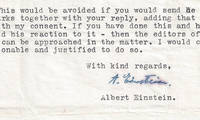
1702Best.-Nr. 1536217/02/1953. In this letter from Einstein to David Bohm Einstein discusses the importance of connecting a key principle of the relatively new theory of quantum mechanics the “Born interpretation” to physical quantities that can be measured in the real world. To him it is essential that mathematical theories be connected to measurable quantities. In this letter Einstein’s uneasiness with quantum mechanics is apparent saying that validation of the seemingly random quantum mechanics “…can only be done on the basis of classical mechanics.” Without this validation quantum theory has essentially “no controllable meaning.” <img class=""alignnone wp-image-22637 size-post-window"" src=""https://cdn.raabcollection.com/wp-content/uploads/20231204163327/Einstein-born-2-e1639117238988-1600x656.jpg"" alt="""" width=""1600"" height=""656"" /> Max Born was a renowned physicist who was crucial for the development of quantum mechanics and also the Ph.D. supervisor of many important physicists including J. Robert Oppenheimer. Quantum mechanics describes the weird behavior of tiny subatomic particles. It’s also the guiding theory that led to critical technologies like nuclear power MRI machines and transistors in computers and phones. One of Born’s biggest contributions to quantum mechanics was the interpretation of the probability density which is a mathematical operation performed on the “psi-function” in Einstein’s words to predict the most probable physical quantities of a quantum particle. Einstein believed that probabilities only make sense if you can determine the values that they predict independently by measurement. This is easy to do in classical Newtonian mechanics the physics of big things in everyday life. But Einstein said we can’t measure it for something like a “bound electron” i.e. an electron in an atom. In order to interpret Born’s probability density function you need to connect the mathematics to real values. Einstein’s correspondence with Born on this subject is published and famous. To Einstein the universe is observable and measurable. When confronted with one of the principle tenets of Quantum Mechanics Einstein remarked now famously “Quantum mechanics is very imposing. But an inner voice tells me that it is not the real McCoy. The theory delivers a lot but hardly brings us closer to the secret of the Old One God. I for one am convinced that He does not throw dice.” This statement was made in one of those significant letters to Born. What he meant here is that rules of science cannot be random and in the rolling of dice we would have to accept unknown variables and therefore be unable to predict precisely via objective measurements. Therefore in Quantum Mechanics as in gambling an uncertainty of measurement exists. And to Einstein the universe is observable and measurable. He did not object to Quantum Mechanics per se; indeed he made notable contributions. But he eschewed any reliance on what was not observable and knowable. <img class=""alignnone wp-image-22634 size-post-window"" src=""https://cdn.raabcollection.com/wp-content/uploads/20231204163356/Einstein-born-5-e1639117103621-1600x616.jpg"" alt="""" width=""1600"" height=""616"" /> David Joseph Bohm was an American scientist who has been described as one of the most significant theoretical physicists of the 20th century and who contributed unorthodox ideas to quantum theory neuropsychology and the philosophy of mind. His first book Quantum Theory published in 1951 was well received by Einstein among others. But Bohm became dissatisfied with the orthodox interpretation of quantum theory he had written about in that book.Bohm’s aim was not to set out a deterministic mechanical viewpoint but to show that it was possible to attribute properties to an underlying reality in contrast to the conventional approach. He began to develop his own interpretation the De Broglie–Bohm theory also called the Pilot wave theory the predictions of which agreed perfectly with the non-deterministic quantum theory. He initially referred to his approach as a hidden variable theory. Bohm originally hoped that hidden variables could provide a local causal objective description that would resolve or eliminate many of the paradoxes of Quantum Mechanics the measurement problem and the collapse of the wavefunction. However Bell’s theorem complicates this hope as it demonstrates that there can be no local hidden variable theory that is compatible with the predictions of Quantum Mechanics. The Bohmian interpretation is causal but not local. Albert Einstein who had suggested that Bohm search for a realist alternative to the prevailing Copenhagen approach did not consider Bohm’s interpretation to be a satisfactory answer to the quantum question. The Copenhagen interpretation is an expression of the meaning of Quantum Mechanics that was largely devised in the years 1925 to 1927 by Niels Bohr and Werner Heisenberg. It remains one of the most commonly taught interpretations of Quantum Mechanics. According to the Copenhagen interpretation physical systems generally do not have definite properties prior to being measured and Quantum Mechanics can only predict the probabilities that measurements will produce certain results. The act of measurement affects the system causing the set of probabilities to reduce to only one of the possible values immediately after the measurement. In classical mechanics a particle has at every moment an exact position and an exact momentum. These values change deterministically as the particle moves according to Newton’s laws. Under the Copenhagen interpretation of Quantum Mechanics particles do not have exactly determined properties and when they are measured the result is randomly drawn from a probability distribution. The Schrödinger equation predicts what the probability distributions are but fundamentally cannot predict the exact result of each measurement. <img class=""alignnone wp-image-22633 size-post-window"" src=""https://cdn.raabcollection.com/wp-content/uploads/20231204163406/Einstein-born-e1639117155596-1600x360.jpg"" alt="""" width=""1600"" height=""360"" /> Typed letter signed on his blind embossed letterhead February 17 1953 Professor Bohm. “Dear Bohm: I thank you very much for the prompt reaction to my little article. I did of course not expect that you would agree with me. For scarcely anyone is inclined to abandon an enterprise in which le has invested a great deal of work. “I do not want to answer your letter in detail although it deserves it very much. Only a short remark concerning the interpretation of Born’s standpoint: “According to Born the physical meaning of the psi-function follows: it determines probabilities f.i. for the value of impulses. this makes sense only if the impulse is defined independently of the mathematical theory by some feasible measurement. This can only be done on the basis of classical mechanics. F.i. if one has calculated the impulse of a bound electron on the basis of a psi-function then this result has no controllable meaning. For there is no possibility to measure such a thing not even approximately. However if one has to do with a makro-object which is at least temporarily approximately free then one is able to determine experimentally at least approximately its impulsef.i. through two successive snapshots or through radar. If it is at all possible to attribute meaning to Born’s interpretation then the impulse the probability of which appears in the theory has to be put equal to the impulse thus measured. Classical approxi_mate measurement of the impulse is however in my example very well feasible without first removing the walls and then waiting some time. Born’s probability therefore has to be interpreted as relative to the impulse thus measured if this probability is to have any meaning at all. “The vanishing of position-probability for the nodes offers no difficulty though it is true that this fact excludes the interpretation of the process as a motion in the strict sense of the word. For the factual process will only approximately be describable as a motion as f.i. the action of a gas upon a small part of the wall is describable only approximately by the concept of pressure. “With regard to the publication of your remarks in the Born volume I have some scruples the reason for which you will readily understand. I have sent a copy of my article to you but not to de Broglie because this would have seemed to me somewhat pretentious. If therefore your answer would be published together with my remarks without de Broglie having had the possibility to do the same he might feel it as an unkindness from my side. “This would be avoided if you would send De Broglie my remarks together with your reply adding that you do this with my consent. If you have done this and have received his reaction to it – then the editors of the Born volume can be approached in the matter. I would consider it as reasonable and justified to do so.” <img class=""alignnone wp-image-22636 size-post-window"" src=""https://cdn.raabcollection.com/wp-content/uploads/20231204163341/Einstein-born-3-1-e1639117201589-1600x672.jpg"" alt="""" width=""1600"" height=""672"" /> This is a remarkably detailed scientific letter mentioning numerous significant physicists containing a hand-drawn symbol and directly relating to his important theories. It is also in a sense his defense of his own work including relativity. unknown books
1986Best.-Nr. 345581986. Softcover. VG. White ill. stapled wraps. 6 pp. 4 color plates. paperback books
1921Best.-Nr. 43310Paris: Gauthier-Villars 1921. 19pp. 228 x 147 mm. Original printed wrappers foxed lower corner chipped. Some toning but very good. French translation by M. Solovine of Einstein's "Geometrie und Erfahrung". Weil 115b. Gauthier-Villars unknown books
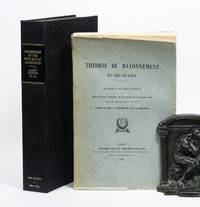
1912Best.-Nr. 2508Paris: Gauthier-Villars 1912. First edition. Original wrappers custom box. Very Good. RARE FIRST EDITION IN ORIGINAL WRAPPERS OF THE REPORTS FROM THE HISTORIC FIRST SOLVAY CONFERENCE "THE FIRST INTERNATIONAL CONFERENCE IN PHYSICS EVER ORGANIZED" AND A CRITICAL MOMENT IN THE BIRTH OF QUANTUM PHYSICS. In the short time that followed Planck's hypothesis of the universal constant that would bear his name the greatest minds in physics were largely at a loss about how to deal with the bizarre theoretical results that followed let alone the experimental results which confirmed them!. Much of the focus at the time was on black-body radiation including work by Planck himself as well as Lorentz Rayleigh and Jeans. However shortly before the first Solvay conference a young Einstein had also started investigating the related question of materials' specific heat. Kuhn. "The purpose of the first Solvay Conference was thus two-fold: first there was the need to examine whether classical theories molecular-kinetic theory and electrodynamics could in some undiscovered ways provide an explanation of the problem of black-body radiation and of the specific heat of polyatomic substances at low temperatures; secondly to consider phenomena in which the theory of quanta could be successfully used." Mehra. Underlying these questions was the more fundamental mystery of how to interpret the existence of the Planck constant. There were two camps both of which were represented at the conference. Planck's took the constant to indicate some fundamental constraint on the radiative processes of emission and absorption. For example "Sommerfeld introduced a version of the quantum hypothesis which he considered to be compatible with classical electrodynamics. He postulated that in 'every purely molecular process' a quantized quantity of action is exchanged." Staumann. Einstein's camp on the other hand took the quantum of action to represent the physicality of a perhaps pseudo-corpuscular theory of energy exchange - his photons of light. Although the debates that followed the lectures included in the proceedings did not rise to the famous heated exchange that Einstein would have with Bohr at the 1927 Solvay conference we do see some of the young Einstein's hotheadedness as he opens the debate following Planck's plenary lecture: "What I find strange about the way Mr. Planck applies Boltzmann's equation is that he introduces a state probability W without giving this quantity a physical definition. If one proceeds in such a way then to begin with Boltzmann's equation does not have a physical meaning." As translated by Straumann. It would take another 14 years for quantum mechanics to be fully formalized but the first Solvay conference represents a pivotal point in quantum history: "During 1911 the situation changed quickly. Articles that applied the quantum to other topics then outnumbered those on blackbody radiation for the first time and some were backed by impressive experimental evidence. In part because of that evidence physicists like Planck and Lorentz who had previously taken the constant h to be characteristic only of the radiation problem began to consider additional areas in which others had earlier staked quantum claims." Kuhn. Albert Einstein and the Solvay Conference: Among the most renown scientists of the day - including Ernest Rutherford Marie Curie and Max Planck - Einstein made quite an impression. At age 32 he was the second youngest participant in the conference. The youngest was British physicist Frederick Lindemann later to become scientific adviser to Winston Churchill. Although "Einstein had already published so many masterpieces none had actually been put to the test and his theories were looked on rather as tours de force than as definitive additions to knowledge. But his pre-eminence among the twelve greatest theoretical physicists of the day was clear to any unprejudiced observer." Frederick Lindemann quoted in Brian. References: Headline quote from the Solvay Institute website. Kuhn T. 1978 Black Body Theory and the Quantum Discontinuity 1894-1912. University of Chicago Press. Mehra J. 1975 The Solvay Conferences on Physics: Aspects of the Development of Physics Since 1911. Straumann N. 2011. On the first Solvay Congress in 1911. The European Physical Journal H 363 379-399. Denis Brian Einstein: A Life p.82. Paris: Gauthier-Villars 1912. Octavo original wrappers; custom box. Splits to top and bottom joint of upper wrapper two creases to front wrapper. Text in fine condition largely unopened. FIRST PRINTINGS IN ORIGINAL WRAPPERS ARE EXTREMELY SCARCE. Gauthier-Villars unknown books
1927Best.-Nr. 49047Berlin: Ernst Wasmuth A.-G 1927. First edition. Good- to fine condition. 176/330. 41 1pp. 42 plates with printed tissue guards. Original quarter vellum over brown paper-covered boards with gilt vignette on cover gilt lettering on spine. Title page with publisher's device and black double frame. Cover design by Lucian Zabel. With an introduction on Russian culture the tradition of ballet and theater set and costume design by Carl Einstein. Many of the plates with dates ranging from 1910 to 1923 including motifs created during the war. The motifs of the plates range from close-up figure drawings to simple folk costumes elaborate gowns for members of the Court mystical figures and various set designs. Illustrated with forty-two plates nineteen of them fully or partially colored by hand or pochoir some heightened in gilt or silver three b/w one sepia-toned lithograph and nineteen plates reproduced in high quality offset printing. The title page calls for forty-two plates and six illustrations in the text. Our copy is illustrated with seven tipped-in color offset reproductions and one b/w lithograph as endpiece on page seventeen. In addition the work is extra-illustrated with five color offset reproductions: one full-page embossed color plate with extensive hand-applied gilt overlay facing page seven Le Roi a full-page embossed color offset reproduction with extensive silver overlay facing plate one Phedre Thesee dated 1923 and three full page color offset reproductions facing plates fifteen L'Amazone with black overprinting twenty-five Scheherazade embossed and heightened in silver and Lampe d'Aladin multicolor overprint and thirty-six La Sultane embossed and overprinted in gilt facing the same image though with greater detail. The copies listed in OCLC vary in publication dates all calling for 42 plates and six in-text illustrations. Auction records call for 1925. One auction record for the 1925 edition calls for the lithograph line drawing in the text. Our copy contains two plates dated 1922 in addition to others dated 1917. We've been unable to find any bibliographic record that describes seven in-text illustrations or the five additional illustrations facing four of the plates and the first page of the text as described. Text in German. Binding with light wear along edges but vellum smudged and variously discolored. Block lightly starting at a few plates 11 15 19 27 30 42. A couples of tissue guards for plates loose but present. Binding in overall good- plates in very good to fine condition. Leon Bakst 1866-1924 was a Russian painter costume and set designer. Bakst studied art at the St. Petersburg Academy of Arts and was a member of the Sergei Diaghilev circle. In 1893 he moved to Paris for four years studying at the Academy Julian. He founded the magazine 'Mir Iskusstva World of Art' with his friends Alexander Benois Sergei Diaghilev and Valentin Serov. Bakst is best known for his work in set and costume design for the Ballet Russes. Ernst Wasmuth A.-G unknown books
1954Best.-Nr. 195551954. in German black ink. Signed “A. Einstein”. A poem written by Einstein to his colleague and collaborator Ernst Straus and his son Daniel. “Dear Strausse both! My best wishes and greetings in poetic form. It brings even more happiness If it has been anticipated for so long also in one’s circle of friends the event is doubly appreciated. This is what I wish: Let Daniel be like his father thoroughly intelligent and not less joyous so few humans are like that. Many - alas - are born few are chosen to bring light and joy. Let such gift be his drive. Yours A. Einstein” In German “Strauss” means bunch bouquet etc. or ostrich and “Strausse” is plural. Ernst G. Straus 1922-1983 was a mathematician who helped found the theories of Euclidean Ramsey theory and of the arithmetic properties of analytic functions. He was Einstein’s assistant and collaborator both at Princeton and afterwards when he moved to become a professor of mathematics at UCLA. His son Daniel is a professor of chemistry at Cal State San Jose. unknown books
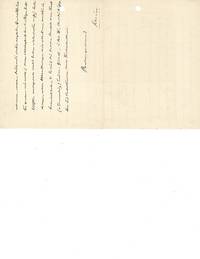
1918Best.-Nr. 135751918. Mathematics Klein Felix. Autograph Letter Signed 10 November 1918 written in German to a former student and colleague directly references Einstein's recently published General Theory of Relativity and comments on the work of the International Mathematical Education Commission. Composed in the closing days of the First World War the letter places Klein within active scholarly exchange concerning the mathematical implications of relativity which had been formally presented in 1915 and widely disseminated by 1918. Klein long established for his foundational contributions to group theory non-Euclidean geometry and mathematical physics addresses questions raised by "Einstein's theory" noting that he required further reflection to clarify its implications for his own work. The document supports research in the history of relativity German mathematical networks scientific communication during wartime and the institutional organization of mathematics in the early twentieth century. Klein Felix. Autograph Letter Signed 10 November 1918. Two pages written on both sides of a single leaf. In German with accompanying English translation. Addressed to a former student the letter discusses the circulation of lecture manuscripts difficulties in securing copyists during wartime conditions and the intellectual demands posed by Einstein's theory: "A further exploration of my work does not exist yet as I had and still have more thinking to do about questions raised by Einstein's theory to clarify it for myself." Klein also comments critically on the IMUK observing that its published statements are "a display of wasted paper" while acknowledging the commission's broader social significance. He singles out contemporary educational treatises including studies by W. Trost Heinrich Emil Timerding and M. Girndt indicating his sustained engagement with mathematical pedagogy alongside theoretical research. The letter was written days before the November Revolution in Germany and at a moment when academic institutions faced political upheaval and material shortages. Klein's remarks regarding limited copyists and uncertainty about the coming months provide contemporaneous evidence of scholarly life under strained postwar conditions. His reference to Einstein situates the correspondence within the earliest phase of professional reception of general relativity among leading mathematicians while his comments on the International Mathematical Education Commission underscore his longstanding commitment to mathematical instruction and institutional reform. Clean and well preserved with strong legibility and a clear signature. Overall near fine condition. A substantive document of early relativity discourse and mathematical research at the end of the First World War. unknown books
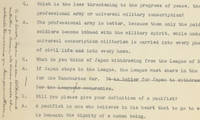
1502Best.-Nr. 2446215/02/1933. He revises the typescript of his interview with the War Resisters League of which he was Honorary Chairman and calls out William Randolph Hearst and the head of the press and film empire in Germany who aided Hitler’s rise On philosophy: “The intellect without the emotions is insignificant”; On racism: “The main thing is that minority groups should be allowed security in the community.” They ought to be “accepted with friendliness as equal members” On the press: He criticizes William Randolph Heart by name but says “The freedom of the press is necessary despite all the dangers or abuse that come with it.”. On pacifism and peace keeping: “A pacifist is one who believes in his heart that to go to war is beneath the dignity of a human being” “Society needs some form of organization for security and protection in international life” and “An international police force…is almost absolutely necessary as one step toward achieving peace. Force when used by an impartial third party to achieve law and order it's not contrary to pacifism”. This document has never previously been offered for sale and was acquired by us from the family that has had it all this time Einstein was well known as a pacifist until Hitler’s rise to power. In 1930 on his second visit to America he joined the War Resisters League and accepted the office of Honorary Chairman. Einstein spoke to the organization that year saying “True pacifists must publicly declare in time of peace that they will not take up arms under any circumstances… even if only 2% of those assigned to perform military service should announce their refusal to fight governments would be powerless they would not dare send such a large number of people to jail.” The league then issued a pamphlet “Einstein on War Resistance” that was widely read and discussed. Meanwhile back in Germany the rising Nazi movement found a convenient target in Einstein and relativity branding the latter “Jewish physics” and sponsoring conferences and book burnings to denounce Einstein and his theories. The Nazis even enlisted other physicists to denounce Einstein; “One Hundred Authors Against Einstein” was published in 1931. When asked to comment on this denunciation of relativity by so many scientists Einstein replied that to defeat relativity one did not need the word of 100 scientists just one fact. <img class=""alignnone wp-image-24605 size-post-window"" src=""https://cdn.raabcollection.com/wp-content/uploads/20231204150044/Einstein-Feb-15-1933-3-1-1600x209.jpg"" alt="""" width=""1600"" height=""209"" /> In December 1932 Einstein decided to leave Germany. The reason: it became obvious to him that his life was in danger. A Nazi organization published a magazine with Einstein’s picture and the caption “Not Yet Hanged” on the cover. There was even a price on his head. In January 1933 Einstein came to the United States to serve at the California Institute of Technology in Pasadena California as a visiting professor. The appointment of Adolf Hitler as chancellor took effect late that month and Einstein decided he would not return to his home in Germany where he had been a professor at the Berlin Academy of Sciences. He would instead return to Europe and assess the situation from there. He and his wife Elsa returned by ship to Belgium in March 1933 to find that that their residences in Germany had been raided numerous times. Einstein accepted the fact that he could not return to Germany and turned in his passport to the German consulate; he also formally renounced his German citizenship. By the summer Einstein learned that his name was on a list of assassination targets. He resided in Belgium for some months and then moved to England for a short period. On October 17 1933 he returned to the US and took up a position at the Institute for Advanced Study at Princeton in New Jersey. And there he remained until his death. On February 15 1933 after Hitler had taken power but before Einstein learned that his homes had been raided he granted an interview to the War Resisters League at the home of one of its officials John Dorland. Dorland wanted the interview to be read aloud at the upcoming March 2 meeting of the members in Pasadena. He prepared a five page typescript of the interview and sent it to Einstein to review. As Dorland said in his cover letter to Einstein “Would you be kind enough to read it and if the answers misrepresent you in any detail may we request that you revise it in such particular as we are very anxious to have these correct.” He also asked Einstein's permission to read the interview aloud. This is the original typescript of the Einstein interview sent to Einstein by Dorland complete with Einstein’s handwritten notations. It is the only such annotated interview of Einstein that we have seen and it covers important topics. <img class=""alignnone wp-image-24606 size-post-window"" src=""https://cdn.raabcollection.com/wp-content/uploads/20231204150037/Einstein-Feb-15-1933-2-1-1600x247.jpg"" alt="""" width=""1600"" height=""247"" /> On page one Einstein makes it clear he was not ready to abandon his resistance to war. “The War Resisters” he stated at the interview “are doing a fine work. They have done more than any other peace group. A strong organized minority who have declared themselves absolutely against war is very powerful.” Question from Dorland. “Can we hope to convince everybody” Answer: “Oh no we cannot convince everybody but we do not need to. One strong man is worth much and has great influence Individuals thoroughly convinced and small groups working earnestly are of the utmost value.” Q: “In trying to arouse interest is it better to appeal to the intellect or the emotions” A: “To both; the intellect without the emotions is insignificant.” On page two Einstein states that “Public protests are very valuable” as is control over munitions production. “The private munitions business is a great threat to the peace of the world and there should be government control. Public opinion is not yet awake to the atrocities of the munitions firms.” Then Dorland changes the subject to “race relations.” Einstein responded “The main thing is that minority groups should be allowed security in the community.” Then Einstein hand writes in some thoughts. If they are not afforded such security “they should isolate themselves from the rest of society since they are not accepted with friendliness as equal members.” Then some fascinating free thoughts emerge. Clearly thinking of the Jews in Germany he crosses out “It insecurity is not so bad” and instead says “They can achieve a healthy existence”. But thinking of the current situation he finishes the thought by adding at least “Up until now!” He surely had less confidence about the future. On page three Einstein discusses the part to be played by international organizations. “The main thing is organization. Disputes will always come but we must have other methods than war for settling them. Society needs some form of organization for security and protection in international life.” Einstein then writes in “Obligatory court of arbitration. Unconditional obligation of the states to accept their verdicts and enforce them.” He is then asked which is less threatening to the progress of peace a professional army or universal military conscription. Einstein answers “The professional army is better because then only the professional soldiers become imbued with the military spirit.” Asked about Japan leaving the League of Nations he hand writes “It is better to let Japan secede from the League of Nations rather than have it the League compromised by a bad compromise.” Sooner let them go than compromise principles to keep them in. Lastly he is asked for his definition of a pacifist and responds “A pacifist is one who believes in his heart that to go to war is beneath the dignity of a human being.” <img class=""alignnone wp-image-24607 size-post-window"" src=""https://cdn.raabcollection.com/wp-content/uploads/20231204150030/Einstein-Feb-15-1933-5-1-1600x242.jpg"" alt="""" width=""1600"" height=""242"" /> On page four Einstein continues by saying that a pacifist “must be active in the prevention of war; that is he must support justice arbitration and conciliation.” In terms of having some international force enforce the peace Einstein is in favor. “an international police force as suggested by the French is almost absolutely necessary as one step toward achieving peace. Force when used by an impartial third party to achieve law and order it's not contrary to pacifism. This international force would exist only for a transition perhaps 20 years.” Dorland then asks Einstein “What do you think of the control over public opinion by the press” Einstein in the interview stated it was not good but in this document he elaborated further. “The freedom of the press is necessary despite all the dangers or abuse that come with it. This is the point with the biggest dependence of the peace movement peace work on economic circumstances. Hearst in America and Hugenberg in Germany demonstrate this fact with frightening clarity”. Alfred Hugenberg was the head of a press and film empire in Germany who aided Hitler’s rise. Einstein’s comparison of William Randolph Hearst with him is interesting. He clearly feels that the press in the wrong hands motivated by profit and political power was a danger. The next question was “Are religious bodies a power for peace” Einstein’s answer: “Not greatly now.” On the final page Einstein states his belief that though no one can change human nature “we can change traditional institutions.” <img class=""alignnone wp-image-24608 size-post-window"" src=""https://cdn.raabcollection.com/wp-content/uploads/20231204150023/Einstein-Feb-15-1933-4-1-1600x231.jpg"" alt="""" width=""1600"" height=""231"" /> This document is full of gems: “The intellect without the emotions is insignificant”; “The main thing is that minority groups should be allowed security in the community.” They ought to be “accepted with friendliness as equal members”; “Society needs some form of organization for security and protection in international life”; “A pacifist is one who believes in his heart that to go to war is beneath the dignity of a human being”; “An international police force…is almost absolutely necessary as one step toward achieving peace. Force when used by an impartial third party to achieve law and order it's not contrary to pacifism”; and “The freedom of the press is necessary despite all the dangers or abuse that come with it.” This is a great and fascinating rarity. A search of public sale records going back over 40 years turns up only one other example of an Einstein annotated interview nor have we ever had one. It wasn’t long in 1933 before the intensity of the threat from Naziism convinced Einstein that only force would be a deterrent a Hitler triumph. He resigned from the War Resisters League later in 1933. To Einstein pacifism became not an absolute concept but one that had to be re-examined depending on the magnitude of the threat. <img class=""alignnone wp-image-24457 size-post-window"" src=""https://cdn.raabcollection.com/wp-content/uploads/20231204150746/Folder-site-8-1600x1327.jpg"" alt="""" width=""1600"" height=""1327"" /> unknown books
1962Best.-Nr. 439676New York: Oxford University Press 1962. Softcover. Very Good. Later printing. Trade paperback. 492pp. Translated by Arthur Mendel and Nathan Broder. Pages lightly age-toned edges rubbed very good. Oxford University Press unknown books
Best.-Nr. 14394NY OXFORD 1945. FIRST AMERICAN EDITION VERY GOOD. 1st Edition. NY, OXFORD, 1945 unknown books
1947Best.-Nr. 33821New York: Norton 1947. Hardcover. Very Good. Octavo. Boards. 371 pp. Norton hardcover books
1947Best.-Nr. 226469New York: Norton 1947. Hardcover. Very Good. First edition. Very good minus hardcover. First edition. Pages light brown clean text. Corners on cover slightly bent. Some water stains on cover. Cover soiled. Norton hardcover books
1947Best.-Nr. 88267New York: Norton 1947. First. hardcover. very good. Illustrated. xii 371pp. 8vo cloth. New York: Norton and Co. 1947. First Edition. A very good copy. Norton unknown books
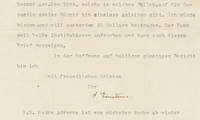
1941Best.-Nr. 3262211/9/41. A generous demonstration by Einstein of his loyalty to friends and belief in the importance of music Dr. Theodor Rosenheim was a physician at the famed Medical University Clinic of the Charité in Germany in the 1880s. He was primarily concerned with the physiology and pathology of the digestive tract. He published an early textbook on the “Pathologie und Therapie der Krankheiten des Verdauungsapparates”. Rosenheim was one of the first in Germany to describe and publish on ulcerative colitis. He was intensively involved in the technical development of esophagoscopy and gastroscopy which at that time were only possible with rigid instruments. The Rosenheim line which was named after him described the largest diagonal diameter of the gastric percussion figure. Rosenheim was appointed professor extraordinarius at Berlin University in 1921. He also founded a polyclinic and a private sanatorium for stomach and intestinal patients. He was well respected in Berlin and his private practice developed successfully with a large circle of patients including Albert Einstein. Theodor’s wife was Hedwig Rosenheim and their daughter Kate was a hero of the Holocaust. She helped several thousand children from Jewish families to escape from Germany. She personally accompanied the legendary Kindertransporte to England among other places. She travelled to the USA in 1936 to negotiate directly with the aid organizations there. She then returned to Germany to actively continue the aid campaigns. Theodor died in 1939. Käte Rosenheim was able to flee Berlin together with her 72-year-old mother Hedwig Rosenheim on January 23 1941. They reached Havana Cuba via France Spain and Portugal. From there they were able to continue to New York where they arrived on April 1 1941. Albert Einstein was an accomplished violinist and music lover who was inspired by music in his scientific work. He often said that he would have been a musician if he hadn't pursued science. Another music lover was Hedwig Rosenheim. She had escaped Germany without her possessions especially her precious musical instruments. Upon arrival in the United States she contacted the old family friend Albert Einstein hoping he could help her get a flute either for herself or another escapee one who may have agreed to look for her. Einstein was sympathetic and rose to the occasion. He even contributed some of his personal funds to secure the flute. Typed letter signed his vacation house in Knollwood at Saranac Lake N.Y. September 11 1941 to his old friend Mrs. Hedwig Rosenheim in New York City. “ The matter of i.e. the quest for the flute shall not fail. First one should know what the committee is giving out – or loaning. Second there is the Hebrew Free Loan Society 108 Second Ave. New York which in such cases provides interest-free loans in exchange for the backing of two guarantors. I will serve as a guarantor and contribute 20 dollars on top of that. The man should visit both institutions and can show this letter. In the hope of receiving a positive report soon I remain with warm greetings your A. Einstein.” “PS. Starting next week my address will again be in Princeton.” The committee he referred may have been the American Jewish Joint Distribution Committee though there were others as well. It shows a lot about Einstein - his generosity his continued concern for old friends who had escaped from Germany and love for music - that he volunteered to make a personal financial contribution to obtaining the flute. <img class=""alignnone wp-image-25018 size-post-window"" src=""https://cdn.raabcollection.com/wp-content/uploads/20231204144051/Folder-site-11-1600x1327.jpg"" alt="""" width=""1600"" height=""1327"" /> unknown books
1920Best.-Nr. 194005Munchen: Wolff 1920. Hardcover. Very Good. Cover has general wear. Bookblock has age toning. Interior pages have age toning. German language text. Green boards. 108 pgs illustrations. Wolff hardcover books
1928Best.-Nr. 374181928. Weil 162. Offprint from S. preuss. Akad. Wiss. unknown books
1923Best.-Nr. 433181923. Offprint from Zeitschrift für Physik 16 1923. Single sheet unpaginated. 230 x 155 mm. One corner creased but very good. First edition offprint issue. Einstein's second response to Friedmann's groudbreaking paper on equations governing the expansion of space which made a valuable contribution to Einstein's theory of relativity and admitted the possibility of an expanding universe. Einstein at first believed that Friedmann's reasoning was incorrect then corrected his own objection in the present brief "Notiz" and called Friedmann's results "clarifying." Pais Subtle is the Lord p. 288. Weil Albert Einstein Bibliography 130. unknown books
1915Best.-Nr. 432951915. Einstein Albert 1879-1955 and Wander Johann de Haas 1878-1960. Notiz zu unserer Arbeit "Experimenteller Nachweis der Ampèreschen Molekularströme." Offprint from Verhandlungen der Deutschen Physikalischen Gesellschaft 17 1915. 1 sheet p. 420. 228 x 156 mm. Original printed wrappers. Fine copy. First Edition Offprint Issue. In 1915 Einstein and Dutch physicist Wander Johannes de Haas conducted gyromagnetic experiments leading to the discovery of the Einstein-de Haas effect which corresponds to the mechanical rotation induced in a ferromagnetic cylinder suspended inside a coil when an impulse of electric current is sent through the coil. Einstein was very enthusiastic about the experimental results stating that he and de Haas had "given firm proof of the existence of Ampère's molecular currents" quoted in Pais Subtle is the Lord pp. 245-246. Einstein and de Haas published their results in a paper published earlier in 1915 see Weil 73; the present "Notiz" is a response to a communication from American physicist Samuel Jackson Barnett who had begun performing similar experiments in 1909 and obtained results complementing those of Einstein and de Haas. Weil Albert Einstein Bibliography 73n. . unknown books