EINSTEIN, ALBERTBiblio.com
3.003 resultados
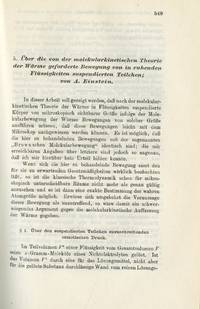
1905ref. 32820546FIRST EDITION. "On the Movement of Small Particles Suspended in a Stationary Liquid Demanded by the Molecular Kinetic Theory of Heat" appears here on pp. 549-560. This landmark paper on Brownian motion is one of the three great papers from 1905 Einstein annus mirabilis. Although most physicists and chemists accepted the idea of atoms as a useful concept in 1905 many still questioned whether they actually existed. Einstein later claimed that "my major aim in this research was to find facts which would guarantee as much as possible the existence of atoms of finite size." In 1827 botanist Robert Brown had used a microscope to look at dust grains floating in water. He found that the floating grains were moving about erratically a phenomenon that became known as "Brownian motion." In this paper Einstein proved the reality of these molecules and their motions by producing the first statistical physics analysis of Brownian motion. French physicist Jean Perrin used Einstein's results to experimentally determine the mass and the dimensions of atoms thereby conclusively verifying Dalton's atomic theory first proposed in 1808. "Eventually the experimental evidence supporting Einstein's theory of Brownian motion became so compelling that the naysayers were forced to accept the existence of material atoms. His fundamental work on applying statistical methods to the random motions of Newtonian atoms also led to his insights into the photo electric effect through the discovery of a critical connection between his statistical theory of heat and the behavior of electromagnetic radiation. This was the first step in his goal to unify the two fields" APS. Complete issue removed from bound volume. Very good.
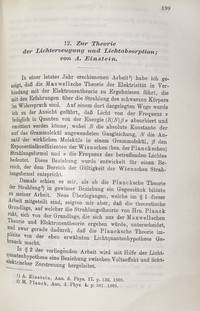
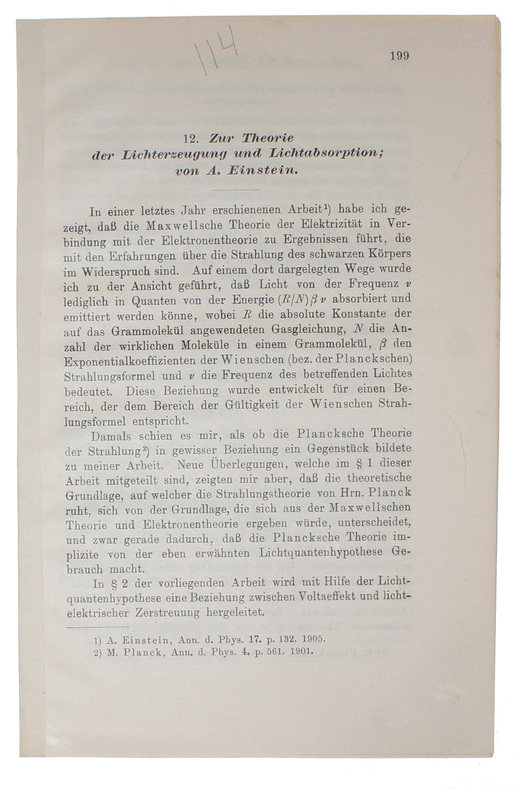
1906ref. 32820369Contemporary half dark green roan. Rubbed some chipping separation at upper joint. Library markings. FIRST EDITION of "On the Theory of Light Production and Light Absorption" pp. 199-206. This classic in the history of physics is Einstein's second paper on the photoelectric effect. Einstein reconciles his and Planck's independent derivations of the blackbody formula E=hν. Planck's derivation of this formula ascribed it to a restriction on the energy changes possible when radiation is produced or absorbed by matter which implied no restriction on the energies of either matter or radiation. Einstein's 1905 derivation ascribed it to a restriction on the energy of radiation alone but in this paper he proposes the modern idea that the energies of both matter and radiation are quantized which led to his work on quantum specific heats. and FIRST EDITION of "The Principle of Conservation of Motion of the Center of Gravity and the Inertia of Energy" pp. 627-633. In this "ingenious thought experiment involving energy transport in a hollow cylinder Einstein returned to the relationship between inertial mass and energy giving more general arguments for their complete equivalence" Calaprice The Einstein Almanac. This is the first statement that the conservation of mass is a special case of the conservation of energy. Annalen der Physik
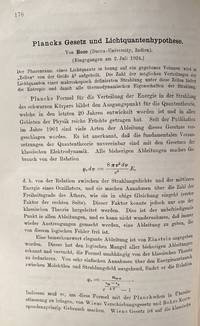
1924ref. 32820524FIRST EDITION of this classic in the history of quantum mechanics "Planck's Law and Light Quantum Hypothesis" pp. 178-181 in vol. 26. Bose sent this paper to Einstein who translated it into German for this initial publication with the comment "In my opinion Bose's derivation of the Planck formula signifies an important advance." In this paper he "succeeded in deriving the Planck blackbody radiation law without reference to classical electrodynamics. Einstein's generalization of Bose's method led to the first of two systems of quantum statistical mechanics known as the Bose-Einstein statistics. Paul Dirac later coined the term 'boson' for particles that obey these statistics" DSB. "With their work Bose and Einstein established the field of quantum statistics one year before the appearance of quantum mechanics" Brandt The Harvest of a Century This volume also contains three papers by Werner Heisenberg. Complete vols. 25-26. Contemporary half calf. Near fine without any library markings.
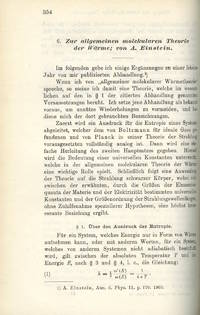
1904ref. 32820371Brown buckram. Library markings. FIRST EDITION of Einstein's fifth published paper "On the General Molecular Theory of Heat" pp. 354-362. Annalen der Physik
1990ref. BN657787Silver & Goldstein. 1990. 1990. Softcover. Zwischen Bebuquin und Negerplastik. Materialien Band I. Zwischen Bebuquin und Negerplastik. Materialien Band I. Einstein Carl - Baacke Rolf-Peter Herausgeber Silver & Goldstein. paperback
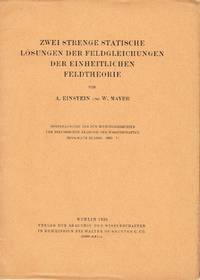
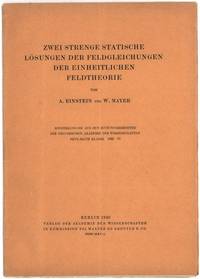
1930ref. 28376Berlin, Gruyter & Co., 1930. 4to. Orig. printed orange wrappers. Offprint/Sonderausgabe aus Sitzungsberichten...pp. (1)-13. Fine fresh copy.
1930ref. 37422Berlin: Akad. Wiss 1930. Weil 170. Offprint from S. preuss. Akad. Wiss. Akad. Wiss unknown books
1930ref. 38646Berlin, Akademie der Wissenschaften, 1930. 4to. Orig. printed green wrapper. No VI, 1930 of Sitzungsberichte der Preussische Akademie der Wissenschaften. Wrappers with very small nicks atspine. Small part of one corner gone. pp. 110-120. A small stamp at foot of frontwrapper.
1930ref. 5742KBerlin: Verlag der Akademie der Wissenschaften in commission at Georg Reimer Reichsdruckerei 11th March 1930. Near Fine. Imperial 8vo 25 4: 18 2 cm. 13 1 pages. Letterpress on machine paper in original publisher’s brochure on orange stock with black title printing. First offprint in the original wrappers and new pagination of this late paper by Einstein about the Unified Field Theory written in collaboration with his assistant the Austrian mathematician Walther Mayer nicknamed „Einstein's calculator“. - Condition: Mint. - Reference: Alicke 144; Boni-Russ-L. 196; Schilpp-Shields 240; Weil 170 quotes the pagination of the first separate printing p. 110-120. Verlag der Akademie der Wissenschaften (in commission at Georg Reimer [Reichsdruckerei]) unknown
1930ref. 270851930. S.Ber. Akad. Wiss. Berl. 1930/ 6. - Berlin Verlag der Akademie der Wissenschaften 1930 8° 13 S. orig. Broschur. First Edtion; the rare off-print from the "Sitzungsberichte". Weil No. 170; Schilpp-Shields No.240; Alicke No. 144 unknown
1930ref. 28376Berlin Gruyter & Co. 1930. 4to. Orig. printed orange wrappers. Offprint/Sonderausgabe aus Sitzungsberichten.pp. 1-13. Fine fresh copy. First edition in the rare Offprint with its separate printed title and separate pagination. Se Weil No. 170 not mentioning this.The early Offprints from "Sitzungsberichten." are called "Sonderabdruck" up to Weil No.165 including this. From Weil 166 they are called "Sonderausgabe.". - Before 161 up to 160 the Offprints do not have separate title and pagination the pagination follows the numbering in the periodical. From 166 the Offprint has both separate printed title and pagination. - So Weil Nos 161-165 is still "Abdruck" but with separate title and pagination. These facts are not mentioned in the bibliographies. unknown
1930ref. 38646Berlin Akademie der Wissenschaften 1930. 4to. Orig. printed green wrapper. No VI 1930 of Sitzungsberichte der Preussische Akademie der Wissenschaften. Wrappers with very small nicks atspine. Small part of one corner gone. pp. 110-120. A small stamp at foot of frontwrapper. First edition in the periodical form. - Weil No. 170 unknown
1930ref. 37422Berlin: Akad. Wiss 1930. Weil 170. Offprint from S. preuss. Akad. Wiss. Akad. Wiss unknown
1930ref. 433141930. Offprint from Sitzungsberichte der preussischen Akademie der Wissenschaften 1930. Single sheet pp. 1-2. 256 x 184 mm. Upper edge a bit creased light toning but very good. First edition offprint issue. One of Einstein's last papers on Riemann metrics and distant parallelism written the year before he abandonded this approach to constructing a unified field theory. Pais Subtle is the Lord p. 347. Weil Albert Einstein Bibliography 173. unknown books
1924ref. 49431Berlin, Springer, 1924. 8vo. Bound in contemporary half cloth. In ""Zeitschrift für Physik"", Bd. 27. Entire volume offered. Stamp to front free end paper. Fine and clean. [Einstein:] Pp. 1-6" P. 392. [Bose:] P. 392. [Entire volume: IV, 395, (1) pp].
1922ref. 28358Berlin, Gruyter & Co., 1922. 4to. Orig.printed orange wrappers. Offprint/Sonderabdruck aus Sitzungsberichten... pp. 18-22. Fine fresh copy.
1922ref. 374051922. unknown books
1906ref. 46956(Leipzig, Johann Ambrosius Barth, 1906). No wrappers. Extracted from ""Annalen der Physik"" Vierte Folge. Bd. 20. Pp. 199-206. Clean and fine.
1906ref. 59121Leipzig, Johann Ambrosius Barth, 1906. Full cloth. Spine with gilt lettering. In: ""Annalen der Physik. Vierte Folge. Band 20. Herausgegeben von Paul Drude."" , Portrait (Paul Drude), VIII,1048 pp. and 6 plates. Einstein papers: pp. 199-206 and 627-33. Internally fine and clean. The entire volume offered. Broad margins.
1906ref. 38794Leipzig, Johann Ambrosius Barth, 1906. Bound together in one contemp. hcloth. Small tears to spine ends. (=) ""Annalen der Physik. Vierte Folge. Band 20. Herausgegeben von Paul Drude."" , Portrait (Paul Drude), VIII,1048 pp. and 6 plates. Einstein papers: pp. 199-206 and 627-33. Internally fine and clean. The whole volume offered.
1906ref. 46962Leipzig, Johann Ambrosius Barth, 1906. Bound together in one contemp. halfcalf. Spine gilt. Minor scratches to spine. A stamp to titlepage and htitle. ""Annalen der Physik. Vierte Folge. Band 20. Herausgegeben von Paul Drude."" , Portrait (Paul Drude), VIII,1048 pp. and 6 plates. Einstein papers: pp. 199-206 and 627-33. The entire volume offered.
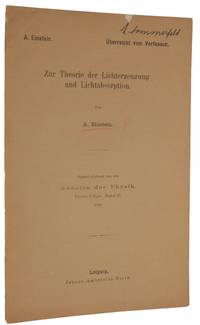
1906ref. 6413Leipzig: Johann Ambrosius Barth 1906. First edition. First edition a very rare author's presentation offprint with 'Überreicht vom Verfasser' from the library of the eminent German physicist Arnold Sommerfeld of this important sequel to Einstein's revolutionary 1905 paper introducing the light-quantum hypothesis - the foundation of quantum theory. In this follow- up work Einstein further develops the implications of his light-quantum hypothesis arguing that Max Planck's black-body radiation law implicitly relies on the same assumption: that light itself consists of discrete quanta of energy. . EINSTEIN ON HIS LIGHT-QUANTUM HYPOTHESIS . First edition very rare author's presentation offprint "Überreicht vom Verfasser" from the library of the great German physicist Arnold Sommerfeld of this brilliant follow-up to Einstein's landmark 1905 paper on the photoelectric effect for which he was awarded the 1921 Nobel Prize in physics. "Thomas Kuhn has argued that it is not to Planck in 1900 but to Einstein in 1905 that we owe the origins of quantum theory" Cassidy. In the 1905 paper 'On a heuristic point of view concerning the production and transformation of light' Einstein had explained the photoelectric effect-the emission of electrons from a metal when irradiated by light-by making the revolutionary proposal that light rather than consisting of continuous waves was instead made up of discrete particles of energy "light quanta" which transferred their entire payload of energy to an electron on impact. In the 1905 paper Einstein made use of Planck's formula for blackbody radiation which had introduced the concept of energy quantization. "In a companion paper published in 1906 offered here Einstein exposed appeal to the quantum as fundamentally counter to the ethos of classical physics: 'the theoretical bases on which Planck's radiation theory rests are different from those of Maxwell's theory'. Planck had not initially intended to quantify light-radiation itself but Einstein demonstrated that his own 'light-quantum hypothesis' was implicit in Planck's earlier work" Honner p. 31. "At first Einstein believed that the light-quantum hypothesis was merely 'heuristic': light behaved only as if it consisted of discontinuous quanta . In his 1906 paper Einstein used his statistical mechanics to demonstrate that when light interacts with matter Planck's entire formula can arise only from the existence of light quanta-not from waves" Cassidy. As Einstein stated when he published the 1905 paper "Planck's theory of radiation seemed to me in a certain respect the antithesis of my own. New considerations which are presented in section 1 of this paper demonstrated to me however that the theoretical bases on which Planck's radiation theory rests are different from those of Maxwell's theory and of electron theory. The difference furthermore is precisely that Planck's theory implicitly makes use of the light-quantum hypothesis" p. 199 of the present paper translation from Kuhn p. 182. Later in the paper p. 203 Einstein is forced to make the following assumption: "Although Maxwell's theory is not applicable to elementary resonators the average energy of such a resonator in a radiation field is the same as that which one would compute from Maxwell's theory". "That statement marks the emergence of the basic paradox of the old quantum theory. The theory has recourse to both Maxwell's equations and those of classical mechanics but its further formulation is incompatible with one or both of those classical theories. Other physicists were to exploit the resulting inconsistency as an argument against any form of quantum discontinuity and Einstein himself was deeply disturbed by it . But neither he nor anyone else was successful in finding a classical resolution of the quantum paradox. When two decades later Bohr and others found a way to resolve it Einstein was unable to accept their fundamentally non-classical interpretation" Kuhn pp. 184-185. RBH lists 4 other copies: in the offprint collections of Einstein himself Christie's June 17 2008 lot 100 Richard Green Christie's June 17 2008 lot 101 Hans Albert Einstein Christie's June 14 2006 lot 264 and Harvey Plotnick Christie's October 4 2002 lot 105. This copy was presented by Einstein to one of the leading physicists of the time surely hoping to make himself known in the scientific world when he was still a technical expert in the Swiss Patent Office. Provenance: Arnold Sommerfeld 1868-1951 his signature and characteristic numbering in red pencil '8' on front cover. "The son of a physician Sommerfeld was educated at the University of Königsberg. After teaching briefly at the universities of Göttingen Clausthal and Aachen he was appointed professor of physics at the University of Münich in 1906. Sommerfeld should have retired in 1936 in favour of his pupil Werner Heisenberg. Opposition from the Nazi party to Heisenberg's appointment prolonged Sommerfeld's tenure and it was not in fact until late 1939 that he finally retired to be succeeded not by Heisenberg but by Wilhelm Müller a Nazi aerodynamicist without a single publication in physics to his credit. Although Sommerfeld and Heisenberg were not Jewish they were regarded by the Nazis as Jewish sympathizers. Sommerfeld however survived the war and returned to his Münich chair in 1945 continuing to work at physics until he died in a car accident in 1951" Oxford Reference. "Arnold Sommerfeld was one of the most distinguished representatives of the transition period between classical and modern theoretical physics. The work of his youth was still firmly anchored in the conceptions of the nineteenth century; but when in the first decennium of the century the flood of new discoveries experimental and theoretical broke the dams of tradition he became a leader of the new movement and in combining the two ways of thinking he exerted a powerful influence on the younger generation. This combination of a classical mind to whom clarity of conception and mathematical rigour are essential with the adventurous spirit of a pioneer are the roots of his scientific success while his exceptional gift of communicating his ideas by spoken and written word made him a great teacher" Max Born p. 275. "Einstein started to study black-body radiation well before 1905. Mach's Wärmelehre which Einstein read in 1897 or shortly thereafter contains two chapters on thermal radiation culminating in a discussion of Kirchhoff's work. Kirchhoff showed that the energy emission spectrum of a perfectly black body defined as one absorbing all incident radiation at a given temperature is a universal function of the temperature and wavelength. He inferred that equilibrium thermal radiation in a cavity with walls maintained at a certain temperature behaves like radiation emitted by a black body at the same temperature. "H. F. Weber Einstein's physics professor at the ETH attempted to determine the universal black-body radiation function. He made measurements of the energy spectrum and proposed an empirical formula for the distribution function . anticipating Wien's formulation of the displacement law for black-body radiation. Weber described his work in a course at the ETH given during the winter semester of 1898-1899 for which Einstein registered. "By March 1899 Einstein had started to think seriously about the problem of radiation. In the spring of 1901 he was closely following Planck's work on black-body radiation. Originally Planck had hoped to explain irreversibility by studying electromagnetic radiation but came to recognize that this could not be done without introducing statistical elements into the argument. In a series of papers published between 1897 and 1900 Planck utilized Maxwell's electrodynamics to develop a theory of thermal radiation in interaction with one or more identical charged harmonic oscillators within a cavity. He was only able to account for the irreversible approach to thermal equilibrium by employing methods analogous to those Boltzmann used in kinetic theory. Planck introduced the notion of 'natural' that is maximally disordered radiation which he defined in analogy with Boltzmann's definition of molecular chaos . "Planck calculated the average energy of an oscillator by making assumptions about the entropy of the oscillators that enabled him to derive Wien's law for the blackbody spectrum which originally seemed well supported by the experimental evidence. But by the turn of the century new observations showed systematic deviations from Wien's law for large values of temperature. "Planck in 1900 presented a new energy density distribution formula that agreed closely with observations over the entire spectrum . this expression now known as Planck's law or Planck's formula involves a new constant h later called Planck's constant. To derive this formula Planck calculated the entropy of the oscillators using what Einstein later called 'the Boltzmann principle': S = k log W where S is the entropy of a macroscopic state of the system the probability of which is W and k is 'Boltzmann's constant'. Following Boltzmann Planck took W proportional to the number of 'complexions' or possible microconfigurations of the system corresponding to its state. He calculated this number by dividing the total energy of the state into a finite number of elements of equal magnitude and counting the number of possible ways of distributing these energy elements among the individual oscillators. If the size of the energy elements is set equal to hv where v is the frequency of the oscillators an expression for the entropy of an oscillator results that leads to Planck's formula . "In the 1905 paper Einstein showed that the expression for the volume dependence of the entropy of radiation at a given frequency is similar in form to that of the entropy of an ideal gas. He concluded that 'monochromatic radiation of low density behaves thermodynamically as though it consisted of quanta of energy which are independent of one another' . Einstein opened the paper by pointing out the 'fundamental formal distinction' between current theories of matter in which the energy of a body is represented as a sum over a finite number of degrees of freedom and Maxwell's theory in which the energy is a continuous spatial function having an infinite number of degrees of freedom. He suggested that the inability of Maxwell's theory to give an adequate account of radiation might be remedied by a theory in which radiant energy is distributed discontinuously in space. Einstein formulated 'the light quantum hypothesis' that the energy of a light ray emitted from a point is not continuously distributed over an ever increasing space but consists of a finite number of energy quanta which are localized at points in space which move without dividing and which can only be produced and absorbed as complete units . Einstein asserted that Planck's derivation implicitly assumes quantization of the energies of charged oscillators" Papers pp. 134-142. "In 1905 Einstein could not make sense of Planck's derivation of Planck's law. In fact he seems to have deliberately avoided any reference to Planck's law in his reasoning . The following year Einstein ceased to avoid Planck's law as he discovered a new way to justify Planck's formal steps toward this law. If a resonator of frequency ν can only emit or absorb full light quanta Einstein reasoned then its energy can only be an integral multiple of hν and Planck's characterization of the complexions for a set of resonators receives a dynamical justification. The only remaining difficulty is that Planck's derivation of the relation between the average energy of a resonator and the spectral density of radiation becomes void. Einstein expressed the need of a new derivation based on some quantized dynamics for the interaction between matter and radiation. Ten years elapsed however before he filled the gap" Janssen & Lehner p. 126. In the final section of this paper Einstein gives a new application of his 'heuristic principle' to the explanation of the 'Volta effect' - that when two different metals are placed in contact a potential difference between them is observed. BRL 12; Weil 12. Shields "Writings of Albert Einstein" in Albert Einstein: Philosopher-Scientist 1948 pp. 689-758 no. 13; also included in Shields' "Chronological list of principal works" on p. 757. The Cambridge Companion to Einstein Janssen & Lehner eds. 2014. The Collected Papers of Albert Einstein Vol. 2: The Swiss Years: Writings 1900-1909. Born 'Arnold Johannes Wilhelm Sommerfeld 1868-1951' Obituary Notices of Fellows of the Royal Society 8 1952 pp. 275-296. Cassidy "Einstein on the Photoelectric Effect." Einstein: Image and Impact. American Institute of Physics n.d. Honner The Description of Nature 1988. Kuhn Black-Body Theory and the Quantum Discontinuity 1894-1912 1978. Pais Subtle is the Lord 1982. 8vo 222 x 144 mm pp. 199-206. Original printed wrappers small chip from upper edge of front wrapper. Johann Ambrosius Barth unknown
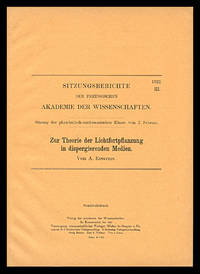
1922ref. 1648Berlin: Verlag der Akademie der Wissenschaften 1922. 1st Edition. FIRST EDITION COMMERCIAL OFFPRINT ISSUE OF EINSTEIN'S THEORY OF THE LIGHT PROPAGATION IN DISPERSIVE MEDIA. WEIL 120. "After 1917 Einstein firmly believed that light-quanta were here to stay thus it is not surprising that he would look for new ways in which the existence of photons might lead to observable deviation from the classical picture. In this he did not succeed. At one point in 1921 he thought he had found a new quantum criterion but it soon turned out to be a false lead as demonstrated in this paper" Schilpp-Shields 162. That paper - the one offered here - is Einstein's evidence that his 1921 efforts were incorrect. In it Einstein introduces a calculation on the topic and explains why his earlier proposed experiment had not been well considered because it could not predict a good choice between two theoretical alternatives" Calaprice Einstein Encyclopedia 98. CONDITION & DETAILS: Berlin: Koniglich Akademie der Wissenschaften. Commercial offprint from Sitzungsberichte der Koniglich preussischen Akademie der Wissenschaften III 1916 pp. 18-22. Octavo 252 x 179 mm. Original printed wrappers. Pristine inside and out. Fine. Verlag der Akademie der Wissenschaften unknown
1906ref. 59121Leipzig Johann Ambrosius Barth 1906. Full cloth. Spine with gilt lettering. In: "Annalen der Physik. Vierte Folge. Band 20. Herausgegeben von Paul Drude." Portrait Paul Drude VIII1048 pp. and 6 plates. Einstein papers: pp. 199-206 and 627-33. Internally fine and clean. The entire volume offered. Broad margins. Both papers first edition. It was for the papers "Ueber einen die Erzeugung und Verwandlung des Lichtes betreffenden heuristischen Gesichtspunkt" of 1905 and "Zur Theorie der Lichterzeugung. Theory of light emission and absorption the offered item that Einstein was awarded the Nobel Prize in 1921. "The quantum theory has affected virtually every branch of physics. Its earliest and one of its most significant developments was Einstein's application of the theory to what is known as the 'photo-electrical effect'.Einstein explained this effext by suggesting that the classical view that light is emitted in the form of continous waves must be abandoned. The photo-electrical effect could be explained only as an example of quantum action where the waves of light or X-rays are emitted in minute particles or bullets. It is he size of the bullet the wave-lenght of the radiation which determines the number of electrons ejected. It was for this and not for the theory of relativity that Einstein was awarded the Nobel Prize in 1921. Einstein's two fundamental papers on this subject are "Ueber einem Erzeugung." 1905 and Zur Theorie der Lichterzeugung the paper offered here" PMM the note to 391. In the second paper Principle of the conservation of the centre of mass motion and the inertia of energy he shows that the conservation of mass is a special application of his energy principle E= Mc2 - Weil: 12 & 13.Among the many papers in this volume we have Max von Laue: Zur Thermodynamik der Inteferenzerscheinungen. pp. 365-378. hardcover
ref. 74098Leipzig Johann Ambosius Barth 1922. 8vo. 14 pp. Original printed wrappers. = An important contribution to the understanding of the radiometer effect by the physicist Edith Einstein 1888-1960. "The Crookes radiometer also known as a light mill consists of an airtight glass bulb containing a partial vacuum with a set of vanes which are mounted on a spindle inside. The vanes rotate when exposed to light with faster rotation for more intense light providing a quantitative measurement of electromagnetic radiation intensity. The reason for the rotation was a cause of much scientific debate in the ten years following the invention of the device" Wikipedia. James Clerk Maxwell first gave a wrong then a correct explanation. However some subtleties still needed to be solved. "In 1920 Albert Einstein selected this topic as a suitable PhD thesis for his cousin Edith Einstein. She completed her doctorate under the supervision of Paul Epstein but with considerable imput from Einstein himself" Calaprice et al. Later in 1924 Albert wrote another paper on the radiometer effect correcting Edith on a few issues. Published in the famous Annalen der Physik vierte Folge Band 69. This being the complete Heft 4 published on 30 November 1922. Minimal wear to spine ends otherwise a very good clean copy. Very uncommon. Calaprice et al. An Einstein Encyclopaedia p. 160. unknown