214 résultats
1952réf. 86694NY:: Dover Publications. Good. 1952. Paperback. With notes by A. Sommerfield. Translated from the German by W. Perrett and G. B. Jeffery. With seven diagrams. First edition thus paperback. Covers are age darkened with a few corner creases else good in printed wraps.; 216 pages . Dover Publications, paperback books
réf. 32479unknown books
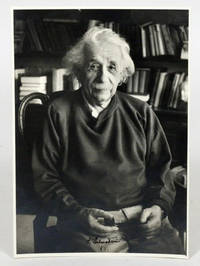
1948réf. 2327Princeton NJ: np 1948. framed. Fine. ONE OF THE MOST CELEBRATED IMAGES OF EINSTEIN SIGNED BY MASTER PHOTOGRAPHER YOUSUF KARSH. On February 11 1948 Yousuf Karsh perhaps the most accomplished portrait photographer of his generation visited The Institute for Advanced Study in Princeton to fulfill a dream of his: to photograph Albert Einstein. As he later explained: "Among the tasks that life as a photographer had set me a portrait of Albert Einstein had always seemed a 'must' - not only because this greatest refugee of our century has been accounted by all the world as the most outstanding scientist since Newton but because his face in all its rough grandeur invited and challenged the camera." Karsh: Beyond the Camera David Travis ed. "At Princeton's Institute for Advanced Study I found Einstein a simple kindly almost childlike man too great for any of the postures of eminence. One did not have to understand his science to feel the power of his mind or the force of his personality" official Karsh website. "Awed before this unique intellect I yet ventured to ask Einstein his views on human immortality. He mused for a moment and then replied 'What I believe of immortality There are two kinds. The first lives in the imagination of people and is thus an illusion. There is a relative immortality which may conserve the memory of an individual for some generations. But there is only one true immortality on a cosmic scale ant that is the immortality of the cosmos itself. There is no other.' "He spoke of these ultimate mysteries as calmly as he might a student's question about mathematics - with such an air of quiet confidence indeed that I found his answer profoundly disturbing to one who held other views. Knowing him to be an accomplished violinist I turned the conversation and asked if there were any connection between music and mathematics. 'In art he said 'and in the higher ranges of science there is a feeling of harmony which underlies all endeavour. There is no true greatness in art or science without that sense of harmony. He who lacks it can never be more than a great technician in either field.' "Was he optimistic about the future harmony of mankind itself He appeared to ponder deeply and remarked in graver tones: 'Optimistic No. But if mankind fails to find a harmonious solution than there will be disaster on a dimension beyond anyone's imagination.' To what source should we look for the hope of the world's future 'To ourselves' said Einstein. He spoke sadly yet serenely as one who had looked into the universe far past mankind's small affairs. In this humor my camera caught him. the portrait of a man who had traveled beyond hope or despair." Yousuf Karsh Regarding Heroes. Opening quote from: Colin Naylor ed. Contemporary Photographers. Silver print. Photo taken Princeton 1948. Printed later. Signed by Karsh in full beneath the image on photographer's mount. With Karsh's original calling "card" - a 4x10 inch cardboard slip - included. Image: 8x9 inches. Framed to an overall size of 12x15 inches. Fine condition. np unknown books
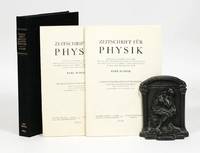
1924réf. 2905Berlin: Julius Springer 1924. First edition. original wrappers. Very Good. FIRST EDITION IN ORIGINAL WRAPPERS of the presentation of "Bose-Einstein statistics." “In 1924 Bose found a way to derive Planck’s equation for black body radiation using a statistical approach based entirely on the idea that light is made up of tiny particles photons. This echoed the statistical mechanics approach of Ludwig Boltzmann to the behaviour of gases but using a different statistical rule; it derives black body radiation entirely in quantum terms without using the idea of electromagnetic radiation at all. Bose wrote a paper about his discovery and sent it to Albert Einstein who immediately saw its significance translated it into German and arranged for its publication in the prestigious Zeitschrift für Physik. Einstein developed the idea to apply to other kinds of particle not just to a ‘gas’ of photons which is why this approach is usually referred to as ‘Bose-Einstein statistics’. Paul Dirac coined the name ‘bosons’ for particles which obey Bose-Einstein statistics" Gribbin Q is for Quantum. Particle Physics: One Hundred Years of Discoveries: “Discovery of new statistical counting rules for light quanta and a new derivation of Planck’s radiation law. Known as Bose-Einstein quantum statistics for particles with integer spins.” WITH a follow-up paper by Bose: "Wärmegleichgewicht im Strahlungsfeld bei Anwesenheit von Materie": "Bose's first paper in 'Zeitschrift für Physik' was followed by another that was also translated by Einstein and published during 1924. In it Bose provided a general statistical treatment of emission and absorption processes for electromagnetic radiation in equilibrium with matter. This paper was accompanied by a note by Einstein expressing serious doubts about the method. In January 1925 Bose wrote to Einstein from Paris that he was working on a paper he felt would remove these doubts. But it seems never to have been completed" DSB. Plancks Gesetz und Lichtquantenhypothese. IN: Zeitschrift für Physik Vol 26 No. 3 August 1924 pp. 178-81. Berlin: Julius Springer 1924. “Wärmegleichgewicht” Vol 27 No. 5/6 September 1924 pp. 384-93. Octavo original wrappers. “Planks Gesetz” with small closed tear at rear wrapper edge; otherwise fine condition; “Wärmegleichgewicht” with small chip to base of front wrapper. SCARCE in original wrappers. Julius Springer unknown books
1938réf. 165146Paris 1938. paperback. Pp. 5-19 IN: Zeitschrift fur Freie Deutsche Forschung. Jahrgang 1 Nummer 1. Herausgegeben von der Freien Deutschen Hochschule in Paris. 168p. printed wrappers. Paris Juli 1938. First number of this scarce short-lived exile publication featuring German & Austrian writers and scholars. Fine. unknown books
1932réf. 1864np: np 1932. First edition. nb. UNPUBLISHED CANDID PHOTOGRAPHS OF EINSTEIN AND LETTERS BY WILLIAM HUBBARD OFFERING AN INTIMATE VIEW OF THE SCIENTIST ON VACATION. On March 2 1932 at the height of his career and world fame Albert Einstein and his wife Elsa set off on a vacation to their German homeland departing from Los Angeles on the M. S. San Francisco. Another passenger aboard the ship was the renowned music scholar William Lines Hubbard. Famous in his own right Hubbard was the music critic for the Chicago Tribune and author of a definitive 11-volume work on the history of opera published 1908. Accompanying Hubbard was his companion Julia Reid their cabins adjacent to that of the Einstein's. As was the practice during this era Hubbard kept detailed journals and letters of his travel experiences. This collection from the estate of Hubbard contains the following items: 1. Three unpublished small black-and-white and sepia photographs. The first photograph 4.5" x 2.5" pictures Einstein his wife Elsa the Ship's Captain Hubbard the tall figure and three other of the ship's passengers dated 3/14/32. The second photograph 3.5" x 3.25" is an outstanding full front image of Einstein his wife Elsa and the ship's Captain. The final photograph 4.5" x 2.5" is a full frontal image of Einstein and his wife Elsa both seated in deck chairs with the ship's Captain standing behind. 2. Typed letter dated March 22 1932 written while sailing through the South Atlantic. Six pages typed front and back on two pieces folded of the ship's original stationary approx. 7.5x11 in. Excerpts on Einstein include: Of our Six Passengers two are Prof. Einstein and wife. They are proving very delightful companions-- sincere unaffected and jolly. At first they were very reserved and merely bowed and smiled and "Guten-Morgan-ed" when entering and leaving the dining room but when they had become rested and saw that none of the rest of us planned to intrude they came forward and have been very genial. She is a great talker but talks interestingly. He walks deck smoking his stubby black pipe or whistling cheerily his gray hair blowing in the breeze. Each forenoon and sometimes in the afternoon he goes to the piano and plays for half hour or so. Plays in that satisfying manner peculiar to a man to whom music is a comfort and who thinks musically. It is in no wise brilliant playing but it is throughly enjoyable to hear. The rest of the time he sits in his steamer chair or in his cabin reading or thinking. On the 14th he had his 53rd birthday and the Capt had ordered from La Libertad Salvador where we had taken cargo the day before large bunches of easter and tiger lilies which in the morning were on the Einstein table together with a birthday cake the ship's cook had made and countless cards and letters which friends had sent. It was all a complete surprise to them both and their happiness was childlike in its spontaneity and sincerity. It was heart warming to watch them. They seem to appreciate being left to themselves and not being lionized. It is the third time they have come through the canal on these boards an they enjoy it to the full. 3. Typed letter dated April 1 1932 written while entering the English Channel. Seven pages on two approx. 8.5x11in sheets folded of the ship's original stationary. Excerpts on Einstein include: We had good fun watching for crocodiles along the banks as we came up the cut and Prof Einstein was especially gleeful when he discovered one. Professor Einstein loves the roung sic weather and has reveled in it. He and the Mme are proving very delightful fellow passengers. She is very chatty but chats interestingly and he struts up and down deck smoking his stubby pipe or whistling like a jolly kid his white hair blowing in the breeze. We have some talks occasionally and he yesterday when he saw the copy of Living Philosophies which I had given me sic before I left San Diego and in which his article is the first took the book and autographed his picture and wrote in remembrance of the happy days on board the San Francisco. I don't think I told you of his birthday which occurred on the 14 of March the day before we reached the Canal. The Capt came to know if it and when the Einsteins came to their table at breakfast they found it decorated with three huge vases of Easter and Tiger lilies which the Capt had secured in La Libertad. The cook had made a gorgeously decorated Torte-- one of the filled and frosted German cakes-- and there were letters and telegrams from friends which had been sent in the Capt's care. It was a complete surprise to the Einsteins and they were like two happy kiddies. It was gladdening to watch their simple and keen enjoyment. Later we had pieces of the Torte which were a bit of muchness for breakfast but which of course we ate. 4. Typed letter dated April 24 1932 written in Merano Italy. Six pages on five 5.5x7in sheets. While recalling a cargo transfer on the M. S. San Fransisco Hubbard writes: The Einsteins were especially enthusiastic and we had a great fun over the boss of the unloading. He was a huge and tremendously rotund gent wearing a soft felt hat and a short overcoat the buttons of which seemed fated to "bust off" at any moment. His chief employment seemed to be running about from side to side of the dock into the warehouse and out again clambering onboard and then clambering off and all the time shouting orders at the top of his voice and gesticulating wildly. Einstein had been reading the "Living Philosophies" which I had loaned him and was especially curious concerning Mencken and how he happened to be included in the great ones in the book. I gave him an outline of Mr. M's greatness and assured him that the book cold sic well largely on account of M being included. All of which amused the Einsteins greatly. So when this wild boss hove into sight that morning and began his excited directing Mrs E said "there is Mister Mencken" and thus he remained so long as we were in Rotterdam. The Einsteins were starting early the next morning for Berlin so they went about 9 pm to the custom house and had their 16 packages bundles and gifts examined. Frau Professor had a funny story to tell of their experience with the 150 pound bag of coffee that had been presented them in Salvador. 5. An official passenger list from the M. S. San Francisco printed on the ship's original stationary 4.75" x 8.25" dated March 2 1932. With "Professor Albert Einstein" and "Mrs. Albert Einstein" shown under the list of cabin passengers going from Los Angeles to Bremen. 6. A postcard depicting Hubbard's profile in black and white 3.45" x 5.45". All items in very good condition letters with wear and soiling at folds and housed in a custom cloth presentation folder. RARE FIRST-HAND TESTIMONY REVEALING THE PERSONALITY OF EINSTEIN IN RELAXED AND INFORMAL MOMENTS. np unknown books
1954réf. 2832Princeton NJ: np 1954. First edition. nb. Fine. EXTREMELY RARE AND BEAUTIFUL SIGNED PHOTOGRAPH OF EINSTEIN BY FREDERICK PLAUT. SIGNED ON THE IMAGE BY EINSTEIN: "A. Einstein 54". A fine photograph of Einstein in 1954 a year before his death sitting in his Princeton home surrounded by books and holding his pipe gazing slightly away from the camera. In his 1964 collection of photographs The Unguarded Moment the photographer Frederick Plaut explains the circumstances of his evocative photo of the elderly Einstein: "There must be a moment in every professional photographer's life when he is so in awe of his subject that he can scarcely focus his camera. That moment for me was when I met Albert Einstein at his home in Princeton. Certainly the great man was not formidable; he greeted my wife and me graciously and proceeded to chat with her while I went to work. I remember that she asked him about his music and when he told her that he no longer played his violin she murmured 'That's too bad.' He smiled 'Ah no. It would have been too bad if I went on.' In the final moments of our visit Einstein looked at me very seriously. 'I hope' he said 'you can sell these pictures for a good price.' Astounded I blurted out: 'Oh no Sir. I have nothing to sell. I just wanted to photograph you.' His face clouded. 'Not sell them If I had known that I never would have let you take them.' After we left I realized the significant of a delightful remark attributed to Mrs. Einstein. Someone once asked Mrs. Einstein whether she understood Professor Einstein's theory of relativity. She answered without hesitation 'No but I understand Professor Einstein'" Frederick Plaut The Unguarded Moment A Photographic Interpretation. The photographer Frederick Plaut moved to the United States from Europe in 1940. After being "discovered" by the legendary photographer Edward Steichen Plaut soon was invited to exhibit in numerous exhibitions. "At the Museum of Modern Art his photographs have been shown in many exhibitions including: 'The Family of Man' 'Music and Musicians' 'The Exact Instant' and others. Plaut's work has appeared in Time Life Esquire Look Saturday Review Vogue U.S. Camera Modern and Popular Photography andRealities et al" The Unguarded Moment. Provenance: Acquired directly from the family of the original recipient Arthur Klein with the original mailing envelope stamped "Jan 27 '54" from The Institute for Advanced Study in Princeton where Einstein was working at the time. Arthur Klein is primarily known for founding with his wife Luce Spoken Arts a highly influential company formed in the 1950s that created and distributed recordings of the works of famous writers and artists usually reading from their own works. Princeton NJ: 1954. Silver gelatin print approximately 4.75 x 6.75 inches. With Plaut's studio stamp on verso. Fine condition with Einstein signature - nicely centered at the base of the photograph - particularly strong. As Plaut mentioned in his account of the photographic session he never intended to sell this photograph and it is likely very few of these photos were printed and distributed. EXTREMELY RARE: WE CAN FIND NO OTHER EXAMPLE OF THIS PHOTOGRAPH SIGNED BY EINSTEIN. np unknown books
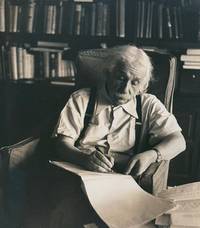
1950réf. 2896Princeton: np 1950. Very Good. A beautiful photo of Einstein at work in his study seemingly absorbed with his thoughts. The photographer Hermann Landshoff like Einstein was a German-Jewish émigré who settled in the United States in the 1930s. His large body of work encompasses portraits of some of the most influential figures of the century. Landshoff was highly respected by his peers with his work prompting the American photographer Richard Avedon to claim "I owe everything to Landshoff." Landshoff visited Einstein to photograph him several times in the 1940s and early 1950s showing Einstein in quieter moments at his home or study in Princeton. With Landshoff's copyright stamp on verso marking this as a "Sample copy" and "Not for sale or reproduction." Also with Landshoff's signature on the original matte board. The original non-archival matte was removed during framing to better preserve the photo but the signature was preserved and is now displayed on verso. Gelatin silver print with sepia tones. Taken c.1950 likely a contemporary or early printing. Approx. 9.25 x 10.5 in 235 x 263 mm. Archivally framed under museum glass to a size of 16 x 17.5 in. A few tiny spots to image generally in fine condition handsomely framed. np unknown books
1950réf. 6682New York: Philosophical Library 1950. First edition. Very Good in pretty good dust jacket. 21 cm; 279 pages portrait frontispiece. Turquoise cloth in plain cream-colored dust jacket. Dust jacket chipped at top of spine. Of the variant dust jackets and issues this is the one with the fewest number of titles advertised on the rear and the price of $4.75 on the inside flap. Philosophical Library hardcover books
1950réf. 617622New York: Philosophical Library 1950. Hardcover. Fine/Near Fine. First edition. Octavo. Fine in very slightly toned near fine dust jacket. Philosophical Library hardcover books
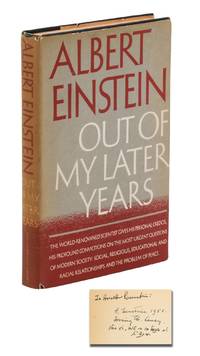
1950réf. 140948403New York: Philosophical Library 1950. First Edition. Near Fine/Near Fine. First edition first printing. Signed by Albert Einstein on the front free endpaper and dated the year of publication. Above and beneath Einstein's signature Rabbi Irving Levey has inscribed this book to former owner Harold Rosenstein and written two lines of Hebrew that translate to "A day that is exceptionally good 19 Kislev 5711." According to Rosenstein's grandson Einstein's signature was procured by Rabbi Levey who lead temple at the Jewish Center at Princeton from 1949-51. Levey and Einstein and worked together on issues relating to the then-newly formed State of Israel. vi 282 pp. Bound in publisher's blue cloth stamped in gilt. Near Fine with light rubbing to corners and spine ends offsetting at endsheets. In a Near Fine unclipped dust jacket with toning light edge wear small stain to rear flap. The iconic theoretical physicist's second collection of essays covering the years 1934-1950 surrounding his personal convictions around religious and humanitarian issues in the wake and aftermath of WWII. Boni 515. Philosophical Library unknown books
1950réf. 148775New York: Philosophical Library 1950. Hardcover. Very Good/Good. Very good in good dust jacket. Book rubbed on edges. Dustwrapper browned and rubbed. Philosophical Library hardcover books
1922réf. 37430Berlin: Slowa 1922. 51 5pp. Original printed wrappers faded front hinge weak tears at spine. First edition in Russian of Weil 111; see Weil 111e. Slowa unknown books
1915réf. 432951915. Einstein Albert 1879-1955 and Wander Johann de Haas 1878-1960. Notiz zu unserer Arbeit "Experimenteller Nachweis der Ampèreschen Molekularströme." Offprint from Verhandlungen der Deutschen Physikalischen Gesellschaft 17 1915. 1 sheet p. 420. 228 x 156 mm. Original printed wrappers. Fine copy. First Edition Offprint Issue. In 1915 Einstein and Dutch physicist Wander Johannes de Haas conducted gyromagnetic experiments leading to the discovery of the Einstein-de Haas effect which corresponds to the mechanical rotation induced in a ferromagnetic cylinder suspended inside a coil when an impulse of electric current is sent through the coil. Einstein was very enthusiastic about the experimental results stating that he and de Haas had "given firm proof of the existence of Ampère's molecular currents" quoted in Pais Subtle is the Lord pp. 245-246. Einstein and de Haas published their results in a paper published earlier in 1915 see Weil 73; the present "Notiz" is a response to a communication from American physicist Samuel Jackson Barnett who had begun performing similar experiments in 1909 and obtained results complementing those of Einstein and de Haas. Weil Albert Einstein Bibliography 73n. . unknown books
1923réf. 433181923. Offprint from Zeitschrift für Physik 16 1923. Single sheet unpaginated. 230 x 155 mm. One corner creased but very good. First edition offprint issue. Einstein's second response to Friedmann's groudbreaking paper on equations governing the expansion of space which made a valuable contribution to Einstein's theory of relativity and admitted the possibility of an expanding universe. Einstein at first believed that Friedmann's reasoning was incorrect then corrected his own objection in the present brief "Notiz" and called Friedmann's results "clarifying." Pais Subtle is the Lord p. 288. Weil Albert Einstein Bibliography 130. unknown books
1928réf. 374181928. Weil 162. Offprint from S. preuss. Akad. Wiss. unknown books
1920réf. 194005Munchen: Wolff 1920. Hardcover. Very Good. Cover has general wear. Bookblock has age toning. Interior pages have age toning. German language text. Green boards. 108 pgs illustrations. Wolff hardcover books
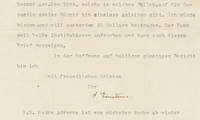
1941réf. 3262211/9/41. A generous demonstration by Einstein of his loyalty to friends and belief in the importance of music Dr. Theodor Rosenheim was a physician at the famed Medical University Clinic of the Charité in Germany in the 1880s. He was primarily concerned with the physiology and pathology of the digestive tract. He published an early textbook on the “Pathologie und Therapie der Krankheiten des Verdauungsapparates”. Rosenheim was one of the first in Germany to describe and publish on ulcerative colitis. He was intensively involved in the technical development of esophagoscopy and gastroscopy which at that time were only possible with rigid instruments. The Rosenheim line which was named after him described the largest diagonal diameter of the gastric percussion figure. Rosenheim was appointed professor extraordinarius at Berlin University in 1921. He also founded a polyclinic and a private sanatorium for stomach and intestinal patients. He was well respected in Berlin and his private practice developed successfully with a large circle of patients including Albert Einstein. Theodor’s wife was Hedwig Rosenheim and their daughter Kate was a hero of the Holocaust. She helped several thousand children from Jewish families to escape from Germany. She personally accompanied the legendary Kindertransporte to England among other places. She travelled to the USA in 1936 to negotiate directly with the aid organizations there. She then returned to Germany to actively continue the aid campaigns. Theodor died in 1939. Käte Rosenheim was able to flee Berlin together with her 72-year-old mother Hedwig Rosenheim on January 23 1941. They reached Havana Cuba via France Spain and Portugal. From there they were able to continue to New York where they arrived on April 1 1941. Albert Einstein was an accomplished violinist and music lover who was inspired by music in his scientific work. He often said that he would have been a musician if he hadn't pursued science. Another music lover was Hedwig Rosenheim. She had escaped Germany without her possessions especially her precious musical instruments. Upon arrival in the United States she contacted the old family friend Albert Einstein hoping he could help her get a flute either for herself or another escapee one who may have agreed to look for her. Einstein was sympathetic and rose to the occasion. He even contributed some of his personal funds to secure the flute. Typed letter signed his vacation house in Knollwood at Saranac Lake N.Y. September 11 1941 to his old friend Mrs. Hedwig Rosenheim in New York City. “ The matter of i.e. the quest for the flute shall not fail. First one should know what the committee is giving out – or loaning. Second there is the Hebrew Free Loan Society 108 Second Ave. New York which in such cases provides interest-free loans in exchange for the backing of two guarantors. I will serve as a guarantor and contribute 20 dollars on top of that. The man should visit both institutions and can show this letter. In the hope of receiving a positive report soon I remain with warm greetings your A. Einstein.” “PS. Starting next week my address will again be in Princeton.” The committee he referred may have been the American Jewish Joint Distribution Committee though there were others as well. It shows a lot about Einstein - his generosity his continued concern for old friends who had escaped from Germany and love for music - that he volunteered to make a personal financial contribution to obtaining the flute. <img class=""alignnone wp-image-25018 size-post-window"" src=""https://cdn.raabcollection.com/wp-content/uploads/20231204144051/Folder-site-11-1600x1327.jpg"" alt="""" width=""1600"" height=""1327"" /> unknown books
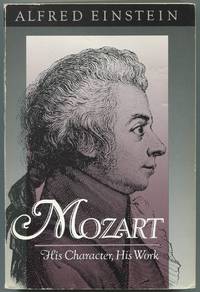
1947réf. 33821New York: Norton 1947. Hardcover. Very Good. Octavo. Boards. 371 pp. Norton hardcover books
1947réf. 226469New York: Norton 1947. Hardcover. Very Good. First edition. Very good minus hardcover. First edition. Pages light brown clean text. Corners on cover slightly bent. Some water stains on cover. Cover soiled. Norton hardcover books
1947réf. 88267New York: Norton 1947. First. hardcover. very good. Illustrated. xii 371pp. 8vo cloth. New York: Norton and Co. 1947. First Edition. A very good copy. Norton unknown books
1962réf. 439676New York: Oxford University Press 1962. Softcover. Very Good. Later printing. Trade paperback. 492pp. Translated by Arthur Mendel and Nathan Broder. Pages lightly age-toned edges rubbed very good. Oxford University Press unknown books
réf. 14394NY OXFORD 1945. FIRST AMERICAN EDITION VERY GOOD. 1st Edition. NY, OXFORD, 1945 unknown books
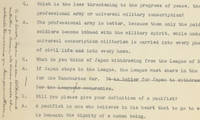
1502réf. 2446215/02/1933. He revises the typescript of his interview with the War Resisters League of which he was Honorary Chairman and calls out William Randolph Hearst and the head of the press and film empire in Germany who aided Hitler’s rise On philosophy: “The intellect without the emotions is insignificant”; On racism: “The main thing is that minority groups should be allowed security in the community.” They ought to be “accepted with friendliness as equal members” On the press: He criticizes William Randolph Heart by name but says “The freedom of the press is necessary despite all the dangers or abuse that come with it.”. On pacifism and peace keeping: “A pacifist is one who believes in his heart that to go to war is beneath the dignity of a human being” “Society needs some form of organization for security and protection in international life” and “An international police force…is almost absolutely necessary as one step toward achieving peace. Force when used by an impartial third party to achieve law and order it's not contrary to pacifism”. This document has never previously been offered for sale and was acquired by us from the family that has had it all this time Einstein was well known as a pacifist until Hitler’s rise to power. In 1930 on his second visit to America he joined the War Resisters League and accepted the office of Honorary Chairman. Einstein spoke to the organization that year saying “True pacifists must publicly declare in time of peace that they will not take up arms under any circumstances… even if only 2% of those assigned to perform military service should announce their refusal to fight governments would be powerless they would not dare send such a large number of people to jail.” The league then issued a pamphlet “Einstein on War Resistance” that was widely read and discussed. Meanwhile back in Germany the rising Nazi movement found a convenient target in Einstein and relativity branding the latter “Jewish physics” and sponsoring conferences and book burnings to denounce Einstein and his theories. The Nazis even enlisted other physicists to denounce Einstein; “One Hundred Authors Against Einstein” was published in 1931. When asked to comment on this denunciation of relativity by so many scientists Einstein replied that to defeat relativity one did not need the word of 100 scientists just one fact. <img class=""alignnone wp-image-24605 size-post-window"" src=""https://cdn.raabcollection.com/wp-content/uploads/20231204150044/Einstein-Feb-15-1933-3-1-1600x209.jpg"" alt="""" width=""1600"" height=""209"" /> In December 1932 Einstein decided to leave Germany. The reason: it became obvious to him that his life was in danger. A Nazi organization published a magazine with Einstein’s picture and the caption “Not Yet Hanged” on the cover. There was even a price on his head. In January 1933 Einstein came to the United States to serve at the California Institute of Technology in Pasadena California as a visiting professor. The appointment of Adolf Hitler as chancellor took effect late that month and Einstein decided he would not return to his home in Germany where he had been a professor at the Berlin Academy of Sciences. He would instead return to Europe and assess the situation from there. He and his wife Elsa returned by ship to Belgium in March 1933 to find that that their residences in Germany had been raided numerous times. Einstein accepted the fact that he could not return to Germany and turned in his passport to the German consulate; he also formally renounced his German citizenship. By the summer Einstein learned that his name was on a list of assassination targets. He resided in Belgium for some months and then moved to England for a short period. On October 17 1933 he returned to the US and took up a position at the Institute for Advanced Study at Princeton in New Jersey. And there he remained until his death. On February 15 1933 after Hitler had taken power but before Einstein learned that his homes had been raided he granted an interview to the War Resisters League at the home of one of its officials John Dorland. Dorland wanted the interview to be read aloud at the upcoming March 2 meeting of the members in Pasadena. He prepared a five page typescript of the interview and sent it to Einstein to review. As Dorland said in his cover letter to Einstein “Would you be kind enough to read it and if the answers misrepresent you in any detail may we request that you revise it in such particular as we are very anxious to have these correct.” He also asked Einstein's permission to read the interview aloud. This is the original typescript of the Einstein interview sent to Einstein by Dorland complete with Einstein’s handwritten notations. It is the only such annotated interview of Einstein that we have seen and it covers important topics. <img class=""alignnone wp-image-24606 size-post-window"" src=""https://cdn.raabcollection.com/wp-content/uploads/20231204150037/Einstein-Feb-15-1933-2-1-1600x247.jpg"" alt="""" width=""1600"" height=""247"" /> On page one Einstein makes it clear he was not ready to abandon his resistance to war. “The War Resisters” he stated at the interview “are doing a fine work. They have done more than any other peace group. A strong organized minority who have declared themselves absolutely against war is very powerful.” Question from Dorland. “Can we hope to convince everybody” Answer: “Oh no we cannot convince everybody but we do not need to. One strong man is worth much and has great influence Individuals thoroughly convinced and small groups working earnestly are of the utmost value.” Q: “In trying to arouse interest is it better to appeal to the intellect or the emotions” A: “To both; the intellect without the emotions is insignificant.” On page two Einstein states that “Public protests are very valuable” as is control over munitions production. “The private munitions business is a great threat to the peace of the world and there should be government control. Public opinion is not yet awake to the atrocities of the munitions firms.” Then Dorland changes the subject to “race relations.” Einstein responded “The main thing is that minority groups should be allowed security in the community.” Then Einstein hand writes in some thoughts. If they are not afforded such security “they should isolate themselves from the rest of society since they are not accepted with friendliness as equal members.” Then some fascinating free thoughts emerge. Clearly thinking of the Jews in Germany he crosses out “It insecurity is not so bad” and instead says “They can achieve a healthy existence”. But thinking of the current situation he finishes the thought by adding at least “Up until now!” He surely had less confidence about the future. On page three Einstein discusses the part to be played by international organizations. “The main thing is organization. Disputes will always come but we must have other methods than war for settling them. Society needs some form of organization for security and protection in international life.” Einstein then writes in “Obligatory court of arbitration. Unconditional obligation of the states to accept their verdicts and enforce them.” He is then asked which is less threatening to the progress of peace a professional army or universal military conscription. Einstein answers “The professional army is better because then only the professional soldiers become imbued with the military spirit.” Asked about Japan leaving the League of Nations he hand writes “It is better to let Japan secede from the League of Nations rather than have it the League compromised by a bad compromise.” Sooner let them go than compromise principles to keep them in. Lastly he is asked for his definition of a pacifist and responds “A pacifist is one who believes in his heart that to go to war is beneath the dignity of a human being.” <img class=""alignnone wp-image-24607 size-post-window"" src=""https://cdn.raabcollection.com/wp-content/uploads/20231204150030/Einstein-Feb-15-1933-5-1-1600x242.jpg"" alt="""" width=""1600"" height=""242"" /> On page four Einstein continues by saying that a pacifist “must be active in the prevention of war; that is he must support justice arbitration and conciliation.” In terms of having some international force enforce the peace Einstein is in favor. “an international police force as suggested by the French is almost absolutely necessary as one step toward achieving peace. Force when used by an impartial third party to achieve law and order it's not contrary to pacifism. This international force would exist only for a transition perhaps 20 years.” Dorland then asks Einstein “What do you think of the control over public opinion by the press” Einstein in the interview stated it was not good but in this document he elaborated further. “The freedom of the press is necessary despite all the dangers or abuse that come with it. This is the point with the biggest dependence of the peace movement peace work on economic circumstances. Hearst in America and Hugenberg in Germany demonstrate this fact with frightening clarity”. Alfred Hugenberg was the head of a press and film empire in Germany who aided Hitler’s rise. Einstein’s comparison of William Randolph Hearst with him is interesting. He clearly feels that the press in the wrong hands motivated by profit and political power was a danger. The next question was “Are religious bodies a power for peace” Einstein’s answer: “Not greatly now.” On the final page Einstein states his belief that though no one can change human nature “we can change traditional institutions.” <img class=""alignnone wp-image-24608 size-post-window"" src=""https://cdn.raabcollection.com/wp-content/uploads/20231204150023/Einstein-Feb-15-1933-4-1-1600x231.jpg"" alt="""" width=""1600"" height=""231"" /> This document is full of gems: “The intellect without the emotions is insignificant”; “The main thing is that minority groups should be allowed security in the community.” They ought to be “accepted with friendliness as equal members”; “Society needs some form of organization for security and protection in international life”; “A pacifist is one who believes in his heart that to go to war is beneath the dignity of a human being”; “An international police force…is almost absolutely necessary as one step toward achieving peace. Force when used by an impartial third party to achieve law and order it's not contrary to pacifism”; and “The freedom of the press is necessary despite all the dangers or abuse that come with it.” This is a great and fascinating rarity. A search of public sale records going back over 40 years turns up only one other example of an Einstein annotated interview nor have we ever had one. It wasn’t long in 1933 before the intensity of the threat from Naziism convinced Einstein that only force would be a deterrent a Hitler triumph. He resigned from the War Resisters League later in 1933. To Einstein pacifism became not an absolute concept but one that had to be re-examined depending on the magnitude of the threat. <img class=""alignnone wp-image-24457 size-post-window"" src=""https://cdn.raabcollection.com/wp-content/uploads/20231204150746/Folder-site-8-1600x1327.jpg"" alt="""" width=""1600"" height=""1327"" /> unknown books
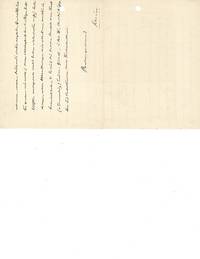
1918réf. 135751918. Mathematics Klein Felix. Autograph Letter Signed 10 November 1918 written in German to a former student and colleague directly references Einstein's recently published General Theory of Relativity and comments on the work of the International Mathematical Education Commission. Composed in the closing days of the First World War the letter places Klein within active scholarly exchange concerning the mathematical implications of relativity which had been formally presented in 1915 and widely disseminated by 1918. Klein long established for his foundational contributions to group theory non-Euclidean geometry and mathematical physics addresses questions raised by "Einstein's theory" noting that he required further reflection to clarify its implications for his own work. The document supports research in the history of relativity German mathematical networks scientific communication during wartime and the institutional organization of mathematics in the early twentieth century. Klein Felix. Autograph Letter Signed 10 November 1918. Two pages written on both sides of a single leaf. In German with accompanying English translation. Addressed to a former student the letter discusses the circulation of lecture manuscripts difficulties in securing copyists during wartime conditions and the intellectual demands posed by Einstein's theory: "A further exploration of my work does not exist yet as I had and still have more thinking to do about questions raised by Einstein's theory to clarify it for myself." Klein also comments critically on the IMUK observing that its published statements are "a display of wasted paper" while acknowledging the commission's broader social significance. He singles out contemporary educational treatises including studies by W. Trost Heinrich Emil Timerding and M. Girndt indicating his sustained engagement with mathematical pedagogy alongside theoretical research. The letter was written days before the November Revolution in Germany and at a moment when academic institutions faced political upheaval and material shortages. Klein's remarks regarding limited copyists and uncertainty about the coming months provide contemporaneous evidence of scholarly life under strained postwar conditions. His reference to Einstein situates the correspondence within the earliest phase of professional reception of general relativity among leading mathematicians while his comments on the International Mathematical Education Commission underscore his longstanding commitment to mathematical instruction and institutional reform. Clean and well preserved with strong legibility and a clear signature. Overall near fine condition. A substantive document of early relativity discourse and mathematical research at the end of the First World War. unknown books