Einstein, Albert and Paul EhrenfestBiblio.com

2,557 results
1923ref. 432881923. Einstein Albert 1879-1955 and Paul Ehrenfest 1880-1933. Zur Quantentheorie des Strahlungsgleichgewichts. Offprint from Zeitschrift für Physik 19 1923. 301-306pp. Original printed self-wrappers. 230 x 157 mm. Light toning but very good. First Edition Offprint Issue. In 1916 after publishing his great work on general relativity Einstein returned to the question of blackbody radiation. In November 1916 he wrote to his friend Besso that "a splendid light has dawned on me about the absorption and emission of radiation" quoted in Pais p. 405 one that led him to a new derivation of Planck's radiation law and convinced him of the reality of light-quanta photons. After publishing these results in three papers culminating with the famous "Zur Quantentheorie der Strahlung" 1917 Einstein kept looking for "new ways in which the existence of photons might lead to observable derivations from the classical picture" Pais p. 413. He found none until 1923 when Arthur Compton and Peter Debye independently derived the relativistic kinematics for the scattering of a photon off an electron at rest. The work of Compton and Debye led Wolfgang Pauli to extend Einstein's work of 1917 to the case of radiation in equilibrium with free electrons see Pais p. 414n. "Pauli examined the requirements of detailed balance under Lorentz transformations and found that scattering of light by free electrons must include a term of a form which we would now call stimulated emission . . . Einstein and Ehrenfest then showed that Pauli's results could be obtained by an extension of Einstein's 1917 paper with the unnecessary specialization to discrete energy levels removed . . . The core of Einstein's argument is that the scattering process should be broken into two parts: the absorption of energy from radiation of frequency 1 and the emission of energy as radiation of frequency 2" Lewis p. 42. Lewis "Einstein's derivation of Planck's radiation law" American Journal of Physics 41 1973: 38-44. Pais Subtle is the Lord ch. 21. Weil Albert Einstein Bibliography 138. . unknown
1923ref. 49498Berlin Julius Springer 1923. 8vo. Bound in contemporary full cloth with gilt lettering to spine. Entire volume 19 "Zeitschrift für Physik" Library stamp to title-page and paper label pasted on to lower part of spine. Minor wear to extremities. A nice and clean copy. Pp. 301-6. Entire volume: IV 426 pp. First edition.Weil 138; Schilpp-Shields 178.The volume also contains:Meitner Lise. Ueber eine mögliche Deutung des kontinuierlichen beta-Strahlenspektrums. Pp. 307-321. hardcover
1923ref. 43840Berlin Julius Springer 1923. 8vo. Entire volume 19 and 20 of "Zeitschrift für Physik" bound in contemporary black half cloth with gilt title to spine. Library stamp to title-page and paper label pasted on to lower part of spine. Minor wear to extremities. A nice and clean copy. Pp. 301-6. Entire volume: IV 426 pp. First edition.Weil 138; Schilpp-Shields 178.The volume also contains:Meitner Lise. Ueber eine mögliche Deutung des kontinuierlichen beta-Strahlenspektrums. Pp. 307-321.Pauli W. Zur Frage der Zuordnung der Komplexstrukturterme in starken und in schwachen äusseren Feldern. Pp. 371-88. hardcover
1923ref. 48937Berlin Julius Springer 1923. 8vo. Bound in contemporary half cloth with gilt lettering to spine. Library stamp to front free end paper and titel page. In "Zeitschrift für Physik" bd. 19. Fine and clean. Pp. 301-6. Entire volume: IV 415 pp. First edition.Weil 138; Schilpp-Shields 178.The volume also contains:Meitner Lise. Ueber eine mögliche Deutung des kontinuierlichen beta-Strahlenspektrums. Pp. 307-321. hardcover
1917ref. 46895Leipzig S. Hirzel 1917. Royal8vo. Bound in contemporary half calf with gilt lettering to spine and 5 raised bands with ornaments in gilt. In "Physikalische Zeitschrift" Bd. 18 1917. Spine and hinges with wear otherwise a fine and clean copy. Pp. 121-128. Entire volume: XI 1 604 pp. 14 plates. The paper was first published in 1916 in Mitteilungen der Physikalischen Gesellschaft in Zürich but here for the first time in Physikalische Zeitschrift. All subsequent research on absorption and emission of radiation and the entire discovery of the maser later the laser was based on the research presented in the present paper. The paper is also notable for introducing the concept but not the name of the photon; Einstein argues that in the interaction of matter and radiation there must be in addition to the processes of absorption and spontaneous emission a third process of stimulated emission. If stimulated emission exists then he can derive the Planck distribution for blackbody radiation and without it the same argument implies the invalid Wien-distribution theory."In this paper he derived Planck's original quantum law from a different starting point he suggested that as well as spontaneous emission and absorption there could also take place the process of stimulated emission. In 1917 this seemed mainly of theoretical interest; forty years later it was utilized to provide the maser and laser of modern technology. In 1916 "Einstein came back once more to blackbody radiation and made further progress. In November 1916 he wrote to Besso: 'A splendid light has fallen on me about the absorption and emission of radiation'. His reasoning is divided into three papers two of which appeared in 1916 and the third one early in 1917 the two papers above - note that these are the two papers of Einstein on radiation theory cited by Weil as "principal works"; a third paper from 1916 is not. In these papers Einstein proposed a statistical theory of the interaction between atoms and photons gave a new demonstration of Planck's radiation theory and introduced the concept of 'stimulated emission' providing the basis for the discovery of masers and lasers " Bertolotti The History of the Laser."When Einstein returned to the radiation problem in 1916 the quantum theory had undergone a major change. Niels Bohr's papers had opened a new and fertile domain for the application of quantum concepts-the explanation of atomic structure and atomic spectra. In addition Bohr's work and its generalizations by Arnold Sommerfeld and others constituted a fresh approach to the foundations of the quantum theory of matter. Einstein's new work showed the influence of these ideas . He had found still another derivation of Planck's black-body radiation law an "astonishingly simple and general" one which he thought mightproperly be called "the derivation" 12 of this important law. It was based on statistical assumptions about the processes of absorption and emission of radiation and on Bohr's basic quantum hypothesis that atomic systems have a discrete set of possible stationary states. The proof turned on the requirement that absorption and emission of radiation both spontaneous and stimulated suffice to keep a gas of atoms in thermodynamic equilibrium. This paper introduced the concept of stimulated emission into the quantum theory and is therefore often described as the basis of laser physics. Einstein himself considered the most important contribution of this work to be not the new derivation of the distribution law but rather the arguments he presented for the directional character of energy quanta. DSB Weil No 91 with an asterix denoting major paper. hardcover
ref. a94782Lipezig 1917. first edition. 4to. hardcover. Volume 18 of Physikalische Zeitschrift volume 18 at pp. 121-128. One of Einstein's great achievements in quantum mechanics. 3/4 maroon cloth with green marbled boards. One old tiny circular stamp of German university NO other library marks no spine number no pocket no bookplate. VG. light cover wear. hinges secure; text clean. . hardcover
ref. a94390Lipezig 1917. first edition. 4to. hardcover. Volume 18 of Physikalische Zeitschrift volume 18 at pp. 121-128. One of Einstein's great achievements in quantum mechanics. 3/4 black cloth and marbled boards gilt spine lettering. Ex-university library with no spine numbers but a bookplate and pocket. Cover board edges rounded at tips. Text clean and binding secure; no other owner marks. no hinges cracked. . hardcover
ref. a87636Berlin 1923 Vieweg Braunschweig Springer. Original printing of this article at pp.301-306 in one complete volume of Zeitschrift fur Physik Volume 19. Included in complete volume 18. Hardcover. Octavo 415p. 148 text figures original contermporary binding. Many additional articles on Physics in volume as well by Hertz Sommerfeld Lise Meitner Georg Joos and others. Good cover board edges and tips worn light spotting on cover end papers toned.hinges not cracked; binding secure; text clean; no owner marks . hardcover
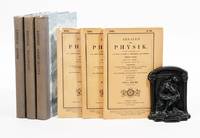
1905ref. 2895Leipzig: Johann Ambrosius Barth 1905. First edition. original wrappers. Very Good. FIRST PRINTINGS WITH EXTREMELY RARE ORIGINAL WRAPPERS of Einstein's revolutionary papers of 1905 including the first edition of the initial paper on special relativity; three of the most important papers in the history of science. Beautiful clean copies without any institutional stamps. In the first paper "On a Heuristic Viewpoint Concerning the Production and Transformation of Light" published in March "Einstein postulated that light is composed of individual quanta later called photons that in addition to wavelike behaviour demonstrate certain properties unique to particles. In a single stroke he thus revolutionized the theory of light and provided an explanation for among other phenomena the emission of electrons from some solids when struck by light called the photoelectric effect" Britannica. It was for this paper on the photoelectric effect that Einstein was granted the Nobel Prize in physics in 1921. The next paper "On the Motion-Required by the Molecular Kinetic Theory of Heat-of Small Particles Suspended in a Stationary Liquid" published in May provided a theoretical explanation of Brownian motion. It is generally regarded as the first proof that molecules exist. Although the first two papers were of astonishing originality and importance it was the third paper introducing what would be later known as Einstein's special theory of relativity that would make him famous. "Toward the end of June it was all written up and on June 30 receipt of the manuscript was recorded at the editorial office of Annalen in Berlin. The thirty-page article published three months later was titled 'On the Electrodynamics of Moving Bodies'. It was a treatise beyond compare and without precedent one of the greatest scientific achievements in content and one of the most brilliant in style. Of course there were later additions some from Einstein himself and some from others but these were mere addenda to a theory which had appeared before all the world ready and complete valid for all time" Folsing Albert Einstein. Einstein's theory with the premise that "if for all frames of reference the speed of light is constant and if all natural laws are the same then both time and motion are found to be relative to the observer" "involved a complete rethinking of the entire conceptual tradition of modern physics from its beginning" Britannica; Folsing. Weil 6. Weil 8. Weil 9. Grolier/Horblit 26b. Zur Elektrodynamik bewegter Korper in Annalen der Physik Vierte Folge Volume 17 part 10 pp. 891-921; WITH: Über einen die Erzeugung und Verwandlung des Lichtes betreffenden heuristischen Gesichtspunkt ibid part 6 pp. 132-148. WITH: Über die von der molekularkinetischen Theorie der Warme geforderte Bewegung von in ruhenden Flussigkeiten suspendierten Teilchen ibid part 8 pp. 549-560. Leipzig: Johann Ambrosius Barth 1905. Octavo three issues in original wrappers rebacked; three custom boxes. Note: The issues are slightly trimmed indicating that it is likely they were originally bound with the wrappers and then re-assembled. With general title page volume half-title and index included in part 6. Some chipping to exceedingly rare and brittle original wrappers; otherwise fine. Extremely rare in such outstanding condition. Johann Ambrosius Barth books
1905ref. 2895Leipzig: Johann Ambrosius Barth 1905. First edition. original wrappers. Very Good. FIRST PRINTINGS WITH EXTREMELY RARE ORIGINAL WRAPPERS of Einstein's revolutionary papers of 1905 including the first edition of the initial paper on special relativity; three of the most important papers in the history of science. Beautiful clean copies without any institutional stamps. In the first paper "On a Heuristic Viewpoint Concerning the Production and Transformation of Light" published in March "Einstein postulated that light is composed of individual quanta later called photons that in addition to wavelike behaviour demonstrate certain properties unique to particles. In a single stroke he thus revolutionized the theory of light and provided an explanation for among other phenomena the emission of electrons from some solids when struck by light called the photoelectric effect" Britannica. It was for this paper on the photoelectric effect that Einstein was granted the Nobel Prize in physics in 1921. The next paper "On the Motion-Required by the Molecular Kinetic Theory of Heat-of Small Particles Suspended in a Stationary Liquid" published in May provided a theoretical explanation of Brownian motion. It is generally regarded as the first proof that molecules exist. Although the first two papers were of astonishing originality and importance it was the third paper introducing what would be later known as Einstein's special theory of relativity that would make him famous. "Toward the end of June it was all written up and on June 30 receipt of the manuscript was recorded at the editorial office of Annalen in Berlin. The thirty-page article published three months later was titled 'On the Electrodynamics of Moving Bodies'. It was a treatise beyond compare and without precedent one of the greatest scientific achievements in content and one of the most brilliant in style. Of course there were later additions some from Einstein himself and some from others but these were mere addenda to a theory which had appeared before all the world ready and complete valid for all time" Folsing Albert Einstein. Einstein's theory with the premise that "if for all frames of reference the speed of light is constant and if all natural laws are the same then both time and motion are found to be relative to the observer" "involved a complete rethinking of the entire conceptual tradition of modern physics from its beginning" Britannica; Folsing. Weil 6. Weil 8. Weil 9. Grolier/Horblit 26b. Zur Elektrodynamik bewegter Korper in Annalen der Physik Vierte Folge Volume 17 part 10 pp. 891-921; WITH: Über einen die Erzeugung und Verwandlung des Lichtes betreffenden heuristischen Gesichtspunkt ibid part 6 pp. 132-148. WITH: Über die von der molekularkinetischen Theorie der Warme geforderte Bewegung von in ruhenden Flussigkeiten suspendierten Teilchen ibid part 8 pp. 549-560. Leipzig: Johann Ambrosius Barth 1905. Octavo three issues in original wrappers rebacked; three custom boxes. Note: The issues are slightly trimmed indicating that it is likely they were originally bound with the wrappers and then re-assembled. With general title page volume half-title and index included in part 6. Some chipping to exceedingly rare and brittle original wrappers; otherwise fine. Extremely rare in such outstanding condition. Johann Ambrosius Barth
1921ref. 248566Berlin, B. Cassirer, 1921. Gr.-8°. 134 S., 1 Bl. Hlwd. m. goldgepr. Rtit. sowie Rsign. Vorderdeckel m. Kleberest. Exlibris a. Innendeckel. M. mehr. Bibl.-St.
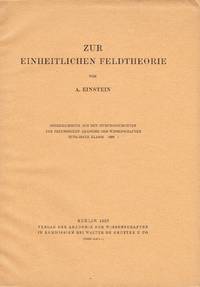
1929ref. 374191929. Einstein Albert 1879-1955. Zur einheitlichen Feldtheorie. Offprint from Sitzungsberichten der preussischen Akademie der Wissenschaften 1 1929. 8vo. 8pp. Berlin: Verlag der Akademie der Wissenschaft 1929. 256 x 183 mm. Original printed wrappers slightly soiled and creased. Very good. First Separate Edition. "In 1928 Einstein embarked on a new approach to a unified field theory . . . involving what he called 'distant parallelism'. . . . By early 1929 he had solved the main problems involved in writing down field equations for his unified theory. On the day of official publication of the third of a formidably technical series of nine articles on the theory . . . excited headlines appeared in foreign newspapers throughout the world. . . . In this frenzied unscientific atmosphere Einstein's new theory was hailed in the press as an outstanding scientific advance. Yet Einstein had stated in his article that it was still tentative; and soon he found he had to abandon it Hoffman Einstein pp. 225-26. This paper is included on Shields's list of Einstein's most significant papers; see Albert Einstein Philosopher-Scientist 1949 p. 758. Weil 165. Pais Subtle is the Lord pp. 344-46. . unknown books
1929ref. 22771Berlin, 1929. Orig. printed orange wrappers. Back strengthend with matching paper. Fresh copy. Offprint/Sonderabdr. aus ""Sitzungsberichte"". pp. 1-8.
1929ref. 28362Berlin, Gruyter & Co., 1929. 4to. Orig. orange printed wrappers. Offprint/Sonderabdruck aus Sitzungsberichten...pp. (1)-8. Fine fresh copy.
1929ref. 19299Berlin: Verlag der Akademia der Wissenschaften in Kommission bei Walter de Gruyter 1929. FIRST EDITION. Original printed orange wrappers; a fine copy unopened and bound into morocco-backed cloth boards spine labeled in gilt. First edition first issue in the rare author’s offprint form with a newly set title-page. One of Einstein’s last important scientific works this publication of the unified field theory caused quite a sensation. It was the first separate printing of one of a series of five papers published between 1925 and 1929 in which Einstein attempted to develop a unified field theory reconciling in a single formula the laws of electromagnetism and gravitation. Weil 165; Printing & the Mind of Man 418. Verlag der Akademia der Wissenschaften in Kommission bei Walter de Gruyter unknown books
1929ref. 5739K-2Berlin: Verlag der Akademie der Wissenschaften in commission at Georg Reimer Reichsdruckerei 30th January 1929. Near Fine. Imperial 8vo 25 4: 18 2 cm. 8 pages. Letterpress on machine paper in original publisher’s brochure on orange stock with black title printing. First offprint in the original wrappers of this important paper by Einstein formulating groundbreaking developments towards a unified field theory. - Content: »On The Unified Field Theory« is one of Einstein's last scientific core works. According to Weil ""This paper represents a new development which was immediate news. A translation by L. L. Whyte appeared in the London Times of Feb. 4 1929. It was quoted in full in ""Observatory"" vol. 52 under the title ""New Field Theory"" pp.82-87 and 1930 pp.11-118."" In 1928 Einstein embarked on a new approach to a unified field theory involving what he called „distant parallelism“. By early 1929 he had solved the main problems involved in writing down field equations for his unified field theory. On the day of offical publication of the third of a formidably technical series of 9 articles on the theory excited headlines appeared in newspapers around the world. - cf. Parkinson Breakthroughs p.279. - Condition State: Mint uncut thus unread. - The list of academy offprints on the rear side of the cover states present offprint not in last place. All offprints listed later were printed in 1929 though. The typeset of all pages is identical to other authentified offprints of this papers. This indicates that our copy is indeed a first offprint but presumably with a later cover. - Reference: Alicke 141; Boni-Russ-L. 183; Norman Collection I 700; Printing and the Mind of Man 416 „Principal Work“; Schilpp-Shields 226; Weil 165. Verlag der Akademie der Wissenschaften (in commission at Georg Reimer [Reichsdruckerei]) unknown
1929ref. 17857Berlin: Verlag Der Akademie der Wissenschaften 1929. An important offprint first edition. With mathematical formulas in text. Small folio in the original orange off-print paper wrappers printed in black on both covers. 8 pp. Very fine nearly as new. A RARE AND IMPORTANT OFFPRINT. EINHEITLICHEN FELDTHEORIE which means "A Coherent Theory of the Electro-Magnetic Field" and is the title of a five-page paper of highest mathematical formulae which Relativist Albert Einstein worked on for ten years. His report is a purely mathematical extension of the general theory of relativity to include gravitational and electromagnetic phenomena. His relativity theory which he phrased within only three printed pages made time & space the creator of matter. When this paper on the Unified Field Theory was published it was a headline story in the newspapers. Few if any people understood the complex mathematics but many were fascinated by the thought that Einstein had possibly came up with a new theory expanding on "General Relativity" and unifying the fundamental forces of nature. It is considered Einstein's last important scientific work Weil #165. "In 1928 Einstein embarked on a new approach to a unified field theory. involving what he called 'distant parallelism'. By early 1929 he had solved the main problems involved in writing down field equations for his unified field theory. On the day of official publication of the third of a formidably technical series of nine articles on the theory. excited headlines appeared in foreign newspapers throughout the world. In this frenzied unscientific atmosphere Einstein's new theory was hailed in the press as an outstanding scientific advance. Yet Einstein had stated in his article that this was still tentative; and soon he found he had to abandon it" Hoffmann/Dukas ''Albert Einstein: Creator and Rebel'' 1972 pp. 225-226 Verlag Der Akademie der Wissenschaften unknown
1929ref. 28362Berlin Gruyter & Co. 1929. 4to. Orig. orange printed wrappers. Offprint/Sonderabdruck aus Sitzungsberichten.pp. 1-8. Fine fresh copy. First edition in the rare Offprint still called "Abdruck" but having separate printed title and separate pagination. See Weil No. 165 where this is not mentioned.Weil No. 165 with an asterix denoting a major work. "The Unified Field-Theory is one of the last importent works by Einstein. This paper presents a new development which was immediate news; translations and abstracts of ite appeared at once besides numerous articles in general periodicals" W. Alicke.The early Offprints from "Sitzungsberichten." are called "Sonderabdruck" up to Weil No.165 including this. From Weil 166 they are called "Sonderausgabe.". - Before 161 up to 160 the Offprints do not have separate title and pagination the pagination follows the numbering in the periodical. From 166 the Offprint has both separate printed title and pagination. - So Weil Nos 161-165 is still "Abdruck" but with separate title and pagination. These facts are not mentioned in the bibliographies. unknown
1929ref. 22771Berlin 1929. Orig. printed orange wrappers. Back strengthend with matching paper. Fresh copy. Offprint/Sonderabdr. aus "Sitzungsberichte". pp. 1-8. First edition. Weil No. 165 - with asterics denoting major work. Printing and the Mind of Man 416. unknown
1929ref. 374191929. Einstein Albert 1879-1955. Zur einheitlichen Feldtheorie. Offprint from Sitzungsberichten der preussischen Akademie der Wissenschaften 1 1929. 8vo. 8pp. Berlin: Verlag der Akademie der Wissenschaft 1929. 256 x 183 mm. Original printed wrappers slightly soiled and creased. Very good. First Separate Edition. "In 1928 Einstein embarked on a new approach to a unified field theory . . . involving what he called 'distant parallelism'. . . . By early 1929 he had solved the main problems involved in writing down field equations for his unified theory. On the day of official publication of the third of a formidably technical series of nine articles on the theory . . . excited headlines appeared in foreign newspapers throughout the world. . . . In this frenzied unscientific atmosphere Einstein's new theory was hailed in the press as an outstanding scientific advance. Yet Einstein had stated in his article that it was still tentative; and soon he found he had to abandon it Hoffman Einstein pp. 225-26. This paper is included on Shields's list of Einstein's most significant papers; see Albert Einstein Philosopher-Scientist 1949 p. 758. Weil 165. Pais Subtle is the Lord pp. 344-46. . unknown
ref. 0484971808.Gpaperback. Good. Access codes and supplements are not guaranteed with used items. May be an ex-library book. paperback
ref. 1333940327.Gpaperback. Good. Access codes and supplements are not guaranteed with used items. May be an ex-library book. paperback
1923ref. 28359Berlin, Gruyter & Co., 1923. 4to. Orig. orange printed wrappers. Offprint/Sonderabdruck aus Sitzungsberichten...pp. 32-38. Fine fresh copy.
1904ref. 38818Leipzig, J.A. Barth, 1904. Contemp. hcloth, tears to hinges at upper part of spine. ""Annalen der Physik. Vierte Folge. Band 14. Herausgegeben von Paul Drude"". VIII,1040 pp. and 3 plates. The Einstein paper: pp. 354-362. Internally clean and fine. The whole volume offered.
1923ref. 374061923. unknown books