Einstein, AlbertBiblio.com
2,980 results
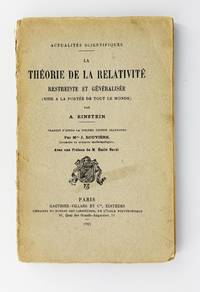
1921ref. 009633Paris: Gauthier-Villars 1921 12mo 19 cm XXII 120 pp. Printed wrappers wrappers slightly stained and frayed; small portions of paper missing from the spine; paper toned inside. Early French edition of Einstein's celebrated popular exposition of the theory of relativity intended to make the fundamental ideas of both the special and the general theory accessible to non-specialists. With a preface by the renowned mathematician Émile Borel who emphasizes the scientific importance of Einstein's work and its profound implications for modern physics. Einstein's text explains the essential concepts of space time motion gravitation and the structure of space-time in clear largely non-technical language presenting the empirical and conceptual foundations of relativity to a broad readership. The French translation was prepared by Maurice Solovine one of Einstein's close early collaborators and an important mediator of his ideas to the French-speaking public. Boni-Russ-Laurence 91.B. Gauthier-Villars paperback
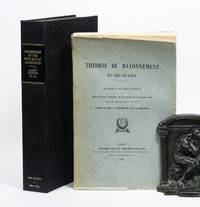
1912ref. 2508Paris: Gauthier-Villars 1912. First edition. Original wrappers custom box. Very Good. RARE FIRST EDITION IN ORIGINAL WRAPPERS OF THE REPORTS FROM THE HISTORIC FIRST SOLVAY CONFERENCE "THE FIRST INTERNATIONAL CONFERENCE IN PHYSICS EVER ORGANIZED" AND A CRITICAL MOMENT IN THE BIRTH OF QUANTUM PHYSICS. In the short time that followed Planck's hypothesis of the universal constant that would bear his name the greatest minds in physics were largely at a loss about how to deal with the bizarre theoretical results that followed let alone the experimental results which confirmed them!. Much of the focus at the time was on black-body radiation including work by Planck himself as well as Lorentz Rayleigh and Jeans. However shortly before the first Solvay conference a young Einstein had also started investigating the related question of materials' specific heat. Kuhn. "The purpose of the first Solvay Conference was thus two-fold: first there was the need to examine whether classical theories molecular-kinetic theory and electrodynamics could in some undiscovered ways provide an explanation of the problem of black-body radiation and of the specific heat of polyatomic substances at low temperatures; secondly to consider phenomena in which the theory of quanta could be successfully used." Mehra. Underlying these questions was the more fundamental mystery of how to interpret the existence of the Planck constant. There were two camps both of which were represented at the conference. Planck's took the constant to indicate some fundamental constraint on the radiative processes of emission and absorption. For example "Sommerfeld introduced a version of the quantum hypothesis which he considered to be compatible with classical electrodynamics. He postulated that in 'every purely molecular process' a quantized quantity of action is exchanged." Staumann. Einstein's camp on the other hand took the quantum of action to represent the physicality of a perhaps pseudo-corpuscular theory of energy exchange - his photons of light. Although the debates that followed the lectures included in the proceedings did not rise to the famous heated exchange that Einstein would have with Bohr at the 1927 Solvay conference we do see some of the young Einstein's hotheadedness as he opens the debate following Planck's plenary lecture: "What I find strange about the way Mr. Planck applies Boltzmann's equation is that he introduces a state probability W without giving this quantity a physical definition. If one proceeds in such a way then to begin with Boltzmann's equation does not have a physical meaning." As translated by Straumann. It would take another 14 years for quantum mechanics to be fully formalized but the first Solvay conference represents a pivotal point in quantum history: "During 1911 the situation changed quickly. Articles that applied the quantum to other topics then outnumbered those on blackbody radiation for the first time and some were backed by impressive experimental evidence. In part because of that evidence physicists like Planck and Lorentz who had previously taken the constant h to be characteristic only of the radiation problem began to consider additional areas in which others had earlier staked quantum claims." Kuhn. Albert Einstein and the Solvay Conference: Among the most renown scientists of the day - including Ernest Rutherford Marie Curie and Max Planck - Einstein made quite an impression. At age 32 he was the second youngest participant in the conference. The youngest was British physicist Frederick Lindemann later to become scientific adviser to Winston Churchill. Although "Einstein had already published so many masterpieces none had actually been put to the test and his theories were looked on rather as tours de force than as definitive additions to knowledge. But his pre-eminence among the twelve greatest theoretical physicists of the day was clear to any unprejudiced observer." Frederick Lindemann quoted in Brian. References: Headline quote from the Solvay Institute website. Kuhn T. 1978 Black Body Theory and the Quantum Discontinuity 1894-1912. University of Chicago Press. Mehra J. 1975 The Solvay Conferences on Physics: Aspects of the Development of Physics Since 1911. Straumann N. 2011. On the first Solvay Congress in 1911. The European Physical Journal H 363 379-399. Denis Brian Einstein: A Life p.82. Paris: Gauthier-Villars 1912. Octavo original wrappers; custom box. Splits to top and bottom joint of upper wrapper two creases to front wrapper. Text in fine condition largely unopened. FIRST PRINTINGS IN ORIGINAL WRAPPERS ARE EXTREMELY SCARCE. Gauthier-Villars unknown books
1954ref. 21146Paris, Gauthier-Villars, 1954. Orig. printed wrappers. VI,180 pp.
1998ref. I-660-456Agora 1998. Paperback. Very Good. Ammareal gives back up to 15% of this item's net price to charity organizations. Agora paperback
1998ref. BN672171Agora 1998. 1998. Softcover. La theorie de la relativite restreinte et generale La theorie de la relativite restreinte et generale Albert Einstein Agora paperback
ref. 65642Gauthier-Villars Paris 1956 In-8 23 cm 179pp couverture avec dos restaure etat moyen Ats30 traduit de l'allemand par Maurice Solovine unknown
1912ref. 2508Paris: Gauthier-Villars 1912. First edition. Original wrappers custom box. Very Good. RARE FIRST EDITION IN ORIGINAL WRAPPERS OF THE REPORTS FROM THE HISTORIC FIRST SOLVAY CONFERENCE "THE FIRST INTERNATIONAL CONFERENCE IN PHYSICS EVER ORGANIZED" AND A CRITICAL MOMENT IN THE BIRTH OF QUANTUM PHYSICS. In the short time that followed Planck's hypothesis of the universal constant that would bear his name the greatest minds in physics were largely at a loss about how to deal with the bizarre theoretical results that followed let alone the experimental results which confirmed them!. Much of the focus at the time was on black-body radiation including work by Planck himself as well as Lorentz Rayleigh and Jeans. However shortly before the first Solvay conference a young Einstein had also started investigating the related question of materials' specific heat. Kuhn. "The purpose of the first Solvay Conference was thus two-fold: first there was the need to examine whether classical theories molecular-kinetic theory and electrodynamics could in some undiscovered ways provide an explanation of the problem of black-body radiation and of the specific heat of polyatomic substances at low temperatures; secondly to consider phenomena in which the theory of quanta could be successfully used." Mehra. Underlying these questions was the more fundamental mystery of how to interpret the existence of the Planck constant. There were two camps both of which were represented at the conference. Planck's took the constant to indicate some fundamental constraint on the radiative processes of emission and absorption. For example "Sommerfeld introduced a version of the quantum hypothesis which he considered to be compatible with classical electrodynamics. He postulated that in 'every purely molecular process' a quantized quantity of action is exchanged." Staumann. Einstein's camp on the other hand took the quantum of action to represent the physicality of a perhaps pseudo-corpuscular theory of energy exchange - his photons of light. Although the debates that followed the lectures included in the proceedings did not rise to the famous heated exchange that Einstein would have with Bohr at the 1927 Solvay conference we do see some of the young Einstein's hotheadedness as he opens the debate following Planck's plenary lecture: "What I find strange about the way Mr. Planck applies Boltzmann's equation is that he introduces a state probability W without giving this quantity a physical definition. If one proceeds in such a way then to begin with Boltzmann's equation does not have a physical meaning." As translated by Straumann. It would take another 14 years for quantum mechanics to be fully formalized but the first Solvay conference represents a pivotal point in quantum history: "During 1911 the situation changed quickly. Articles that applied the quantum to other topics then outnumbered those on blackbody radiation for the first time and some were backed by impressive experimental evidence. In part because of that evidence physicists like Planck and Lorentz who had previously taken the constant h to be characteristic only of the radiation problem began to consider additional areas in which others had earlier staked quantum claims." Kuhn. Albert Einstein and the Solvay Conference: Among the most renown scientists of the day - including Ernest Rutherford Marie Curie and Max Planck - Einstein made quite an impression. At age 32 he was the second youngest participant in the conference. The youngest was British physicist Frederick Lindemann later to become scientific adviser to Winston Churchill. Although "Einstein had already published so many masterpieces none had actually been put to the test and his theories were looked on rather as tours de force than as definitive additions to knowledge. But his pre-eminence among the twelve greatest theoretical physicists of the day was clear to any unprejudiced observer." Frederick Lindemann quoted in Brian. References: Headline quote from the Solvay Institute website. Kuhn T. 1978 Black Body Theory and the Quantum Discontinuity 1894-1912. University of Chicago Press. Mehra J. 1975 The Solvay Conferences on Physics: Aspects of the Development of Physics Since 1911. Straumann N. 2011. On the first Solvay Congress in 1911. The European Physical Journal H 363 379-399. Denis Brian Einstein: A Life p.82. Paris: Gauthier-Villars 1912. Octavo original wrappers; custom box. Splits to top and bottom joint of upper wrapper two creases to front wrapper. Text in fine condition largely unopened. FIRST PRINTINGS IN ORIGINAL WRAPPERS ARE EXTREMELY SCARCE. Gauthier-Villars unknown
1961(Il mosaico del pensiero). 16°, pp.207 (1), t. cart. edit., astuccio edit. (Lineamenti della teoria della relatività e pensiero filosofico; Il principio di relatività nella meccanica classica;Relatività particolare; Cenno sulle geometrie non euclidee; Teoria della relatività generale e sintesi successive; Nuove vedute geometriche di Weyl e Eddington; Interpretazioni unitarie dei fenomeni naturali).
1951(Firenze, IGM, 1951) stralcio con copertina posticcia muta, pp. 779/782. - !! ATTENZIONE !!: Con il termine estratto (o stralcio) intendiamo riferirci ad un fascicolo contenente un articolo di rivista, sia che esso sia stato stampato a parte utilizzando la stessa composizione sia che provenga direttamente da una rivista. Le pagine sono indicate come "da/a", ad esempio: 229/231 significa che il testo è composto da tre pagine. Quando la rivista di provenienza non viene indicata é perchè ci è sconosciuta. - !! ATTENTION !!: : NOT A BOOK : “estratto” or “stralcio” means simply a few pages, original nonetheless, printed in a magazine. Pages are indicated as in "from” “to", for example: 229/231 means the text comprises three pages (229, 230 and 231). If the magazine that contained the pages is not mentioned, it is because it is unknown to us.
1922Brossura editoriale, buona copia. Ritrato di Einstein in antiporta. Prima edizione. Sc. U.
1961in cofanetto
1987Einstein La teoria della relatività. , Universale tascabile Newton 1987, Piatti e dorso segnati dal tempo. Tagli bruniti. Prima di copertina leggermente scollata. Interno brunito, complessivamente in buono stato. Buono (Good) . 111
1973In-8°, pp. 95, bross. edit.
1969In-8°, pp. 440, bross. edit. Numerose vignette n.t.
1976In-16° gr. pp. 440, bross. edit. Ottimo stato.
1998Mm 130x180 Collana " Universale scientifica Boringhieri ". Volume di 440 pp., firma di precedente proprietario. Pari al nuovo (as new). Spedizione in 24 ore dalla conferma dell'ordine.
1973ill., br. Uno dei massimi interpreti della fisica del Novecento, il premio Nobel Max Born non considerava disdicevole dedicare parte notevole delle sue energie al tentativo di comunicare, principalmente ai giovani studenti, i risultati della ricerca. Espressione del suo impegno come divulgatore è il presente volume, il più riuscito, forse, tra i molti scritti per introdurre un pubblico più vasto alle idee di Albert Einstein. Anziché enfatizzare, banalmente, l'elemento «rivoluzionario», di rottura, che esse presentano rispetto alle nozioni usuali di contemporaneità, massa, energia e così via, Born con un ampliamento di prospettiva ne ricerca le premesse nel generale processo evolutivo della fisica. Dei sette capitoli di cui si compone il libro, cinque sono così dedicati a un riepilogo delle teorie e dei concetti della fisica classica, di cui la relatività non è il capovolgimento, ma la naturale estensione. La lucida analisi di Born spazia dalle prime misure di spazio e tempo e dagli assiomi della geometria euclidea ai concetti fondamentali della dinamica newtoniana e alla teoria elettromagnetica di Maxwell. La relatività speciale e generale è trattata negli ultimi due capitoli. Grande rilievo vi assumono i fenomeni ottici, da sempre cruciale banco di prova di ogni tentativo di sistemazione razionale del mondo fisico.
1924ref. LFA-126720319Une plaquette de 26 pages, format 125 x 200 mm, brochée, publiée en 1924, Payot
1990INTRODUZIONE DI ALBERTO FRIGERIO JACA BOOK 1990 LIEVI SEGNI DEL TEMPO, VOLUME INTONSO, PERFETTO. Indice Alberto Frigerio 9 La struttura dell'atomo secondo Niels Bohr 21 Paul Dirac 28 Teoria dei quanti ed astrofisica 34 La realtà del mondo atomico 41 cielo è azzurro 48 destino sociale della fisica contemporanea 57 Scienza tecnica e società 61 Parole e frasi comuni Alamos all'inizio all'interno allora antiparticella applicata aspetti bisogna bomba certo chimica collisione complementarità comprendere comprensione concetto considerare dell'elettrone dell'esperienza umana dell'universo determinata differenza Dirac Einstein elementi elettrica elettromagnetica elettroni elettronvolt energie cinetiche esempio esso fasci di particelle fenomeni fisica classica fisica contemporanea fisica delle particelle fisica nucleare forma fotoni Heisenberg identità Jaca Book l'atomo l'elettrone l'energia livello di energia Louis de Broglie materia Maxwell meccanica classica meccanica quantistica milioni di elettronvolt molecole mondo natura ondulatoria neutroni Niels Bohr nucleari nuclei atomici nucleoni nuova orbite oscillatori osservare Paul Dirac Pauli pensiero Planck possibile problema processi protoni punto di vista quan quantiche dell'atomo quantizzata questione radiazione realtà ricerca fondamentale risultati rivoluzione Rutherford sarebbe scala quantica scientifica scienza scoperta secolo sistema planetario sistemi atomici sottolineare specifiche spiegare stabilire storia della fisica struttura atomica struttura dell'atomo sviluppo tecnico tecnologia temperatura teoria della relatività teoria quantistica teorica trova un'energia un'onda vibrazioni vuoto Weisskopf
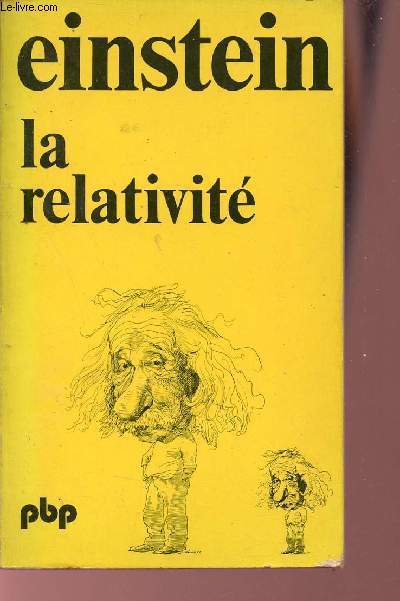
ref. 19688Petite Bibliothèque Payot, 1969. In-12, broché, 184 pages. Très agréable. Très propre.
1981ref. R320135431Payot. 1981. In-12. Broché. Etat d'usage, Couv. convenable, Dos satisfaisant, Papier jauni. 184 pages - annotation sur la page de garde.. . . . Classification Dewey : 100-PHILOSOPHIE ET DISCIPLINES CONNEXES
ref. 67584Coll. "Sciences", Paris, éd. Hachette, 1998, EDITION ORIGINALE, in-8, br., couv. ill. coul. éd., 320 pp., quelques graphiques en noir, glossaire, notes, table des matières, Il y a plus de quatre siècles, après que Copernic eut ébranlé l'idée d'une position absolue, Galilée découvrait que le " mouvement est comme rien " : il n'existe pas en soi, un corps ne se meut que par rapport à un autre corps. Au début du XXe siècle, Poincaré et Einstein franchissaient une nouvelle étape avec la relativité restreinte, où l'espace et le temps ne sont plus séparés. Puis Einstein inventait une nouvelle manière de penser avec la relativité généralisée. Celle-ci n'est plus seulement une théorie des objets dans un cadre préétabli. Elle offre une description dynamique de la géométrie d'un espace-temps courbe et dépendant de son contenu matériel. La gravitation n'y existe plus en soi, mais devient, elle-même, relative au choix du système de coordonnées. La relativité a-t-elle dit son dernier mot ? Son principe exige que les lois de la nature soient valides quel que soit le système de référence. Mais les lois de la mécanique quantique ne l'ont-elles pas mis en défaut vers les échelles microscopiques ? Laurent Nottale suggère d'envisager les effets quantiques comme la manifestation d'une relativité étendue aux changements d'échelle. En passant du macroscopique au microscopique, l'espace-temps, de courbe, deviendrait fractal. Un essai à la fois très accessible et profondément novateur. Très bon état
ref. 11149Bruxelles. J. Meeuwissen, éditeur. 1924. Plaquette grand in-8° agrafée. 82 figures dans le texte. 29 pages. E.O.
ref. 9782228940719Payot
ref. 80608Payot 1983, format poche n° 62; collection pbp - bon état