Einstein, AlbertBiblio.com
1956 risultati
2012rif. DADAX3642312780Springer 2012-09-14. 24. Aufl. 2009. Unver. paperback. New. 6.10x0.28x9.25. Buy with confidence. Excellent Customer Service & Return policy. Springer paperback
1909rif. 003223Leipzig: J. A. Barth 1909. Only the first paper is with J. Laub. Contemporary three-quarter cloth marbled boards. First Edition. Very Good. J. A. Barth hardcover
1911rif. 38841Leipzig J.A. Barth 1911. Contemp. hcalf spine gilt. "Annalen der Physik. Vierte Folge. Band 34. Hrsg. von W.Wien und Max Planck." VIII1032 pp. 6 plates. Einstein papers: pp. 165-169; pp. 170-174; pp.; 175-176; p. 590; pp. 591-592. Fine and clean. The whole volume offered. First edition of all 5 papers. In "Relation between elastic behaviour and specific heat of solid bodies with monatomic molecules" Einstein comments Sutherlands importent paper in Philosophical Magazine from 1910. Sutherland made the importent remark that the infrared eigenfrequencies of solid bodies have their origin possibly in the elastic vibrations of these bodies. Einstein impressed by this remark adds that electrically charged ions are the sources of optical vibrations whreas elastic vibrations are caused by the mutual motion of the entire molecule. Hence he prefers to test the hypothesis of Sutherland by solid bodies which are composed of monatomic molecules."Lanczos. - Weil Nos 38 39 this with an asterix denoting major work40 1-2 and 41. unknown
1909rif. 38830Berlin J.A. Barth 1909. Orig. printed wrappers. Frontwr. eith tears endwr. only partly preserbed. "Annalen der Physik. Vierte Folge. Band 28 Heft 2. Heft 2 in 15 parts pp.217-248. Einstein Paper: pp. 445-47. First edition. The authors claimed in "Elementare Theorie der Brownschen Bewegungen" that the boundary conditions for E D H B on the boundary surface between two different media remain the same whwther the bodies are at rest or in motion. This is in fact not tthe case. The correction is made here with the help of a method which was originally employed by H. Hertz. Lanzos. - Weil No 26. unknown
1907rif. 29339Leipzig Barth 1907. 8vo. Extract from "Annalen der Physik IV23" pp.206-208. Some slight browning to leaves. First edition. Weil No. 18. unknown
1911rif. 50604Leipzig J.A. Barth 1911. 8vo. In Contemporary half calf with gilt lettering to spine. In "Annalen der Physik. Vierte Folge. Band 34. Hrsg. von W.Wien und Max Planck.". The whole volume offered. A tear to lower part of spine and small stamp to title page otherwise fine. Einstein papers: pp. 165-169; pp. 170-174; pp.; 175-176; p. 590; pp. 591-592. Entire volume: VIII1032 pp. 6 plates. First edition of all 5 papers. In "Relation between elastic behaviour and specific heat of solid bodies with monatomic molecules" Einstein comments Sutherlands importent paper in Philosophical Magazine from 1910. Sutherland made the importent remark that the infrared eigenfrequencies of solid bodies have their origin possibly in the elastic vibrations of these bodies. Einstein impressed by this remark adds that electrically charged ions are the sources of optical vibrations whreas elastic vibrations are caused by the mutual motion of the entire molecule. Hence he prefers to test the hypothesis of Sutherland by solid bodies which are composed of monatomic molecules."Lanczos. - Weil Nos 38 39 this with an asterix denoting major work40 1-2 and 41. unknown
1911rif. 50315Leipzig: Johann Ambrosius Barth 1911. Einstein Albert 1879-1955. 1 Bemerkung zu dem Gesetz von Eötvös. In Annalen der Physik 34 1: 165-169 pp. 1910. Weil 38 Boni 35. 2 Eine beziehung zwischen dem elastischen Verhalten und der spezifischen Wärme bei festen Körpen mit einatomigem Molekül. In Annalen der Physik 34 1: 170-174 pp. 1910. Weil 39 Boni 36. 3 Bemerkungen zu den P. Hertzschen Arbeiten: "Über die mechanischen Grundlagen der Thermodynamik." In Annalen der Physik 34 1: 175-176 pp. 1910. Weil 40 Boni 37. 4 Bemerkung zu meiner Arbeit: "Eine Beziehung zwischen dem elastischen Verhalten . . ." In Annalen der Physik 34 3: p. 590. Weil 40. 5 Berichtigung zu meiner Arbeit: "Eine neue Bestimmung der Moleküldimensionen." In Annalen der Physik 34 3: p. 591. Weil 41. Leipzig: Johann Ambrosius Barth 1911. Whole volume: viii 1032 pp. 6 plates 5 folding 1 b/w/ silver photograph. Figs. Text-illust. 210 x 140 mm. Red cloth with gilt lettering on spine. First Edition. Pages are a little toned as are plates 5 and 6 otherwise Very Good. Approximate English translations of titles: 1 "Remarks on the law of Eötvös." 2 "A connection between the elastic conduct and the specific heat of solid bodies with monatomic molecule." 3 "Remarks on P. Hertz' work: 'On the mechanical foundations of thermodynamics.'" Eövtös' findings served as part of the basis of Albert Einstein's General Theory of Relativity in which the principle of equivalence acts as the keystone no. 1 above. "Einstein adds a comment on p.590 of the same journal no. 2 above. To supplement Sutherland's observation that infared eigenfrequencies of solid bodies possibly originate in the elastic vibrations of these bodies Einstein adds that electrically charged ions are the source of optical vibrations while the mututal motions of the entire molecule cause elastic vibrations." Calaprice Alice et al. An Einstein Encyclopedia. 2015. p. 291. Weil's Einstein Bibliography nos. 38 39 40 and 41. Boni's Einstein Checklist nos. 35 36 and 37. . Johann Ambrosius Barth unknown
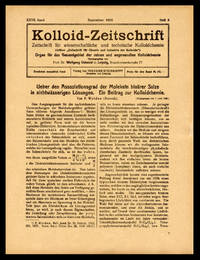
1920rif. 14561920. 1st Edition. First edition in original wraps of Einstein's review of a paper by Nobel Prize winner Walter Rudolf Hess entitled Theory of the Viscosity of Heterogeneous Systems. CONDITION: The journal was published in three sections. All three are here all bright clean and in near fine condition. paperback
1923rif. 433171923. Offprint from Sitzungsberichte der preussischen Akademie der Wissenschaften 1923. Single sheet pp. 76-77. 265 x 184 mm. A few marginal chips and tiny tears but very good. First edition offprint issue. The second of the four short papers Einstein published in 1923 on Eddington's program for a unified field theory. Weil Albert Einstein Bibliography 131n. unknown
1911rif. 003225Leipzig: J. A. Barth 1911. title continued "Uber der mechanischen Grundlagen der Thermodynamik" pp. 175-76 and Bemerkung zu meiner Arbeit: "Eine Beziehung zxischen dem elastischen verhalten" p. 590 and Berichtigung zu meiner Arbeit: Enie neue Bestimmung der Molkuldimensionen" pp. 591-92. In Annalen der Physik Vierte Folge Band 34. Contemporary three-quarter cloth marbled boards. Short scratch in spine; small stain on rear cover; three nicks in outer edge of rear cover. First Edition. About Very Good. J. A. Barth hardcover
1912rif. 003230Leipzig: J. A. Barth 1912. Contemporary three-quarter cloth marbled boards. First Edition. Very Good. J. A. Barth hardcover
1914rif. 48163Braunschweig Vieweg & Sohn 1914. No wrappers. "Verhandlungen der Deutschen Physikalischen Gesellschaft im Jahre 1914. Hrsg. von Karl Scheel." 16. Jahrgang Nr. 16. Pp. 765- 834. Entire issue offered. With the general titlepage to 16. Jahrg. Titlepage stamped at foot. Einstein paper pp. 820-828. First edition. In this paper "Contributions to quantum theory" two considerations are given which are interrelated by a common goal inasmuch as it is attempted to derive two of the most importent achievementss of quantum theory viz. Planck's radiation law and Nernst's third law of thermodynamics in a new manner. The proofs do not involve Boltzmann's equation and are thus based enterely on macroscopic thermodynamics. They do introduce however the quantum hupothesis. Einstein points out that the alleged 'proofs' which try to derive the theorem of Nernst from the mere fact that the heat capacity of all substances goes to zero at absolute zero temterature are not genuine. Cornelius Lanczos.Weil No 67. unknown
1914rif. 38840Braunschweig Vieweg & Sohn 1914. Later full cloth. A stamp to the general titlepage. IX1072;414 pp. textillustrations. "Verhandlungen der Deutschen Physikalischen Gesellschaft im Jahre 1914. Sechzehnter Jahrgang. Hrsg. von Karl Scheel." Einstein paper pp. 820-828. Internally clean and fine. The whole volume offered First edition. In this paper "Contributions to quantum theory" two considerations are given which are interrelated by a common goal inasmuch as it is attempted to derive two of the most importent achievementss of quantum theory viz. Planck's radiation law and Nernst's third law of thermodynamics in a new manner. The proofs do not involve Boltzmann's equation and are thus based enterely on macroscopic thermodynamics. They do introduce however the quantum hupothesis. Einstein points out that the alleged 'proofs' which try to derive the theorem of Nernst from the mere fact that the heat capacity of all substances goes to zero at absolute zero temterature are not genuine. Cornelius Lanczos.- Weil No 67. hardcover
rif. a106117Braunschweig 1914 first edition. Vieweg. Vol XVI of Berichte der Deutschen Physikalishchen. Original binding. hardcover thick octavo. 3/4 darkbrown cloth with matching dark brown papercovered boards. Gilt spine lettering. Illustrations. 1072p. Among many other important papers this volume includes: EINSTEIN "Beitrage zur Quantentheorie " pp. 820-828 VG. no owner marks; light foxing on end papers; just very light cover wear; hinges not cracked. Clean solid excellent condition! Pictures available on request. . hardcover
rif. a97179Braunschweig 1914 first edition. Vieweg. Vol XVI of Berichte der Deutschen Physikalishchen. hardcover very thick octavo. 3/4 dark brown cloth with brown/black marbled boards. Gilt spine lettering. Illustrations. 1072p. plus 414p. Halbonatliches Literaturverszeichnis. Includes: EINSTEIN landmark article pp. 820-828. Other article in same volume by A.Euken J. Franck G. Hertz andothers. Owner stamps on titlepage end of text and on end papers - no other marks. Very nice condition: Near Fine end papers slightly toned. Text Fine. . hardcover
rif. 0266793762.Ghardcover. Good. Access codes and supplements are not guaranteed with used items. May be an ex-library book. hardcover
rif. EDZZ0740Berlin-Wilmersdorf Vlg. der Wochenschrift Die Aktion 1917. 99 S. 7 S. Verlagsanz. Mit 1 Portr. von Max Oppenheimer. = Aktions-Bücher der Aeternisten Bd. 5. Orig.-Pappband unt. Kapital mit 3 cm Fehlstelle. Raabe/Hannich-B. 65.1. Das Erstlingswerk Einsteins war zuvor 1912 erschienen als erste Buchpublikation der Aktion mit dem Untertitel ""Die Dilettanten des Wunders"". Berlin-Wilmersdorf, Vlg. der Wochenschrift Die Aktion 1917. unknown
rif. 13884Frankfurt Insel Verlag 1963. 62 S. Pbd. Insel-Bücherei Nr. 801 unknown
rif. 0993840140.Gpaperback. Good. Access codes and supplements are not guaranteed with used items. May be an ex-library book. paperback
rif. 0870190032.Gpaperback. Good. Access codes and supplements are not guaranteed with used items. May be an ex-library book. paperback
2007rif. Q-0061144649HarperCollins 2007-09-25. Hardcover. New. New. In shrink wrap. Looks like an interesting title! HarperCollins hardcover
1989rif. Q-0517675773Random House Value Publishing 1989-01-13. Hardcover. New. New. In shrink wrap. Looks like an interesting title! Random House Value Publishing hardcover
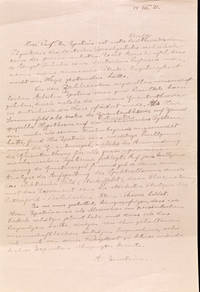
1921rif. 1206201921. Signed. EINSTEIN Albert. Autograph letter signed. No place August 14 1921. Single sheet of cream lined paper measuring 7-1/2 by 11 inches; p. 1. $35000.Rare heartfelt autograph letter of recommendation written and signed by Einstein in German enthusiastically recommending his friend and colleague physicist Prof. Dr. Paul Epstein for an academic position.The autograph letter dated ""14 VIII 21"" written entirely in Einstein's hand reads translated from the original German: ""Prof. Dr. Epstein is certainly one of the most prominent living theoretical physicists of the German-speaking world. Without a doubt he would have been appointed to a German professorship a long time ago had his Russian nationality not stood in the way. Among Epstein's numerous original scientific papers two findings which advanced the modern quantum theory in crucial ways should be noted. After Mr. Sommerfeld as the first physicist who on the basis of special hypotheses had applied the quantum theory to a certain mechanical system of more than one degree of freedom Mr. Epstein discovered an important generalization of the quantum principle which established the application of the quantum theory for all quasi-periodic mechanical systems. Based on that general application of the quantum principle he then provided an analysis of the splitting of spectral lines in the electrical field Stark effect the accordance of which with the experiment provides one of the strongest supports for the Rutherford-Bohr atomic theory. I would like to add that I have also come to appreciate Mr. Epstein in personal interactions as a human being and that I had the pleasure of attending several scientific lectures given by him which enabled me to convince myself of his competence in delivering clearly understandable oral exposition. / A. Einstein.""Einstein and Epstein were friends and longtime correspondents who shared an interest in physics Judaism and the founding of Israel. Paul Epstein was a Russian-American mathematical physicist. He remains best known for his contributions to the development of quantum mechanics. Indeed he was one of a select group that included Lorentz Einstein Minkowski Thomson Rutherford Sommerfeld Rntgen von Laue Bohr de Broglie Ehrenfest and Schwarzschild. Born in Warsaw then part of Imperial Russia Epstein was brought up solidly middle class. He later stated that his mother recognized his potential at the age of four and predicted his future as a mathematician. Epstein studied mathematics and physics for his entire university career eventually earning a degree from the Imperial University of Moscow. He then went on to earn a Ph.D. at the Technical University of Munich in 1914 concentrating on a problem in the theory of diffraction of electromagnetic waves. However the outbreak of World War I rendered Epstein an enemy alien in Germany. Sommerfeld intervened on his behalf and he was allowed to stay as a private citizen and continue his research. In 1916 Epstein published an important paper explaining the Stark Effect using the Bohr-Sommerfeld quantum theory. After the war Epstein went to Leiden and worked as an assistant for Lorentz and Ehrenfest. In 1921Ñthe year this letter was writtenÑEpstein was recruited by Robert Millikan to join the physicists at the California Institute of Technology. Epstein accepted the position and stayed there for the rest of his career publishing extensively on quantum theory. Epstein was something of polymath and worked in numerous areas outside of quantum theory including work on air resistance the settling of gasses the theory of vibration and the absorption of sound. He was an avid supported of Freudian psychoanalysis including as one of the founding members of the Psychoanalytic Study Group that later merged with the Los Angeles Institute for Psychoanalysis. Epstein was also notably anti-communist and worried about the threat of nationalism.The areas of study mentioned in Einstein's letter of recommendation all came together to help form the science behind atomic and hydrogen bombs though neither Einstein nor Epstein anticipated quite where the science was headed in 1921. The letter mentions the Stark effect which is the shifting and splitting of spectral lines of atoms and molecules due to the presence of an external electric field. It is analogous to the Zeeman effect in which a magnetic field is the influence. The Rutherford-Bohr model presented in 1913 is a system consisting of a small dense nucleus surrounded by orbiting electronsÑsomewhat like the Solar System but with electrostatic forces instead of gravity. The Bohr model came to be recognized as a relatively primitive model of the hydrogen atom compared to the valence shell atom model. However because of its simplicity and the correct results it generates for certain systems it is still commonly used to introduce students to quantum mechanics.Overall this letter provides valuable insight into the scientific world during the height of Einstein's international career right when he first began traveling abroad and meeting fellow scientists internationally. The letter reflects Einstein's importance in the community and is a testament to Epstein's ability as a physicist. Original mailing creases. Fine condition. unknown
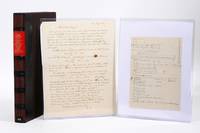
1932rif. 3054Caputh Germany: np 1932. First edition. Very Good. AN IMPORTANT SCIENTIFIC LETTER FROM EINSTEIN TO HIS CLOSEST MATHEMATICAL COLLABORATOR ACCOMPANIED BY A MANUSCRIPT LEAF OF CALCULATIONS IN EINSTEIN'S HAND ON THE SAME LINE OF RESEARCH. Although the original association of the letter and the leaf of calculations cannot be confirmed the two pieces clearly emerge from the same scientific context and have been preserved together. A superb pair from the final months of Einstein's German period. The Letter: In this intense and intellectually urgent letter Einstein writes to Walther Mayer his indispensable mathematical collaborator often referred to as "Einstein's Calculator" describing a newly conceived approach to the technical obstacles in their unified-field theory involving semi-vectors spinors and modified Dirac-type equations. Einstein tells Mayer he believes he "sees a new possibility" one that determines key constants in the system without resorting to the semi-vector construction. He then sketches the structure of the revised scheme points to the condition under which the full set of field equations reduces to a single one and warns that if this same collapse occurs in the general case "the whole thing would be useless." With his imminent departure from Germany he urges Mayer to examine the issue quickly and gives instructions for where a reply will reach him while en route. Dirac and De Broglie - Significance of the Scientific References: Of particular importance is Einstein's explicit engagement in this letter with the work of Paul Dirac and Louis de Broglie two of the central figures in early quantum theory. Einstein refers directly to the Dirac equations introduced only a few years earlier which provided a relativistic formulation of the electron and played a foundational role in quantum mechanics. He also invokes the De Broglie equations for matter waves reflecting his continued effort to reconcile quantum ideas with relativistic field theory. These references place the letter squarely at the intersection of Einstein's unified-field program and the emerging quantum framework he famously regarded with both fascination and skepticism. The letter thus documents Einstein actively testing whether concepts originating in quantum mechanics-Dirac's relativistic wave equation and De Broglie's wave-particle duality-could be absorbed into a geometrically unified classical field theory. Letters in which Einstein explicitly grapples with Dirac and De Broglie at this technical level are rare and represent an important record of his engagement with the central theoretical developments of the early twentieth century. Historical Context: Einstein's collaboration with Walther Mayer beginning around 1930 produced some of the most technically sophisticated papers of Einstein's later career. Together they developed new mathematical structures-semi-vectors spinors and higher-dimensional tangent-space formulations-used in their unified-field attempts. This letter dates from December 1932 only weeks before Einstein left Germany permanently and belongs to the final phase of their joint work published in the Sitzungsberichte of the Prussian Academy. Einstein valued Mayer so highly that he later persuaded the Institute for Advanced Study to create a permanent position for him the only such appointment ever granted for one of Einstein's collaborators. The Manuscript Calculations: Accompanying the letter is a two-page manuscript leaf containing Einstein's working calculations: trial expressions constraint conditions and variant formulations of the same type of semi-vector and spinor problems addressed in the letter. While we cannot confirm that these pages were originally enclosed with the letter they concern the same scientific material and have been preserved alongside it. Einstein manuscript leaves of this depth and technical significance-especially when tied to a known collaborative problem-are scarce. Significance: Whether or not originally sent together the letter and the calculations form a powerful and coherent scientific pair offering a rare view of Einstein actively working through equations testing ideas and relying on Mayer to verify mathematical structure. They capture Einstein at a critical inflection point in both his scientific life and personal circumstances as he prepared to leave Germany forever. --------- The letter from Einstein to Mayer reads in full translated from the original German: Dear Mr. Mayer! I believe I see a new possibility which promises success. It is along the lines of the recently devised way according to which one places zero on the right side of the Dirac-Equations. The novelty is in the fact that the constants a1 . a4 aside from a totally irrelevant factor are completely known without passing on to the specific Semi-Vectors. After omission of the _-terms the equations read Ee st ys = s 1 xe Or for De-Broglie-Equations of the restless particle E4 st ys = s 1a x4 Here is what's new: How does one choose the ay so that the De Broglie - Choices stay largely undetermined Result: The four equations 1a reduce themselves into a single one when and only when if one lets a1 = 1 a2 = 1 a3 = 1 a4 = 1 I believe that with this selection ay is for the equation describing the _-terms 1 the fitting substitute for the DeBroglie-Equation. These equations are already supplied by the simplest Hamilton function. See if the general equations 1 degenerate with this placing for a as well. If this were the case the whole thing would be useless. I leave on Saturday. A letter that is sent to Antwerp to the `Oakland' Hapag Antwerp harbor will reach me until December 13. Cordial greetings from your A. E. Autograph Letter Signed Written in German. One page 8.5 x 11 in.; 216 x 279 mm. probably Caputh near Potsdam Germany the location of Einstein's country home Sunday 4 December 1932. Scattered spotting affecting four words; usual folds. WITH: Two-page leaf of mathematical calculations. Housed together in decorated half-leather box by noted book artist Sjoerd Hofstra. np unknown
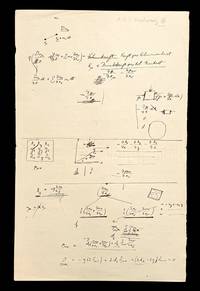
1912rif. 3056np: np 1912. first edition. custom box. Very Good. ON THE ROAD TO RELATIVITY: A four-panel working bifolium from Einstein's early post-Minkowski tensor phase. A remarkable working sheet showing Einstein making tensor formalism physically operational for continuum mechanics. Across three working zones the manuscript moves from a formal four-dimensional tensor transformation identity written in a distinct unidentified hand to Einstein's own derivations involving Volumenkraft Druckkraft stress force density diagrammatic testing and a heavily underlined mechanical equilibrium result. The folded rotated format gives the sheet the character of a compact notebook in miniature: formal tensor language brought into contact with physical terms local force relations diagrams and repeated calculation. The manuscript's all-lower-index notation explicit summations in Einstein's hand mixed coordinate idiom second-hand tensor identity and visible effort to make tensor language mechanically operational point most naturally to the 1912-1913 Zurich tensor period when Einstein was absorbing the post-Minkowski mathematics that General Relativity would require. Later revisitations cannot be entirely excluded but they explain the sheet less naturally. A rare survival documenting Einstein's working method on one of the foundational matter-side problems on the road to General Relativity. EINSTEIN ALBERT. Autograph scientific manuscript unsigned and undated most plausibly 1912-1913. A four-panel working bifolium 330 × 210 mm open from Einstein's early post-Minkowski tensor period retained among his private research papers and annotated by Helen Dukas: "A.E.'s Handwriting H.D." Provenance: Sotheby's New York 26 June 1998; Jagdish Mehra. PLEASE CLICK ON THE LINK BENEATH THE IMAGES FOR A PDF CONTAINING THE FULL DESCRIPTION. np unknown