Albert EinsteinBiblio.com
1980 resultados
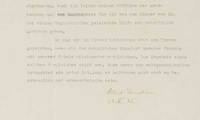
1935ref. 1383623/05/1935. He prophesizes however that the road ahead for the Jews will be “arduous and very painful” The Institute for Advanced Study in Princeton New Jersey was founded in 1930 by educator Abraham Flexner with funding from department store magnate Louis Bamberger. Flexner first recruited noted mathematicians from Princeton University to join the Institute then broadened its scope by including established scholars in economics politics and humanistic studies. In 1932 Flexner offered Einstein a faculty position at the Institute. Einstein’s decision was effected by historical events as in January 1933 Adolf Hitler became Chancellor of Germany. Soon after Einstein made the decision to resign from his Berlin position give up his German citizenship and accept the position in Princeton. The ocean liner Westmoreland which carried Einstein at age 54 to what would become his new home country arrived in New York Harbor on October 17 1933. <img class=""alignnone size-full wp-image-24695"" src=""https://cdn.raabcollection.com/wp-content/uploads/20231204145639/einsteinsig.gif"" alt="""" width=""1920"" height=""1080"" /> Einstein found the Institute and life in the United States congenial so in April 1934 just six months after his arrival Einstein announced that he was staying in Princeton indefinitely and assuming a permanent full-time status at the Institute. He would remain in the United States the rest of his life. Meanwhile he was very much a celebrity and was invited to the White House to meet with the Roosevelts. He politely declined saying he did not want to call attention to himself a position that German Jews had become accustomed to adopting during the rise of Naziism. However the First Lady Eleanor Roosevelt intervened writing Einstein directly requesting his presence. So Einstein and his wife Elsa arrived at the White House on January 24 1934 had dinner and spent the night. President Roosevelt was able to converse with them in passable German. Among other things they discussed Roosevelt’s marine prints and Einstein’s love for sailing. On learning that the Einsteins had decided to stay in the United States Roosevelt suggested that the Einsteins should accept the offer of some Congressmen to have a special bill passed on their behalf that he would sign granting them citizenship so that they would not have to endure the five year waiting period. The Einsteins declined the President’s generous suggestion saying they wanted to be treated like any other applicant for American citizenship. Because the Einsteins had not been sure of their ultimate destination and declared themselves as visitors instead of immigrants when they arrived in October 1933 this meant that they would need to leave the U.S. and return again to declare intention to seek citizenship. The United Jewish Appeal UJA planned a fund-raising dinner in Einstein’s honor for May 28 1935. This was exactly the time the Einsteins had set aside to leave the country to perfect their citizenship so he was forced to decline the invitation. He did however provide them with a statement that was received by the UJA on May 25 the very day the Einsteins stepped onboard the Queen Mary to travel to British-owned Bermuda for a few days to satisfy the formalities. The royal governor was there to greet them when they arrived in Hamilton and he recommended the island’s two best hotels. Einstein found them stuffy and pretentious. As they walked through town he saw a modest guest cottage and that is where they ended up. <img class=""alignnone wp-image-32085 size-post-window"" src=""https://cdn.raabcollection.com/wp-content/uploads/20240908143641/Einstein-May-23-1935-1-1600x968.jpg"" alt="""" width=""1600"" height=""968"" /> Typed statement signed in German Princeton May 23 1935 time stamped as received on May 25 to be read at the UJA dinner and issued to the press accordingly. It takes the moral high ground but warns of great dangers ahead. ”Unfortunately because of non-deferrable obligations I can only express in writing my recognition and gratitude for the assistance provided to the many unfortunate people by the dinner on the 28th of May. We can gain consolation in this critical time if we compare the moral standard of our friends and our enemies with each other. The result of such a comparison shows us that our way for world history can be considered the better one even if at times it is arduous and very painful.” Our research indicates that this important statement is unpublished as the dinner was postponed and it was never released to the press. But even this moving and forceful statement was not enough for the event organizers. Learning that Einstein could not attend they postponed the dinner. Instead the $50-a-plate dinner for the benefit of the UJA arranged by that organization and the Council of Jewish Organizations was held in New York City on June 26 with Einstein in attendance. About 1000 people attended the banquet at which Einstein spoke. In his speech Einstein returned to the same theme of morality as in the above statement saying that the ""moral disintegration and intensified national egoism"" of the times requires all Jews to strengthen their ranks to preserve Jewry. Of foremost importance he said was the upbuilding of the settlement in Palestine. On June 28 the UJA announced it was using the proceeds from the dinner to aid German refugees in New York City by allocating funds to local agencies equipped to care for the refugees. Einstein reentered the U.S. from Bermuda on June 3 1935. On January 15 1936 the Einsteins submitted their declaration of intention to become citizens of the United States. <img class=""alignnone wp-image-25018 size-post-window"" src=""https://cdn.raabcollection.com/wp-content/uploads/20231204144051/Folder-site-11-1600x1327.jpg"" alt="""" width=""1600"" height=""1327"" /> unknown
ref. 1298941474.Ghardcover. Good. Access codes and supplements are not guaranteed with used items. May be an ex-library book. hardcover
ref. 101957027X.Ghardcover. Good. Access codes and supplements are not guaranteed with used items. May be an ex-library book. hardcover
ref. 0265215838.Ghardcover. Good. Access codes and supplements are not guaranteed with used items. May be an ex-library book. hardcover
ref. E04E-02027McGraw-Hill Osborne Media. Used - Very Good. Very Good condition. Sorry CD missing. A copy that may have a few cosmetic defects. May also contain light spine creasing or a few markings such as an owner’s name short gifter’s inscription or light stamp. McGraw-Hill Osborne Media unknown
ref. 0078822394.Gpaperback. Good. Access codes and supplements are not guaranteed with used items. May be an ex-library book. paperback
ref. 0078824028.Gpaperback. Good. Access codes and supplements are not guaranteed with used items. May be an ex-library book. paperback
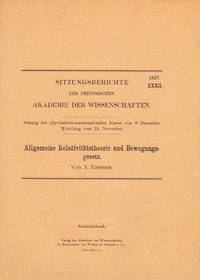
1927ref. 5736KBerlin: Verlag der Akademie der Wissenschaften in commission at Georg Reimer Reichsdruckerei 24th February 1927; 14th February 1928. Near Fine. Imperial 8vo 25 4: 18 2 cm. 12 pages numbered 2-13; 12 pages numbered 235-245 1. Letterpress on machine paper in original publisher’s brochures on orange stock with black title printing. First offprints in the original wrappers of two of Einstein's papers about the interrelations of the General Theory of Relativity and the Law of Motion the 2nd paper conducted with his assistant Jakob Grommer. - Condition: Mint. - Reference: Boni-Russ-L. 171; Schilpp-Shields 212; Weil 155 and 160. Verlag der Akademie der Wissenschaften (in commission at Georg Reimer [Reichsdruckerei]) unknown
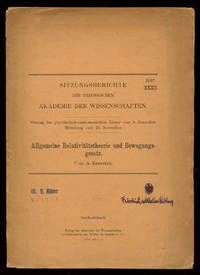
1927ref. 1663Berlin: Verlag der Akademie der Wiss 1927. 1st Edition. FIRST EDITION OFFPRINT ISSUE IN ORIGINAL PAPER WRAPS VERY GOOD CONDITION. "Einstein and Grommer's work treats the particle as a singularity in the field and attemptss to obtain the equations of motion by imposing conditions on the exterior field in the neighborhood of the singularity" Stachel Einstein from 'B' to'Z' pp. 507. Weil 155. In 1927 Einstein's research "concentrated on a new approach to the problem of the motion of particles in a general field theory" Mehra The Golden Age of Theoretical Physics 997. He presented his work conducted with Jakob Grommer in this report. Einstein and Grommer here show that 'in the case of a pure gravitational field the mechanical behavior of singularities can be derived' a result which in Einstein's opinion 'opened the possibility to obtain on the basis of the field equations a theory of matter characterized as discontinuities in space' ibid 997; Einstein and Grommer 1927. "After Einstein had tried for years to obtain a theory of material particles in a generalized field theory by describing these objects with the help of continuous functions Einstein and Grommer now proposed 'to consider elementary particles as singular points or singular world lines respectively' motivated by the observation 'that both the equations of the pure gravitational field and the equations augmented by Maxwell's electromagnetic field possess simple spherically-symmetric solutions which contain a singularity' ibid. Finally they arrived at the result: In the approximation of the gravitational field obtained by solving linearized equations the equation of motion for a singularity is completely determined - at least in the case of equilibrium - and corresponds to the law of a geodetic line" ibid. CONDITION & DETAILS: Berlin: Verlag der Akademie der Wiss. Pp. 2-13. Offprint in original wraps. 10 x 7.25 inches; 250 x 181mm. Toning at the edges & bearing the ownership stamp of "Friedrich Wilhelm Ritter" W. F. Ritter 1839-1929. Ritter had a large library. Very good condition. Verlag der Akademie der Wiss paperback
1927ref. 433031927. Offprint from Sitzungsberichte der preussischen Akademie der Wissenschaften 1927. 235-245pp. 255 x 183 mm. Original printed wrappers. Fine. On the problem of motion in general relativity theory; a follow-up to his and Grommer's paper of the same title published earlier in 1927. Weil Albert Einstein Bibliography 160. unknown
1927ref. 374151927. Offprint from S. preuss. Akad. Wiss. Weil 155. unknown
ref. ria9780313273636_inpHardcover. New. New Book; Fast Shipping from UK; Not signed; Not First Edition; N/A hardcover
ref. 637393386ABC-Clio Incorporated . Hardback. New. pp. 340 ABC-Clio, Incorporated hardcover
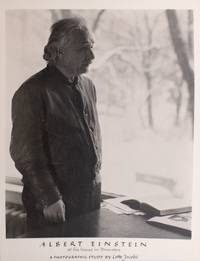
1940ref. 3293321940. Black and white photographic print. 6 1/2 x 4 7/8 in. Fine. Black and white photographic print. 6 1/2 x 4 7/8 in. unknown
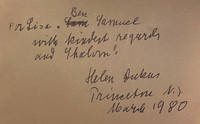
1979ref. 32820372FIRST EDITION. Presentation copy inscribed by Einstein's longtime assistant Helen Dukas: "For Lisa Ben Samuel with kindest regards and Shalom Helen Dukas Princeton N.J. March 1980." Helen Dukas became Einstein's secretary in 1928 and after his death in 1955 served as a trustee of his literary estate and archivist of his papers. This volume prints letters and documents selected by Dukas over the years to shed light on Einstein's character and personality. Original cloth and dust jacket. Some rubbing to jacket else very good. Princeton: University Press
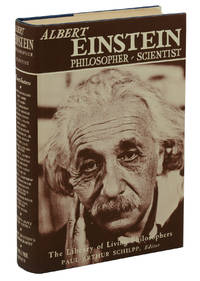
1949ref. 140941891Evanston IL: The Library of Living Philosophers Inc 1949. First Edition. Fine/Fine. First edition trade issue. xvi 781 pp. Bound in publisher's navy cloth with gilt spine lettering. Fine with offsetting to endpapers in a Fine dust jacket unfaded and unworn. A very sharp copy of a collectible volume all about the famous theoretical physicist. The Library of Living Philosophers, Inc unknown
1949ref. 140941039Evanston IL: The Library of Living Philosophers Inc 1949. First Edition. Near Fine/Very Good. First edition first printing. Bound in publisher's original dark blue cloth stamped in gilt. Near Fine with toning to pages offsetting to endsheets former owner name to front free endpaper and small sticker ghost to front paste down. In a Very Good dust jacket with fraying and chip at bottom spine end and short closed tear at head light edge wear toning and soiling to rear panel. The Library of Living Philosophers, Inc unknown
2000ref. 374007Shanghai Translation Publishing House; 1 January 2000-01-01. paperback. Used - Good. Ship out in 2 business day And Fast shipping Free Tracking number will be provided after the shipment.Paperback. Pages Number: 151 Language: Chinese. Publisher: Shanghai Translation Publishing House; 1 199 Satisfaction guaranteedor money back. Shanghai Translation Publishing House; 1 (January paperback
1979ref. N2216Braunschweig / Wiesbaden: Fiedr.Vieweg & Sohn 1979. Original Cloth with d/j. Near Fine. 8vo. XV22pp. A fine copy with fine DJ. Fiedr.Vieweg & Sohn hardcover
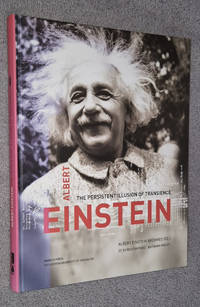
2007ref. 018809Particularly well-illustrated survey of Einstein's life and ideas through photographs and reproductions of his fascinating personal papers. 263 p. : ill. some col. ; 32 cm. Rev. and enlarged ed. Previous ed. published under the title: Albert through the looking-glass. 1998. Illustrated boards slight shelf wear to edges some fading around the spine no inscriptions tight and square binding. Photographs available on request. All books dispatched same or next working day in robust packaging. Albert Einstein Archives : Magnes Press, the Hebrew University of Jerusalem hardcover
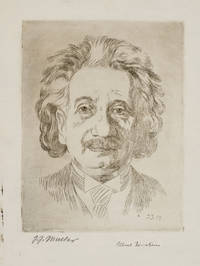
1933ref. H-217A stunning portrait etching of one of the greatest human minds signed by both the artist J J Muller and Albert Einstein. The sketch is signed in ink by Einstein and by the artist J. J. Muller in pencil n.p. 1933. Plate 195 x 150mm; sheet 253 x 200mm. A true collector's copy of a beautiful signed portrait.
ref. Juanpebooks038106WE ship worldwide. Brand new 100%guarentee unknown
1949ref. 343971949. On scientists and military work: “The majority of really good scientists in this country have withdrawn from military work…The young ones who cannot lean upon a standing of their own have generally given in to the almost irresistible pressure. One cannot expect it to be any different."" Einstein and other scientists faced the harsh reality of the product of their work after the war and the bombing of Japan; Here Einstein in a way grapples with his own role On the timeless nature of fighting for what you believe: “The truth appears foolish to the insane.Lost people are content to find themselves in agreement with the masses."" <img class=""alignnone wp-image-34606 size-post-window"" src=""https://cdn.raabcollection.com/wp-content/uploads/20251001204256/Einstein_Letter_11-1-1600x897.jpg"" alt="""" width=""1600"" height=""897"" /> Although Albert Einstein’s participation in the production of the atomic bomb was limited the public perceived his role as crucial and he was in fact the face of the project to many. The reasons were that although he did not work on the Manhattan Project the US effort to build the bomb his famous equation E=mc2 provided the theoretical basis for understanding the immense energy released in nuclear fission which is the process that powers the bomb. And his 1939 letter to President Roosevelt co-signed by Leo Szilárd alerted the US government to the potential of nuclear weapons and prompted the start of research that eventually led to the Manhattan Project. Feeding the public perceptions of his responsibility were publications like The Smyth Report a history of the development of the bomb published the day after the bombing of Nagasaki which ascribed great historical weight to Einstein’s 1939 letter to President Franklin D. Roosevelt in catalyzing the development of the bomb. In 1946 Time magazine published the famous cover featuring Einstein’s portrait backgrounded by an enormous mushroom cloud emblazoned with “E=mc2” and the accompanying article by Whittaker Chambers referred to him as “the father of the bomb” a title which resonated in the popular imagination. A March 1947 Newsweek cover featured Einstein above the headline “Godfather of the Atomic Bomb”. Einstein was hounded by the association throughout the rest of his life culminating in his November 1954 admission to Linus Pauling “I made one great mistake in my life when I signed the letter to President Roosevelt recommending that atom bombs be made….” Albert Einstein was known for his dedication to morality which he said was “of the highest importance” as well as beliefs that stemmed from morality like pacifism anti-militarism and loyalty to the facts taught by science. He viewed morality as fundamentally human and believed that ethical behavior should form a basis for both individual well-being and the collective good of humanity. Thus for Einstein the pursuit of morality was the most vital human endeavor essential for bringing beauty and dignity to life and ensuring the survival and thriving of the human race. He shared these beliefs with Dr. Herbert Jehle. Dr. Jehle was a pioneering theoretical physicist whose work spanned quantum field theory biophysics and astrophysics. He was a student and friend of Einstein in the 1920s in Germany; and a disciple and friend of Dietrich Bonhoeffer. At Princeton in 1947 he provided Richard Feynman with the spark which would lead to his path integral formulation. Einstein had left for the United States in 1933 the same year that Jehle received his doctorate from the Technische Hochschule Berlin. In the same year Dietrich Bonhoeffer Jehle's friend and mentor stepped down from his professorship at Berlin in protest of the Nazi ascent to power. In 1940 Jehle refused to assist in the German armament and atomic project and was interned in concentration camps. Escaping in 1941 with the help of Quaker and Christian relief organizations Jehle made his way to the United States where he took a position at Harvard University until leaving for Princeton in 1947. At Princeton Jehle's pacifist beliefs coincided with Einstein's own and they reconnected bonding over shared views of social responsibility and ethics in science and playing music together regularly Einstein on violin Jehle on the piano. Jehle was also the editor of the Society for Social Responsibility in Science newsletter of which Einstein was a member. Jehle additionally submitted articles to other science publications. During the 1950s Jehle collaborated with Linus Pauling on DNA research as well as advocating with Pauling for peace. In the early 1960s Jehle worked as a consultant to Marshall Nirenberg at the NIH on DNA-coding for which Nirenberg also won a Nobel Prize for in 1968. Jehle's 1949 article ""For a Universal Morality"" asserted that ""participation in war preparations posed a challenge to man's conscience under any circumstances. and urged that scientists refuse to participate in war work under any government democratic or totalitarian"" see Nathan & Norden Einstein on Peace p 514. The editor of the Bulletin Eugene Rabinowitch rejected the article in a letter to Einstein to which Einstein replied advocating Jehle's position praising Jehle for not being “deterred by taboos” and then sent this letter to Jehle. It is interesting to think how time and war had affected Einstein's thinking. Where his letter did much to advance the nuclear militarization and as a scientist he felt a need to intervene here is advocating the opposite. Autograph letter signed on paper watermarked ""Whiting Mutual Bond Rag Content""Princeton 1949 to Herbert Jehle endorsing the article by Jehle that had been submitted to the Bulletin of Atomic Scientists on the topics of science and morality and cautioning Jehle on the complications of his position in the post-war world. “I have read your article several times and find that it agrees exactly with my thinking. In accordance with your wishes I am sending your paper with my recommendation to the Bulletin of Atomic Scientists in the hope that they will publish it. “I doubt however that the effect will correspond with the good intentions of the article. The truth appears foolish to the insane. He suspects disloyal intent and revolts against the thought that the 'foreigner' considers himself a better judge of what Americans should do. There are after all few who think and feel in a supra-national manner. Lost people are content to find themselves in agreement with the masses. “The majority of really good scientists in this country have withdrawn from military work more so than it was ever the case in Germany. The young ones who cannot lean upon a standing of their own have generally given in to the almost irresistible pressure. One cannot expect it to be any different since few are born to be martyrs - if no mass movement drives them in that direction. I see the real justification of your approach in the attempt to help generate such a mass movement. “The predicament in which we are is in a certain sense timeless. The public institutions necessarily represent a rather low moral level as do the men who stand behind these institutions. The individual is at the mercy of these institutions the standards of which he must recognize to be low if he is conscientious and not completely without ideas. He is thus forced into some compromise since he sees that that kind of necessarily imperfect institution cannot be dispensed with. “If those who see the light do not stand honestly and courageously for the good the world will get deeper and deeper into the morass. In expressing my joy that you have acted in this way and continue to do so I remain with friendly greetings. Yours A. Einstein.” With: Autograph statement as a PS from Einstein in German with Jehle's autograph English translation beneath and annotations above transcribing his recommendation for Jehle which Einstein sent to the editor of the Bulletin. “I am sending you this book article. It comes from a younger physicist who is courageous enough to simply say what is evident without being deterred by taboos. I hope that his note can be published in the Bulletin.” An important letter reflecting Einstein's post-war advocacy for morality and peace and assessments of the place of scientists in the moral sphere as well as realistic observations on and understanding of world politics. We obtained this letter directly from the Jehle family. <img class=""alignnone wp-image-25018 size-post-window"" src=""https://cdn.raabcollection.com/wp-content/uploads/20231204144051/Folder-site-11-1600x1327.jpg"" alt="""" width=""1600"" height=""1327"" /> unknown
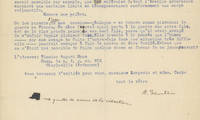
ref. 342445/11/19. A remarkable letter before his great fame referencing and shown to Marie Curie Einstein who helped free so many from the jaws of Nazism makes an impassioned plea for a World War I German POW in France who would escape but later die in the Holocaust In 1905 while a young patent clerk and physicist in Bern Switzerland Albert Einstein obtained his doctorate and published a paper that explained his newly developed Special Theory of Relativity. This unlocked many mysteries of the universe and introduced the world to the idea equating mass and the speed of light with energy which we know today as e=mc2. Einstein's insight and one element that distanced his work from that of Newton was to recognize that mc2 was the proper energy of mass the energy associated with that mass and was independent of its motion. Mass must be measured in this way as resting mass. This was a foundation of e=mc2. The breakdown of molecules therefore released energy. This energy is often used by cells to perform work such as powering movement. In the early years of the 20th century thanks to the development of mass spectrographs science had acquired the capacity to ""weigh"" atoms with extreme precision. Indeed Einstein provided the theoretical explanation for Brownian motion while French Chemist Perrin experimentally verified Einstein's theory solidifying the evidence for the existence of atoms. Scientists among them Perrin noted that when comparing the mass of a helium nuclei to that of the four elementary nuclei it was made of there was a slight discrepancy—one helium atom was slightly lighter than four hydrogen atoms; in other words the whole was smaller than the sum of the parts. Where did the missing mass go Einstein knew the answer: in accordance with his famous E=mc_ equation a tiny fraction of the mass had been transformed into a formidable quantity of energy. <img class=""alignnone wp-image-34256 size-post-window"" src=""https://cdn.raabcollection.com/wp-content/uploads/20250724151316/Einstein-Nov-1919-1-1600x709.jpg"" alt="""" width=""1600"" height=""709"" /> The French mathematician Paul Langevin understood the formidable source of energy that resulted from these ""transmutations."" But it was Jean Perrin a professor of physical chemistry in Paris who first proposed in 1919 that the fusion of hydrogen into helium was the energy source of the Sun and stars accounting for the billions of years of sunshine past and the billions of years to come. During this time radiation studies too were in their infancy. Marie Curie famously decided to do her thesis on radiation recently discovered in uranium by Henri Becquerel. She found that an ore containing uranium was far more radioactive than could be explained by its uranium content. This led her and her husband Pierre to the discovery of a new element that was 400 times more radioactive than uranium. In 1898 it was added to the Periodic Table as polonium named after Curie’s birth country. Then Curie discovered an even more radioactive element radium and through observation of radium made a fundamental discovery: Radiation wasn’t dependent on the organisation of atoms at the molecular level; something was happening inside the atom itself. The atom was not as scientists believed at the time inert indivisible or even solid. This discovery led to an overlapping one: At the time people did not know what powered the Sun. Many however thought it was Radium. Perrin was one of those who believed this. His hypothesis borrowing from E=MC2 was that radiation in the form of Radium was emanating from bodies like earth causing the breakdown of molecules on the Sun and that the breakdown was powering the Sun and other stars. In 1919 Perrin sent to Einstein his new publication proposing this theory. Einstein's response notes the breakdown of molecules and the released energy can likely be accomplished by other means than radiation. He uses the mathematical equation for the breakdown of one molecule into atoms. He references a first order reaction a chemical reaction where the rate of the reaction is directly proportional to the concentration of only one reactant. In simpler terms if you double the concentration of that reactant you double the reaction rate. A common example is radioactive decay. And he gives his best to the Madame Curie. Einstein had last met in Paris with Perrin Pierre Langevin Professor of Experimental Physics at the Collège de France and Curie then Professor of Physics at the Sorbonne on the occasion of Einstein’s lecture to the French Physical Society in late March 1913. They first met at the Solvay Congress in Brussels in autumn 1911. At the same time Einstein who helped so many Jews escape Germany during World War II had a distant cousin the geologist August Moos who had volunteered in the German infantry at the start of the First World War in 1914. After being taken prisoner in 1915 he made several attempts to escape which resulted in a sentence that prevented his release after the armistice of 1918. His mother asked for help from Einstein who turned to his friend Perrin as well as mathematician and statesman Paul Painlevé asking them to intercede. Moos was finally released in February 1920. He would work as an oil geologist in the interwar period before being tragically arrested due to his Jewish heritage under the Nazi regime. Moos would die in the Buchenwald concentration camp during World War II. Typed letter signed in French signed “A. Einstein"" November 5 1919 to Professor Jean Baptiste Perrin who would go on to win the Nobel Prize for Physics in 1926 for his work on the atomic structure of matter. ""Dear Perrin! I received your publications and thank you cordially. Your opinion of the primary importance of radiation for all chemical reactions still seems to me dubious even if it was certain which it is not that reactions of the type J_ - JJ added by hand are of the first order. It would be possible for example that J_ molecules whose internal energy exceeds a certain limit would decompose in accordance with radioactive bodies. ""One more prayer. One of the parents of one of my cousins—a geologist—is a prisoner of war in France. His widowed mother having lost her other son in the war is in the greatest pain for her only son since he had tried to flee several times. She shudders at the thought that the man—through his old efforts to flee in a very difficult situation—might try to flee again and be shot. Wouldn't it be possible to do something for this young scholar"" He goes on to give the address of August Moos held in Charleville Ardennes and concludes by offering his ""many friendships for you Mr. Langevin and Madame Curie."" Below he notes an ink spill draws an arrow and writes ""drop of editorial sweat from editing."" Perrin responded the very same day confirming that he believed rays from Earth were breaking down molecules in the sun and that he assumed the first order nature of the reaction. In other words he did not agree with Einstein that radiation was not breaking down molecules releasing energy and powering the sun. ""I do indeed believe that I2 Einstein used J but Perrin used I decomposes like radioactive bodies and I devoted a chapter of my work to this but precisely on the conviction that radioactive bodies like I2 are decomposed by light for radium ultra-short X rays emanating from the Earth at _ = 10–11 light which suddenly increases the internal energy. I read your letters to Mrs. Curie and to Langevin. They too send you their very best regards."" Perrin and In addition to this important family and political content Einstein comments on a theory that Perrin had developed in which all chemical transformations including radioactive decay are triggered by radiation calling it ""dubious."" Also significant is the date: one day before the official report of Eddington's expedition debuted before the Royal Society of London confirming Einstein's theory of general relativity. Widespread newspaper coverage of the results vaulted Einstein into immediate international fame. An altogether remarkable letter from one Nobel Prize winner to another shown to yet a third and using the chemical equation for the breakdown of molecules into atoms in his own hand. <img class=""alignnone wp-image-25018 size-post-window"" src=""https://cdn.raabcollection.com/wp-content/uploads/20231204144051/Folder-site-11-1600x1327.jpg"" alt="""" width=""1600"" height=""1327"" /> unknown
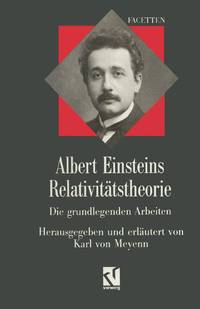
ref. ria9783528063368_inpPaperback. New. New Book; Fast Shipping from UK; Not signed; Not First Edition; Albert Einsteins grundlegende Arbeiten zur Relativitatstheorie Karl von Meyenn Unter der ungewohnlich groBen Anzahl hervorragender Gelehrter und Naturwissenschaftler die das 20. Jahrhundert in seinem Verlaufe hervor gebracht hat nimm paperback