2 986 résultats
réf. 123093Princeton NJ early December 1950. . Ten-line autograph letter with initial on cream laid paper 14 x 22.5 cm on the verso of an autograph letter by Behram Kur uno lu together with a typed letter signed by Helen Dukas on Institute for Advanced Study stationery 16.5 x 14 cm and a later letter from Dukas dated 1979; a few tiny spots excellent condition. Initialled autograph letter by Albert Einstein correcting the work of a graduate student who would become a prominent member of the theoretical physics community. Turkish physicist Behram Kur uno lu 1922-2003 studied in Edinburgh and completed his doctoral work at Cambridge under Paul Dirac during the late 1940s and early 1950s. He specialised in relativity and unified field theories participated in the discovery of two neutrinos and founded the Center for Theoretical Studies at the University of Miami. In his initial letter to Einstein written on November 24th 1950 Kur uno lu writes that he is 'enclosing you a note on the possibility of a slight modification of the unified field theory. I shall be very grateful if you can kindly read it. I hope it is not inconsistent with the ideas of the theory. I apologise for disturbing you'. Einstein replies in detail on the verso of Kur uno lu's letter returning it and the accompanying manuscript no longer together with the letter with a covering note by his secretary Helen Dukas. Einstein writes 'Equ 1 is not solved by 5 or 6. You have overlooked that not both equations. can hold. I have defined the contravariant y by the first of these equations - The non-existence of a practical solution for the T is no logical objection to the theory. The really problematic point of the theory lies in the compatibility of the equations for the T. E.' In 1952 Kur uno lu published a paper in the Physical Review 'Gravitation and Electrodynamics' in which 'Einstein's unified field theory is modified and some of the physical implications of the new theory are examined' Physical Review volume 88 number 1369 December 15th 1952. Princeton, NJ, early December 1950. unknown
1984Infeld Leopold Infeld Leopold. Albert Einstein. L' uomo, lo scienziato. La teoria della relatività e la sua influenza. Einaudi 1984.. Torino, Einaudi 1984 italiano, in sedicesimo pp. 152 13639 Infeld Leopold. Albert Einstein. L' uomo, lo scienziato. La teoria della relatività e la sua influenza. Einaudi 1984. In-16. 152 pp. Brossura. Ottimo.
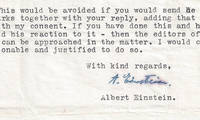
1702réf. 1536217/02/1953. In this letter from Einstein to David Bohm Einstein discusses the importance of connecting a key principle of the relatively new theory of quantum mechanics the “Born interpretation” to physical quantities that can be measured in the real world. To him it is essential that mathematical theories be connected to measurable quantities. In this letter Einstein’s uneasiness with quantum mechanics is apparent saying that validation of the seemingly random quantum mechanics “…can only be done on the basis of classical mechanics.” Without this validation quantum theory has essentially “no controllable meaning.” <img class=""alignnone wp-image-22637 size-post-window"" src=""https://cdn.raabcollection.com/wp-content/uploads/20231204163327/Einstein-born-2-e1639117238988-1600x656.jpg"" alt="""" width=""1600"" height=""656"" /> Max Born was a renowned physicist who was crucial for the development of quantum mechanics and also the Ph.D. supervisor of many important physicists including J. Robert Oppenheimer. Quantum mechanics describes the weird behavior of tiny subatomic particles. It’s also the guiding theory that led to critical technologies like nuclear power MRI machines and transistors in computers and phones. One of Born’s biggest contributions to quantum mechanics was the interpretation of the probability density which is a mathematical operation performed on the “psi-function” in Einstein’s words to predict the most probable physical quantities of a quantum particle. Einstein believed that probabilities only make sense if you can determine the values that they predict independently by measurement. This is easy to do in classical Newtonian mechanics the physics of big things in everyday life. But Einstein said we can’t measure it for something like a “bound electron” i.e. an electron in an atom. In order to interpret Born’s probability density function you need to connect the mathematics to real values. Einstein’s correspondence with Born on this subject is published and famous. To Einstein the universe is observable and measurable. When confronted with one of the principle tenets of Quantum Mechanics Einstein remarked now famously “Quantum mechanics is very imposing. But an inner voice tells me that it is not the real McCoy. The theory delivers a lot but hardly brings us closer to the secret of the Old One God. I for one am convinced that He does not throw dice.” This statement was made in one of those significant letters to Born. What he meant here is that rules of science cannot be random and in the rolling of dice we would have to accept unknown variables and therefore be unable to predict precisely via objective measurements. Therefore in Quantum Mechanics as in gambling an uncertainty of measurement exists. And to Einstein the universe is observable and measurable. He did not object to Quantum Mechanics per se; indeed he made notable contributions. But he eschewed any reliance on what was not observable and knowable. <img class=""alignnone wp-image-22634 size-post-window"" src=""https://cdn.raabcollection.com/wp-content/uploads/20231204163356/Einstein-born-5-e1639117103621-1600x616.jpg"" alt="""" width=""1600"" height=""616"" /> David Joseph Bohm was an American scientist who has been described as one of the most significant theoretical physicists of the 20th century and who contributed unorthodox ideas to quantum theory neuropsychology and the philosophy of mind. His first book Quantum Theory published in 1951 was well received by Einstein among others. But Bohm became dissatisfied with the orthodox interpretation of quantum theory he had written about in that book.Bohm’s aim was not to set out a deterministic mechanical viewpoint but to show that it was possible to attribute properties to an underlying reality in contrast to the conventional approach. He began to develop his own interpretation the De Broglie–Bohm theory also called the Pilot wave theory the predictions of which agreed perfectly with the non-deterministic quantum theory. He initially referred to his approach as a hidden variable theory. Bohm originally hoped that hidden variables could provide a local causal objective description that would resolve or eliminate many of the paradoxes of Quantum Mechanics the measurement problem and the collapse of the wavefunction. However Bell’s theorem complicates this hope as it demonstrates that there can be no local hidden variable theory that is compatible with the predictions of Quantum Mechanics. The Bohmian interpretation is causal but not local. Albert Einstein who had suggested that Bohm search for a realist alternative to the prevailing Copenhagen approach did not consider Bohm’s interpretation to be a satisfactory answer to the quantum question. The Copenhagen interpretation is an expression of the meaning of Quantum Mechanics that was largely devised in the years 1925 to 1927 by Niels Bohr and Werner Heisenberg. It remains one of the most commonly taught interpretations of Quantum Mechanics. According to the Copenhagen interpretation physical systems generally do not have definite properties prior to being measured and Quantum Mechanics can only predict the probabilities that measurements will produce certain results. The act of measurement affects the system causing the set of probabilities to reduce to only one of the possible values immediately after the measurement. In classical mechanics a particle has at every moment an exact position and an exact momentum. These values change deterministically as the particle moves according to Newton’s laws. Under the Copenhagen interpretation of Quantum Mechanics particles do not have exactly determined properties and when they are measured the result is randomly drawn from a probability distribution. The Schrödinger equation predicts what the probability distributions are but fundamentally cannot predict the exact result of each measurement. <img class=""alignnone wp-image-22633 size-post-window"" src=""https://cdn.raabcollection.com/wp-content/uploads/20231204163406/Einstein-born-e1639117155596-1600x360.jpg"" alt="""" width=""1600"" height=""360"" /> Typed letter signed on his blind embossed letterhead February 17 1953 Professor Bohm. “Dear Bohm: I thank you very much for the prompt reaction to my little article. I did of course not expect that you would agree with me. For scarcely anyone is inclined to abandon an enterprise in which le has invested a great deal of work. “I do not want to answer your letter in detail although it deserves it very much. Only a short remark concerning the interpretation of Born’s standpoint: “According to Born the physical meaning of the psi-function follows: it determines probabilities f.i. for the value of impulses. this makes sense only if the impulse is defined independently of the mathematical theory by some feasible measurement. This can only be done on the basis of classical mechanics. F.i. if one has calculated the impulse of a bound electron on the basis of a psi-function then this result has no controllable meaning. For there is no possibility to measure such a thing not even approximately. However if one has to do with a makro-object which is at least temporarily approximately free then one is able to determine experimentally at least approximately its impulsef.i. through two successive snapshots or through radar. If it is at all possible to attribute meaning to Born’s interpretation then the impulse the probability of which appears in the theory has to be put equal to the impulse thus measured. Classical approxi_mate measurement of the impulse is however in my example very well feasible without first removing the walls and then waiting some time. Born’s probability therefore has to be interpreted as relative to the impulse thus measured if this probability is to have any meaning at all. “The vanishing of position-probability for the nodes offers no difficulty though it is true that this fact excludes the interpretation of the process as a motion in the strict sense of the word. For the factual process will only approximately be describable as a motion as f.i. the action of a gas upon a small part of the wall is describable only approximately by the concept of pressure. “With regard to the publication of your remarks in the Born volume I have some scruples the reason for which you will readily understand. I have sent a copy of my article to you but not to de Broglie because this would have seemed to me somewhat pretentious. If therefore your answer would be published together with my remarks without de Broglie having had the possibility to do the same he might feel it as an unkindness from my side. “This would be avoided if you would send De Broglie my remarks together with your reply adding that you do this with my consent. If you have done this and have received his reaction to it – then the editors of the Born volume can be approached in the matter. I would consider it as reasonable and justified to do so.” <img class=""alignnone wp-image-22636 size-post-window"" src=""https://cdn.raabcollection.com/wp-content/uploads/20231204163341/Einstein-born-3-1-e1639117201589-1600x672.jpg"" alt="""" width=""1600"" height=""672"" /> This is a remarkably detailed scientific letter mentioning numerous significant physicists containing a hand-drawn symbol and directly relating to his important theories. It is also in a sense his defense of his own work including relativity. unknown books
1702réf. 1536217/02/1953. In this letter from Einstein to David Bohm Einstein discusses the importance of connecting a key principle of the relatively new theory of quantum mechanics the “Born interpretation” to physical quantities that can be measured in the real world. To him it is essential that mathematical theories be connected to measurable quantities. In this letter Einstein’s uneasiness with quantum mechanics is apparent saying that validation of the seemingly random quantum mechanics “…can only be done on the basis of classical mechanics.” Without this validation quantum theory has essentially “no controllable meaning.” <img class=""alignnone wp-image-22637 size-post-window"" src=""https://cdn.raabcollection.com/wp-content/uploads/20231204163327/Einstein-born-2-e1639117238988-1600x656.jpg"" alt="""" width=""1600"" height=""656"" /> Max Born was a renowned physicist who was crucial for the development of quantum mechanics and also the Ph.D. supervisor of many important physicists including J. Robert Oppenheimer. Quantum mechanics describes the weird behavior of tiny subatomic particles. It’s also the guiding theory that led to critical technologies like nuclear power MRI machines and transistors in computers and phones. One of Born’s biggest contributions to quantum mechanics was the interpretation of the probability density which is a mathematical operation performed on the “psi-function” in Einstein’s words to predict the most probable physical quantities of a quantum particle. Einstein believed that probabilities only make sense if you can determine the values that they predict independently by measurement. This is easy to do in classical Newtonian mechanics the physics of big things in everyday life. But Einstein said we can’t measure it for something like a “bound electron” i.e. an electron in an atom. In order to interpret Born’s probability density function you need to connect the mathematics to real values. Einstein’s correspondence with Born on this subject is published and famous. To Einstein the universe is observable and measurable. When confronted with one of the principle tenets of Quantum Mechanics Einstein remarked now famously “Quantum mechanics is very imposing. But an inner voice tells me that it is not the real McCoy. The theory delivers a lot but hardly brings us closer to the secret of the Old One God. I for one am convinced that He does not throw dice.” This statement was made in one of those significant letters to Born. What he meant here is that rules of science cannot be random and in the rolling of dice we would have to accept unknown variables and therefore be unable to predict precisely via objective measurements. Therefore in Quantum Mechanics as in gambling an uncertainty of measurement exists. And to Einstein the universe is observable and measurable. He did not object to Quantum Mechanics per se; indeed he made notable contributions. But he eschewed any reliance on what was not observable and knowable. <img class=""alignnone wp-image-22634 size-post-window"" src=""https://cdn.raabcollection.com/wp-content/uploads/20231204163356/Einstein-born-5-e1639117103621-1600x616.jpg"" alt="""" width=""1600"" height=""616"" /> David Joseph Bohm was an American scientist who has been described as one of the most significant theoretical physicists of the 20th century and who contributed unorthodox ideas to quantum theory neuropsychology and the philosophy of mind. His first book Quantum Theory published in 1951 was well received by Einstein among others. But Bohm became dissatisfied with the orthodox interpretation of quantum theory he had written about in that book.Bohm’s aim was not to set out a deterministic mechanical viewpoint but to show that it was possible to attribute properties to an underlying reality in contrast to the conventional approach. He began to develop his own interpretation the De Broglie–Bohm theory also called the Pilot wave theory the predictions of which agreed perfectly with the non-deterministic quantum theory. He initially referred to his approach as a hidden variable theory. Bohm originally hoped that hidden variables could provide a local causal objective description that would resolve or eliminate many of the paradoxes of Quantum Mechanics the measurement problem and the collapse of the wavefunction. However Bell’s theorem complicates this hope as it demonstrates that there can be no local hidden variable theory that is compatible with the predictions of Quantum Mechanics. The Bohmian interpretation is causal but not local. Albert Einstein who had suggested that Bohm search for a realist alternative to the prevailing Copenhagen approach did not consider Bohm’s interpretation to be a satisfactory answer to the quantum question. The Copenhagen interpretation is an expression of the meaning of Quantum Mechanics that was largely devised in the years 1925 to 1927 by Niels Bohr and Werner Heisenberg. It remains one of the most commonly taught interpretations of Quantum Mechanics. According to the Copenhagen interpretation physical systems generally do not have definite properties prior to being measured and Quantum Mechanics can only predict the probabilities that measurements will produce certain results. The act of measurement affects the system causing the set of probabilities to reduce to only one of the possible values immediately after the measurement. In classical mechanics a particle has at every moment an exact position and an exact momentum. These values change deterministically as the particle moves according to Newton’s laws. Under the Copenhagen interpretation of Quantum Mechanics particles do not have exactly determined properties and when they are measured the result is randomly drawn from a probability distribution. The Schrödinger equation predicts what the probability distributions are but fundamentally cannot predict the exact result of each measurement. <img class=""alignnone wp-image-22633 size-post-window"" src=""https://cdn.raabcollection.com/wp-content/uploads/20231204163406/Einstein-born-e1639117155596-1600x360.jpg"" alt="""" width=""1600"" height=""360"" /> Typed letter signed on his blind embossed letterhead February 17 1953 Professor Bohm. “Dear Bohm: I thank you very much for the prompt reaction to my little article. I did of course not expect that you would agree with me. For scarcely anyone is inclined to abandon an enterprise in which le has invested a great deal of work. “I do not want to answer your letter in detail although it deserves it very much. Only a short remark concerning the interpretation of Born’s standpoint: “According to Born the physical meaning of the psi-function follows: it determines probabilities f.i. for the value of impulses. this makes sense only if the impulse is defined independently of the mathematical theory by some feasible measurement. This can only be done on the basis of classical mechanics. F.i. if one has calculated the impulse of a bound electron on the basis of a psi-function then this result has no controllable meaning. For there is no possibility to measure such a thing not even approximately. However if one has to do with a makro-object which is at least temporarily approximately free then one is able to determine experimentally at least approximately its impulsef.i. through two successive snapshots or through radar. If it is at all possible to attribute meaning to Born’s interpretation then the impulse the probability of which appears in the theory has to be put equal to the impulse thus measured. Classical approxi_mate measurement of the impulse is however in my example very well feasible without first removing the walls and then waiting some time. Born’s probability therefore has to be interpreted as relative to the impulse thus measured if this probability is to have any meaning at all. “The vanishing of position-probability for the nodes offers no difficulty though it is true that this fact excludes the interpretation of the process as a motion in the strict sense of the word. For the factual process will only approximately be describable as a motion as f.i. the action of a gas upon a small part of the wall is describable only approximately by the concept of pressure. “With regard to the publication of your remarks in the Born volume I have some scruples the reason for which you will readily understand. I have sent a copy of my article to you but not to de Broglie because this would have seemed to me somewhat pretentious. If therefore your answer would be published together with my remarks without de Broglie having had the possibility to do the same he might feel it as an unkindness from my side. “This would be avoided if you would send De Broglie my remarks together with your reply adding that you do this with my consent. If you have done this and have received his reaction to it – then the editors of the Born volume can be approached in the matter. I would consider it as reasonable and justified to do so.” <img class=""alignnone wp-image-22636 size-post-window"" src=""https://cdn.raabcollection.com/wp-content/uploads/20231204163341/Einstein-born-3-1-e1639117201589-1600x672.jpg"" alt="""" width=""1600"" height=""672"" /> This is a remarkably detailed scientific letter mentioning numerous significant physicists containing a hand-drawn symbol and directly relating to his important theories. It is also in a sense his defense of his own work including relativity. unknown
1977réf. 18100501n.p.: Margaret Shepherd 1977. Limited Edition. No binding. Fine. One of 200 copies broadside inscribed by Margaret Shepherd. Margaret Shepherd is a prominent artist and teacher of calligraphy with a career spanning forty-five years; Shepherd has published numerous books about the history of calligraphy and correspondence as well as instructional books on the art form itself and has taught classes and workshops at the Rhode Island School of Design and Stanford University among others n. b. from the website of Margaret Shepherd. This broadside features her elegant lettering with the large "T" foil-stamped the text printed by photo-offset depicting a quote from Albert Einstein; per the artist about 200 were printed and were used as gifts and professional examples with "a few sold occasionally". ___DESCRIPTION: Broadside with photo-offset printed red and black calligraphy with a large initial "T" decorated wtih an acorn and oak leaf embossed and foil stamped in gilt bottom edge uncut; 15.5" by 11.5" one of 200 copies unnumbered inscribed in pencil "for Ruth Shelby" dated 2011 by Margaret Shepherd. ___CONDITION: Fine clean with bright colours without wear. ___POSTAGE: International customers please note that additional postage may apply as the standard does not always cover costs; please inquire for details. ___Swan's Fine Books is pleased to be a member of the ABAA ILAB and IOBA and we stand behind every book we sell. Please contact us with any questions you may have we are here to help. Margaret Shepherd unknown books
1977réf. 18100501n.p.: Margaret Shepherd 1977. Limited Edition. No binding. Fine. One of 200 copies broadside inscribed by Margaret Shepherd. Margaret Shepherd is a prominent artist and teacher of calligraphy with a career spanning forty-five years; Shepherd has published numerous books about the history of calligraphy and correspondence as well as instructional books on the art form itself and has taught classes and workshops at the Rhode Island School of Design and Stanford University among others n. b. from the website of Margaret Shepherd. This broadside features her elegant lettering with the large "T" foil-stamped the text printed by photo-offset depicting a quote from Albert Einstein; per the artist about 200 were printed and were used as gifts and professional examples with "a few sold occasionally". ___DESCRIPTION: Broadside with photo-offset printed red and black calligraphy with a large initial "T" decorated wtih an acorn and oak leaf embossed and foil stamped in gilt bottom edge uncut; 15.5" by 11.5" one of 200 copies unnumbered inscribed in pencil "for Ruth Shelby" dated 2011 by Margaret Shepherd. ___CONDITION: Fine clean with bright colours without wear. ___POSTAGE: International customers please note that additional postage may apply as the standard does not always cover costs; please inquire for details. ___Swan's Fine Books is pleased to be a member of the ABAA ILAB and IOBA and we stand behind every book we sell. Please contact us with any questions you may have we are here to help. Margaret Shepherd unknown
réf. 22407Berlin, VEB Deutscher Verlag der Wissenschaften. 4°, 44 S., 44 S., 44 S., durchgehend s/w u. farb. Ill., Bezahlung per PayPal möglich, we accept PayPal, min. Gebr.sp., Pappband, gebunden
2008"RAFFAELLO CORTINA 2008 LIEVI SEGNI DEL TEMPO, VOLUME INTONSO, MAI SFOGLIATO. Ne parlano tutti ma nessuno l’ha mai visto: il tempo è un mistero la cui natura profonda resta ancora oscura. Ci hanno provato e sono stati sconfitti fisici e filosofi, biologi e teologi. Il tempo che noi percepiamo, che lascia il segno sul nostro viso, è lo stesso di quello degli scienziati? Ha avuto un inizio? E ha davvero una direzione? I teorici hanno provato a invertirlo. Ma, riflettendo sulla sua disperante irreversibilità, Étienne Klein ci avverte che il tempo è quell’affascinante entità nella quale non possiamo spostarci a nostro piacimento. L'autore Étienne Klein, professore di Fisica all’École Centrale, ha creato e dirige il Commissariato per l’energia atomica di Parigi. Nella collana “Scienza e idee” ha pubblicato Sette volte la rivoluzione (2006).
1990Mm 105x180 Brossura editoriale di pp. 113, collana Ritmi, 34, in stato di nuovo. SPEDIZIONE IN 24 ORE DALLA CONFERMA DELL'ORDINE.
1914In 16, leg. in tela, pp. 123, 141 ill. in b/n n.t., 1 ill. a colori in antiporta. Ottime condizioni.Il volumetto, molto raro, diviso in VIII lezioni che forniscono spiegazioni riguardo la propagazione del suono, della luce, la refrazione delle luce nelle lenti, i colori e la fotografia. Il lavoro opera del prof. Temistocle Calzecchi, fisico e inventore. I suoi studi sulle onde elettromagnetiche gli permisero di inventare il coesore, strumento fondamentale per lo sviluppo della radio.Luogo di pubblicazione MilanoEditore Federazione Italiana delle Biblioteche PopolariAnno pubblicazione 1914Collana Serie A corsi organici d'insegnamentoMateria/Argomento Fisica, Einstein
1959In-8 (cm. 20.50), tela editoriale, pp. (8), 219. Traduzione di Luigi A. Radicati di Bròzolo. In buono stato di conservazione (good copy).
1999GARZANTI 1999 FONDO DI MAGAZZINO: SEGNI DEL TEMPO, VOLUME INTONSO. ASSOLUTAMENTE INTROVABILE.. «La civiltà tecnica è la conquista dello spazio da parte dell'uomo. È un trionfo al quale spesso si perviene sacrificando un elemento essenziale dell'esistenza, cioè il tempo. Nella civiltà tecnica, noi consumiamo il tempo per guadagnare spazio. Tuttavia, avere di più non significa essere di più. Il potere che noi conseguiamo sullo spazio termina bruscamente alla linea di confine del tempo: e il tempo è il cuore dell'esistenza.» Che cosa è il giorno festivo delle grandi tradizioni religiose? Che cosa è il sabato? Qual è il suo rapporto con «la sorgente del tempo», con «l'eterno che è nel tempo»? Sono questi i temi che Heschel affronta con straordinaria competenza teologica, filosofica e letteraria. Ma Il sabato non è solo un saggio di grande cultura, ricchissimo di informazioni e notizie: è in primo luogo una meditazione offerta a tutti i lettori, credenti e non, sul giorno di festa e sul suo significato profondo, un invito a rispondere alle nevrosi della civiltà moderna ricominciando ad ascoltare il richiamo del trascendente.
2016br. Tra la fine dell'Ottocento e l'inizio del Novecento, i più importanti fisici del pianeta stanno cercando di trovare risposta ad alcune anomalie che riguardano la velocità della luce, la trasformazione e generazione della luce, l'esistenza dell'etere e delle molecole. Lo sforzo di scienziati come Hendrik Lorentz, Ludwig Boltzmann, Max Planck è orientato a ultimare la faticosa costruzione di una fisica che, di lì a pochi anni, sarà chiamata classica. Sono fisici maturi e preparati che dovranno affrontare la sfida di un giovane ribelle che non ebbe paura di criticare un apparato intellettuale formidabile che sembrava a un passo dal suo perfezionamento. Albert Einstein, considerato l'ultimo dei fisici classici, riesce a percepire le contraddizioni della scienza del suo tempo, ad affrontarle con semplicità, ma rifuggendo ogni soluzione che fosse parziale, particolare o di comodo. La sua ricerca, anche quando affronta problemi specifici come quello della luce, è animata da una visione unitaria del mondo fisico che lo collega direttamente a Galileo Galilei. In questo libro si racconta come, nell'arco di oltre vent'anni, Einstein e i suoi contemporanei abbiano trovato nel tema dell'interazione tra radiazione e materia la chiave che ha condotto alla fisica dei quanti.
2021br. La storia inedita del pianoforte regalato da Einstein alla sorella Maja nel 1931 sullo sfondo dell'Italia fascista. Se gli oggetti potessero parlare, quante storie potrebbero raccontare: le storie delle persone a cui sono appartenuti, ma anche le storie dei tempi da loro attraversati. Quella del pianoforte di Einstein, passato nelle mani del pittore Hans Joachim Staude e ora conservato all'Osservatorio astrofisico di Arcetri, narra una vicenda costellata di avvenimenti a volte meravigliosi, a volte tragici, mai banali. Un'avventura vissuta a fianco delle vite di molte donne e uomini che hanno dovuto confrontarsi con sfide quotidiane ed epocali, quasi sempre accompagnati da un filo conduttore, la musica, che ha legato le loro esistenze, nel decennio in cui furono promulgate le leggi razziali. Il libro ricostruisce, attraverso fonti e immagini, il rapporto tra Einstein e l'Italia e soprattutto Firenze, percorrendo la storia d'Italia nel periodo del fascismo tra musica, arte e cultura, ma anche la questione ebraica, la guerra, l'emigrazione negli Stati Uniti.
2021Ciardi Marco-Gasperini Antonella Il pianoforte di Einstein : vite e storie in bilico tra Firenze, Europa e America. Milano, Hoepli 2021 italian, 264 SC226B Brossura editoriale, volume come nuovo, copertina e interno in condizioni eccellenti, legatura salda 264 pagine circaCopertina come da foto
1958EDIZIONI DI COMUNITà 1958 2 VOLUMI (1FILOSOFIA EPISTEMOLOGIA LOGICA, 340 PP.; 2 SCIENZE SOCIALI 390 PP.), SCRITTI DI GILLO DORFLES SAFFIRIO SARTORI CANESTRARI MARZI GRIZIOTTI BARBANO VISALBERGHI ETC. SEGNI DEL TEMPO, FIORITURE AI TAGLI, QUALCHE STRAPPETTO ALLA SOVRACOPERTA, RARISSIMI (NELL'ORDINE DI 5 O 6) SEGNI A BIRO, PER IL RESTO QUASI PERFETTI, CONSIDERATI GLI OLTRE 50 ANNI DEI VOLUMI.
2010Milano, RCS Quotidiani, 2010, 8vo brossura editoriale, pp. 11 (I classici del pensiero libero, 11; supplemento a Sette Corriere della Sera) .
2014Mm 140x205 "La Biblioteca delle Scienze" - Brossura editoriale di 216 pagine con figure in nero nel testo. Opera in ottime condizioni, mai letta. SPEDIZIONE IN 24 ORE DALLA CONFERMA DELL'ORDINE.
2008Mm 120x195 Edizione allegata a Focus - Brossura editoriale con bandelle, 113 pagine. Edizione a cura di Helen Dukas e Banesh Hoffmann, prefazione di Claudio Bartocci. Opera in condizioni pari al nuovo. SPEDIZIONE IN 24 ORE DALLA CONFERMA DELL'ORDINE.
1990MONDADORI 1990 SEGNI DEL TEMPO ALLA SOVRCCOPERTA, VOLUME INTONSO, IN ECCELLENTISSIME CONDIZIONI.
2016br. Genio indiscusso, appassionato pacifista, eclettico rivoluzionario delle scienze, Albert Einstein ha sovvertito il nostro modo di concepire l'universo. Michio Kaku ripercorre in questo libro le tappe principali che hanno portato alla nascita, al completamento e alla pubblicazione della teoria della relatività, uno dei capisaldi della cultura del Novecento, capace di estendere la sua influenza ben oltre i confini della fisica. Gli aneddoti sulla vita privata di Einstein e sul rapporto con i colleghi si alternano al racconto delle sue straordinarie scoperte scientifiche; un continuo dialogo tra storia pubblica e cronaca privata.
2017br. Nella scienza i capolavori sono rari come nelle arti. Per essere tali, in loro la perfezione deve uguagliare la dirompenza. Perché rivoluzionano il mondo, alla lettera. John Gribbin non esita a spendere la parola "capolavoro" per la teoria generale della relatività, che lo stesso Albert Einstein definì "la scoperta più preziosa della mia vita... una teoria di incomparabile bellezza". Quando la elaborò nella forma che conosciamo era trascorso un decennio dal 1905, ritenuto concordemente dagli studiosi il suo annus mirabilis: pochi mesi leggendari durante i quali, in un impeto di creatività scientifica che non si era più registrato dai tempi di Newton, aveva concepito anche la teoria ristretta della relatività e scoperto la legge dell'effetto fotoelettrico, che gli avrebbe poi valso il premio Nobel nel 1921. Gribbin tuttavia rivede l'opinione comune, posticipando il vero miracolo dal 1905 al 1915, quindi alla generalizzazione della teoria, questa sì in sconvolgente anticipo sui tempi della ricerca. L'estensione della relatività dagli oggetti che si muovono a velocità costante in linea retta al moto accelerato e alla gravità compie il prodigio di descrivere il nostro Universo e tutto lo spaziotempo che contiene. Nel secolo trascorso da allora, ciò che suscitò sconcerto si è via via consolidato, soprattutto durante gli ultimi cinquant'anni, come una delle teorie più comprovate dell'intera storia della scienza.
1965In-8 (cm. 21.90), cartonato editoriale, sovracoperta editoriale illustrata, pp. 349, (3). A cura di Carl Seelig. Traduzione di Franco Fortini. Consulenza di Camillo Losurdo. Macchie di polvere e minime mancanze alla sovracoperta; macchie, sempre di polvere, al taglio superiore; peraltro, testo in buono stato (text in good condition).
(Einstein) Einstein Albert. Idee e opinioni. Milano, 1957. 8°, leg. edit. t.t.; pp. 346 con una tav. f.t.
2010réf. 102564London:: Folio Society. Fine. 2010. Hardcover. Introduction by David Bodanis. First edition thus. Fine in a fine slipcase. ; 370 pages . Folio Society, hardcover books