Schwartz Joseph; McGuinness MichaelMareMagnum

2 976 résultats
2009ill., br. La descrizione della Germania scientificamente e industrialmente avanzata del XIX secolo introduce, in modo spiritoso e divertente, all'infanzia di Einstein, al suo rapporto conflittuale con la scuola, al rifiuto del militarismo imperante, ai suoi legami con giovani studiosi e rivoluzionari fino all'entusiasmo per la fisica e alle prime, originali intuizioni della teoria della relatività. I continui ma semplici richiami a matematici e filosofi dell'antichità, dai babilonesi agli etruschi, da Galileo a Newton, aiutano il lettore a familiarizzare con i complessi rapporti tra spazio, tempo e velocità, e a comprendere uno dei più grandi geni della storia dell'umanità. "Se la relatività si dimostrerà corretta, i tedeschi mi considereranno tedesco, gli svizzeri diranno che sono cittadino elvetico e i francesi mi definiranno un grande scienziato. Se si dimostrerà errata, i francesi diranno che sono svizzero, gli svizzeri che sono tedesco e i tedeschi che sono ebreo." Albert Einstein
1982réf. V33028Reinbek (Rowohlt Taschenbuch Verlag) 1982 (= rororo sachbuch 7215, Erste Ausgabe). 8°, Originalbroschur ( Paperback) 166 S., ISBN 3 499 17215 1 1
1913réf. 50339Leipzig: Johann Ambrosius Barth 1913. Einstein Albert 1879-1955. Einige argumente fur die annahme einer molekularen agitaation beim absoluten nullpunkt. In Annalen der Physik 40 pp.551-560. With: Otto Stern 1888-1969. Red cloth with gilt lettering on the spine. Whole volume: 1056 pp. 1 plate. 210 x 130 mm. A very good copy. "Some arguments for the assumption of molecular agitation at absolute zero." In this paper Einstein and Stern show that the quantum theory of solids to give the best agreement with experiments at normal temperatures seems to demand that at absolute zero a residual energy would remain in the solids which they term "zero-point energy." They thus introduced this important concept to physics." p. 292. Calaprice Kennefick & Shulmann. An Einstein Encyclopedia. 2015. Otto Stern was a German-American physicist and Nobel Laureate in Physics. He was the second most nominated person for a Nobel Prize with 82 nominations in the years 1925-1945 ultimately winning in 1943 "for his contribution to the development of the molecular rat method and his discovery of the magnetic moment of the proton". In 1912 Stern did his doctoral dissertation in concentrated solutions. After receiving his Ph.D. degree Stern took advantage of his economic independence to join Albert Einstein at Prague. Stern was with Einstein from the spring of 1912 until 1914. Weil's Bibliography no. 53. . Johann Ambrosius Barth unknown
1913réf. 003231Leipzig: J. A. Barth 1913. Contemporary three-quarter cloth marbled boards. Minor abrasions on front cover. . First Edition. Very Good. J. A. Barth hardcover
1913réf. 38832Berlin J.A. Barth 1913. Later full cloth. "Annalen der Physik. Vierte Folge. Band 40. Hrsg. von W. Wien und M. Planck." VIII1056 pp. 1 plate. Einstein paper: pp. 551-60. Internally fine and clean. The whole volume offered. First edition. In this paper "Some arguments for the existance of a molecular agitation at the absolute zero point" Einstein derives Planck's radiation law without the usual discontinuity assumptions.The volume contains also papers by W. Pauli Stark Nordström and others. - Weil No 53. hardcover
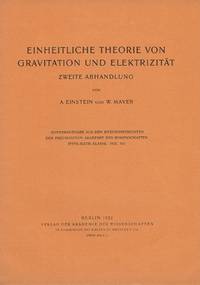
1931réf. 37425Berlin: Akad. Wiss 1931. Einstein Albert 1879-1955 and Walther Mayer 1887-1948. 1 Einheitliche Theorie von Gravitation und Electrizität. Offprint from Sitzungsberichten der preussischen Akademie der Wissenschaften 1931. 19pp. 2 Einheitliche Theorie von Gravitation und Elektrizität. Zweite Abhandlung. Offprint from Sitzungsberichten der preussischen Akademie der Wissenschaften 1932. 10pp. Together 2 offprints. 258 x 185 mm. Original printed wrappers no. 1 lightly creased vertically. Fine copies. First Editions Offprint Issues. Einstein made several attempts at a five-dimensional unified field theory including this two-part collaboration with mathematician Walther Mayer "in which a new unified field theory was proposed one based on a four-dimensional space-time continuum with a five-dimensional tangent space attached at each point" Pais Subtle is the Lord p. 492. This two-part paper is included on Shields's list of Einstein's most significant papers; see Albert Einstein Philosopher-Scientist 1949 p. 758. Shields 251; 261. Weil 182; 185. . Akad. Wiss unknown books
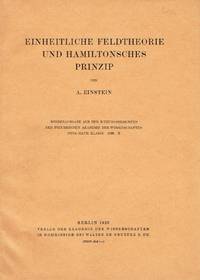
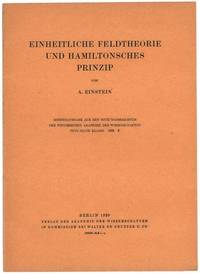
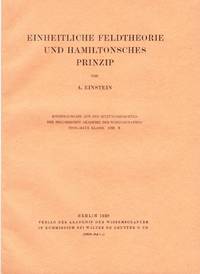
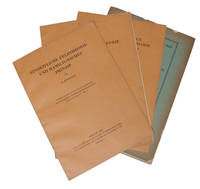
1929réf. 5740KBerlin: Verlag der Akademie der Wissenschaften in commission at Georg Reimer Reichsdruckerei 23th April 1929. Near Fine. Imperial 8vo 25 4: 18 2 cm. 6 pages. Letterpress on machine paper in original publisher’s brochure on orange stock with black title printing. First offprint in the original wrappers and new pagination of this late paper by Einstein about Hamilton's principle of stationery applied for the Unified Field Theory. - Content: Einstein already had succesfully used Hamiltion's achievements in the field of classical mechanics for his General Theory of Relativity in 1926. - Condition: Mint. - Reference: Schilpp-Shields 227; Weil 166 quotes the pagination of the first separate printing p. 156-159. Verlag der Akademie der Wissenschaften (in commission at Georg Reimer [Reichsdruckerei]) unknown
1931réf. 5745KBerlin: Verlag der Akademie der Wissenschaften in commission at Georg Reimer Reichsdruckerei 2nd December 1931; 30th April 1932. Near Fine. Imperial 8vo 25 4: 18 2 cm. 19 1 pages; 12 pages numbered 235-245 1. Letterpress on machine paper in original publisher’s brochures on salmon-coloured and orange stock with black title printing. First offprints in the original wrappers and new pagination of this important two-part paper by Einstein formulating new developments towards Unified Field Theories. - Content: Einstein made several attempts at a five-dimensional unified field theory including this two-part collaboration with Austrian mathematician Walther Mayer nicknamed „Einstein's calculator“ ""in which a new unified field theory was proposed one based on a four-dimensional space-time continuum with a five-dimensional tangent space attached at each point"" Pais Subtle is the Lord p. 492. - Condition: Very well preserved. - Reference: Boni-Russ-L. 207; Printing and the Mind of Man 416 „Principal Work“; Schilpp-Shields 251 and 261; Weil 182 and 185 quotes the paginations of the first separate printings p. 541-557 and 130-137. Verlag der Akademie der Wissenschaften (in commission at Georg Reimer [Reichsdruckerei]) unknown
1928réf. 270911928. S.Ber. Akad. Wiss. Berl. 1928/10. - Berlin Verlag der Akademie der Wissenschaften 1929 8° 6 S. orig. Broschur. First Edition; the rare off-print from the "Sitzungsberichte". Weil No.166; Schilpp-Shields No. 227; Alicke No. 143. unknown
1929réf. 6551Berlin: Verlag der Akademie der Wissenschaften in Kommision bei Walter de Gruyter U. Co 1929. First separate edition. Fine. 6 pages in printed wraps. Not exactly an "offprint" since the pages are numbered from 1 and the pamphlet is given its own title page this is considered the first separate edition of a paper Einstein published in the periodical of the Prussian Academy. It is considered Einstein's initial effort having established general and special relativity to find a unified theory uniting gravity and electromagnetism a problem he struggled with for his remaining life. Verlag der Akademie der Wissenschaften in Kommision bei Walter de Gruyter U. Co paperback
1925réf. 59960Berlin Königlich Akademie der Wissenschaften 1925-1929. 1. Einheitliche Feldtheorie von Gravitation und Elektrizität. 1925 pp. 414-419. Uncut unopened n the original printed wrappers. missing small parts of spine and upper part of front wrapper detached otherwise fine. Weil 147 / Boni 155.2. Neue Möglichkeit für eine einheitliche Feldtheorie von Gravitation und Elektrizität. Offprint: S. B. preuss. Akad. Wiss. 1928 pp.235-245. In the original yellow wrappers. Very fine and clean. Weil 162/ Boni 175.3. Zur einheitlichen Feldtheorie. Offprint: S. B. preuss. Akad. Wiss. 1929 pp.2-7. In the original yellow wrappers. Very fine and clean. Weil 165/ Boni 183.4. Einheitliche Feldtheorie und Hamiltonsches Prinzip. Offprint: S. B. preuss. Akad. Wiss. 1929 pp.156-159. In the original yellow wrappers. Very fine and clean. Weil 166/ Boni 184. Fine collection three in offprint and one in the original printed wrappers of the four papers that together constitute Einstein's attempt towards creating a unified field theory: "a new theory of space with a view to unification of all forms of activity that fall within the sphere of physics giving them a common explanation" PMM416. The task of unifying nuclear electromagnetic and gravitational force is nowadays by many considered the holy grail of theoretical physics.Maxwell was the first to develop such a theory when he described the forces of electricity and magnetism as the single force electromagnetism. After Einstein had completed his general theory of relativity a field theory for gravitation he turned his attention towards generalizing his theory even further to include Maxwell's theory. Even though Einstein never succeeded in completing this task in the way that he finished his earlier theories he pioneered and explored many areas of this subject."It had been repeatedly observed that Einstein's general theory of relativity necessitated a pluralistic explanation of the universe. In 1925 he announced that he had resolved this difficulty but the announcement was premature. In 1928 he attacked the problem once more only to find that Riemann's conception of space on which the general theory was based would not permit of a common explanation of electromagnetic and gravitational phenomena. In a series of papers the present devoted to the development of 'A Uniform Theory of Gravitation and Electricity' he outlined a new theory of space with a view to unification of all forms of activity that fall within the sphere of physics giving them a common explanation. All that would then remain to complete a scientific unison is the correlation of the organic and inorganic".PMM 416Barchas 586Weil 147 162 165 & 166. unknown
1929réf. 28364Berlin Gruyter & Co. 1929. 4to. Orig. printed orange wrappers. Offprint/Sonderausgabe aus Sitzungsberichten.pp. 1-6. Fine fresh copy. First edition in the rare Offprint now called "Sonderausgabe" instead of "Sonderabdruck" having separate printed title and separate pagination. See Weil: 166 where this is not mentioned.The early Offprints from "Sitzungsberichten." are called "Sonderabdruck" up to Weil No.165 including this. From Weil 166 they are called "Sonderausgabe.". - Before 161 up to 160 the Offprints do not have separate title and pagination the pagination follows the numbering in the periodical. From 166 the Offprint has both separate printed title and pagination. - So Weil Nos 161-165 is still "Abdruck" but with separate title and pagination. These facts are not mentioned in the bibliographies.Weil No. 166. unknown
1931réf. 28370Berlin Gruyter & Co. 1931. 4to. Orig. printed orange wrapper. Offprint/Sonderausgabe aus Sitzungsberichten.pp. 1-19. Fine fresh copy. First edition in the rare Offprint with separate printed title and separate pagination. Se Weil No. 182 where this is not mentioned. Weil No. 182 with an asterix denoting a major work.The early Offprints from "Sitzungsberichten." are called "Sonderabdruck" up to Weil No.165 including this. From Weil 166 they are called "Sonderausgabe.". - Before 161 up to 160 the Offprints do not have separate title and pagination the pagination follows the numbering in the periodical. From 166 the Offprint has both separate printed title and pagination. - So Weil Nos 161-165 is still "Abdruck" but with separate title and pagination. These facts are not mentioned in the bibliographies. unknown
1925réf. 52559Berlin Königlich Akademie der Wissenschaften 1925-1929. 1. Einheitliche Feldtheorie von Gravitation und Elektrizität. Offprint: S. B. preuss. Akad. Wiss. 1925 pp.414-419. Original wrappers. Mint. Weil 147 / Boni 155.2. Neue Möglichkeit für eine einheitliche Feldtheorie von Gravitation und Elektrizität. Offprint: S. B. preuss. Akad. Wiss. 1928 pp.235-245. Original wrappers. Mint. Weil 162/ Boni 175.3. Zur einheitlichen Feldtheorie. Offprint: S. B. preuss. Akad. Wiss. 1929 pp.2-7. Original wrappers. Mint. Weil 165/ Boni 183.4. Einheitliche Feldtheorie und Hamiltonsches Prinzip. Offprint: S. B. preuss. Akad. Wiss. 1929 pp.156-159. Original wrappers. Mint. Weil 166/ Boni 184.5. Über den gegenwärtigen Stand der Feldtheorie. In: Festschrift Dr. A. Stodola Zürich Füssli 1929 pp.126-132. Publishers full cloth. Spine slightly faded. Otherwise mint. Weil 168 / Boni 178.All in all a very fine set. Offprint of all four papers and first edition of the final essay constituting Einstein's attempt toward creating a unified field theory: "a new theory of space with a view to unification of all forms of activity that fall within the sphere of physics giving them a common explanation" PMM416. The task of unifying nuclear electromagnetic and gravitational force is nowadays by many considered the holy grail of theoretical physics.Maxwell was the first to develop such a theory when he described the forces of electricity and magnetism as the single force electromagnetism. After Einstein had completed his general theory of relativity a field theory for gravitation he turned his attention towards generalizing his theory even further to include Maxwell's theory. Even though Einstein never succeeded in completing this task in the way that he finished his earlier theories he pioneered and explored many areas of this subject. "It had been repeatedly observed that Einstein's general theory of relativity necessitated a pluralistic explanation of the universe. In 1925 he announced that he had resolved this difficulty but the announcement was premature. In 1928 he attacked the problem once more only to find that Riemann's conception of space on which the general theory was based would not permit of a common explanation of electromagnetic and gravitational phenomena. In a series of papers the present devoted to the development of 'A Uniform Theory of Gravitation and Electricity' he outlined a new theory of space with a view to unification of all forms of activity that fall within the sphere of physics giving them a common explanation. All that would then remain to complete a scientific unison is the correlation of the organic and inorganic".PMM 416Barchas 586 hardcover
1931réf. 38732Berlin Akademie der Wissenschaften 1931-32. 4to. Both papers with orig. printed orange wrappers. Offprints Sonderausgabe "Sitzungsberichten der Preussischen Akademie der Wissenschaften". 19;10 pp. Fine and clean. First edition. - Weil: 182 and 185. With asteerix denoting major paper. unknown
1979réf. 74040München, Bayerischer Schulbuchverlag (bsv Lernprogramme Physik), 1979. 194 S. (15 cm) broschiertes Taschenbuch
1921Introduzione alla teoria della relatività , allora recente. Rilegato in cartone. Rilegato
1903réf. 003206Leipzig: J.A.Barth 1903. Spine ends lightly rubbed; former owner's ink stamp on title page. First Edition. Contemporary Red Cloth. Very Good. J.A.Barth Hardcover
1903réf. 38800Leipzig Johann Ambrosius Barth 1903. Contemp. hcloth. Some small nicks to spine. = "Annalen der Physik. Vierte Folge. Band 11. Herausgegeben von Paul Drude.". VIII1144pp. and 6 plates. The Einstein paper: pp. 170-187. Internally fine and clean. First edition of Einsteins fourth paper. In his paper from 1902 Einstein "says in his introduction that nobody has yet succeeded in deriving the conditions of thermal equilibrium and of the second law of thermodynamics from probability considerations although Maxwell and Boltzmann came near to it. Willard Gibbs is not mentioned. In fact Einstein's paper was written in ignorance of Gibbs paper published 1901. In the present paper Einstein builds the theory on another basis not used by Gibbs namely on the consideration of a single system in course of time later called "Zeit-Gesamtheit" time assembly and proves that this is equivalent to a certain virtual assembly of many systems Gibb's micro-canonical assembly.Einstein at once proceeded to apply his theorems to a case of utmost importance namely to systems of a size suited for demonstrating the reality of molecules and the correctness of the kinetic theory of matter."Walter Alicke. - Weil No. 4. hardcover
1903réf. 47072Leipzig Johann Ambrosius Barth 1903. Contemp. hcloth. Handwritten paperlabel on spine. In: "Annalen der Physik. Vierte Folge. Band 11. Herausgegeben von Paul Drude.". VIII1144pp. and 6 plates. Entire volume offered. The Einstein paper: pp. 170-187. Faint signs of dampstains in outer margins on a few leaves. First edition of Einsteins fourth paper. In his paper from 1902 Einstein "says in his introduction that nobody has yet succeeded in deriving the conditions of thermal equilibrium and of the second law of thermodynamics from probability considerations although Maxwell and Boltzmann came near to it. Willard Gibbs is not mentioned. In fact Einstein's paper was written in ignorance of Gibbs paper published 1901. In the present paper Einstein builds the theory on another basis not used by Gibbs namely on the consideration of a single system in course of time later called "Zeit-Gesamtheit" time assembly and proves that this is equivalent to a certain virtual assembly of many systems Gibb's micro-canonical assembly.Einstein at once proceeded to apply his theorems to a case of utmost importance namely to systems of a size suited for demonstrating the reality of molecules and the correctness of the kinetic theory of matter."Walter Alicke. First edition of Einsteins fourth paper. In his paper from 1902 Einstein "says in his introduction that nobody has yet succeeded in deriving the conditions of thermal equilibrium and of the second law of thermodynamics from probability considerations although Maxwell and Boltzmann came near to it. Willard Gibbs is not mentioned. In fact Einstein's paper was written in ignorance of Gibbs paper published 1901. In the present paper Einstein builds the theory on another basis not used by Gibbs namely on the consideration of a single system in course of time later called "Zeit-Gesamtheit" time assembly and proves that this is equivalent to a certain virtual assembly of many systems Gibb's micro-canonical assembly.Einstein at once proceeded to apply his theorems to a case of utmost importance namely to systems of a size suited for demonstrating the reality of molecules and the correctness of the kinetic theory of matter."Walter Alicke. - Weil No. 4 - Boni No 4. hardcover
1906réf. 38892Leipzig 1906. Einstein Albert 1879-1955. 1 Eine neue Bestimmung der Molekuldimensionen. In Ann. d. Physik 4th series 19 1906: 289-306. 2 Zur Theorie der Brownschen Bewegung. In ibid.:371-381. Whole volume 8vo. viii 1080pp. 5 plates. 213 x 143 mm. Original cloth spine faded split in upper half of spine inner hinge cracking. Very good. 1 First Edition in Journal Form Revised of Einstein's doctoral thesis ranked by his biographer as being on the same level as his 1905 papers on relativity the light quanta and Brownian motion. In his thesis Einstein presented a new theoretical method for determining molecular radii and Avogadro's number the number of atoms or molecules needed to make up a mass equal to a substance's atomic or molecular weight in grams. The thesis appeared in print in the spring of 1905; in the journal version published at the beginning of 1906 Einstein added a brief appendix containing an improved value of Avogadro's number. Einstein's biographer Abraham Pais wrote of Einstein's thesis as follows: "It is not sufficiently realized that Einstein's thesis is one of his most fundamental papers. Histories and biographies invariably refer to 1905 as the miraculous year because of his article on relativity the light-quantum and Brownian motion. In my opinion the thesis is on a par with the Brownian motion article. In fact in some-not all-respects his results on Brownian motion are by-products of his thesis work emphasis ours. This goes a long way toward explaining why the paper on Brownian motion was received by the Annalen der Physik on May 11 1905 only eleven days after the thesis had been completed. "Three weeks after the thesis was accepted this same journal received a copy of the thesis for publication. It was published only after Einstein supplied a brief addendum in January 1906. . . . As a result of these various delays the thesis appeared as a paper in the Annalen der Physik only after the Brownian motion article had come out in the same journal. This may have helped create the impression in some quarters that the relation between diffusion and viscosity-a very important equation due to Einstein and Sutherland-was first obtained in Einstein's paper on Brownian motion. Actually it first appeared in his thesis . . . ." "Quite apart from the fundamental nature of some results obtained in the thesis there is another reason why this paper is of uncommon interest: it has had more widespread practical applications than any other paper Einstein ever wrote . . . . The thesis dealing with bulk rheological properties of particle suspensions contains results which have an extraordinarily wide range of applications. They are relevant to the construction industry the motion of sand particles in cement mixes to the dairy industry the motion of casein micelles in cow's milk and to ecology the motion of aerosol particles in clouds to mention but a few scattered examples. Einstein might have enjoyed hearing this since he was quite fond of applying physics to practical situations" Pais Subtle is the Lord pp. 89-90. Pais notes that during the period 1970-1974 the 1906 journal version of Einstein's thesis was cited four times more often than his 1916 paper on general relativity and eight times more often than his 1905 paper on light quanta. 2 First Edition of Einstein's second paper on Brownian motion containing two further methods for finding Avogadro's number. This was the first of his papers on the subject to include the term "Brownian motion" in the title. Pais pp. 95 98. . unknown books
1906réf. 003208Leipzig: J. A. Barth 1906. First Edition. Contemporary Red Cloth. Very Good. J. A. Barth Hardcover
1908réf. 38837Leipzig Hirzel 1908. 4to. Contemp. hcalf. Spine gilt. Corners and spine ends with light wear. "Physikalische Zeitschrift. Herausgegeben von E. Riecke und H.Th. Simon. Neunter Jahrgang". XIX928 pp. textillustrations and 8 plates. Einstein paper: pp. 216-217. Internally clean and fine. The whole volume offered. First edition. The volume contains also importent papers by Otto Hahn Lise Meitner Max Planck. unknown
réf. a94586Leipzig 1908 first edition. Hirzel. sm4to. original printed wraps. Einstein article on pp. 216-217. near VG extreme tip on 3 initial pages chipped ; backstrip chipped; text clean; binding secure. . paperback
1906réf. 38892Leipzig 1906. Einstein Albert 1879-1955. 1 Eine neue Bestimmung der Molekuldimensionen. In Ann. d. Physik 4th series 19 1906: 289-306. 2 Zur Theorie der Brownschen Bewegung. In ibid.:371-381. Whole volume 8vo. viii 1080pp. 5 plates. 213 x 143 mm. Original cloth spine faded split in upper half of spine inner hinge cracking. Very good. 1 First Edition in Journal Form Revised of Einstein's doctoral thesis ranked by his biographer as being on the same level as his 1905 papers on relativity the light quanta and Brownian motion. In his thesis Einstein presented a new theoretical method for determining molecular radii and Avogadro's number the number of atoms or molecules needed to make up a mass equal to a substance's atomic or molecular weight in grams. The thesis appeared in print in the spring of 1905; in the journal version published at the beginning of 1906 Einstein added a brief appendix containing an improved value of Avogadro's number. Einstein's biographer Abraham Pais wrote of Einstein's thesis as follows: "It is not sufficiently realized that Einstein's thesis is one of his most fundamental papers. Histories and biographies invariably refer to 1905 as the miraculous year because of his article on relativity the light-quantum and Brownian motion. In my opinion the thesis is on a par with the Brownian motion article. In fact in some-not all-respects his results on Brownian motion are by-products of his thesis work emphasis ours. This goes a long way toward explaining why the paper on Brownian motion was received by the Annalen der Physik on May 11 1905 only eleven days after the thesis had been completed. "Three weeks after the thesis was accepted this same journal received a copy of the thesis for publication. It was published only after Einstein supplied a brief addendum in January 1906. . . . As a result of these various delays the thesis appeared as a paper in the Annalen der Physik only after the Brownian motion article had come out in the same journal. This may have helped create the impression in some quarters that the relation between diffusion and viscosity-a very important equation due to Einstein and Sutherland-was first obtained in Einstein's paper on Brownian motion. Actually it first appeared in his thesis . . . ." "Quite apart from the fundamental nature of some results obtained in the thesis there is another reason why this paper is of uncommon interest: it has had more widespread practical applications than any other paper Einstein ever wrote . . . . The thesis dealing with bulk rheological properties of particle suspensions contains results which have an extraordinarily wide range of applications. They are relevant to the construction industry the motion of sand particles in cement mixes to the dairy industry the motion of casein micelles in cow's milk and to ecology the motion of aerosol particles in clouds to mention but a few scattered examples. Einstein might have enjoyed hearing this since he was quite fond of applying physics to practical situations" Pais Subtle is the Lord pp. 89-90. Pais notes that during the period 1970-1974 the 1906 journal version of Einstein's thesis was cited four times more often than his 1916 paper on general relativity and eight times more often than his 1905 paper on light quanta. 2 First Edition of Einstein's second paper on Brownian motion containing two further methods for finding Avogadro's number. This was the first of his papers on the subject to include the term "Brownian motion" in the title. Pais pp. 95 98. . unknown