3 003 résultats
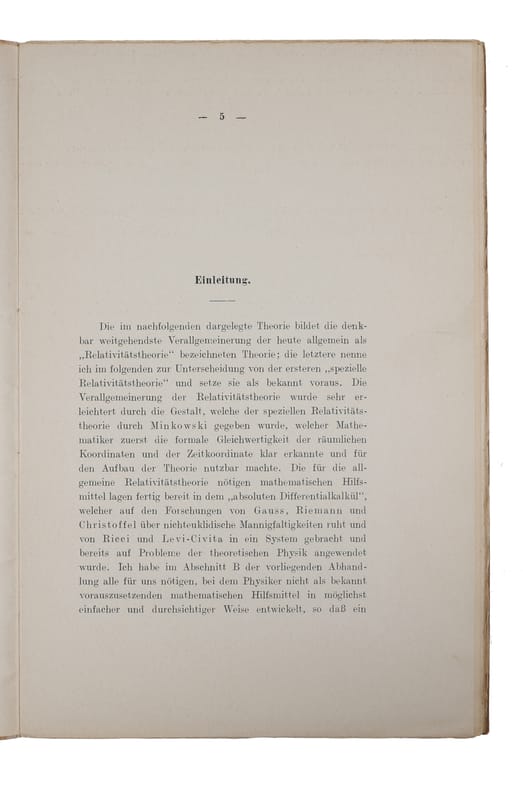
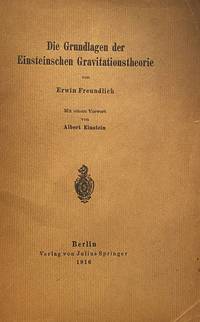
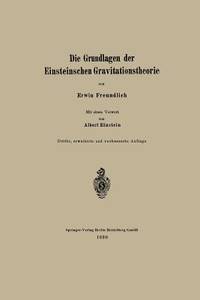
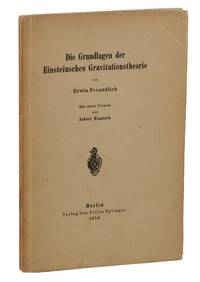
1916réf. 140945574Berlin: Verlag von Julius Springer 1916. First edition. First edition. 64 pp. Bound in publisher's wraps. Very Good with slightly toned wraps tiny stain to back wrap slightly bumped corners bookplate on verso of front wrap. An early German language work on Einstein's theory of gravitation with a foreword by the man himself. Freundlich's first book. Verlag von Julius Springer unknown books
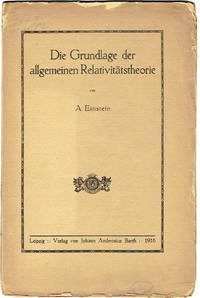
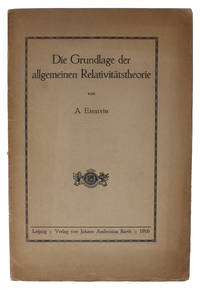
1916réf. 60254Leipzig, Ambrosius Barth, 1916. 8vo. Uncut in the original printed wrappers. Light discolouration to margins of wrappers. Inner hinges with professional repairs. Small stamp (exlibris?) to lower part of title-page. Previous owner's name (Erik Broekmeyer) in contemporary hand to upper outer corner of title-page. A fine copy. 64 pp.
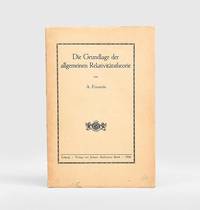
1916réf. 62767Leipzig, Verlag von Johann Ambrosius Barth (Druck von Metzger & Wittig in Leipzig), 1916. Gr.-8°. 64 S., OKart.
1916réf. 19266Leipzig: J.A Barth 1916. FIRST SEPARATE EDITION. Original printed wrappers on rippled paper; wrappers and interior soiled and spotted mostly likely with minor water damage. From the library of Einstein protege Dr. Kurt Eisenmann with his siganture and stamps. First separate printing of Einstein’s classic paper. Not an offprint from the Annalen der Physik as is often thought but a completely new setting of type with significant and important additions and revisions including an introduction published here for the first time which was not in the journal issue. Printing & the Mind of Man 408; Weil 80a. J.A Barth unknown books
1916réf. 32820373Original wrappers. Very good. FIRST EDITION. This work on Albert Einstein's theory of gravitation contains a foreword by Einstein. Freundlich is best known for his attempts to experimentally test the general theory of relativity using astronomical observations based on the gravitational redshift. Freundlich worked as an assistant at the University Observatory in Berlin at the time he published this work. In 1920 he moved to the Astrophysical Observatory in Potsdam where he was director from 1921-33 Springer paperback
1619réf. 5711KLeipzig: Johann Ambrosius Barth Omnitypie-Ges. Nachfl. L. Zechnall Stuttgart; Metzger & Wittig Leipzig Wrappers 1916 but c. 1919. Near Fine. 8vo. 16: 24 3 cm. 64 pages. Letterpress on machine paper in original publisher’s wrappers on cream stock with black title printing on covers and spine incorporating publisher's emblem and ornamental framing on front cover as well as publisher's advertisements on rear cover. Particularly rare early anastatic reprint of the first separate edition of Einstein's first and most important synopsis of his general theory of relativity. – Edition Contents: „In mid-January 1916 Einstein had still expressed doubts about his ability to write such a paper calling his writings ""correct but quite indigestible"" ""zwar richtig aber reichlich unverdaulich."" Einstein to H. A. Lorentz 17 January 1916“. But a „few months after the final papers had appeared 4 papers of Nov. and Dec. 1915 where he finally had completed the theory of general relativity as a logical structure note WoP Einstein was ready to spend some time writing a review paper in which the whole theory was presented and explained in a consistent and accessible way . It gives an excellent overview of the theory.“ cf. Einstein Papers. For present synopsis Einstein also made substantial additions published here for the first time. „Einstein’s paper of March 1916 concludes with a brief section on the three new predictions: the red shift the bending of light and the precession of the perihelion of Mercury. In the final paragraph of that section is recorded the single major experimental confirmation which at that time could be claimed for the theory: the Mercury anomaly. In 1916 next to nothing was known about the red shift; the bending of light was first observed in 1919.“ cf. Paise – The paper was first printed on May 11th 1916 in the special interest journal »Annalen der Physik« series 4 vol. XLIX issue no. 7 pp. 769-822 and probably simultaneously as separate printing in book form by the Leipzig editor Barth titled »Sonderdruck« enlarged with an introduction by Einstein and a table of content. Edited in this way and therefore more accessible for a broader audience of interested lay people the Barth book edition of Einstein's probably most important achievement in the history of science became popular and was reprinted several times until 1929. According to Weil present first reprint from 1919 is of better printing quality than others and is bound in the original paper wrappers of the 1916 edition with an updated publisher's ads list of 5 available titles appearing between 1911 and 1918. – Condition: Former faults and tears at margins of front and rear cover skilfully restored front cover with shelf wear paper time-stained otherwise clean copy. – Rarity: Scarce in trade. RHB ABPC 1973ff. and JBP/JAP/APO record 4 copies of this particular reprint in the original wrappers and comparable condition at auction 2016 2014 former copy of Karl Malmkvist 2006 2004. – Reference: Boni N.: A bibliographical checklist and index to the published writings of Albert Einstein 78 for the journals issue 78.1 for the separate edition; Carter/Muir Bücher die die Welt verändern 725; Norman 696 for the journal issue; Shields M. C.: Bibliography der Schriften Einsteins. In: Schilpp P. A.: Albert Einstein als Philosoph und Naturforscher 84 for the separate edition 86 for the journal issue; The Collected Papers of Albert Einstein. Volume 6 30 cit. p. XIX and p. 238 fn 1; Weil E.: Albert Einstein. A bibliography of his scientific papers 1901-1930 80a; Pais A.: Subtle is the Lord. The Science and Life of Albert Einstein 2005 ed. p. 273; Sauer T. „Albert Einstein review paper on general relativity theory“. In: Grattan-Guinness I. et al. ed.: Landmark Writings in Western Mathematics 2015 pp. 802-22. Johann Ambrosius Barth (Omnitypie-Ges., Nachfl. L. Zechnall, Stuttgart; Metzger & Wittig, Leipzig [Wrappers]) unknown
1916réf. ABE-1748062254979Verlag von Johann Ambrosius Barth 1916 Pamphlet finely bound in Dark green quarter leather over marbled boards. Signed twice in ink either by Einstein or a decent forger. Signature faded. First separate edition for the first time with the introduction which did not appear in the "Annalen." - "The theory of relativity has turned astrophysics upside down even the entire scientific world view" Carter/Muir Books That Change the World p. 727. "This separate edition is printed on good strong paper the wrappers are of strong material too 163 x 243 and it is described now as 'the original edition' of this classic paper ." Weil. - Cover slightly browned with a few edge chips top and foredge. Minor repairs to rear cover. Carter/Muir Books That Change the World 408 in "Annals of Physics"; Boni 78; Weil 80a; Laurence 78; Norman 696; Horblitt 26c. Signed by Authors. 1st Edition. Hardcover. Very Good. Verlag von Johann Ambrosius Barth hardcover
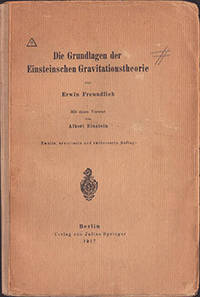
réf. 51-7409Berlin: Verlag von Julius Springer 1917. 8vo. 15 x 22cm. Original wraps; spine repaired. 74pp. OCLC Number / Unique Identifier: 20115415. Berlin: Verlag von Julius Springer, 1917 paperback
1916réf. 189311Leipzig: Johann Ambrosius Barth 1916. The foundation of general relativity First separate edition first issue of the work presenting the finalized version of general relativity. The Grundlage was also published in the Annalen der Physik in 1916 but Weil clarifies that the separate publication is now accepted as the earliest published edition of the paper. Einstein had almost finalized the general theory of relativity in 1913. However an error led him to contend that his equations could not be covariant - that they could not be applied without a system of spacetime co-ordinates devised by humans and therefore contextually specific. His first attempt at an overall presentation of the theory as delivered in 1914 was based on this assumption. By 1915 his subsequent reflections had driven him to reapply covariance and in November he published several papers outlining covariant field equations of general relativity. The present work adapts the comprehensive perspective of the 1914 paper with the revised mathematics of the 1915 equations to present "the first systematic exposition of general relativity" Janssen p. 1. Tilman Sauer notes that "in essence Einstein's general theory of relativity of 1916 remains today's accepted theory of the gravitational field" p. 24. This copy includes all the necessary first issue points: the imprint "Druck von Metzger & Wittig in Leipzig. 314" on the title page verso; Ziehen's Die Psychologie as the last title listed in the publisher's advertisement on the rear wrapper; and the imprint "Metzger & Wittig Leipzig" on the rear wrapper. Octavo. Device to title page formulae in the text. Original tan vertically ribbed wrappers printed in black. Light browning and rubbing several small ink spots to foot of front cover wrappers neatly re-glued to block contents crisp: a very good copy. Norman 696; Printing and the Mind of Man 408; Weil 80a. Michael Janssen "Einstein's First Systematic Exposition of General Relativity" 2004; Tilman Sauer "Albert Einstein's 1916 Review Article on General Relativity" in Ivor Grattan-Guiness ed. Landmark Writings in Western Mathematics 1640-1940 2004. unknown
1916réf. 19266Leipzig: J.A Barth 1916. FIRST SEPARATE EDITION. Original printed wrappers on rippled paper; wrappers and interior soiled and spotted mostly likely with minor water damage. From the library of Einstein protege Dr. Kurt Eisenmann with his siganture and stamps. First separate printing of Einstein’s classic paper. Not an offprint from the Annalen der Physik as is often thought but a completely new setting of type with significant and important additions and revisions including an introduction published here for the first time which was not in the journal issue. Printing & the Mind of Man 408; Weil 80a. J.A Barth unknown
réf. 3662275279.Gpaperback. Good. Access codes and supplements are not guaranteed with used items. May be an ex-library book. paperback
1916réf. 60254Leipzig Ambrosius Barth 1916. 8vo. Uncut in the original printed wrappers. Light discolouration to margins of wrappers. Inner hinges with professional repairs. Small stamp exlibris to lower part of title-page. Previous owner's name Erik Broekmeyer in contemporary hand to upper outer corner of title-page. A fine copy. 64 pp. First issue of the first edition in book form being not an offprint of the"Annalen der Physik" journal issue as often stated but a separate edition of the paper completely re-set and with significant changes and additions including for the first time in print the "Einleitung" and the "Inhalt".The first issue is distinguished from the later reprints by the printing of "Sonderdruck aus dem "Annalen der Physik" Band 49 1916" and "Druck von Metzger & Wittig in Leipzig. 314" to the verso of the title-page and "Metzger & Wittig Leipzig" to the foot of the back wrapper. Furthermore "This separate edition is printed on good strong paper the wrappers are of strong material too and it is described now as 'the original edition' of this classic paper" Weil. Einstein's seminal "General Theory of Relativity" has had an immense impact on all science philosophy and man's view of the world in general. Few other books of the 20th century can be said to have so basically altered the way that we view the world and our place in it. Determining space and time as being interwoven into a single continuum known as "space-time" and determining that there is no absolute space-time coordinate system - i.e. that there are no absolute positions in time and pace - established the fact that events that occur at the same time for one observer could occur at different times for another i.e. all positions in space and time are relative. This general theory of relativity here presented in its full exposition for the first time in book form is now a basic foundation for scientific thought."The theory of relativity has transformed astrophysics and indeed the whole scientific outlook." PMM."Whereas Special Relativity had brought under one set of laws the electromagnetic world of Maxwell and Newtonian mechanics as far as they applied to bodies in uniform relative motion The General Theory did the same thing for bodies with the accelerated relative motion epitomized in the acceleration of gravity. But first it had been necessary for Einstein to develop the true nature of gravity from his principle of equivalence.Basically he proposed that gravity was a function of matter itself and that its effects were transmitted between contiguous portions of space-time. Where matter exists so does energy; the greater the mass of matter involved the greater the effect of the energy which can be transmitted. In addition gravity affected light. exactly as it affected material particles. Thus the universe which Newton had seen and for which he had constructed his apparently impeccable mechanical laws was not the real universe. Einstein's paper gave not only a correct picture of the universe but also a fresh set of mechanical laws by which its details could be described" R.W. Clark. "This paper was the first comprehensive overview of the final version of Einstein's general theory of relativity after several expositions of preliminary versions and latest revisions of the theory in November 1915. It includes a self-contained exposition of the elements of the tensor calculus that are needed for the theory. T. Sauer in Landmark Writings in Western Mathematics. PMM: 408. Horblit 26 c. Weil 80.Boni: 781 Schilpp-Schields: 86. unknown
1916réf. 140945574Berlin: Verlag von Julius Springer 1916. First edition. First edition. 64 pp. Bound in publisher's wraps. Very Good with slightly toned wraps tiny stain to back wrap slightly bumped corners bookplate on verso of front wrap. An early German language work on Einstein's theory of gravitation with a foreword by the man himself. Freundlich's first book. Verlag von Julius Springer unknown
1920réf. 63609Ohne Ort [Wien], Im Selbstverlage des W. H. W., 1920. 4°. 48 (recte 49) (1) S., Lose in Orig.-Umschlag.
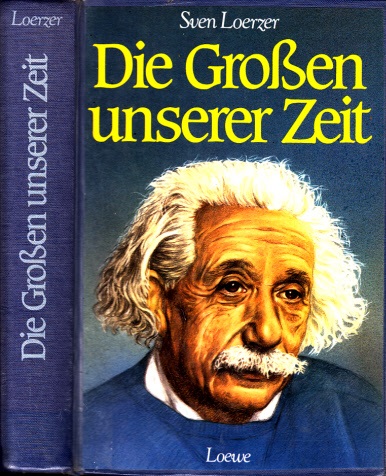
1989réf. 35650Bindlach, Loewes Verlag, 1989. 1. Auflage 313 Seiten , 24 cm, Hardcover/Pappeinband
1996réf. 31214München : Dt. Taschenbuch-Verl., 1996. 409 S. : Ill. ; 20 cm kart.
1994réf. 130750Berlin : Byblos-Verlag. 1994. 409 S. : Ill. 24*15,5 cm OBroschur.
1914réf. 2124Berlin: Königlichen Akademie der Wissenschaften 1914. FIRST EDITION OFFPRINT. Original wrappers. Fine. FIRST EDITION COMMERCIAL OFFPRINT ISSUE of Einstein's important 1914 paper on the development of general relativity. "In summer 1914 Einstein felt that the new theory general relativity should be presented in a comprehensive review. He also felt that a mathematical derivation of the field equations that would determine them uniquely was still missing. "Both tasks are addressed in a long paper presented in October 1914 to the Prussian Academy for publication in its Sitzungsberichte. It is entitled 'The formal foundation of the general theory of relativity'; here for the first time Einstein gave the new theory of relativity the epithet 'general' in lieu of the more cautious 'generalized' that he had used for the Entwurf" Landmark Writings in Western Mathematics 1640-1940. "According to John Norton 'How Einstein Found His Field Equations' this major review article was intended to convey the full content of the 1913 'Entwurf' theory: 'The principal novelty lies in the mathematical formulation of the theory. Drawing on earlier work with Marcel Grossman Einstein formulated his gravitational field equations using a variation principle. Using this richer mathematical structure Einstein offered a proof purporting to demonstrate that his theory had the maximum covariance compatible with the hole argument; that is covariance under 'justified' transformation between the 'adapted coordinate systems' he had introduced with Grossman'" Calaprice The Einstein Almanac. Offprint from: Sitzungsberichte der Königlich Preussischen Akademie der Wissenschaften XLI 19 November 1914 pp. 1030-1085. Berlin: Königlichen Akademie der Wissenschaften 1914. Octavo original wrappers; custom box. Neat early ownership name on front wrapper. Only the slightest wear; a fine copy. Rare. Königlichen Akademie der Wissenschaften unknown books
réf. H3974Berlin Akademie der Wissenschaften 1914 In: Sitzungsberichte der Königl.Preuss. Akademie der Wissenschaften Band 1914/2. 4to. S. 1030-1095. Anbei weiters: Planck Max: Eine veränderte Formulierung der Quantenhypothese. S.918-923. Schwarzschild K.: 1 Über Diffusion und Absorption in der Sonnenathmosphäre. S.1183-1200. 2 Über die Verschiebungen der Bande bei 3883 A im Sonnenspectrum. S.1201-1213. Halbleinenband der Zeit leicht berieben Bibl.-Nr.am Rücken Original-Broschur miteingebunden unaufgeschnitten gutes Exemplar. unknown
1914réf. 2124Berlin: Königlichen Akademie der Wissenschaften 1914. FIRST EDITION OFFPRINT. Original wrappers. Fine. FIRST EDITION COMMERCIAL OFFPRINT ISSUE of Einstein's important 1914 paper on the development of general relativity. "In summer 1914 Einstein felt that the new theory general relativity should be presented in a comprehensive review. He also felt that a mathematical derivation of the field equations that would determine them uniquely was still missing. "Both tasks are addressed in a long paper presented in October 1914 to the Prussian Academy for publication in its Sitzungsberichte. It is entitled 'The formal foundation of the general theory of relativity'; here for the first time Einstein gave the new theory of relativity the epithet 'general' in lieu of the more cautious 'generalized' that he had used for the Entwurf" Landmark Writings in Western Mathematics 1640-1940. "According to John Norton 'How Einstein Found His Field Equations' this major review article was intended to convey the full content of the 1913 'Entwurf' theory: 'The principal novelty lies in the mathematical formulation of the theory. Drawing on earlier work with Marcel Grossman Einstein formulated his gravitational field equations using a variation principle. Using this richer mathematical structure Einstein offered a proof purporting to demonstrate that his theory had the maximum covariance compatible with the hole argument; that is covariance under 'justified' transformation between the 'adapted coordinate systems' he had introduced with Grossman'" Calaprice The Einstein Almanac. Offprint from: Sitzungsberichte der Königlich Preussischen Akademie der Wissenschaften XLI 19 November 1914 pp. 1030-1085. Berlin: Königlichen Akademie der Wissenschaften 1914. Octavo original wrappers; custom box. Neat early ownership name on front wrapper. Only the slightest wear; a fine copy. Rare. Königlichen Akademie der Wissenschaften unknown
réf. 3499250179.Gperfect. Good. Access codes and supplements are not guaranteed with used items. May be an ex-library book. unknown
1956réf. RO40142607Rowohlt. 1956. In-12. Broché. Bon état, Couv. convenable, Dos satisfaisant, Intérieur acceptable. 210 pages. Gravure ornementale en noir et blanc en frontispice. Etiquette de code sur le dos. Tampons et annotation d'institution religieuse en page de titre.. . . . Classification Dewey : 430-Langues germaniques. Allemand
1987réf. BN711677Rowohlt Taschenbuch Verlag 1987. 1987. Softcover. Die Evolution der Physik. Tb Die Evolution der Physik. Tb Einstein Albert / Infeld Leopold Rowohlt Taschenbuch Verlag paperback
1909réf. 662931909. Physik. Zschr. 10. - Leipzig Verlag von S. Hirzel 1909 4° XXII 2 1040 pp. mit Textabbildungen und 26 Tafeln Halbleinenband d.Zt.; St.a.Tit. feines Expl. A LANDMARK W. PAULI FIRST EDITION "of this extensive paper given as lecture before the 81st assembly of the "Gesellschaft Deutscher Naturforscher" in Salzburg on 21st September 1909. He spoke on "The Development of Our View of the Nature and Constitution of Radiation" a topic that embraced both relativity and quanta. Among those who attended Einstein's lecture were some of the world's foremost physicists. In Einstein's austere opinion his address regarded strictly as a work of science was of little importance since as he writes to a co-worker it contained nothing new. Einstein was being overmodest. Besides to many in Einstein's audience and it should be born in mind that it was the year after Minkowski's stirring introduction of the concept of the fourth dimension this Lecture came as a revelation. The occasion was important for Einstein too. He had been working for years in a sort of scientific exile and his curiosity as to what great scientists were like in face-to-face discussion was at least as great as their curiosity about him. His confidence in himself was certainly not harmed when he found that he was able to hold his own easily in their company. Moreover at this congress Einstein first met Planck. In addition he made new'lasting friendships leading to a voluminous scientific correspondence. Amongst those attending the congress were Max von Laue Max Born. Arnold Sommerfeld Hasnohrl. Ladenburg. Max von Laue was to be the first to publish in 1911 the first text-book on relativity theory. All of them are present in this issue with scientific papers of their own." Walter Alicke Weil No. 30; Schilpp-Shields No. 30; Hoffmann Einstein p. 93; Alicke Nr. 34 unknown
1923réf. 38826Berlin, Verlag der Akademie der Wissenschaften, 1923. 4to. Uncut and partly unopened in orig. wrappers to issue XXVIII-XXIV of ""Sitzungsberichte der Preussischen Akademie der Wissenschaften"". Wrappers with nicks and tears, especilly frontwrapper with marginal loss. Die Energieschwankungen...pp. 350-354. - Bemerkung zu Quantenstatistik...pp. 355-58.- Bietet die Feldtheorie...pp. 359-364. - Zur Theorie der von glühende...pp. 334-348.