Einstein, Professor Albert,Biblio.com

2 557 résultats
réf. 46407703like new. unknown
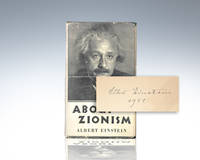
1931réf. 146050New York: The MacMillan Company 1931. First edition of this volume of Einstein's speeches and letters concerning his views on Zionism. Octavo original cloth. Boldly signed and dated in the year of publication on the front free endpaper "Albert Einstein 1931." Near fine with light toning to the endpapers in the scarce original dust jacket which is in good condition with some wear. Translated and edited with an introduction by Leon Simon. Exceptionally rare signed. Einstein was a prominent supporter of both Labor Zionism and efforts to encourage Jewish-Arab cooperation. He supported the creation of a Jewish national homeland in the British mandate of Palestine but was opposed to the idea of a Jewish state "with borders an army and a measure of temporal power." In a letter to Jawaharlal Nehru dated June 13 1947 he asserted "Long before the emergence of Hitler I made the cause of Zionism mine because through it I saw a means of correcting a flagrant wrong.The Jewish people alone has for centuries been in the anomalous position of being victimized and hounded as a people though bereft of all the rights and protections which even the smallest people normally has.Zionism offered the means of ending this discrimination." Einstein's speeches lectures and letters concerning Zionism were first published in 1930 by The Soncino Press and eleven of these essays were later collected in The World as I See It published in 1933 which Einstein dedicated "to the Jews of Germany". The MacMillan Company hardcover
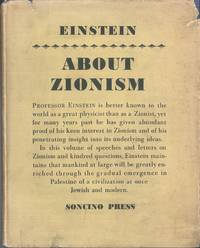
1931réf. 345H4370New York: The Macmillan Company of Canada Limited. Good. 1931. First American Edition. Hardcover. 8 9-94 pages. Select Bibliography. First published in London in 1930. "Professor Einstein is better known as a physicist than as a Zionist. Yet for many years he has given abundant proof both of a keen interest in Zionism and of a penetrating insight into its underlying ideas. He is impelled to Zionism by his acute consciousness of the excessive price at which the blessings of assimilation are bought by the Jewish communities of the Western world which for him are mainly represented by that of Germany. The price is a loss of solidarity of moral independence and self-respect. These in his view can be regained only if assimilated Jews find some common task of absolute human value to which they can bend their corporate energies as Jews. Such a task is to be found in the restoration of Jewish national life in Palestine." - Introduction. Unmarked with average wear. Backstrip lettering faded. Binding tight. A sound copy of this important compilation. Emanuel p.51. Boni Russ & Laurence 306.; 8vo - over 7¾" - 9¾" tall; Zionism Albert Einstein Politics Israel Palestine Theodor Herzl Zionist Organisation Jewish Colonial Trust Balfour Declaration Keren Hayesod Palestine Foundation Fund . The Macmillan Company of Canada Limited hardcover
1930réf. 246ABC376London: The Soncino Press 1930. 1st Edition . Hardcover. Very Good/Poor. First British Edition First Edition in English Precedes the American edition by one year. Original Blue Cloth with some fading with title printed vertically in orange on the spine.Interior pages are clean and bright; a little foxing and some pencil markings inside covers.Original paper dust jacket with the price '5s. NET' printed on the spine in shabby condition as illustrated. A collection of Albert Einstein's speeches and letters concerning his views on Zionism Jewish-Arab cooperation and the Jewish National Home in Palestine. The Soncino Press hardcover
1920réf. 188923Rostock, 1920. 15 S. OBr. im Pp.-Schutzumschl. M. wenigen Anstreich.
1925Mm 65x110 Collana Medaglie. Brossura editoriale di pagine 57, ritratto in antiporta, sovracoperta editoriale in pergamino, piccola macchia che interessa Il contropiatto anteriore e le prime carte. Opera in buone condizioni. Spedizione in 24 ore dalla conferma dell'ordine.
1985réf. 2-019318513XOxford Univ Pr 1985. Paperback. New. 2nd edition. 274 pages. 8.25x6.50x0.50 inches. Oxford Univ Pr paperback
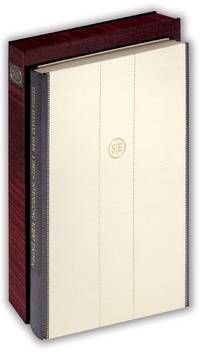
réf. 35452Rockport ME: Two Ponds Press 2015. Fine. Number 35 of 75 copies signed and numbered by Joseph Goldyne. Joseph Goldyne was born in 1942 in Chicago IL. He came to prominence as an artist on the West Coast. He has been credited as one of the artists responsible for the rebirth of monotype and monoprint as valuable approaches to art. He is also known for his artist's books often done in collaboration with printer Peter Rutledge Koch. From the Prospectus: "Joseph Goldyne brought this project to our attention and the Press was convinced that this little-known oratory by George Bernard Shaw deserved wider recognition one that Goldyne thought a most unexpectedly wondrous and humorous introduction to Albert Einstein perhaps the most transformative and towering figure of the twentieth century. Goldyne's own introduction " An Introduction to an Introduction" speaks to his discovery of Shaw's speech its presentation Shaw's record of condemning anti-Semitism and his public support for Einstein. The full text of Shaw's speech is reprinted together with Einstein's response delivered in German and printed here in English translation. Goldyne illustrates the volume with five drypoint etchings created especially for this publication. They pay tribute to the featured speakers as well as to the sense of the event." Beautifully bound in cream paper covered boards with gilt dotted rulings and ornament on front cover of circle with initials "SE" in its center. Gray leather spine and trim along front edges with gilt titling on spine. Printed in Monotype Bembo and Gill Sans types on paper handmade at the Velké Losiny mill in the Czech Republic. Letterpress printing by Arthur Larson at Horton Tank Graphics with additional hand composition by Rose Ku'ulealoha Wisotzky. Design and typography planned by Michael Russem Housed in a slipcase covered in dark red cloth with "SE" symbol on spine. Accompanied by prospectus. A lovely book in fine condition. Measures 6.5 x 10 inches. 39 pages. PRI/112321. Two Ponds Press unknown books
réf. 35452Rockport ME: Two Ponds Press 2015. Fine. Number 35 of 75 copies signed and numbered by Joseph Goldyne. Joseph Goldyne was born in 1942 in Chicago IL. He came to prominence as an artist on the West Coast. He has been credited as one of the artists responsible for the rebirth of monotype and monoprint as valuable approaches to art. He is also known for his artist's books often done in collaboration with printer Peter Rutledge Koch. From the Prospectus: "Joseph Goldyne brought this project to our attention and the Press was convinced that this little-known oratory by George Bernard Shaw deserved wider recognition one that Goldyne thought a most unexpectedly wondrous and humorous introduction to Albert Einstein perhaps the most transformative and towering figure of the twentieth century. Goldyne's own introduction " An Introduction to an Introduction" speaks to his discovery of Shaw's speech its presentation Shaw's record of condemning anti-Semitism and his public support for Einstein. The full text of Shaw's speech is reprinted together with Einstein's response delivered in German and printed here in English translation. Goldyne illustrates the volume with five drypoint etchings created especially for this publication. They pay tribute to the featured speakers as well as to the sense of the event." Beautifully bound in cream paper covered boards with gilt dotted rulings and ornament on front cover of circle with initials "SE" in its center. Gray leather spine and trim along front edges with gilt titling on spine. Printed in Monotype Bembo and Gill Sans types on paper handmade at the Velké Losiny mill in the Czech Republic. Letterpress printing by Arthur Larson at Horton Tank Graphics with additional hand composition by Rose Ku'ulealoha Wisotzky. Design and typography planned by Michael Russem Housed in a slipcase covered in dark red cloth with "SE" symbol on spine. Accompanied by prospectus. A lovely book in fine condition. Measures 6.5 x 10 inches. 39 pages. PRI/112321. Two Ponds Press unknown
1947réf. 222250New York: Dorset Press 1947. Hardcover. Near Fine/Very Good. Second edition. Near fine in very good dust jacket. Slight spine lean. Dorset Press hardcover books
1953réf. GB0000CIJJXI3N01Cassell 1953. Hardcover. Good. Missing dust jacket; Pages can have notes/highlighting. Spine may show signs of wear. ~ ThriftBooks: Read More Spend Less.Dust jacket quality is not guaranteed. Cassell hardcover
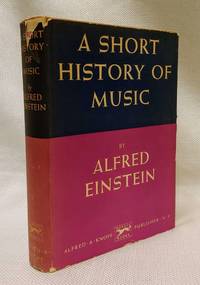
1937réf. 336583New York: Alfred A. Knopf 1937. First Edition. Hardcover. Good/Good. First thus. Alfred A. Knopf 1937; stated First American Edition no additional printings indicated same date on title and copyright pages; x 253 xii 1pp. Binding is tight sturdy and square; light wear light foxing to edges of tan cloth boards magenta and brown stamped title and decoration on spine and front board remains bright and bold; text very good throughout. Unclipped $2.50 dust jacket is edge-worn and age-toned with several small closed tears one chip at head of spine; light foxing to jacket as well. A presentable First American printing of Einstein's classic work of music history and criticism. From a private collection. Ships from Dinkytown in Minneapolis Minnesota. Alfred A. Knopf hardcover
réf. 0880290978New. hardcover. New. Satisfaction Guaranteed or your money back. hardcover
1987réf. Q-0880290978Hippocrene Books 1987-03-01. Hardcover. New. In shrink wrap. Looks like an interesting title! Hippocrene Books hardcover
1957réf. 49057New York: Vintage Books 1957. 4th American Edition; Later Printing. Softcover. Very Good in wrappers. Small crease to front panel.; 12mo 7" - 7½" tall. Vintage Books unknown
réf. 14497Softcover. UCLA Fowler Museum of Cultural History c1996 spiral-bound paperback about 8½x11 Fine 70 pages QUILTS QUILTING AMISH CULTURE; E2555 . paperback
réf. B9781017081169Hardback. New. hardcover
réf. 61266827Nova Science Publishers Incorporated . Hardback. Used. pp. xiii 239 Index Nova Science Publishers, Incorporated hardcover
réf. 022646413X.Ghardcover. Good. Access codes and supplements are not guaranteed with used items. May be an ex-library book. hardcover
1980réf. 2610130008Dover 1980. Paperback. Good. An extremely large collection of foundational mathematical texts from a mathematical professor's library 68 volume set. Softcover. Most volumes are in good condition. Clean unmarked pages. Some volumes have reading creases down the spine various wear and are only fair condition. Various dates most volumes are from the late 1970s-1980s. Includes: 1. Handbook of Mathematical Functions: With Formulas Graphs and Mathematical Tables Milton Abramowitz; Irene A. Stegun2. Lectures on Ordinary Differential Equations Witold Hurewicz; 3. The Divine Proportion: A Study in Mathematical Beauty H E Huntley; 4. Infinite Sequences and Series Knopp Konrad; 5. Functional Analysis Frigyes Riesz; Bela Sz.-Nagy;6. Lectures on Classical Differential Geometry: 2nd Ed Struik Dirk J.;7. Advanced Number Theory Cohn Harvey; 8. Contributions to the Founding of the Theory of Transfinite Numbers Cantor Georg; 9. Geometry of Complex Numbers Hans Schwerdtfeger;10. Introduction to Partial Differential Equations with Applications Zachmanoglou E. C.; Thoe Dale W.;11. Thirty Years That Shook Physics: The Story of Quantum Theory Gamow George;12. Information Theory Robert Ash; 13. Introduction to Bessel Functions Frank Bowman; 14. Mathematical Foundations of Information Theory A Ya Khinchin; 15. Vector and Tensor Analysis with Applications Borisenko A. I. Tarapov I. E.; 16. On Formally Undecidable Propositions of Principia Mathematica and Related Systems Godel Kurt; 17. Tensor Calculus Synge J. L.; Schild A.; 18. Differential Geometry Kreyszig Erwin; 19. A Collection of Problems on Complex Analysis Volkovyskii L. I.; Lunts G. L.; Aramanovich I. G.;20. Introduction to Difference Equations Samuel Goldberg;21. Distribution Theory and Transform Analysis: An Introduction to Generalized Functions with Applications Zemanian A. H.; 22. Physics of Waves Elmore William C.; Heald Mark A.; 23. Orthogonal Functions G. Sansone; 24. Lie Algebras Jacobson Nathan; 25. Topology John G Hocking; 26. Mathematical Recreations and Essays Ball W. W. Rouse; Coxeter; 27. An Introduction to Algebraic Structures Landin Joseph28. Differential Forms with Applications to the Physical Sciences Harley Flanders;29. The Theory of Groups and Quantum Mechanics Hermann Weyl; 30. Nonlinear Mathematics Thomas L. Saaty; Joseph Bram; 31. An Introduction to Information Theory Symbols Signals and Noise John R Pierce; 32. Introduction to the Theory of Fourier's Series and Integrals Carslaw H. S.; 33. Quantum Theory David Bohm; 34. Introduction to Differentiable Manifolds Auslander Louis Mackenzie Robert E.; 35. An Introduction to Harmonic Analysis Katznelson Yitzhak; 36. Conformal Mapping on Riemann Surfaces Harvey Cohn; 37. Conformal Mapping Nehari Zeev; 38. Axiomatic Set Theory Suppes Patrick; 39. Differential Geometry Heinrich W. Guggenheimer; 40. Challenging Mathematical Problems With Elementary Solutions Vol. 1 A. M. Yaglom;41. Group Theory W. R. Scott; 42. An Introduction to the Calculus of Variations Fox Charles; 43. Tensor Analysis on Manifolds Goldberg Samuel I. Bishop Richard; 44. Non-Euclidean Geometry Bonola Roberto; 45. The Philosophy of Mathematics Korner Stephan; 46. Computational Methods of Linear Algebra Faddeeva V. N.; 47. Tensors Differential Forms and Variational Principles Lovelock David Rund Hanno;48. Metric Affine Geometry Snapper Ernst & Troyer Robert J.; 49. Fourier Series and Orthogonal Functions Harry F Davis;50. Unbounded Linear Operations Goldberg Seymour; 51. Geometry Relativity and the Fourth Dimension Rudolf Rucker; 52. Banach Spaces of Analytic Functions Hoffman Kenneth; 53. Topological Uniform Structures Page Warren; 54. The Higher Arithmetic: An Introduction to the Theory of Numbers Harold Davenport;55. The Thirteen Books of the Elements Vol. 2 Euclid; 56. The Theory of the Properties of Metals and Alloys Jones Mott Neville; 57. Asymptotic Expansions of Integrals Norman Bleistein; 58. Investigations on the Theory of the Brownian Movement Einstein Albert; 59. The Principle of Relativity Albert Einstein; 60. The Theory of Spinors Bagemihl Bagemihl; 61. Selected Papers on Quantum Electrodynamics Julian Schwinger; 62. About Vectors Banesh Hoffmann; 63. Fads and Fallacies in the Name of Science Martin Gardner; 64. Theory of Sets Kamke E.; 65. First Order Mathematical Logic Angelo Margaris; 66. Essays on the Theory of Numbers Dedekind Richard; 67. Modern Nonlinear Equations Thomas Saaty; 68. Theory of Groups of Finite Order Burnside. This is an oversized or heavy book which WILL require additional postage for Priority Mail or International delivery outside the US. Dover paperback
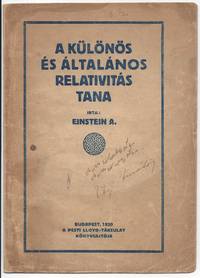
1920réf. 1870Budapest: A Pesti Lloyd-Társulat Könyvsajtója 1920. First separate edition. Offprint of Természettudományi Közlöny. In publisher’s printed wrappers. Cover chipped at extremities. Restored rear panel replaced with cardboard similar to original. Old ownership inscriptions on front panel. Contemporary notes and underlines throughout in pen and pencil. Pages discolored due to the acidic paper. Overall in good condition. First separate edition. Offprint of Természettudományi Közlöny. In publisher’s printed wrappers. 2 19 1 p. First Hungarian edition of Einstein’s Über die spezielle und allgemeine Relativitätstheorie Braunschweig 1917 published as an extract. Offprint of Természettudományi Közlöny. One of the earliest Hungarian publications of Einstein’s works. . A Pesti Lloyd-Társulat Könyvsajtója unknown
réf. MA06C-03367Pantheon Irodalmi Intezet. Used - Acceptable. Budapest: Pantheon Irodalmi Intezet 1922. 12mo hardcover. Rebound gray cloth with original front paper wrap bound in. 94pp. Hungarian. Fair book. Ex-Library copy from the New York Public Library with usual markings and pocket on front pastedown in Hungarian. Dampstaining and red paint flecks on front board. Upper corner dampstained throughout. Albert Einstein Theory of Relativity Books in Hungarian Inquire if you need further information. Pantheon Irodalmi Intezet hardcover books
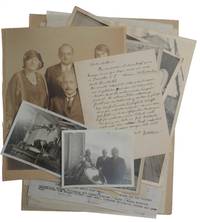
1931réf. 60051931. First edition. An important group of photographs documenting Einstein's visit to Caltech. The main purpose of the visit was to discuss Edwin Hubble's observations made in 1929 with the 100-inch telescope at the Mount Wilson Observatory which showed that light from distant nebulae galaxies was red-shifted indicating that the universe was expanding. Einstein had believed that the universe is static and had introduced his 'cosmological constant' into his equations of general relativity to allow for a static solution. When Einstein met Hubble at the Mount Wilson Observatory in January and February 1931 he was visibly moved with Hubble's discovery and reportedly said with tears in his eyes that "It was the most beautiful and satisfying interpretation of astronomical science." In light of the new evidence Einstein published a paper two months later renouncing the concept of a cosmological constant whose invention Einstein denounced as "the greatest blunder of my life." . 'the greatest blunder of my life'. An important group of photographs documenting Einstein's second visit to America and his first to the California Institute of Technology which began at the end of December 1930. The main purpose of the visit was to discuss Edwin Hubble's observations made in 1929 with the 100-inch telescope at the Mount Wilson Observatory then the largest telescope in the world which showed that light from distant nebulae galaxies was red-shifted indicating that the universe was expanding. Einstein had believed that the universe is static and had introduced his 'cosmological constant' into his equations of general relativity to allow for a static solution. When Einstein met Hubble at the Mount Wilson Observatory in January and February 1931 he was visibly moved with Hubble's discovery and reportedly said with tears in his eyes that "It was the most beautiful and satisfying interpretation of astronomical science." In light of the new evidence Einstein published a paper two months later renouncing the concept of a cosmological constant whose invention Einstein denounced as "the greatest blunder of my life." Einstein was accompanied on his visit by Walther Mayer 1887-1948 who had been appointed as his mathematical assistant in 1929. Mayer and Einstein worked together on several approaches towards a unified field theory. "On the way over Einstein and his mathematical calculator Walther Mayer holed up working on revisions to his unified field theory in an upper-deck suite with a sailor guarding the door" Isaacson p. 368. Two of the photographs are of Einstein at Mount Wilson one with Mayer and the observatory's director Walter Adams 1876-1956 who had confirmed Einstein's prediction of the gravitational red-shift although his observations were later shown to be faulty; the other with Mayer and solar physicist Charles St. John 1857-1935 who had assisted Hubble with his red-shift observations. Another photograph shows Einstein between fellow Nobel Laureates Albert Michelson 1852-1931 and Robert Millikan 1868-1953 Caltech's "chairman of the executive council" effectively its president. Together with Edward Morley Michelson had in 1887 carried out the famous Michelson-Morley experiment which failed to detect evidence of the existence of the luminiferous ether; this provided crucial evidence for the early acceptance of special relativity. On this trip Einstein "paid tribute to the aging Michelson carefully praising his famous experiments that detected no ether drift without explicitly saying that they were a basis for his special theory of relativity" Isaacson p. 372. "In the early 1930s Einstein came to California specifically to consult with scientists at the California Institute of Technology. Few members of the general public understood the nature of his visits but they idolized him all the same. From the moment his boat docked in San Diego on December 31 1930 the reception accorded him by Californians was one part show business one part hero worship and one part genuine affection. Groups of children dressed in blue and white middies serenaded him and thrust wreaths of flowers into his hands two bands struck up tunes and in Los Angeles a theatrical group the Yale Puppeteers opened a play called Mr. Noah in which the ark landed on Mt. Wilson instead of on Mt. Ararat . "As early as 1913 Einstein was looking for experimental verification for the correctness of his theory of general relativity and he had been in correspondence with Caltech's George Ellery Hale asking him to make an astronomical measurement. He was anxious to know if Hale could detect the influence of the sun's gravitation field upon a light ray. Hale replied that in order to try he needed a solar eclipse. The experiment was finally carried out in 1919 by two British expedition teams and again in 1922 by an American team of astronomers - and it did confirm the theory of general relativity. "There were cosmological implications in this theory and they attracted a lot of attention in the 1920s and 1930s - nowhere more than at Caltech. Millikan had been urging Einstein to visit the campus for some time and in the fall of 1930 he agreed to spend the winter quarter in Pasadena. Not only would he be able to discuss his theory and its interpretation with distinguished scientists; he would also be meeting old friends again - Richard Tolman the cosmologist; Paul Epstein the theoretical physicist; and Theodore von Karman the aerodynamicist . "The new Athenaeum at Caltech was the setting for many dinners to honor Einstein. At the first on January 15 1931 the guests included the physicist and Nobel Laureate A. A. Michelson and 200 members of the California Institute Associates. Several weeks later a second dinner was held at which all the astronomers from the Institute and the Mt. Wilson Observatory were present. Edwin Hubble was there as was Charles E. St. John who verified the third prediction of the theory of general relativity the gravitational red-shift. Colleagues came from Berkeley including Tolman's close friend and co-author G. N. Lewis who wrote to say he was coming with a friend - though not without some mildly humorous trepidation. As he put it in his letter to Tolman: 'I have just accepted an invitation from Oppenheimer to drive me down. Do you think I should take out accident insurance' "Einstein was not without a sense of humor himself. At a farewell luncheon in his honor on February 24 1931 which was sponsored by the Pasadena Chamber of Commerce he said: "I want to thank the extraordinary group of scholars in the fields of physics and astronomy who have afforded me glimpses of their work. They have conducted me not only into the world of atoms and crystals but also to the surface of the sun and into the outermost depths of space. There I saw worlds which are flying away from us with incomprehensible rapidity in spite of the fact that their inhabitants do not know us well enough to justify any such action'" Goodstein. "Millikan was a physicist who had won the Nobel Prize in 1923 for having 'verified experimentally Einstein's all-important photoelectric equation.' He likewise verified Einstein's interpretation of Brownian motion. So it was understandable that as he was building Caltech into one of the world's pre-eminent scientific institutions he worked diligently to bring Einstein there. "Despite al they had in common Millikan and Einstein were different enough in their personal outlooks that they were destined to have an awkward relationship. Millikan was so conservative scientifically that he resisted Einstein's interpretation of the photoelectric effect and his dismissal of the ether even after they were apparently verified by his own experiments. And he was even more conservative politically. A robust and athletic son of an Iowa preacher he had a penchant for patriotic militarism that was as pronounced as Einstein's aversion to it" Isaacson p. 373. "To physics posterity Viennese mathematician Walther Mayer is mostly known as 'Einstein's calculator'. He had apparently been called that at the California Institute of Technology in Pasadena which Einstein and Mayer visited together in the winter of 1930/31. It is true that in order to advance in his studies to construct a unified field theory Einstein relied on the expertise of mathematicians. With his unified field theory Einstein attempted to formally join his own theory of general relativity with Maxwell's electromagnetism. "When Einstein was looking for a new mathematics assistant in 1929 Mayer was hired on the recommendation of eminent mathematician Richard von Mises. Like Einstein von Mises at that time held a professorship in Berlin. Walther Mayer then served as private lecturer at the University of Vienna finishing the second volume of a very well received textbook series on differential geometry which he co-authored with fellow Viennese mathematician Adalbert Duschek. Subsequently Mayer and Einstein worked together on several approaches towards a unified field theory consisting of 1 the analysis of solutions to Einstein's so-called distant teleparallelism approach 2 the invention of a variant of the Kaluza-Klein theory in which not space-time but attached vector spaces are 5-dimensional and finally 3 the construction of a formalism they referred to as "semi-vectors" for interpreting Dirac-spinors in simpler classical field-theoretical terms and reformulating the Dirac equation accordingly. Their joint work was published in 7 papers over a period of roughly four years 1930-1934 . "While being humbly appreciative of the vital improvement that Einstein brought to his career Mayer was at the same time also quite unhappy about his role as Einstein's 'appendage'. Einstein however was aware of and respected this sentiment of Mayer's: When he bargained his Princeton position with Abraham Flexner a founding director of Princeton's Institute for Advanced Study he insisted on an independent professorship for Mayer as well. After some back and forth this was indeed granted at the last minute. However the question of Mayer's legitimacy as an independent professor at Princeton surfaced again after their arrival. Feeling unwelcomed and not sufficiently supported by Einstein Mayer finally ended their collaboration after just one further joint paper in 1934. He felt that his career would be advanced best if from now on he would focus entirely on his own studies in pure mathematics. In the end Mayer was able to retain his tenure at Princeton for the rest of his life but he subsequently appeared to have wished to no longer be associated with work on unified field theory. On the outside Einstein and Mayer remained in friendly contact while Einstein found new collaborators. The ones immediately succeeding Walther Mayer at Princeton were Boris Podolsky and Nathan Rosen" Lessel. The photographs are accompanied by a number of letters from Mayer to his brother Arthur in Austria discussing Einstein's work Hitler and the Nazis. Mayer was Jewish and it was only through Einstein's intervention that he was given the title of professor at the University of Vienna. Mayer immediately took a leave of absence from this position to continue his collaboration with Einstein when he had returned to Berlin. At a press conference on his arrival in New York Einstein was asked "'What do you think of Adolf Hitler' Einstein replied 'He is living on the empty stomach of Germany. As soon as economic conditions improve he will no longer be important'" Isaacson p. 369. "On the day he left New York Einstein revised slightly one of the statements he had made on his arrival. Asked again about Hitler he declared that if the Nazis were ever able to gain control he would consider leaving Germany" ibid. p. 371. In April 1933 Einstein discovered that the new German government had passed laws barring Jews from holding any official positions including teaching at universities. He left Germany in summer 1933 and took up a position at the Institute for Advanced Study in Princeton despite Millikan's efforts to lure him to Caltech. He remained at the Institute until his death in 1955. Goodstein 'Albert Einstein in California' Engineering and Science May-June 1979 pp. 17-19 - Isaacson Einstein. His Life and Universe 2007. Lessel 'Walther Mayer - more than 'Einstein's calculator'' - ;/span> . unknown
1968réf. 57192New Haven CT: Yale University Press 1968. good fair. 269 illus. biographical directory bibliography of Lewis Einstein's published writings index front DJ flap price clipped. Raised stamp on half title DJ worn and discolored small edge tears and chips to DJ edges discoloration inside front and rear boards and flyleaves. Foreword by George F. Kennan. Lewis Einstein 1877-1967 entered the diplomatic service in 1903; serving for 25 years he was possibly the first American of the 20th century to perceive the meaning of the emerging role of the United States in the world balance of power. There are references to Presidents Theodore Roosevelt and William Howard Taft in the index. Yale University Press hardcover
2015brossura In questo articolo del 1918, suo unico sul paradosso degli orologi, Einstein tenta di rifasare l'orologio rimasto indietro ricorrendo alla "induzione gravitazionale" che lui stesso ha introdotta nel campo gravitazionale con la Relatività Generale. Ma questo campo non esiste e, comunque, i numeri non tornano giusti in alcun modo.