CLIFFORD A. PICKOVERMareMagnum

2 557 résultats
1999RAFFAELLO CORTINA 1999 LIEVI SEGNI DEL TEMPO, PARI AL NUOVO. Vorreste davvero sentire Chopin che suona il piano e magari partecipare alla battaglia di Waterloo o assistere in prima fila al processo di Carlo I? Usate questo libro come un vero e proprio vademecum per viaggiare nel tempo, dato che, almeno in linea di principio, è possibile concepire dei "cunicoli" temporali che smentiscono Aristotele, secondo il quale il tempo va solo avanti. Ma qualsiasi direzione scegliate, state attenti a non correre troppo. Vi trasformereste in tachioni, cioè in particelle più veloci della luce, e rischiereste di finire all'altro mondo, al di là del cono di luce di Einstein.
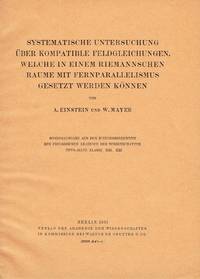
1931réf. 28368Berlin, Gruyter & Co., 1931. 4to. Orig. printed orange wrappers. Offprint/Sonderausgabe aus Sitzungsberichten....pp. (1)-11. Fine fresh copy.
1931réf. 38647Berlin, Akademie der Wissenschaften, 1931. 4to. Orig. printed green wrappers in Sitzungsberichte 1931 Heft XIII-XV pp. 257-65. Small nicks to frontwrapper.
1931réf. 37424Berlin: Akad. Wiss 1931. Weil 180. Offprint from S. preuss. Akad. Wiss. Akad. Wiss unknown books
1931réf. 5744KBerlin: Verlag der Akademie der Wissenschaften in commission at Georg Reimer Reichsdruckerei 30th Mai 1931. Near Fine. Imperial 8vo 25 4: 18 2 cm. 11 1 pages. Letterpress on machine paper in original publisher’s brochure on orange stock with black title printing. First offprint in the original wrappers and new pagination of this late paper by Einstein about field equations in a Riemannian Space. - Content: This work was written in collaboration with his assistant the Austrian mathematician Walther Mayer nicknamed „Einstein's calculator“. In 1928 Einstein already had made use of the Elliptic geometry of German mathematician Bernhard Riemann for his calculations. - Condition: Mint. - Reference: Alicke 149; Schilpp-Shields 250; Weil 180 quotes the pagination of the first separate printing p. 257-265. Verlag der Akademie der Wissenschaften (in commission at Georg Reimer [Reichsdruckerei]) unknown
1931réf. 38647Berlin Akademie der Wissenschaften 1931. 4to. Orig. printed green wrappers in Sitzungsberichte 1931 Heft XIII-XV pp. 257-65. Small nicks to frontwrapper. First edition in the periodical form. - Weil: 180. unknown
1931réf. 28368Berlin Gruyter & Co. 1931. 4to. Orig. printed orange wrappers. Offprint/Sonderausgabe aus Sitzungsberichten.pp. 1-11. Fine fresh copy. First edition of the rare Offprint with separate title and separate pagination. Se Weil No. 180 where this is not mentioned. - Mayer came to America in 1933 and about him as his collaborator Einstein said "It is he who produced all my calculations his skill is fantastic You know."The early Offprints from "Sitzungsberichten." are called "Sonderabdruck" up to Weil No.165 including this. From Weil 166 they are called "Sonderausgabe.". - Before 161 up to 160 the Offprints do not have separate title and pagination the pagination follows the numbering in the periodical. From 166 the Offprint has both separate printed title and pagination. - So Weil Nos 161-165 is still "Abdruck" but with separate title and pagination. These facts are not mentioned in the bibliographies. unknown
1931réf. 37424Berlin: Akad. Wiss 1931. Weil 180. Offprint from S. preuss. Akad. Wiss. Akad. Wiss unknown
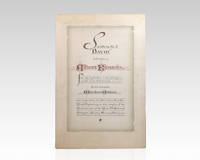
1951réf. 153420Tel-Aviv: Israeli Music Publications 1951. First edition of the published facsimile score of Menachem Avidom’s Symphony No. 2 “David” together with the painted calligraphic broadside dedicating the symphony to Albert Einstein. Folio the manuscript orchestral score reproduced in facsimile spiral bound in plain black boards published by Israeli Music Publications of Tel-Aviv. Accompanied by an elaborate painted calligraphic presentation broadside by the artist Sol Nodel reading “Symphony No. 2 ‘David’ dedicated to Albert Einstein for his inspiration to the Jewish people and to all humanity by the composer Menahem Avidom and presented by the American Fund for Israel Institutions on the occasion of the American tour of the Israel Philharmonic Orchestra January February March 1951.” The broadside is additionally inscribed by the composer in black ink at the top left corner “To the greatest man in our generation Prof. A. Einstein humbly from the Composer M. Avidom Princeton 10/1/51.” The symphony was dedicated to Albert Einstein for his inspiration to the Jewish people and to all humanity. Einstein the most celebrated scientist of the twentieth century was also a lifelong and devoted musician a gifted violinist who adored Mozart and revered Bach and who once said that had he not been a scientist he would have become a musician and that the greatest joy of his life had come to him from his violin. A passionate champion of Jewish cultural and educational causes and of the young State of Israel he was among the founders of the Hebrew University of Jerusalem and lent his name and moral authority to the building of its institutions. The presentation of Avidom’s score took place during the first American tour of the Israel Philharmonic Orchestra in the opening months of 1951 when the orchestra led by Leonard Bernstein and Serge Koussevitzky gave fifty-three concerts in forty cities. Together with an original photograph showing the composer presenting the broadside to Einstein and a photocopy of a 1986 letter recording that the score and broadside were the gift of Einstein’s daughter Margot Einstein. In very good condition with light toning and soiling the front cover of the spiral-bound score detached. A remarkable Einstein association uniting a dedicated symphonic score its presentation broadside and a photograph of the moment it was given to him. Menachem Avidom 1908-1995 was one of the founding figures of modern Israeli classical music. Born Menahem Mahler-Kalkstein in Stanislaviv then part of Austria-Hungary he was reportedly a cousin of the composer Gustav Mahler. He studied in Paris and spent several years in Egypt an experience that led him to look beyond the European traditions in which he had been trained. In 1939 he wrote arrangements for the Yemenite-Jewish singer Bracha Zefira and the encounter kindled a lasting interest in fusing Middle Eastern and European musical idioms. In 1944 he produced a series of works in this new style that shaped the rest of his career and helped lay the groundwork for later Mizrahi and Sephardic composers in Israel. From 1945 he served as general secretary of the Israel Philharmonic Orchestra and in 1955 he was named director of ACUM the Israeli performing rights society. His Symphony No. 2 “David” drawing on the biblical shepherd king is among his best-known works and the present copy presented and inscribed to Albert Einstein is the most storied of its kind. Israeli Music Publications hardcover
1922In-8 p., bross., pp. 65. “Extrait du "Journal de Mathématiques", 1922. Fasc. n.° 2”. “Elie Cartan (1869-1951), matematico francese. Insegnò successivamente nelle università di Montpellier, Lione, Nancy e dal 1909 in quella di Parigi. La maggior parte dei suoi lavori riguardano la teoria dei gruppi; in particolare a lui si devono la teoria della struttura dei gruppi continui e la teoria degli spazi generalizzati che permettono rappresentazioni di nuovi universi. Una delle sue più feconde creazioni fu nel 1922 la concezione dello spazio a parallelismo assoluto, spazio senza curvatura, che Einstein, ignorando il suo lavoro, riscopri’ nel 1928”. Cosi’ Encicl. Larousse,III, p. 473 Intonso, ben conservato.
réf. 116062aafParis, Gauthier-Villars, 1951, gr. in-8vo, 50 p. brochure originale, jaquette.
1951réf. 997581951 Gauthiers-Villars - 1951 - Grand In-8 broché - 50 pages
réf. FR3567HBroché. Tampon bibliothèque école normale supérieure. PHOTOS SUR DEMANDE
réf. 11444Gauthier-Villars, imprimeur-éditeur - Libraire du Bureau des Longitudes, de l'Ecole Polytechnique. 1951. Grand in-8° broché. 50 pages. E.O.
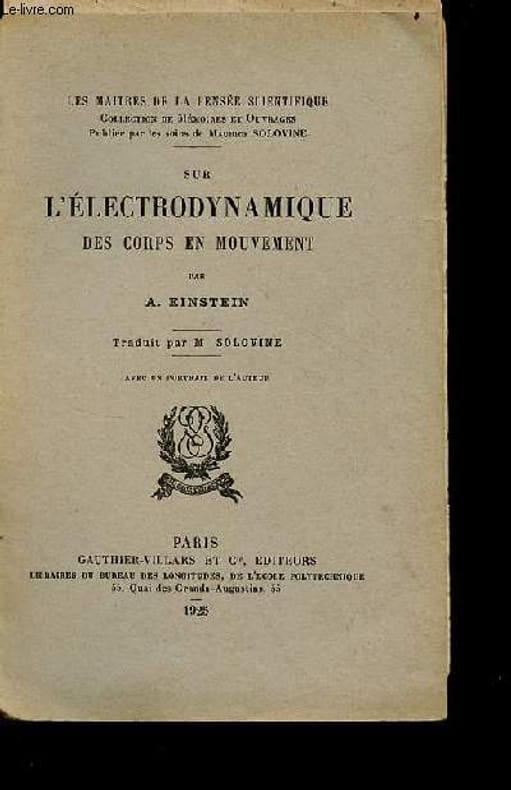
1925réf. 39308Paris, Gauthier-Villars et Cie, 1925. Small8vo. Uncut in orig. printed wrappers. Portrait. (4),56,(2) pp. + Publisher's Cat. (6 pp.). 2 leaves with an insignificant small loss of upper right corner. A fine copy.
réf. 7146P., Gauthier-Villars, 1955, un volume in 8 broché couverture imprimée, 1 portrait d'Einstein, (2), 56pp.
1925réf. R160222037Gauthier-villars et cie. 1925. In-12. Broché. Etat d'usage, 1er plat abîmé, Coiffe en pied abîmée, Papier jauni. 56 pages - portrait en noir et blanc de l'auteur en frontispice - coiffes abîmées - 1er plat désolidarisé - tampon sur la page de faux titre.. . . . Classification Dewey : 530-Physique
2005réf. H-744-296Jacques Gabay 2005. Paperback. Very Good. Former library book. Edition 2005. Ammareal gives back up to 15% of this item's net price to charity organizations. Jacques Gabay paperback
1925réf. 39308Paris Gauthier-Villars et Cie 1925. Small8vo. Uncut in orig. printed wrappers. Portrait. 4562 pp. Publisher's Cat. 6 pp. 2 leaves with an insignificant small loss of upper right corner. A fine copy. First French edition of the initials papers on Special Relativity. It is a translation of the 2 Einstein-papers which appeared in 1905 "Elektrodynamik bewegter Körper" and "Ist die Trägheit eines Körpers von seinem Energieinhalt abhängig ". Published in the series "Les Maitres de la Pensee scientifique". - Weil: 9 c - Schielpp-Schields: 189. - Boni-Laurence: 9 B and 10 B. unknown
1925réf. 31311Paris, Gauthier-Villars, 1925, in-12, 56pppp, broché, Superbe exemplaire! 56pppp
réf. 31311Couverture rigide. Bon/1925. in-12. Paris Gauthier-Villars 1925 in-12 56pppp broché Superbe exemplaire! unknown
1925réf. 79Paris: Gauthier-Villars 1925. First French edition of Zur Elektrodynamik bewegter Korper On the Electrodynamics of Moving Bodies and 1st die Tragheit eines Korpers von seinem Energieinhalt abhangig Does the Inertia of a Body Depend on its Energy Content. Both 1905 treatises are "beyond compare and without precedent one of the greatest scientific achievements in content and one of the most brilliant in style" Gosling Albert Einstein. The first paper is "a landmark in the development of physics one of the two papers that laid out the theory of special relativity formulated a new conception of time. By assuming that the speed of light is the same to every observer moving at a constant velocity Einstein showed that space and time were not independent: spacetime was born. According to Hermann Weyl in 1918 this theory 'led to the discovery that time is associated as a fourth coordinate on an equal footing with the other three coordinates of space and that the scene of material events the world is therefore a four-dimensional metrical continuum.' It was a revolutionary piece of scientific work" Calaprice The Einstein Almanac 15. In the second work Einstein uses "the postulates of the special theory of relativity Einstein showed that energy radiated is equivalent to mass lost. For the first time he concluded that 'the mass of a body is a measure of its energy content'" ibid 16. CONDITION & DETAILS: Paris: Gauthier-Villars 1925. Small 8vo. 4 56 2 6 catalog. ILLUSTRATION: Frontispiece portrait of Einstein. EXTERIOR: Complete issue bound in original light brown stiff wraps. Some light surface dirt on the front wraps and a small area in the lower right where a piece of tape has been removed. Two barely visible repairs at the spine. Tightly bound. INTERIOR: Complete. Very small spot at the upper margin of page 3. Otherwise very good condition throughout. Gauthier-Villars paperback
2016br. Albert Einstein è da tempo diventato l'icona dello scienziato geniale, l'eletto in grado di porre le basi di una rivoluzione scientifica fertile e duratura. La svolta della relatività, iniziata nel 1905 e proseguita con la formulazione della teoria della relatività generale nel 1915, offre però moltissimo materiale per indagare più a fondo e in maniera meno ovvia le ragioni e le modalità di un cambiamento tanto epocale nel nostro modo di intendere il mondo, Einstein certamente poggiava "sulle spalle dei giganti" che lo avevano preceduto (da Galileo a Newton), ma per Jürgen Renn la scienza non progredisce in modo lineare, per semplice e lento accumulo di nozioni; più spesso di quanto si pensi all'impresa scientifica partecipano anche molti "nani", che contribuiscono in maniera decisiva a determinare le grandi scoperte. Frutto di un'indagine corale, svolta all'Istituto Max Planck di Berlino per oltre vent'anni, "Sulle spalle di giganti e nani" delinea un ritratto esemplare e a tutto tondo di una teoria complessa e solida, che mette in risalto tutti i rivoli che ne costituiscono il fondamento e che ne hanno determinato il successo, permettendoci di conoscere un po' più nel dettaglio il mondo nel quale viviamo.
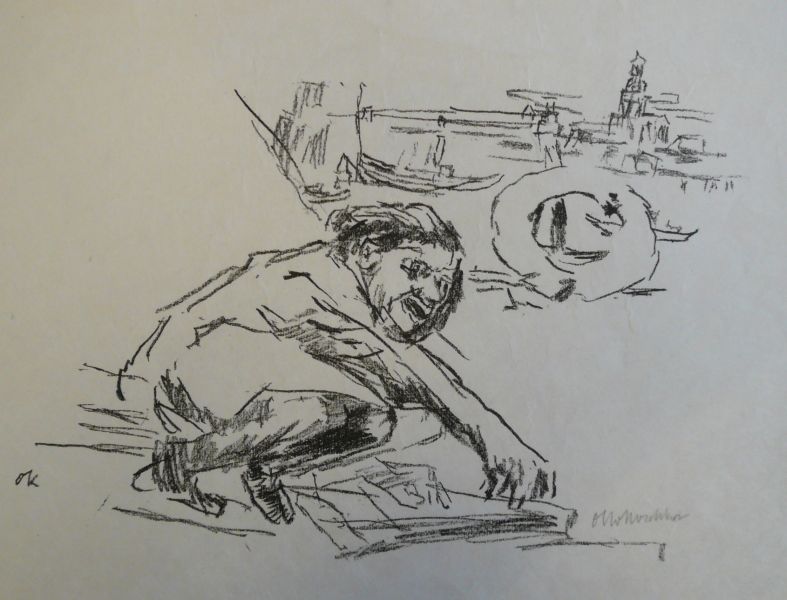
1975réf. 1403301975. Signiert. Im Stein monogrammiert. Druck auf Japan. 24,8 x 35,8 cm. Papier: 35 x 44,5 cm.
1916réf. 2364Braunschweig: Druck und Verlag von Friedr Vieweg and Son 1916. First edition. Original wrappers. Very Good. FIRST PRINTING IN ORIGINAL WRAPPERS OF ONE OF EINSTEIN'S MAJOR WORKS: HIS FIRST PAPER ON THE DERIVATION OF PLANK'S LAW AND PROVIDING THE THEORETICAL BASIS FOR THE LASER. "Einstein commended the 'unparalleled boldness' of Planck's derivation of 1900 meaning not only the problem itself but also the fact that it was based on assumptions that were not entirely free of contradictions. Einstein now succeeded in the first of two papers in eliminating that flaw. More interesting than the derivation itself was the general character of his methods. Einstein proceeded from Niels Bohr's basic--and by then well tested--assumption that the electrons within an atom occupy a number of discrete energy states and are able through emission or absorption of radiation to pass from one of those states to another. Added to this was an assumption of thermodynamic equilibrium between radiation field and atom as well as a consideration of the 'classical' limiting case at high temperatures--and there was Planck's formula. This brief argument. also covers emission stimulated by the radiation field; thus the formulas already by implication contain the theory of the laser though it was to take nearly half a century to be realized" Folsing Albert Einstein 389. Weil 85. The "implication" containing the theory of the laser was more fully developed in his companion paper "On the Quantum Theory of Radiation" published a few weeks later. In the first paper Einstein wrestled with the concept that the atomic emission of radiation could be a directed process; in the second paper he convincingly demonstrates that this is indeed the case. IN: Verhandl. D. Deutch. Phys. Ges. Vol 18 pp. 318-323. Braunschweig: Druck und Verlag von Friedr. Vieweg and Son 1916. Octavo original wrappers; housed in custom half leather chemise. One thread literally resewn on wrappers a little creasing and soiling. A beautiful copy. RARE IN ORIGINAL WRAPPERS. Druck und Verlag von Friedr Vieweg and Son unknown books