1.938 Ergebnisse
Best.-Nr. SONG1846317088Used: Good unknown
Best.-Nr. DADAX1846317088New unknown
Best.-Nr. DADAX0367173808New unknown
Best.-Nr. DADAX0415582113New unknown
Best.-Nr. DADAX0415590329New unknown
Best.-Nr. DADAX0415853729New unknown
Best.-Nr. BC-LUL4-3PA9This is the OVERSIZED softcover stated Committee For A Sane Nuclear Policy Edition from 1960. Other than the slightest hint of a cover corner crease the book is in excellent condition. There are no rips tears markings etc.---and the pages and binding are tight see photo. Note: All books listed as FIRST EDITIONS are stated by the publisher in words or number lines--or--only stated editions that include only the publisher and publication date. Check my feedback to see that I sell exactly as I describe. So bid now for this magnificent impossible-to-find POLITICAL COLLECTIBLE.Like New paperback
Best.-Nr. SONG159018212XUsed: Good unknown
Best.-Nr. DADAX0415698561New unknown
Best.-Nr. DADAX0415542006New unknown
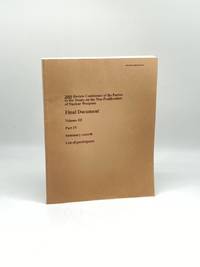
2001Best.-Nr. HVD-79820-OS-0Parties To the Treaty On the Non-Proliferation of Nuclear Weapons. Very Good. Paperback. 443 pages; Very Good condition. No noteworthy defects. No markings. . 2001. Parties To the Treaty On the Non-Proliferation of Nuclear Weapons paperback
1970Best.-Nr. 2090202120401106Iwanamishoten 1970. Soft Cover. Fine. Number of books: 1 Iwanamishoten paperback
1995Best.-Nr. 74849La Grange Park IL 1995. Wraps. Very good. vii 1 86 pages. Footnotes. Institution stamp on title page with date in ink. Among the members of the Special Panel were: Glen Seaborg Harold Bengelsdorf Harold Agnew Alexander Haig Bertrand Goldschmidt and Rudolph Rometsch. Laid in is a related item 11 pages and business card of the key conclusions and recommendations and other information. The American Nuclear Society ANS established an independent and prestigious panel to publish a report regarding the protection and management of civil and excess weapons plutonium. In terms of approach ANS focused on several short- and long-term issues. The short-term focus was on the disposition of excess weapons plutonium while the longer-range issue concerned the disposition of the plutonium being produced in the civil nuclear fuel cycle. The report contains recommendations that the members believed to be vital to US plutonium management policy it also was intended to serve as a tool for further use. The panel has concluded that immediate emphasis should be placed on the assurance that all unconverted materials are protected as securely as when they were part of the active weapon stockpiles. More importantly the panel also recommended prompt implementation of the so-called reactor option for disposing of surplus US and Russian weapons plutonium. The longer-term issues covered by the panel were those posed by the growing stocks of both separated plutonium and spent fuel generated in the world`s civil nuclear power programs. These issues included what fuel cycle policies should be prudently pursued in light of proliferation risks and likely future energy needs what steps should be taken in regard to the increase in the demand for power in the future and how plutonium in its various forms should be protected and managed to minimize proliferation. Overall the panel concluded that plutonium is an energy resource that should be used and not a waste material to be disposed of. paperback
1987Best.-Nr. 2083002116409682Iwanamishoten 1987. Soft Cover. Fine. The book is in fine condition. Iwanamishoten paperback
1995Best.-Nr. 2090502113717139Not Available 1995. Soft Cover. Fine. The book is in fine condition. Not Available paperback
1969Best.-Nr. 82559Sandia Base Albuquerque New Mexico: Defense Atomic Support Agency Field Command Nuclear Training Directorate 1969. Presumed First Edition First printing thus. Wraps. Good. Three-hole punched and stapled at left side. iv 22 pages. Illustrated front cover. Illustrations. Cover has some wear. The Table of Contents has an introduction and sections on: Pershing Organization Characteristics Pershing Missile Ground Support Equipment Trajectory Theory Flight Sequence and Summary. The fifteen illustrations are: Pershing 1a System Missile Structures Battery Control Central Erector-Launcher and M757 Tractor Programer-Test Station and Power Station Vehicle Radio Terminal Set AN/TRC-80 Missile Section Containers Pershing Trajectory First-Stage Ignition Coast Period First-State Separation and Second-Stage Ignition Thrust Termination and Warhead Separation Case Venting Warhead Reentry and Detonation. In order to improve Pershing's performance in the quick reaction alert role Pershing 1a was developed. Ground support equipment was designed for maximum tactical and strategic mobility electronic computation of firing data and automatic test and checkout equipment. The Pershing 1a also had a specially designed communications set that allowed extremely reliable communications over great distances 99.9-percent reliability at 160 kilometers. This publication was intended for home study and reference by students attending the Nuclear Weapons Maintenance Course Army Weapons Division Nuclear Training Directorate Field Command. An understanding of the facts herein was deemed essential for the proper comprehension of classroom instruction in these courses. 1964 a series of operational tests and follow-on tests were performed to determine Pershing reliability. The Secretary of Defense then requested that the Army define the modifications required to make Pershing suitable for the Quick Reaction Alert QRA role. The Pershing 1a development program was approved in 1965 the original Pershing renamed to Pershing 1 and Martin Marietta received the Pershing 1a production contract in 1967. Project SWAP replaced all the Pershing equipment in Germany by mid-1970 and the first units quickly achieved QRA status. Secretary of Defense Robert McNamara directed that the U.S. Air Force's MGM-13 Mace missile would be replaced by the Pershing 1a in 1965. Pershing 1a was a Quick Reaction Alert system and so had faster vehicles launch times and newer electronics. The total number of launchers increased from 8 to 36 per battalion. Production of the Pershing 1a missile ended in 1975 and reopened in 1977 to replace missiles expended in training. Pershing 1a was further improved in 1971 with the Pershing Missile and Power Station Development Program. A total of 754 MGM-31A missiles were built. Defense Atomic Support Agency, Field Command, Nuclear Training Directorate paperback
1970Best.-Nr. 2090202120700527Japan Atomic Industry Council 1970. Soft Cover. Fine. Number of pages: 502 pages Size: A6 Japan Atomic Industry Council paperback
1975Best.-Nr. 2083002116412319Gyoseitsushinsha 1975. Soft Cover. Fine. The book is in fine condition. Gyoseitsushinsha paperback
Best.-Nr. 2080702109501196Okura Ministry of Printing Bureau N.A. Soft Cover. Fine. Number of pages: 195p Size: 21cm Number of books: 1 Okura Ministry of Printing Bureau paperback
Best.-Nr. 2080702109504255Nikkei Science 1983.7 N.A. Soft Cover. Fine. Number of pages: 148p Size: 29cm Nikkei Science 1983.7 paperback
Best.-Nr. 2080702109501703Iwanamishoten N.A. Soft Cover. Fine. Number of pages: 221p Size: 26cm Iwanamishoten paperback
Best.-Nr. 2081502112302545Tokenshuppan N.A. Soft Cover. Fine. Number of books: 1 Tokenshuppan paperback
2005Best.-Nr. 2091502135417679Not Available 2005. Soft Cover. Fine. Number of books: 1 Not Available paperback
Best.-Nr. 2091502133540109Association of Kansai Literature Against Nuclear Warfare N.A. Soft Cover. Fine. Number of books: 1 Association of Kansai Literature Against Nuclear Warfare paperback
1983Best.-Nr. 54539Los Alamos NM: Los Alamos National Lab 1983. very good. 3-ring binder approximately 2 inches of material. Course met from October 17 to November 4 1983. Sponsored by the U.S. Department of Energy in cooperation with the International Atomic Energy Agency. The course director was Charles R. Hatcher. Los Alamos National Lab unknown