1,429 results
1984ref. 91047Washington DC: Defense Nuclear Agency 1984. Presumed First or early issuance. Three Ring Binder showing wear and tear with text disc and effects calculator in a slip case. Very good. This is one of the Defense Nuclear Agency's Electronic Handbook Series. This includes: Weapon Effects Rule WEG-1 Instructions for Use dated December 1983 tabbed section title DD From 1473 and 8 pages with illustrations; Weapon Effects Program for IBM PC/XT dated 7 December 1984 tabbed section title DD From 1473 and 16 pages disc with version 2.1 in pocket after IBM PC/XT tabbed material. The front pocket holds Weapon Effects Rule WEG-1 DNA-EH-84-01-J. The pocket has summary Instructions and Examples. Also laid in is a very rare surviving copy of DNA NWE Calculation Aids User Bulletin Issue 1-85-1 May 1985. In this issue 6 sheets printed on one side only was a statement of purpose announcement of Cratering & Ground Shock and Blast Programs Obtaining Help General Trends in NWE Calculation Aids Programs Quick Reference Matrix of NWE Calculation Aides and C&GS and Blast Order Form and Description. This is a RARE SURVIVING COPY. The Defense Nuclear Agency DNA now known as the Defense Threat Reduction Agency DTRA developed various tools manuals and aids to calculate the effects of nuclear weapons including blast thermal radiation and fallout. These tools are critical for nuclear safety survivability studies and operational planning. Key Calculation Aids and Tools: Nuclear Bomb Effects Computer Slide Rule: Included with the 1957/1962/1964 editions of The Effects of Nuclear Weapons by Samuel Glasstone and Philip J. Dolan. This circular slide rule developed by the Lovelace Foundation allows for the evaluation of 28 different effects including blast thermal radiation fallout and cratering as a function of yield and range; DOS-Based Weapons Effects Programs 1984: Validated computer simulations and models developed under contract for the Defense Nuclear Agency which are still used in some contexts. DTRA Effects Manual One EM-1: Known as "Capabilities of Nuclear Weapons" this is a foundational multi-chapter manual providing in part validated calculations and data for nuclear effects. These tools cover a range of parameters including air blast overpressure initial radiation thermal dose and crater size. Defense Nuclear Agency unknown
ref. Z1-E-014-01535Amer Nuclear Society. Used - Good. Ships from UK in 48 hours or less usually same day. Your purchase helps support Sri Lankan Children's Charity 'The Rainbow Centre'. Ex-library so some stamps and wear and may have sticker on cover but in good overall condition. 100% money back guarantee. We are a world class secondhand bookstore based in Hertfordshire United Kingdom and specialize in high quality textbooks across an enormous variety of subjects. We aim to provide a vast range of textbooks rare and collectible books at a great price. Our donations to The Rainbow Centre have helped provide an education and a safe haven to hundreds of children who live in appalling conditions. We provide a 100% money back guarantee and are dedicated to providing our customers with the highest standards of service in the bookselling industry. Amer Nuclear Society unknown
1970ref. 743921970. Presumed First Edition First printing. Hardcover. Good. 2 volumes. Volume 1 x 858 2 pages and Volume 2 vi 859-1785 5 pages. Illustrations. Footnotes. Formulae. References. Binding added proceeding soft covers present. Cover has some wear and soiling. Sponsored by the American Nuclear Society in cooperation with the Atomic Energy Commission. Related to the Plowshare program. In structuring the technical presentations contributions of the broadest interest were placed at the beginning thus forming a common base of current information and applied science understanding developed in support of Plowshare technology. Sessions of specialty or pertaining to specific areas of application and engineering follow logically in the program. Name of previous owner Jerry R. Kline present on fep of each volume. This is believed to be the Jerry Kline who served at the Puerto Rico Nuclear Center 1965-68 Argonne National Laboratories 1968-1973 and with the Atomic Energy Commission and as an Administrative Judge on the Atomic Safety and Licensing Board. Edward Teller was a presenter! This proceedings includes 112 papers presented at 15 technical sessions covered all technical aspects of the Plowshare Program. The conference summary reviewed the principal themes areas of significant advance and subjects requiring further attention that emerged during the technical conference. This proceeding is the record of this symposium. At this symposium there were 620 registrations peak attendance in technical sessions was 800 and 28 members of the press attended. There were 16 foreign countries represented and 24 universities. In terms of industrial firms 117 were from the United States and 18 were foreign. The International Atomic Energy Agency participated as did representatives from 5 foreign governments. hardcover
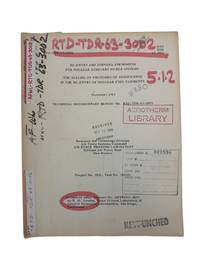
1963ref. 239921963. A 1963 U.S. Air Force and General Dynamics study addressing one of the fundamental hazards of early nuclear spaceflight: what would happen to an orbiting nuclear reactor and its fuel during an uncontrolled return through the Earth's atmosphere. Prepared by R. W. Andrews of the Advanced Technology Laboratory General Dynamics/Astronautics for the Air Force Weapons Laboratory at Kirtland Air Force Base the report develops scaling methods for modeling the heating structural failure and dispersal of nuclear fuel elements under reentry conditions. Its November 1963 date places the work during active American development of SNAP era space nuclear systems shortly before the 1965 launch of SNAP 10A the first U.S. nuclear reactor placed in orbit when the fate of reactor fuel during unsuccessful missions had become a defined aerospace safety problem. Andrews R. W. Re Entry and Disposal Phenomena for Nuclear Auxiliary Power Systems: The Scaling of Processes of Significance in the Re Entry of Nuclear Fuel Elements. Kirtland Air Force Base New Mexico: Research and Technology Division Air Force Systems Command Air Force Weapons Laboratory 1963. Technical Documentary Report RTD TDR 63 3002. Prepared under Contract No. AF29601 5893 by the Advanced Technology Laboratory General Dynamics/Astronautics San Diego California. 39 pages. 8.5 x 11 inches. The abstract states that the study formulates model scaling laws for physical phenomena associated with "re entry and dispersal of the debris from an orbiting nuclear reactor or power source" specifically addressing tumbling and free fall aerodynamic heating thermal stresses and temperature gas desorption and expansion in homogeneous solids. Andrews develops prototype scale trajectories for spheres and tumbling rods examines aerodynamic heating under hypersonic flight and ground test conditions and considers transient heating degassing and stresses produced in homogeneous materials. The publication review leaf bears manuscript approval signatures of project and USAF personnel while the foreword acknowledges discussions with specialists associated with General Dynamics/Astronautics and the Air Force program. This copy preserves extensive institutional use evidence: an "AEROTHERM LIBRARY" stamp "RECEIVED OCT 19 1966" stamp "KEEP PUNCHED" marking accession number 021594 project and task fields adhesive classification or routing labels and manuscript report numbers and shelf annotations across the front wrapper. The report belongs to the period in which American space nuclear engineering had to address not only reactor performance in orbit but the consequences of launch failure orbital decay and uncontrolled return through the atmosphere. Reentry engineering required proving through scaled ground tests that nuclear fuel elements robust enough for launch and operation would nevertheless heat fragment melt or disperse predictably during atmospheric return. Moderate toning and handling wear to wrappers with institutional stamps labels and manuscript markings as described; interior leaves generally clean with light age toning. Overall good condition. A technical record of the effort to make the destruction and atmospheric behavior of nuclear spacecraft components calculable before nuclear power systems entered operational use in orbit. unknown