1.422 resultados
ref. 2831Oak Ridge Institute of Nuclear Studies Medical Division; Oak Ridge Tennessee; 1964-1965. A hardcover volume consisting of reprints from the Oak Ridge Institute of Nuclear Studies Medical Division for the years 1964-1965. With the ownership inkstamp of Dr. Michael E. DeBakey on the front free endpaper. Red cloth-covered boards gilt spine lettering 11 x 8 1/2 inches. Contains multiple reprints from journals book chapters government documents and abstracts. All originating from the Medical Division Oak Ridge Institute of Nuclear Studies. 3214022. F. Hardcover. Oak Ridge Institute of Nuclear Studies, Medical Division; Oak Ridge, Tennessee; 1964-1965. hardcover
2009ref. LFA-126719588Revue trimestrielle fondée par Raymond Aron : 288 pages, format 185 x 255 mm, brochée, bon état
2009ref. LFA-126719589Revue trimestrielle fondée par Raymond Aron : 280 pages, format 185 x 255 mm, brochée, bon état
ref. 201508604S.l., Editions hirle, 2007 ; in-4, 187 pp., cartonnage de l'éditeur.
ref. 201412237, Editions hirlé , 2007 ; in-4, 187 pp., cartonnage de l'éditeur.
1976ref. 62132Couverture souple. Broché. 130 pages. Légèrement défraîchi.
1967ref. 2092902143900652Japan Atomic Industry Council 1967. Soft Cover. Fine. Number of books: 1 book Japan Atomic Industry Council paperback
1967ref. 2092902143800650Japan Atomic Industry Council 1967. Soft Cover. Fine. Number of books: 1 book Japan Atomic Industry Council paperback
1996ref. 291467PN. New. 1996. Soft Cover. Date is original print. This is a reprint edition . PN paperback
1997ref. 776571997 Paris, Transition, 1997, in 8° broché, 315 pages ; couverture illustrée.
1974ref. 26402Couverture souple. Broché. 446 pages. Pliure à la couverture.
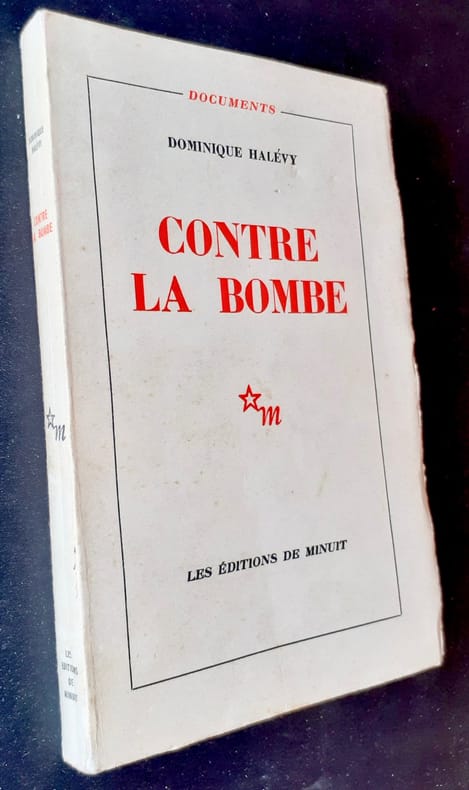
ref. 46949Paris : Editions de Minuit, 1960. Un volume broché (18,5x12 cm), 191 pages. Quelques rousseurs sur la couverture sinon bon état.
1950204p. Inked ownership. 8vo. Original full red paper binding. Original dust jacket, worn. Hardbound. SPACE/3
1987SOFTCOVER. Sticker to spine and inside cover, stamp to page block. Text is clean, tight and bright Ex - Library
2004ref. 1342809PN. New. 2004. Soft Cover. md . PN paperback
1967Book is in excellent condition in grey cloth HB covers with sparkles, silver print at spine. Binding is solid and square, covers have sharp corners, exterior shows no blemishes, text/interior is clean and free of marking of any kind. Dust jacket shows the slightest signs of shelf wear only, no tears, now wrapped in protective clear cover. Contents includes: Journey from Sharpeville to Selma,
ref. 1500208930.Gpaperback. Good. Access codes and supplements are not guaranteed with used items. May be an ex-library book. paperback
ref. A9781286862872Paperback / softback. New. paperback
ref. B9781286862872Paperback / softback. New. paperback
ref. 1494939959.Gpaperback. Good. Access codes and supplements are not guaranteed with used items. May be an ex-library book. paperback
Minuit, 1981, 176 pp., broché, quelques passages signalés au stylo et au feutre transparent, légères traces d'usage, annotation et ex-libris en première page, annotation en troisième de couverture, état correct.
1957Secondo manifesto del Movimento Arte Nucleare che, dopo l'affermazione della volontà di combattere ogni accademismo, risalente al primo manifesto, afferma ora l'irripetibilità dell'opera d'arte. Testo in italiano, francese e inglese, stampato fronte retro su foglio di cartoncino ripiegato in tre parti, da un lato con scritte gialle su fondo nero e dall'altro lato con scritte nere su fondo grigio. Copertine di velina azzurra. Il manifesto è firmato da Armand, Enrico Baj, Bemporad, Gianni Bertini, Jaques Calonne, Stanley Chapmans, Mario Colucci, Danerlo, Enrico De Miceli, Reinhout D'Haese, Wout Hoeboer, Hundertwasser, Yves Klein, Théodore Koenig, Piero Manzoni, Nando, Joseph Noiret, Arnaldo Pomodoro, Giò Pomodoro, Pierre Restany, Saura, Ettore Sordini, Serge Vandercam, Angelo Verga / The second manifesto of the Arte Nucleare Group. Folded card sheet, printed in black and yellow on heavy black card within printed turquoise tissue wrapper . 4to (cm 30,5x17). . . Ottimo (Fine). . . .
1992ref. 87382La Grange Park IL: American Nuclear Society 1992. Presumed First Edition First printing. Hardcover. Very good. xii 193 3 pages. Footnotes. Illustrations a few with color. Tabular data. Bibliography. Illustrated front cover. No dust jacket present. It's been 50 years since the Chicago Pile experiment and the first controlled chain reaction. Anonymous volunteer contributors from the ANS have put together this history which ends with a celebration of the future of nuclear power but does not talk of what to do with radioactive waste. This book was prepared by a volunteer effort of a large number of people over several months. The authors take responsibility for the choice of material on the many possible issued covered. It was the belief of the authors that the beneficial impacts of nuclear energy while already enormous represent only a small fraction of the benefits yet to be gained and that this brief history of the first 50 years of the controlled nuclear chain reaction represents only the first phase of the nuclear era. The contents include Introduction Chicago Pile No. 1: The First Controlled Nuclear Chain Reaction; Development of Nuclear Power Plants in the United States; Development of Nuclear Power Plants in Canada and Europe; Status of Nuclear Power Development; Other Peaceful Applications of Nuclear Energy; Nuclear Fuel Technology; Nuclear Safety; and Working Toward a Nuclear Future. Chicago Pile-1 CP-1 was the world's first artificial nuclear reactor. On 2 December 1942 the first human-made self-sustaining nuclear chain reaction was initiated in CP-1 during an experiment led by Enrico Fermi. The secret development of the reactor was the first major technical achievement for the Manhattan Project the Allied effort to create nuclear weapons during World War II. Developed by the Metallurgical Laboratory at the University of Chicago CP-1 was built under the west viewing stands of the original Stagg Field. Although the project's civilian and military leaders had misgivings about the possibility of a disastrous runaway reaction they trusted Fermi's safety calculations and decided they could carry out the experiment in a densely populated area. Fermi described the reactor as "a crude pile of black bricks and wooden timbers." After a series of attempts the successful reactor was assembled in November 1942 by a team of about 30 that in addition to Fermi included scientists Leo Szilard Leona Woods Herbert L. Anderson Walter Zinn Martin D. Whitaker and George Weil. The reactor used natural uranium. This required a very large amount of material in order to reach criticality along with graphite used as a neutron moderator. The reactor contained 45000 ultra-pure graphite blocks weighing 360 short tons and was fueled by 5.4 short tons of uranium metal and 45 short tons of uranium oxide. Unlike most subsequent nuclear reactors it had no radiation shielding or cooling system as it operated at very low power - about one-half watt. The success of Chicago Pile-1 provided the first vivid demonstration of the feasibility of the military use of nuclear energy by the Allies as well as the reality of the danger that Nazi Germany could succeed in producing nuclear weapons. Previously estimates of critical masses had been crude calculations leading to order-of-magnitude uncertainties about the size of a hypothetical bomb. The successful use of graphite as a moderator paved the way for progress in the Allied effort. The Germans had failed to account for the importance of boron and cadmium impurities in the graphite samples on which they ran their test of its usability as a moderator while Leo Szilard and Enrico Fermi had asked suppliers about the most common contaminations of graphite after a first failed test. They consequently ensured that the next test would be run with graphite entirely devoid of them. In 1943 CP-1 was moved to Red Gate Woods and reconfigured to become Chicago Pile-2 CP-2. There it was operated for research until 1954 when it was dismantled and buried. The stands at Stagg Field were demolished in August 1957; the site is now a National Historic Landmark and a Chicago Landmark. American Nuclear Society hardcover
1992ref. Q-0894485571Amer Nuclear Society 1992-12-01. Hardcover. New. In shrink wrap. Looks like an interesting title! Amer Nuclear Society hardcover
ref. DADAX0894485571Brand: Amer Nuclear Society 0000-00-00. hardcover. New. 6.50x0.75x9.50. Buy with confidence. Excellent Customer Service & Return policy. Brand: Amer Nuclear Society hardcover