Castelli, Enrico (Ed.)Antiquariat.de

2246 resultados
1971ref. 3125375Paris: Aubier 1971. 211 Seiten. Gr. 8° (22,5-25 cm). Orig.-Broschur. [Softcover / Paperback].
2000ref. 3129135Paris: Honoré Champion 2000. (6), 544 Seiten. 8° (17,5-22,5 cm). Orig.-Broschur. [Softcover / Paperback].
1956ref. 145282Paris: Centre National de la Recherche scientifique 1956. 280 Seiten. Gr. 8° (22,5-25 cm). Orig.-Leinenband. [Hardcover / fest gebunden].
1970ref. 3082985Paris: Aubier 1970. 584 Seiten. Gr. 8° (22,5-25 cm). Orig.-Broschur. [Softcover / Paperback].
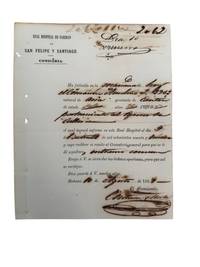
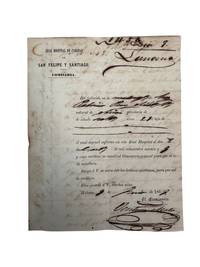
1869ref. 238081869. Cantonese Chinese migrant hospital certificate from Havana in 1869 recording the death and burial administration of a man identified in manuscript as "natural de Asia provincia de Canton" during the height of Chinese contract migration to Cuba. Evidence collected from 1176 Chinese laborers by the 1874 Cuba Commission identified 998 as coming from Canton and recent scholarship estimates that approximately 85 percent of Chinese laborers transported to Cuba originated in the province. More than 141000 Chinese workers reached Cuba during the trade from 1847 to 1874 where colonos asiáticos supplied low paid bound labor to sugar plantations and other sectors while African slavery remained legal. The manuscript designation on this sheet therefore connects an individual hospital patient to the principal South Chinese migration stream supplying nineteenth century Cuba's contract labor system. Real Hospital de Caridad de San Felipe y Santiago Comisaría. Havana 1869. One partially printed document completed in manuscript in brown ink one leaf. 5.75" x 7.25". The form identifies the deceased as "natural de Asia provincia de Canton" followed by manuscript entries in printed fields for civil status age and parentage. Its formula begins "Ha fallecido en la." and records his entry into the "Real Hospital" followed by the circumstances of his death. The printed disposition directs that "cuyo cadaver se remite al Cementerio general para que se le de sepultura" placing the individual within the administrative sequence connecting hospital death with municipal burial. The certificate closes "Luego á V. se sirva dar las órdenes oportunas para que asi se verifique. Dios guarde á V. muchos años" followed by a manuscript date of August 10 1869 and signatures. The sheet carries substantial brown manuscript writing and administrative notations with extensive ink offsetting and show through on the verso. Chinese contract migration to Cuba developed alongside slavery rather than replacing it immediately allowing Cuban planters to supplement enslaved African labor with a substantially cheaper bound workforce. Between 1865 and 1874 alone more than 64000 Chinese indentured laborers entered Cuba and the majority worked initially on sugar plantations. Canton and the Pearl River Delta supplied the overwhelming share of these migrants whose standard first indentures commonly lasted eight years; the trade continued until 1874 while existing contracts remained in force afterward. By the time this certificate was issued in 1869 Chinese laborers were present not only on plantations but in factories transportation construction public works and urban occupations creating institutional encounters extending beyond the labor contract itself. Moderate toning and staining several small punctures and marginal tears old folds extensive manuscript ink offsetting and show through; principal printed and manuscript content remains legible. Overall good condition. An individualized record connecting Cantonese migration to Cuba with the hospital death and burial bureaucracy encountered by Chinese migrants within the island's nineteenth century contract labor society. unknown books
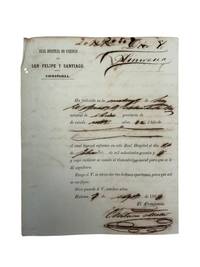
1869ref. 238091869. Chinese migrant hospital certificate from Havana in 1869 documenting the admission and death of a man identified in manuscript as a native of China within the Real Hospital de Caridad de San Felipe y Santiago. Issued while Chinese contract labor supplied Cuba with a large migrant workforce under a system regulating employment movement subsistence discipline and medical treatment the certificate records one individual at the point where that labor regime intersected with colonial hospital administration. Chinese labor contracts of the period commonly stipulated medical attendance and hospital care during illness while later testimony documented high rates of sickness and death among Chinese workers subjected to excessive labor inadequate food punishment and compulsory recontracting. Real Hospital de Caridad de San Felipe y Santiago Comisaría. Havana 1869. One partially printed document completed in manuscript in brown ink one leaf. 5.75" x 7.25". The deceased is identified in the manuscript as "natural de China" followed by entries within printed fields for province civil status age and parentage. The printed form begins "Ha fallecido en la." and subsequently records the date on which the individual "ingreso enfermo en este Real Hospital." Its concluding administrative language directs that "cuyo cadaver se remite al Cementerio general para que se le de sepultura" followed by the request that the appropriate orders be given "para que asi se verifique." The certificate closes "Dios guarde á V. muchos años" with a manuscript Havana date in 1869 and an administrative signature. Extensive brown manuscript entries occupy the principal fields with signatures and notations extending beyond the printed guide lines and offsetting substantially onto the verso. Chinese contract migration to Cuba began in 1847 and brought more than 100000 migrants to the island before the overseas contract trade ended in the 1870s. The overwhelming majority were men recruited from southern China and bound to fixed terms of labor under contracts governing wages subsistence discipline illness and medical treatment. By 1869 these migrants worked within an economy in which African slavery and Chinese indenture operated concurrently particularly in sugar production but also in transportation construction manufacturing domestic service and urban employment. Hospital records add a different administrative dimension to the labor contracts through which this population is more commonly documented. Surviving records of the Real Hospital de Caridad de San Felipe y Santiago classify patients by names ages origins racial or legal categories illnesses and deaths and institutional holdings preserve certificates specifically concerning Chinese colonos. Moderate toning and staining small marginal punctures and tears old folds and extensive brown ink offsetting and show through; manuscript and printed text remain substantially legible. Overall good condition. An individualized record of the medical and mortuary bureaucracy through which an Asian migrant was classified hospitalized and buried in Havana in 1869. unknown books
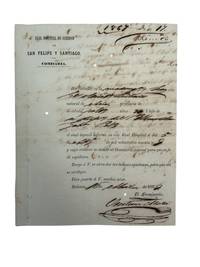
1869ref. 238071869. Chinese migrant hospital certificate from Havana in 1869 documenting the admission and death of a man identified in manuscript as a native of China within the Real Hospital de Caridad de San Felipe y Santiago. Issued while Chinese contract labor supplied Cuba with a large migrant workforce under a system regulating employment movement subsistence discipline and medical treatment the certificate records one individual at the point where that labor regime intersected with colonial hospital administration. Chinese labor contracts of the period commonly stipulated medical attendance and hospital care during illness while later testimony documented high rates of sickness and death among Chinese workers subjected to excessive labor inadequate food punishment and compulsory recontracting. Real Hospital de Caridad de San Felipe y Santiago Comisaría. Havana 1869. One partially printed document completed in manuscript in brown ink one leaf. 5.75" x 7.25". The form begins "Ha fallecido en la." with manuscript completion identifying the individual and supplying personal information including his Chinese origin followed by printed fields for province marital status age as 30 years old and parentage. The central printed language records entry into the "Real Hospital" on a specified date and provides for the circumstances of the patient's death and burial concluding with the formula "y cuyo cadaver se remite al Cementerio general para que se le de sepultura." The final lines state that the certificate is issued "para que asi se verifique" followed by "Dios guarde á V. muchos años" and the manuscript date at Havana in 1869. Multiple manuscript signatures and administrative notations appear across the recto with substantial brown ink offsetting and show through on the verso. The form belongs to a documented class of death and burial certificates issued by the Real Hospital de Caridad de San Felipe y Santiago for patients moving through Havana's nineteenth century charitable hospital system. Chinese labor migration to Cuba began in 1847 and developed into a coercive contract system that brought large numbers of Chinese men to the island as colonos asiáticos. Surviving contracts from the 1860s identify individual workers by name age origin occupation marital status wages rations clothing allowances and provisions for medical treatment while regulating the duration and conditions of their service. By 1869 the system was deeply established and increasingly subject to criticism over recruitment practices punishment illness mortality restrictions on movement and the conditions under which workers could complete or renew their contracts. The explicit death and burial language makes this document more precisely identifiable than a general admission certificate. Moderate toning and staining several small wormholes punctures and marginal tears old folds extensive manuscript ink offsetting and show through not affecting the printed text. Overall good condition. An individualized 1869 record connecting a Chinese migrant in Havana with the hospital death and burial bureaucracy operating alongside Cuba's nineteenth century system of Chinese contract labor. unknown books
1866ref. 238061866. Chinese migrant hospital certificate from Havana in 1866 recording the name admission and treatment of a young man identified on the document as a native of China during the height of Cuba's Chinese contract labor system. Tens of thousands of Chinese men were brought to nineteenth century Cuba under contracts that regulated labor wages food clothing discipline illness and medical care; surviving Cuban labor agreements from the same year specifically required employers to provide medical attendance and hospital treatment. Issued by the Real Hospital de Caridad de San Felipe y Santiago this partially printed form places the Chinese patient within the institutional machinery that administered illness and hospitalization in colonial Havana. Its 1866 date also coincides with international efforts to regulate Chinese overseas recruitment following extensive reports of kidnapping coercion and abuse within the labor migration system. Real Hospital de Caridad de San Felipe y Santiago Comisaría. Havana 1866. Partially printed document completed in manuscript in brown ink one leaf. 5.75" x 7.25". The form identifies the patient's name in manuscript describes him as "natural de China" and records his age as approximately 29 years indicative of the harsh work conditions many of these contract laborers faced. It states that he entered the "Real Hospital" on the 10th of an unidentified month 1866 and remained there until his discharge after which the document was issued so that the appropriate government office could determine the charges incurred during his hospital stay. The printed conclusion reads in part "y cuyo cadaver se remitia al Cementerio general para que se le de sepultura.". The English translation of the phrase is: "and whose body was sent to the general cemetery to be buried." Marked "Habana" in 1866 with manuscript completion and signatures in brown ink. The verso bears substantial ink offsetting and show through from the manuscript entries. Chinese migration to Cuba had developed into a large contract labor system by the 1860s supplying workers to an economy undergoing the gradual transformation of slavery while retaining coercive labor practices. Cuban Chinese contracts preserved in institutional collections identify workers by Spanish and sometimes Chinese names and record age origin occupation wages food clothing hours illness and medical treatment; a University of Florida collection alone contains fifty two such contracts dating from 1861 to 1878 including Havana contracts from 1866. Chinese authorities were simultaneously receiving accounts of laborers being deceived kidnapped or sold into overseas service prompting the 1866 regulations intended to control recruitment and protect emigrant laborers. Later diplomatic negotiations over conditions in Cuba specifically addressed Chinese laborers incapacitated by sickness contractual medical obligations freedom from physical punishment completion of service and repatriation demonstrating how health and physical capacity were embedded in the administration of the labor regime. This hospital certificate records that system at the level of one Chinese individual not through the clauses of a labor agreement but through the medical bureaucracy encountered when a migrant entered a Havana charitable hospital. Moderate toning and edge wear several small marginal tears and punctures manuscript ink offsetting and staining with loss at the lower left edge not affecting the principal printed text. Overall good condition. An individualized record of a Chinese migrant passing through Havana's colonial hospital system in 1866 connecting Chinese migration and contract labor to the bureaucratic administration of sickness institutional care and bodily capacity in nineteenth century Cuba. unknown books
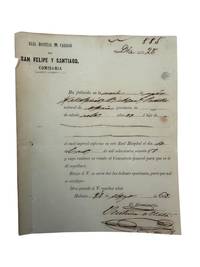
1869ref. 238101869. Chinese migrant hospital certificate from Havana in 1869 documenting the admission and death of a man identified in manuscript as a native of China within the Real Hospital de Caridad de San Felipe y Santiago. Issued while Chinese contract labor supplied Cuba with a large migrant workforce under a system regulating employment movement subsistence discipline and medical treatment the certificate records one individual at the point where that labor regime intersected with colonial hospital administration. Chinese labor contracts of the period commonly stipulated medical attendance and hospital care during illness while later testimony documented high rates of sickness and death among Chinese workers subjected to excessive labor inadequate food punishment and compulsory recontracting. Real Hospital de Caridad de San Felipe y Santiago Comisaría. Havana 1869.One partially printed document completed in manuscript in brown ink one leaf. 5.75" x 7.25". The form identifies the deceased as "natural de China" and records his age as 29 years followed by manuscript entries in printed fields for civil status and parentage. The institutional formula begins "Ha fallecido en la." and subsequently records the date on which the man "ingreso enfermo en este Real Hospital." Following his death the printed text directs that "cuyo cadaver se remite al Cementerio general para que se le de sepultura" then requests the appropriate administrative orders "para que asi se verifique." The certificate concludes "Dios guarde á V. muchos años" with a manuscript Havana date in 1869 and signatures. Manuscript annotations extend across the printed fields and margins with extensive brown ink offsetting and show through on the verso. Chinese contract migration to Cuba began in 1847 and brought more than 100000 migrants to the island before the overseas contract trade ended in the 1870s. The overwhelming majority were men recruited from southern China and bound to fixed terms of labor under contracts governing wages subsistence discipline illness and medical treatment. By 1869 these migrants worked within an economy in which African slavery and Chinese indenture operated concurrently particularly in sugar production but also in transportation construction manufacturing domestic service and urban employment. Hospital records add a different administrative dimension to the labor contracts through which this population is more commonly documented. Surviving records of the Real Hospital de Caridad de San Felipe y Santiago classify patients by names ages origins racial or legal categories illnesses and deaths and institutional holdings preserve certificates specifically concerning Chinese colonos. Moderate toning and staining small marginal wormholes old folds and extensive brown ink offsetting and show through; manuscript and printed text remain substantially legible. Overall good condition. An individualized record of the medical and mortuary bureaucracy through which an Asian migrant was classified hospitalized and buried in Havana in 1869. unknown books
2002ref. 187736Los Angeles: AIDS Healthcare Foundation 2002. Magazine. 28p. 8.5x11 inches profusely illustrated with color and b&w photos graphs figures tables reports very good glossy report/brochure in stapled pictorial wraps. AIDS Healthcare Foundation unknown books
2018ABOUT THE BOOK:- Maternal health is a globally accepted important human development indicator. International community recognizes maternal well being as basic human right of women. Through various conventions United Nations Organisation has tried to make member states responsible for providing quality health care to its citizens. Reduction of maternal mortality is an area of concern for the Governments across the globe. Maternal health care for women who are poor, and facing multiple vulnerabilities and biases continues to be inadequate. Health budgets, adequate, skilled, gender sensitive health personnel, remain inadequate. Services don’t reach the mothers who need them, even years after various schemes. Uttarakhand being a high focus state of the National Health Mission. Still a significant number of home deliveries take place because of the difficult terrain, lack of transport facilities. The mothers and newborns need much better care and support than what they receive in many parts, especially if they are poor and the newborn is a girl child. ABOUT THE AUTHOR:- Archana Sinha, a Doctorate in Agricultural Economics, currently is Fellow and Head, of the Department of Women's Studies; and just before this she was Head, of the Department of Rural and Urban Studies, Indian Social Institute, Lodi Road, New Delhi, India for the past several years. She is responsible for implementing research on various women issues, rural and urban based issues on gender and development, women at work, social conflict, agriculture related rural economy, livelihood, gender and social exclusion, food security, nutrition, health promotion, MDGs and now SDGs related issues, etc. She is also involved in research studies, proposals, plans and surveys. She worked for evaluation studies and impact assessment in several flagship development programmes of Government of India with experiences drawn from the field and research. Also involved in publications of research reports, designing, conducting and organizing research methodology, advocacy and capacity building programs, networking and collaborating with similar other organizations in research, capacity building in research, etc and advocacy programs. She has written extensively on agriculture, gender, water, labour, food security, health & nutrition, and issues related to sustainable development and and human development. CONTENTS:- Foreword . 11 Acknowledgements . 15 Glossary of Abbreviations . 17 1. Understanding Maternal Health Care in India . 21 • Socio-Demographic Influences and Maternal Health • Recognizing Maternal Health Care System • Contextual Framework • Conceptual Framework • Objectives of the Study • Study Area • Methodology • Data Collection Tools • Sample Selection • Sample Size. 2. Promoting Safe Institutional Delivery . 41 • Understanding Janani Suraksha Yojana (JSY) • Health System and Service Providers • Accessibility of Health System and Quality of Care. 3. Health Status Profile of Uttarakhand . 53 • Public Health Institutions and Professionals. 4. Access and Utilization of Janani Suraksha Yojana in Uttarakhand . 59 • Characteristics of Respondents’ Households • Practices of Health Care by Respondent Women and Extent of JSY Use • Problems Faced by Partial-Users or Non-Users of Janani Suraksha Yojana • Status of Maternal Health Care Utilisation in Uttarakhand • Pregnancy Related Beliefs and Practices • General Awareness and Perception about JSY. 5. Critique of Service Providers and Health Institutions in Uttarakhand . 99 • Selected Service Providers • Perception of Health Service Providers on Utilization Level of Maternal Health Services • Challenges of JSY Service Providers • Response of Health Service Providers on Institutional Deliveries • Selected Health Institutions. 6. Maternal Health Care and the Way Forward . 119 • Major Findings • Recommendations. Bibliography . 131 Index . 137 The Title 'Maternal Health Care: Study of Janani Suraksha Yojana (JSY) in Uttarakhand written/authored/edited by Archana Sinha', published in the year 2018. The ISBN 9788189762674 is assigned to the Hardcover version of this title. This book has total of pp. 143 (Pages). The publisher of this title is Indian Social Institute (Gyan Publishing House). This Book is in English. The subject of this book is Women Studies / Healthcare. Size of the book is 14.34 x 22.59 cms Vol:-
2019The Title 'Husband Participation in Maternal Healthcare written/authored/edited by Dr. Gyanvati', published in the year 2019. The ISBN 9789353240622 is assigned to the Hardcover version of this title. This book has total of pp. 128 (Pages). The publisher of this title is Kalpaz Publications. This Book is in English. The subject of this book is Women Studies / Maternal Healthcare. Size of the book is 14.34 x 22.59 cms Vol:-
in-4° 302 pp., broche, couverture plastifiee. NEUF sous cello. [PLC-7]
2 volumes in-12, 1112 pp., broches, couv. Bon ensemble. [DV-20] Tome I : Médécine.- Tome II : Chirurgie et Spécialités.
in-8°, 399 pp., broche, couv. Bel exemplaire [109B-11]
in-8°, 188 pages, broche, couverture illustree en couleurs. Bon etat. [LA-7]
in-8°, 205 pages, ill. h.t. n&b, notes, lexique, biblio, broche, couverture illustree à rabats. Bel exemplaire. [LA-7]
fort volume in-12, 448 pp., gravures, cartonnage illustre de l"editeur, dos basane, piece de titre. Bon etat (Qq. defauts d'us.). [CA31-8]
in-8, 290 p., nombreuses figures et illustrations in-t. n., broche, couv. Bon etat [MI-25][CL-5]
fort volume in-4, 861 pp., nombreuses planches couleurs, modele anatomique à système, gravures in-t., cartonnage toilé bleu illustre de l"editeur (image collée). Décharges d'adhésif aux gardes sinon tres bel exemplaire. [PIL-5A]
fort volume in-12, 809 + 24 pp., gravures, cartonnage percale rouge illustré de l"editeur. Bon etat (Qq. defauts d'us.). [BAT-3]
in-8, 192 pages, broché. Etat d'usage [SO-6]
1997127 pages. An accessible, often humorous, and entirely practical resource for pastoral caregivers and healthcare professionals. A timely book for anyone with a friend or relative in continuing care. Clean, bright and unmarked with very light wear. Excellent copy. Book
1975Signed and inscribed by Tommy Douglas upon title page. 333 pages. Index. Footnotes. "Few political leaders have earned the affection of their followers to the degree that Tommy Douglas has. And few politicians have accomplished so much while retaining their integrity, humanity, and principles so completely." - from dust jacket. A 2004 national vote of Canadians selected Mr. Douglas as the greatest Canadian of all time. Unmarked. Somewhat above-average overall wear. Binding intact. Moderate spine slant. Coffee stains to fore- and bottom edges. Dust jacket now preserved in glossy new archival-grade Brodart. A wonderful Tommy Douglas memento. Book
1996ii, 99 pages. Includes black and white reproductions of photos, list of practising doctors, list of long-term serving staff, list of licensed practical nurse grads, and tributes to Agnes (Fast) Anderson, P.K. Penner, and Judge J.M. George. Author served as an administrator at this hospital located in Steinbach, Manitoba. He was motivated to record the hospital's history either "as an ego trip or due to a queasy feeling that a carefully orchestrated dismantling process of our health care system is at work." - Preface. First blank leaf removed. Clean and unmarked with moderate wear. A sound copy of this informative history. Book