2 542 résultats
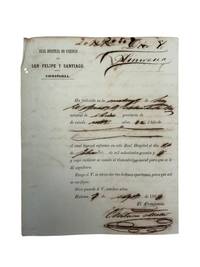
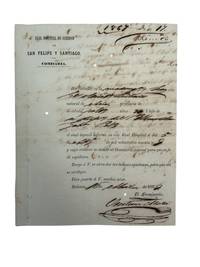
1869réf. 238071869. Chinese migrant hospital certificate from Havana in 1869 documenting the admission and death of a man identified in manuscript as a native of China within the Real Hospital de Caridad de San Felipe y Santiago. Issued while Chinese contract labor supplied Cuba with a large migrant workforce under a system regulating employment movement subsistence discipline and medical treatment the certificate records one individual at the point where that labor regime intersected with colonial hospital administration. Chinese labor contracts of the period commonly stipulated medical attendance and hospital care during illness while later testimony documented high rates of sickness and death among Chinese workers subjected to excessive labor inadequate food punishment and compulsory recontracting. Real Hospital de Caridad de San Felipe y Santiago Comisaría. Havana 1869. One partially printed document completed in manuscript in brown ink one leaf. 5.75" x 7.25". The form begins "Ha fallecido en la." with manuscript completion identifying the individual and supplying personal information including his Chinese origin followed by printed fields for province marital status age as 30 years old and parentage. The central printed language records entry into the "Real Hospital" on a specified date and provides for the circumstances of the patient's death and burial concluding with the formula "y cuyo cadaver se remite al Cementerio general para que se le de sepultura." The final lines state that the certificate is issued "para que asi se verifique" followed by "Dios guarde á V. muchos años" and the manuscript date at Havana in 1869. Multiple manuscript signatures and administrative notations appear across the recto with substantial brown ink offsetting and show through on the verso. The form belongs to a documented class of death and burial certificates issued by the Real Hospital de Caridad de San Felipe y Santiago for patients moving through Havana's nineteenth century charitable hospital system. Chinese labor migration to Cuba began in 1847 and developed into a coercive contract system that brought large numbers of Chinese men to the island as colonos asiáticos. Surviving contracts from the 1860s identify individual workers by name age origin occupation marital status wages rations clothing allowances and provisions for medical treatment while regulating the duration and conditions of their service. By 1869 the system was deeply established and increasingly subject to criticism over recruitment practices punishment illness mortality restrictions on movement and the conditions under which workers could complete or renew their contracts. The explicit death and burial language makes this document more precisely identifiable than a general admission certificate. Moderate toning and staining several small wormholes punctures and marginal tears old folds extensive manuscript ink offsetting and show through not affecting the printed text. Overall good condition. An individualized 1869 record connecting a Chinese migrant in Havana with the hospital death and burial bureaucracy operating alongside Cuba's nineteenth century system of Chinese contract labor. unknown books
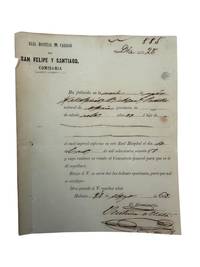
1869réf. 238091869. Chinese migrant hospital certificate from Havana in 1869 documenting the admission and death of a man identified in manuscript as a native of China within the Real Hospital de Caridad de San Felipe y Santiago. Issued while Chinese contract labor supplied Cuba with a large migrant workforce under a system regulating employment movement subsistence discipline and medical treatment the certificate records one individual at the point where that labor regime intersected with colonial hospital administration. Chinese labor contracts of the period commonly stipulated medical attendance and hospital care during illness while later testimony documented high rates of sickness and death among Chinese workers subjected to excessive labor inadequate food punishment and compulsory recontracting. Real Hospital de Caridad de San Felipe y Santiago Comisaría. Havana 1869. One partially printed document completed in manuscript in brown ink one leaf. 5.75" x 7.25". The deceased is identified in the manuscript as "natural de China" followed by entries within printed fields for province civil status age and parentage. The printed form begins "Ha fallecido en la." and subsequently records the date on which the individual "ingreso enfermo en este Real Hospital." Its concluding administrative language directs that "cuyo cadaver se remite al Cementerio general para que se le de sepultura" followed by the request that the appropriate orders be given "para que asi se verifique." The certificate closes "Dios guarde á V. muchos años" with a manuscript Havana date in 1869 and an administrative signature. Extensive brown manuscript entries occupy the principal fields with signatures and notations extending beyond the printed guide lines and offsetting substantially onto the verso. Chinese contract migration to Cuba began in 1847 and brought more than 100000 migrants to the island before the overseas contract trade ended in the 1870s. The overwhelming majority were men recruited from southern China and bound to fixed terms of labor under contracts governing wages subsistence discipline illness and medical treatment. By 1869 these migrants worked within an economy in which African slavery and Chinese indenture operated concurrently particularly in sugar production but also in transportation construction manufacturing domestic service and urban employment. Hospital records add a different administrative dimension to the labor contracts through which this population is more commonly documented. Surviving records of the Real Hospital de Caridad de San Felipe y Santiago classify patients by names ages origins racial or legal categories illnesses and deaths and institutional holdings preserve certificates specifically concerning Chinese colonos. Moderate toning and staining small marginal punctures and tears old folds and extensive brown ink offsetting and show through; manuscript and printed text remain substantially legible. Overall good condition. An individualized record of the medical and mortuary bureaucracy through which an Asian migrant was classified hospitalized and buried in Havana in 1869. unknown books
1866réf. 238061866. Chinese migrant hospital certificate from Havana in 1866 recording the name admission and treatment of a young man identified on the document as a native of China during the height of Cuba's Chinese contract labor system. Tens of thousands of Chinese men were brought to nineteenth century Cuba under contracts that regulated labor wages food clothing discipline illness and medical care; surviving Cuban labor agreements from the same year specifically required employers to provide medical attendance and hospital treatment. Issued by the Real Hospital de Caridad de San Felipe y Santiago this partially printed form places the Chinese patient within the institutional machinery that administered illness and hospitalization in colonial Havana. Its 1866 date also coincides with international efforts to regulate Chinese overseas recruitment following extensive reports of kidnapping coercion and abuse within the labor migration system. Real Hospital de Caridad de San Felipe y Santiago Comisaría. Havana 1866. Partially printed document completed in manuscript in brown ink one leaf. 5.75" x 7.25". The form identifies the patient's name in manuscript describes him as "natural de China" and records his age as approximately 29 years indicative of the harsh work conditions many of these contract laborers faced. It states that he entered the "Real Hospital" on the 10th of an unidentified month 1866 and remained there until his discharge after which the document was issued so that the appropriate government office could determine the charges incurred during his hospital stay. The printed conclusion reads in part "y cuyo cadaver se remitia al Cementerio general para que se le de sepultura.". The English translation of the phrase is: "and whose body was sent to the general cemetery to be buried." Marked "Habana" in 1866 with manuscript completion and signatures in brown ink. The verso bears substantial ink offsetting and show through from the manuscript entries. Chinese migration to Cuba had developed into a large contract labor system by the 1860s supplying workers to an economy undergoing the gradual transformation of slavery while retaining coercive labor practices. Cuban Chinese contracts preserved in institutional collections identify workers by Spanish and sometimes Chinese names and record age origin occupation wages food clothing hours illness and medical treatment; a University of Florida collection alone contains fifty two such contracts dating from 1861 to 1878 including Havana contracts from 1866. Chinese authorities were simultaneously receiving accounts of laborers being deceived kidnapped or sold into overseas service prompting the 1866 regulations intended to control recruitment and protect emigrant laborers. Later diplomatic negotiations over conditions in Cuba specifically addressed Chinese laborers incapacitated by sickness contractual medical obligations freedom from physical punishment completion of service and repatriation demonstrating how health and physical capacity were embedded in the administration of the labor regime. This hospital certificate records that system at the level of one Chinese individual not through the clauses of a labor agreement but through the medical bureaucracy encountered when a migrant entered a Havana charitable hospital. Moderate toning and edge wear several small marginal tears and punctures manuscript ink offsetting and staining with loss at the lower left edge not affecting the principal printed text. Overall good condition. An individualized record of a Chinese migrant passing through Havana's colonial hospital system in 1866 connecting Chinese migration and contract labor to the bureaucratic administration of sickness institutional care and bodily capacity in nineteenth century Cuba. unknown books
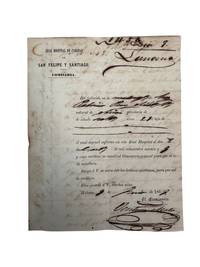
1869réf. 238101869. Chinese migrant hospital certificate from Havana in 1869 documenting the admission and death of a man identified in manuscript as a native of China within the Real Hospital de Caridad de San Felipe y Santiago. Issued while Chinese contract labor supplied Cuba with a large migrant workforce under a system regulating employment movement subsistence discipline and medical treatment the certificate records one individual at the point where that labor regime intersected with colonial hospital administration. Chinese labor contracts of the period commonly stipulated medical attendance and hospital care during illness while later testimony documented high rates of sickness and death among Chinese workers subjected to excessive labor inadequate food punishment and compulsory recontracting. Real Hospital de Caridad de San Felipe y Santiago Comisaría. Havana 1869.One partially printed document completed in manuscript in brown ink one leaf. 5.75" x 7.25". The form identifies the deceased as "natural de China" and records his age as 29 years followed by manuscript entries in printed fields for civil status and parentage. The institutional formula begins "Ha fallecido en la." and subsequently records the date on which the man "ingreso enfermo en este Real Hospital." Following his death the printed text directs that "cuyo cadaver se remite al Cementerio general para que se le de sepultura" then requests the appropriate administrative orders "para que asi se verifique." The certificate concludes "Dios guarde á V. muchos años" with a manuscript Havana date in 1869 and signatures. Manuscript annotations extend across the printed fields and margins with extensive brown ink offsetting and show through on the verso. Chinese contract migration to Cuba began in 1847 and brought more than 100000 migrants to the island before the overseas contract trade ended in the 1870s. The overwhelming majority were men recruited from southern China and bound to fixed terms of labor under contracts governing wages subsistence discipline illness and medical treatment. By 1869 these migrants worked within an economy in which African slavery and Chinese indenture operated concurrently particularly in sugar production but also in transportation construction manufacturing domestic service and urban employment. Hospital records add a different administrative dimension to the labor contracts through which this population is more commonly documented. Surviving records of the Real Hospital de Caridad de San Felipe y Santiago classify patients by names ages origins racial or legal categories illnesses and deaths and institutional holdings preserve certificates specifically concerning Chinese colonos. Moderate toning and staining small marginal wormholes old folds and extensive brown ink offsetting and show through; manuscript and printed text remain substantially legible. Overall good condition. An individualized record of the medical and mortuary bureaucracy through which an Asian migrant was classified hospitalized and buried in Havana in 1869. unknown books
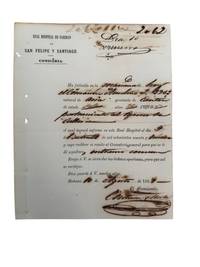
1869réf. 238081869. Cantonese Chinese migrant hospital certificate from Havana in 1869 recording the death and burial administration of a man identified in manuscript as "natural de Asia provincia de Canton" during the height of Chinese contract migration to Cuba. Evidence collected from 1176 Chinese laborers by the 1874 Cuba Commission identified 998 as coming from Canton and recent scholarship estimates that approximately 85 percent of Chinese laborers transported to Cuba originated in the province. More than 141000 Chinese workers reached Cuba during the trade from 1847 to 1874 where colonos asiáticos supplied low paid bound labor to sugar plantations and other sectors while African slavery remained legal. The manuscript designation on this sheet therefore connects an individual hospital patient to the principal South Chinese migration stream supplying nineteenth century Cuba's contract labor system. Real Hospital de Caridad de San Felipe y Santiago Comisaría. Havana 1869. One partially printed document completed in manuscript in brown ink one leaf. 5.75" x 7.25". The form identifies the deceased as "natural de Asia provincia de Canton" followed by manuscript entries in printed fields for civil status age and parentage. Its formula begins "Ha fallecido en la." and records his entry into the "Real Hospital" followed by the circumstances of his death. The printed disposition directs that "cuyo cadaver se remite al Cementerio general para que se le de sepultura" placing the individual within the administrative sequence connecting hospital death with municipal burial. The certificate closes "Luego á V. se sirva dar las órdenes oportunas para que asi se verifique. Dios guarde á V. muchos años" followed by a manuscript date of August 10 1869 and signatures. The sheet carries substantial brown manuscript writing and administrative notations with extensive ink offsetting and show through on the verso. Chinese contract migration to Cuba developed alongside slavery rather than replacing it immediately allowing Cuban planters to supplement enslaved African labor with a substantially cheaper bound workforce. Between 1865 and 1874 alone more than 64000 Chinese indentured laborers entered Cuba and the majority worked initially on sugar plantations. Canton and the Pearl River Delta supplied the overwhelming share of these migrants whose standard first indentures commonly lasted eight years; the trade continued until 1874 while existing contracts remained in force afterward. By the time this certificate was issued in 1869 Chinese laborers were present not only on plantations but in factories transportation construction public works and urban occupations creating institutional encounters extending beyond the labor contract itself. Moderate toning and staining several small punctures and marginal tears old folds extensive manuscript ink offsetting and show through; principal printed and manuscript content remains legible. Overall good condition. An individualized record connecting Cantonese migration to Cuba with the hospital death and burial bureaucracy encountered by Chinese migrants within the island's nineteenth century contract labor society. unknown
1869réf. 238091869. Chinese migrant hospital certificate from Havana in 1869 documenting the admission and death of a man identified in manuscript as a native of China within the Real Hospital de Caridad de San Felipe y Santiago. Issued while Chinese contract labor supplied Cuba with a large migrant workforce under a system regulating employment movement subsistence discipline and medical treatment the certificate records one individual at the point where that labor regime intersected with colonial hospital administration. Chinese labor contracts of the period commonly stipulated medical attendance and hospital care during illness while later testimony documented high rates of sickness and death among Chinese workers subjected to excessive labor inadequate food punishment and compulsory recontracting. Real Hospital de Caridad de San Felipe y Santiago Comisaría. Havana 1869. One partially printed document completed in manuscript in brown ink one leaf. 5.75" x 7.25". The deceased is identified in the manuscript as "natural de China" followed by entries within printed fields for province civil status age and parentage. The printed form begins "Ha fallecido en la." and subsequently records the date on which the individual "ingreso enfermo en este Real Hospital." Its concluding administrative language directs that "cuyo cadaver se remite al Cementerio general para que se le de sepultura" followed by the request that the appropriate orders be given "para que asi se verifique." The certificate closes "Dios guarde á V. muchos años" with a manuscript Havana date in 1869 and an administrative signature. Extensive brown manuscript entries occupy the principal fields with signatures and notations extending beyond the printed guide lines and offsetting substantially onto the verso. Chinese contract migration to Cuba began in 1847 and brought more than 100000 migrants to the island before the overseas contract trade ended in the 1870s. The overwhelming majority were men recruited from southern China and bound to fixed terms of labor under contracts governing wages subsistence discipline illness and medical treatment. By 1869 these migrants worked within an economy in which African slavery and Chinese indenture operated concurrently particularly in sugar production but also in transportation construction manufacturing domestic service and urban employment. Hospital records add a different administrative dimension to the labor contracts through which this population is more commonly documented. Surviving records of the Real Hospital de Caridad de San Felipe y Santiago classify patients by names ages origins racial or legal categories illnesses and deaths and institutional holdings preserve certificates specifically concerning Chinese colonos. Moderate toning and staining small marginal punctures and tears old folds and extensive brown ink offsetting and show through; manuscript and printed text remain substantially legible. Overall good condition. An individualized record of the medical and mortuary bureaucracy through which an Asian migrant was classified hospitalized and buried in Havana in 1869. unknown
1869réf. 238071869. Chinese migrant hospital certificate from Havana in 1869 documenting the admission and death of a man identified in manuscript as a native of China within the Real Hospital de Caridad de San Felipe y Santiago. Issued while Chinese contract labor supplied Cuba with a large migrant workforce under a system regulating employment movement subsistence discipline and medical treatment the certificate records one individual at the point where that labor regime intersected with colonial hospital administration. Chinese labor contracts of the period commonly stipulated medical attendance and hospital care during illness while later testimony documented high rates of sickness and death among Chinese workers subjected to excessive labor inadequate food punishment and compulsory recontracting. Real Hospital de Caridad de San Felipe y Santiago Comisaría. Havana 1869. One partially printed document completed in manuscript in brown ink one leaf. 5.75" x 7.25". The form begins "Ha fallecido en la." with manuscript completion identifying the individual and supplying personal information including his Chinese origin followed by printed fields for province marital status age as 30 years old and parentage. The central printed language records entry into the "Real Hospital" on a specified date and provides for the circumstances of the patient's death and burial concluding with the formula "y cuyo cadaver se remite al Cementerio general para que se le de sepultura." The final lines state that the certificate is issued "para que asi se verifique" followed by "Dios guarde á V. muchos años" and the manuscript date at Havana in 1869. Multiple manuscript signatures and administrative notations appear across the recto with substantial brown ink offsetting and show through on the verso. The form belongs to a documented class of death and burial certificates issued by the Real Hospital de Caridad de San Felipe y Santiago for patients moving through Havana's nineteenth century charitable hospital system. Chinese labor migration to Cuba began in 1847 and developed into a coercive contract system that brought large numbers of Chinese men to the island as colonos asiáticos. Surviving contracts from the 1860s identify individual workers by name age origin occupation marital status wages rations clothing allowances and provisions for medical treatment while regulating the duration and conditions of their service. By 1869 the system was deeply established and increasingly subject to criticism over recruitment practices punishment illness mortality restrictions on movement and the conditions under which workers could complete or renew their contracts. The explicit death and burial language makes this document more precisely identifiable than a general admission certificate. Moderate toning and staining several small wormholes punctures and marginal tears old folds extensive manuscript ink offsetting and show through not affecting the printed text. Overall good condition. An individualized 1869 record connecting a Chinese migrant in Havana with the hospital death and burial bureaucracy operating alongside Cuba's nineteenth century system of Chinese contract labor. unknown
1866réf. 238061866. Chinese migrant hospital certificate from Havana in 1866 recording the name admission and treatment of a young man identified on the document as a native of China during the height of Cuba's Chinese contract labor system. Tens of thousands of Chinese men were brought to nineteenth century Cuba under contracts that regulated labor wages food clothing discipline illness and medical care; surviving Cuban labor agreements from the same year specifically required employers to provide medical attendance and hospital treatment. Issued by the Real Hospital de Caridad de San Felipe y Santiago this partially printed form places the Chinese patient within the institutional machinery that administered illness and hospitalization in colonial Havana. Its 1866 date also coincides with international efforts to regulate Chinese overseas recruitment following extensive reports of kidnapping coercion and abuse within the labor migration system. Real Hospital de Caridad de San Felipe y Santiago Comisaría. Havana 1866. Partially printed document completed in manuscript in brown ink one leaf. 5.75" x 7.25". The form identifies the patient's name in manuscript describes him as "natural de China" and records his age as approximately 29 years indicative of the harsh work conditions many of these contract laborers faced. It states that he entered the "Real Hospital" on the 10th of an unidentified month 1866 and remained there until his discharge after which the document was issued so that the appropriate government office could determine the charges incurred during his hospital stay. The printed conclusion reads in part "y cuyo cadaver se remitia al Cementerio general para que se le de sepultura.". The English translation of the phrase is: "and whose body was sent to the general cemetery to be buried." Marked "Habana" in 1866 with manuscript completion and signatures in brown ink. The verso bears substantial ink offsetting and show through from the manuscript entries. Chinese migration to Cuba had developed into a large contract labor system by the 1860s supplying workers to an economy undergoing the gradual transformation of slavery while retaining coercive labor practices. Cuban Chinese contracts preserved in institutional collections identify workers by Spanish and sometimes Chinese names and record age origin occupation wages food clothing hours illness and medical treatment; a University of Florida collection alone contains fifty two such contracts dating from 1861 to 1878 including Havana contracts from 1866. Chinese authorities were simultaneously receiving accounts of laborers being deceived kidnapped or sold into overseas service prompting the 1866 regulations intended to control recruitment and protect emigrant laborers. Later diplomatic negotiations over conditions in Cuba specifically addressed Chinese laborers incapacitated by sickness contractual medical obligations freedom from physical punishment completion of service and repatriation demonstrating how health and physical capacity were embedded in the administration of the labor regime. This hospital certificate records that system at the level of one Chinese individual not through the clauses of a labor agreement but through the medical bureaucracy encountered when a migrant entered a Havana charitable hospital. Moderate toning and edge wear several small marginal tears and punctures manuscript ink offsetting and staining with loss at the lower left edge not affecting the principal printed text. Overall good condition. An individualized record of a Chinese migrant passing through Havana's colonial hospital system in 1866 connecting Chinese migration and contract labor to the bureaucratic administration of sickness institutional care and bodily capacity in nineteenth century Cuba. unknown
1869réf. 238101869. Chinese migrant hospital certificate from Havana in 1869 documenting the admission and death of a man identified in manuscript as a native of China within the Real Hospital de Caridad de San Felipe y Santiago. Issued while Chinese contract labor supplied Cuba with a large migrant workforce under a system regulating employment movement subsistence discipline and medical treatment the certificate records one individual at the point where that labor regime intersected with colonial hospital administration. Chinese labor contracts of the period commonly stipulated medical attendance and hospital care during illness while later testimony documented high rates of sickness and death among Chinese workers subjected to excessive labor inadequate food punishment and compulsory recontracting. Real Hospital de Caridad de San Felipe y Santiago Comisaría. Havana 1869.One partially printed document completed in manuscript in brown ink one leaf. 5.75" x 7.25". The form identifies the deceased as "natural de China" and records his age as 29 years followed by manuscript entries in printed fields for civil status and parentage. The institutional formula begins "Ha fallecido en la." and subsequently records the date on which the man "ingreso enfermo en este Real Hospital." Following his death the printed text directs that "cuyo cadaver se remite al Cementerio general para que se le de sepultura" then requests the appropriate administrative orders "para que asi se verifique." The certificate concludes "Dios guarde á V. muchos años" with a manuscript Havana date in 1869 and signatures. Manuscript annotations extend across the printed fields and margins with extensive brown ink offsetting and show through on the verso. Chinese contract migration to Cuba began in 1847 and brought more than 100000 migrants to the island before the overseas contract trade ended in the 1870s. The overwhelming majority were men recruited from southern China and bound to fixed terms of labor under contracts governing wages subsistence discipline illness and medical treatment. By 1869 these migrants worked within an economy in which African slavery and Chinese indenture operated concurrently particularly in sugar production but also in transportation construction manufacturing domestic service and urban employment. Hospital records add a different administrative dimension to the labor contracts through which this population is more commonly documented. Surviving records of the Real Hospital de Caridad de San Felipe y Santiago classify patients by names ages origins racial or legal categories illnesses and deaths and institutional holdings preserve certificates specifically concerning Chinese colonos. Moderate toning and staining small marginal wormholes old folds and extensive brown ink offsetting and show through; manuscript and printed text remain substantially legible. Overall good condition. An individualized record of the medical and mortuary bureaucracy through which an Asian migrant was classified hospitalized and buried in Havana in 1869. unknown
2010réf. R200041552TREDANIEL. 2010. In-12. Broché. Bon état, Couv. convenable, Dos satisfaisant, Intérieur frais. Environ 90 pages- non annoté- couverture contrepliée. . . . Classification Dewey : 646.72-Soins de beauté
2015réf. R160209628Marabout. 2015. In-12. Broché. Bon état, Couv. convenable, Dos satisfaisant, Intérieur frais. 156 pages. Nombreuses photographies en couleurs dans et hors texte.. . . . Classification Dewey : 646.72-Soins de beauté
2003réf. RO40043865Selection du reader's digest. 2003. In-4. Relié. Bon état, Couv. convenable, Dos satisfaisant, Intérieur frais. 359 pages. Texte sur trois colonnes. Nombreuses illustrations en couleur, dans le texte.. . . . Classification Dewey : 646.72-Soins de beauté
1985réf. R320004555MESSIDOR. 1985. In-4. Broché. Bon état, Couv. convenable, Dos satisfaisant, Intérieur frais. 315 pages illustrées de nombreuses photos et dessins en noir et blanc - Augmenté de nombreuses coupures de journaux.. . . . Classification Dewey : 649-Puériculture, soins à la maison des malades et des infirmes
1997réf. R160000148JC Lattès. 1997. In-12. Broché. Bon état, Couv. convenable, Dos satisfaisant, Intérieur frais. 191 pages.. . . . Classification Dewey : 646.72-Soins de beauté
FAYARD. 1958. In-8 Carré. Relié. Bon état. Couv. convenable. Dos satisfaisant. Intérieur frais. 158 pages- quelques illustrations en noir et blanc et quelques-unes colorisées dans le texte
FAYARD.. 1959.. In-12 Carré. Cartonné. Bon état. Couv. légèrement passée. Dos satisfaisant. Intérieur acceptable. 157 pages. 1ère de couverture illustrée en couleurs. Nombreux dessins en noir et blanc et couleurs, dans le texte. Dessins de Jacqueline Chaumont. Avant tout, ayez bonne mine, on vous regarde dans les yeux, l'un de ces visages et le votre, beauté minute, beauté d'un soir, donnez du PEP a vos cheveux. Collection dirigée par Miriam Cendrars.
ISBN : 2704804184. FRANCE-EMPIRE.. 1985.. In-8 Carré. Broché. Bon état. Couv. légèrement passée. Dos satisfaisant. Intérieur acceptable. 253 pages. 1ère de couverture illustrée en couleurs. Nombreuses illustrations en noir et blanc, hors texte. Interview : M.F. Bauer.
réf. DADAX0471926345New unknown
1987réf. RO30324212Retz. 1987. In-8. Broché. Bon état, Couv. convenable, Dos satisfaisant, Papier jauni. 159 pages. Quelques illustrations et partitions en noir et blanc, dans le texte.. . . . Classification Dewey : 649-Puériculture, soins à la maison des malades et des infirmes
1987réf. RO40054628Retz. 1987. In-8. Broché. Bon état, Couv. convenable, Dos satisfaisant, Intérieur frais. 159 pages. Quelques illustrations et partitions en noir et blanc, dans le texte.. . . . Classification Dewey : 649-Puériculture, soins à la maison des malades et des infirmes
1937réf. R160112692CAF DE BORDEAUX ET GIRONDE. 1937. In-8. Broché. Etat passable, Couv. défraîchie, Dos plié, Intérieur acceptable. 162 pages.. . . . Classification Dewey : 649-Puériculture, soins à la maison des malades et des infirmes
1980réf. RO20025274Presses de la cité. 1980. In-8. Broché. Bon état, Couv. légèrement passée, Dos satisfaisant, Intérieur frais. 218 p.. . . . Classification Dewey : 646.72-Soins de beauté
1971réf. RO20054252TALLANDIER Jules. 1971. In-8. Cartonnage d'éditeurs. Très bon état, Couv. convenable, Dos satisfaisant, Intérieur frais. 282 pages. Nombreuses photos en noir et blanc dans le texte et en planches hors-texte. Relié pleine toile verte.. . . . Classification Dewey : 646.72-Soins de beauté
1990réf. RO80216848Ramsay. 1990. In-4. Cartonné. Bon état, Couv. défraîchie, Dos satisfaisant, Papier jauni. 344 pages augmentées de quelques illustrations en noir et blanc dans le texte.Tranches jaunies avec quelques rousseurs.. . . . Classification Dewey : 649-Puériculture, soins à la maison des malades et des infirmes
2003réf. R200027750CHARIOT D'OR. 2003. In-8. Broché. Bon état, Couv. convenable, Dos satisfaisant, Intérieur frais. 205 pages.. . . . Classification Dewey : 646.72-Soins de beauté