3343 resultados
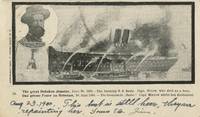
1900ref. BK0100New York: Franz Huld and Arthur Livingston 1900. Three illustrated private mailing cards approximately 3 ¼ x 5 ½ inches each with manuscript messages and Hoboken postmarks dated August 23 1900 addressed to J. H. McNally of Lowell Massachusetts. Minor handling wear and soiling very good. Three postcards depicting the destruction caused by the June 30 1900 North German Lloyd pier fire at Hoboken mailed from the city less than two months later by a man signing himself "Jim" to his brother in Lowell. Two are Franz Huld cards nos. 31 and 32 showing the North German Lloyd docks the day after the fire and the burning S.S. Saale; the third published by Arthur Livingston shows the ruins at the entrance to the company's docks. The sender adds brief observations from Hoboken to the printed disaster views. On the view of the ruined docks he writes "The fire is still smoking." Of the Saale: "This boat is still here they are repairing her." The third explains the group: "I saw these cards today and I thought you would like them. Everything is O.K." The fire swept through the North German Lloyd piers and several vessels in the harbor killing more than 300 people. Postcard historian George Miller has described it as "the first major disaster recorded on postcards" noting at least sixteen American postcard issues and an exceptionally rapid response by publishers; the earliest known copyright was registered only five days after the fire.1 The present cards were mailed while its physical aftermath remained visible on the Hoboken waterfront. 1 George Miller "The first major disaster recorded on postcards" Postcard History October 25 2021 https://postcardhistory.net/2021/10/the-first-major-disaster-recorded-on-postcards-the-hoboken-pier-fire-june-30-1900/. . Franz Huld and Arthur Livingston unknown books
1974ref. 46340New York: Praeger Publishers 1974. Very Good/Very Good. New York: Praeger Publishers 1974. First Edition. Signed by Blaze Starr at front free endpaper with inscription "to Jack a man who appreciates the fine things in life. Love Blaze Starr." Octavo; photo-illustrated dust jacket; magenta boards stamped in gilt; 210pp. Black and white photographs. Light wear to edges of unclipped dust jacket with a few minor nicks and a patch of dampstaining along top edge. Edgewear to boards; spine ends nudged and corners bumped; binding sound; pages unmarked; a Very Good copy. Praeger Publishers unknown books
ref. UBLALEB00lhLibrairie Theatrale ND. Good. Blaze Castil. Le Barbier de Seville. Paris: Librairie Theatrale ND. 103pp. 16mo. Paper wraps. Book condition: Good. Slightly wavy. Wraps are slightly loose. Librairie Theatrale paperback books
1715ref. 21193London 1715. Broadside. Disbound. Small folio. Early folds and early stab holes in left margin. Some foxing. A rare leaflet lobbying Parliament on behalf of British merchants who had recently lost £22500 worth of sugar ginger oil and sasparilla in a great fire. The merchants had just recently imported the goods paying approximately £3000 in customs. In the present document the merchants petition the House of Commons to allow them to import goods duty-free up to the value of the customs of the goods destroyed. This is among the earliest examples of commercial lobbying literature which first began proliferating in the lobby of the House of Commons at the time of the accession of King George I and the British general election of 1715. ESTC lists three copies: at the University of London Oxford and Harvard. Goldsmiths 5228.1; Hanson 2169. unknown books
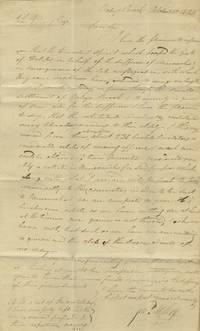
1825ref. 102273Letter sheets 8" x 12" 3 pages plus integral address leaf. Extensive tape repairs to folds mostly archival tape but some regular tape too which has caused a little browning in areas long tear obscures writers signature but partially visible creased normal aging and browning remnant of wax seal; otherwise good or better. The letter is to Boston Mayor Josiah Quincy 1772-1864 a future head of Harvard and served eight years in Congress. It appears after becoming Boston's mayor he sent delegates to New York and Philadelphia to study fire fighting techniques in those cities. The author of this letter read about this mission and sent Mayor Quincy a lengthy letter on the subject. The probable author is Solon Robinson 1803-1880 although his signature is partially obscured by a tear. However on the back page a smudged docketed note identifies him as Solon Robertson or Robinson. Robinson was a writer and would become a well known Indiana pioneer. In any case the author would suggest a far more modern system for fighting fires than the existing practice of engines carrying water to fires which would become useless when the water ran out. he proposed putting lead aqueduct pipes "laid deep underground and leading to every part of the city." While her does not use the term fire hydrants the water would be accessed from locked iron covers that would serve that function. ABN. books
1874ref. 142501874. FARMERS' MUTUAL FIRE ASSURANCE ASSN. OF NEW JERSEY. Charter and By-Laws of the Farmers' Mutual Fire Assurance Association of New Jersey. Brooklyn 1874. Cover titrle 16 p. Wrappers rear chipped and a bit scruffy. "Edition of 1874. unknown books
1901ref. 70838Roanoke VA: The church Lookabill's Ptg. House Roanoke 1901. Program for the service. Bifolium title verso of first leaf a four-verse each eight lines "greeting" adapted from "Our Firemen by Rev. Dr. Vedder" and four officers of the Junior Hose Company printed recto of integral leaf. Very good. The church (Lookabill's Ptg. House, Roanoke) unknown books
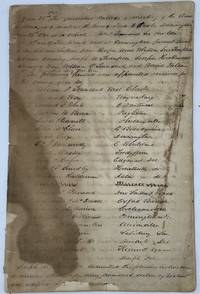
1849ref. 70885Chester Co. PA 1849. Stitched sheets 30 cm. 36 pp. in ink first and last pages detached some chipping around edges a tender copy. Old staining to gutters extending into the text occasionally obscuring some words on the first few leaves else in a clear clerical hand. Manuscript notes a record of the meetings of the Board of Managers for this Fire Insurance Company from Sept. 23 1846 to Oct. 15 1849. A close look at the inner workings of a small local fire insurance company. The first entry called a meeting of the Board of Managers at the house of Jacob E. Parke Downington and recorded the names of the members including Morris Cope Solomon Lukens Davis Hoopes Morris Whitson Jno. Templeton Charles Downing Joseph M. Thompson Joseph Hickman Bernard also spelled Baynard Way William P. Townsend and David Wilson. This is followed by a long list of 21 names and locations of the persons appointed receivers for the coming year. The Treasurer Joseph M. Thompson gave "instructions to receivers" for collecting payment of dues for depositing those fees in a secure banking institution and for accurate reporting of the payments to the company. For their efforts they were to deduct a one percent commission on their collections. The notes also record officers' salaries and the payments to committee members appointed to fix premiums of one dollar a day plus 5 cents a mile for travel. Over the course of the other meeting notes mention is made of the claims of several of the insured for payments for fire damage to dwellings barns and businesses. In January 1847 Rebecca W. Lukens received $25 "to be distributed among the persons who were usefully active in extinguishing the fire in the rolling Mill of said R.W. Lukens sometime ago." Louis Bachman of North Coventry Township Wm. McCullough of Cecil Co. and Jacob Emery of Salisbury Township all recovered claims for partial damage to their dwellings in these years. One case related to the loss of Hayes Clark's Cotton Factory was disputed because he had not paid the initial interest due on his policy before a conflagration took the entire operation on Doe Run. Details of the dispute resurface in several meetings. The company eventually paid his claim. The meeting notes also established premium amounts for various structures rating buildings as first second third and fourth class; differentiating between costs to insure stone or brick barns and those built of wood; and accounting for variations in types of businesses insured including cabinet makers smith shops taverns and book sellers. An end of the year financial accounting for 1847 reported 2194 perpetual policies issued and advance amounts of money thereon as $3788.64. In 1848 premiums were adjusted for property situated within 200 yards of any railroad on which locomotives ran. A long list of increases in premium rates for affected dwellings and businesses followed. In January 1849 a resolution was passed to make alterations to one of the company's fire proof safes to make it capable of holding copies of their insurance policies. John Smith Futhey in his book "History of Chester County Pennsylvania with Genealogical and Biographical Sketches" Phila. PA: 1881 p.391 describes the history of this fire insurance company. Chartered by the Pennsylvania Legislature on April 21 1840 it was organized that May with Joseph M. Thompson as President Enoch Harlan as secretary and Amos Fredd as treasurer. It began issuing policies of five years duration members being assessed to meet losses occuring each insurer being a member. At the end of the five years the company proving successful perpetual policies began to be issued substituting for the "first or five-year ones. To furnish insurance at the lowest possible cost has been the aim of the company and its success in that direction is perhaps without a parallel in the history of fire insurance." In an article in The Jeffersonian newspaper of Jan. 25 1848 the "Report of the Board of Managers of the Mutual Fire Insurance Company of Chester Co." appears with details of the company's finances. The company "went into operation" in 1840 and had since paid out over $26000 for losses by fire. It also stated that if things continued as they had been going they estimated they would soon be able to reduce the annual payment due from members from 6% "to such less percentage as may be deemed sufficient. unknown books
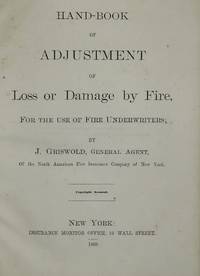
1868ref. 56003New York: Insurance Monitor Office 1868. First edition. Small 4to. 105 3 pp. Introduction: "It is a collection of scattered fragments of insurance wisdom collated from a great variety of sources freely appropriated and brought into an aggregated form whence the tyro in the profession can gather the fruits divested of technicalities." With a southern ownership signature "Jno. R. Long Agt. / Columbus Miss." OCLC locates six copies Buffalo/Erie County Public New York Public Library of Congress Smithsonian North Carolina Brown. Original gilt-stamped blue cloth spine ends and corners rubbed. Very good. 2525. Insurance Monitor Office unknown books
1850ref. 48467Sinking Springs PA: The Mutual Fire Insurance Company 1850. Very Good. Sinking Springs PA: The Mutual Fire Insurance Company 1850. Bi-fold document folded into quarters 42 cm open. Policy title and details to front with manuscript information of policy holder and fees. Description of coverage and length of policy at interior signed by Harvey as the policy holder and the president of the company. Manuscript to interior of quarter fold as well. Generally dust soiled edges rubbed and mild staining. Previous folds toned with minor tears along seams. Offsetting from manuscript to facing pages. A Very Good example. Mr. Harvey a tanner secured insurance for his business home barn and shed against fire renewing it for five years after the initial year term ended. The Mutual Fire Insurance Company unknown books
1843ref. 48469Boston 1843. Very Good. Boston: 1843. Oblong cardstock 14cm. Blue printed invitation with manuscript corrections and details; evidently removed from scrapbook the verso pasted with paper and cut-out newspaper images. Recto toned from exposure to glue printed image faded and edges gently rubbed. Entire piece stiff and rippled gently from glue. Verso paper backing has peeled away at edges with similar toning overall. An interesting and curious example in About Very Good condition. The Attentive Fire Society of Boston was a volunteer group of firefighters. They met usually on the last Wednesday of every month at a local coffee house this time the Cornhill Coffee House to attend to society matters. This invitation was for Stephen Shelton who was a member beginning in 1841. Printed image on recto shows a woman whose hand is seemingly sparking flames while Fire Society members gather bags of water to put it out. Verso is pasted with newspaper cut outs of the Attentive Fire Society's annual festival and the Robert Burns monument in Edinburgh Scotland. Not separately catalogued in OCLC as of June 2026. unknown books
1825ref. BK0033Bailey's Brook Nova Scotia 1825. Autograph letter signed "Geo. McLeod" to John Young Esq. Halifax. Stampless folded letter with manuscript "7 / Paid" rate "Post Paid" notation and a clear "POST OFFICE PICTOU / PAID" handstamp. Light filing folds; very good. A contemporary account of rural relief organized for survivors of the Great Miramichi Fire written only eighteen days after the disaster. George McLeod reports traveling personally through Bailey's Brook and the surrounding settlements to solicit provisions and clothing gathering approximately 230 bushels of potatoes together with "considerable articles of wearing apparel" for immediate shipment through Pictou: "I went yesterday in person through the small settlement of Bailey's Brook & its vicinity in quest of some aide for the sufferers & have the pleasure to say that the inhabitants individually contributed very liberally according to their ability. I this day received from them into my store about 230 bushels buntatoes sic & considerable articles of wearing apparel & much more could be obtained if time permitted." The letter is particularly revealing about the material circumstances of disaster relief in a cash-poor agricultural community. The residents had little money available and "nothing else at hand" as their grain had not yet been threshed and the lateness of the season required them to contribute whatever could be gathered and transported without delay-nonetheless they were "willing to give." McLeod notes that additional supplies had been collected at Merigomish and would be combined with those from Bailey's Brook sent to the committee at Pictou and forwarded onward to Miramichi. He also records keeping a list of the individual contributors and the articles supplied under each name. We find no other examples of documents or primary source materials relating to the disaster in commerce or in auction records. A focused primary document of one of the largest fires in early Canadian history with a detailed description of the mechanics of relief. . unknown books
1864ref. 41533Monroe Michigan: M. D. Hamilton Printer Commercial Office 1864. 8pp. Stitched in original printed orange title wrappers as issued. A few light fox spots an old vertical fold. Very Good. The founding documents of this Michigan insurance corporation. Original by-laws are printed emphasizing the importance of preventing fires: no smoking around any insured building; safe disposition of ashes. The Company insures only "farm property." "The object of this Company is not to pay for gross carelessness but accident." Not located on OCLC as of December 2025. M. D. Hamilton, Printer, Commercial Office unknown books
1877ref. 35307Philadelphia: Published by Wm. Smith. Looking Glass Portrait & Picture Frames of every description 1877. Folio broadside 14" x 17". Printed in three columns: the first an 'Address of Hon. R.T. Conrad'; second 'Fireman's Address. Written at the request of the Association for the Relief of Disabled Firemen' by 'Hon. Robert T. Conrad'; third 'Address of Philip S. White Esq.' Very Good. The ceremony seeks to make amends for Philadelphia's long history of antipathy to Irish Catholics. Conrad had been elected Mayor of Philadelphia on a Know-Nothing platform that capitalized on anti-Irish sentiment. But he says here "Whatever prejudices may have existed in regard to fireman sic have disappeared before the favorable evidence of the past and present conduct and character." Also a poet and writer Conrad composed a poem for the occasion printed in the second column. Praising the Company in column three was a leading temperance advocate Philip S. White. The Hibernia Company was responsible for an area of great "importance": "all the Exchange Post Office and Custom House brokers-- all the printing offices-- all the newspapers of the city. all the steamboat landings-- all the banks save two and nearly all the insurance offices." OCLC records six locations under three accession numbers as of July 2024: the Library Company Clements NYHS Brown Notre Dame Library of Congress Published by Wm. Smith... Looking Glass, Portrait & Picture Frames of every description unknown books
1859ref. 30233New York: Slote & Janes Stationers 1859. 20pp stitched in original printed wrappers. Several contemporary corrections in ink. Very Good with a tipped-in certification from the Insurance Department that the original is on file with that Department. This is probably the Standard Fire Insurance Company's retained copy of its original charter. In addition to the tipped-in certificate the front wrapper is stamped "Received from the Secretary of State and filed in the Department of Banking and Insurance" and signed by the Commissioner of Banking and Insurance. Not located on OCLC as of May 2013. Slote & Janes, Stationers unknown books
1800ref. 5672Boston 1800. 18 1pp. No half title. Disbound light tanning and wear. With a list of members. George Minot was President of the Society which was incorporated in 1794. IRST EDITION. Evans 37929. unknown books
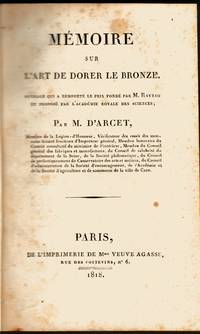
1818ref. 25055Paris: De l'imprimerie de Mme. veuve Agasse Rue des Poitevins no 6 1818. First Edition. Contemporary half leather. Very good; occasional spotting; modest rubbing. 8vo xl 1 - 192 2 - folding tables pp. 6 leaves of plates Rare. Among the most lethal of the commercial decorative-arts trades practiced in the 18th & 19th centuries. The gilding of bronze castings and the high finish and design achieved for such articles was a defining characteristic and mainstay of the Parisian clock furniture and arts trade. So dominant were the Parisian merciers in this that attempts to establish competitive practitioners of gilding in other nations all failed. The author's Ottomeyer & Pröschel have characterized the trade in their epoch two volume Vergoldete Bronzen 1986 as vol.1 p.323: "Das Pariser Vorbild blieb im 19. Jahrhundert wie auch auf vielen anderen Gebieten der Mode und des Luxus stets tonangebend. Die Geschichte der Bronzearbeiten während des Empire und der Restauration die sich nicht davon trennen läßt ist geprägt von der Abkehr von handwerklicher Gestaltung und Produktionsweise und dem zunehmenden Übergang zu Groß- serien der Luxusindustrie. Die genau nach Plan gefertigten Teile gingen durch viele Hände. Die additiven Strukturen der Herstellung durch die Serienfertigung bestimmt finden sich in der Formgebung wieder bei der die präzise abgestimmten vorgefertigten Metallteile wie Bausteine zusammengesetzt wurden.Es ist schwer zu sagen ob der Stil die Produktionsweise ermöglichte oder aber die Produktionsweise den Stil bestimmte der die Bronzearbeiten in ihrer kohärenten Formgebung bei additiver Zusammensetzung auszeichnet." D'Arcet's book is exceptional for its detailed exposition of the trade and the means to accomplishing the finished product. The book was printed by Mme. Agasse who was both printer and bookseller. De l'imprimerie de Mme. veuve Agasse, Rue des Poitevins, no 6 hardcover books
1805ref. 675Boston: Russell and Cutler 1805. First Edition. stitched as issued. A very good copy; old embossed ownership stamp with release on a blank portion of the title. 8vo. The regulations of the Mass. fire insurance scheme. S & S # 8872. Russell and Cutler unknown books
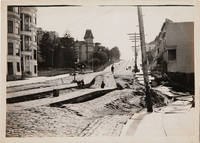
1906ref. 61981San Francisco. 1906. Photographs of the Great Earthquake and Fire of 1906 A remarkable collection of photographs taken immediately after the San Francisco earthquake and fires of April 1906 showing the scope of the damage to the city as well as providing a stark reminder of the human toll taken by what is considered one of the worst natural disasters in American history. Many of these images are apparently unpublished having been produced by an Army engineer and used to accompany a report on earthquake relief efforts made for the United States Senate. Although there was a quick and immediate response from San Francisco's large military population the earthquake and fires killed an estimated 3000 people and left over 200000 San Francisco residents homeless. Fifteen of the twenty-nine images in this collection are signed in the negative "Hughes Fort Mason" or simply "Hughes" and were almost certainly taken by Private William H. Hughes a member of the First Battalion Corps of Engineers stationed at Fort Mason located on the bay at the northern edge of San Francisco. The other fourteen are not signed by a photographer but some of them may have also been taken by Hughes. Troops from Fort Mason were the first military units to respond following the earthquake of April 18 1906. There was no photography studio at Fort Mason in 1906 but Private Hughes was acknowledged as being "a very efficient photographer" for John Steven Sewell's report on the 1906 disaster "The Effects of the Earthquake and Fire on Buildings Engineering Structures and Structural Materials" for the United States Geologic Survey. Many of Hughes' photographs from the present series accompany the Army's report to the U.S. Senate on earthquake and fire relief efforts now housed with the records of the United States Senate in the National Archives. Since many of the images in this series were taken for the relief effort report to the Senate there is a focus on the human aspect of the disaster. As far as we know Hughes' photographs were not published except in conjunction with the Army report to the Senate. The photographs in the present collection include an image of members of San Francisco's business community dressed in suits bowler hats and patent leather shoes helping to haul a fire hose close to an active fire; a small group of people viewing the devastation following the quake and during the fire; San Francisco residents cooking in the street and queuing for food and bedding; and a panoramic view of the of a San Francisco refugee camp near Fort Mason showing some refugees just starting to set up their tents. There are also two images showing the tragic loss of life during this disaster – one deceased man pinned upside down in a pile of rubble and another within a panoramic view of city-wide devastation pinned by a massive beam in the basement of what was likely his home. This collection of original photographs shows the devastation and the very human tragedy left in the wake of the San Francisco earthquake and fire with four of the photographs showing the fire in progress and two showing the loss of men killed by the rubble in which they were trapped. Fifteen of the photographs carry the imprint "Hughes" or "Hughes Fort Mason" in the negative those that do not are numbers 3 4 5 9 13 14 22 23 24 25 26 27 28 and 29 below. The photographs included in this collection are captioned as follows captions in the negatives are given within quotes; those without captions have our descriptive caption provided: 1 "52 Union St." remaining caption is indecipherable. Image of severe ground upheaval on Union Street with cable car tracks lifted above ground level the brick street sinking and concrete sidewalks shattered. Pedestrians walk in the street and children sit on the cable-car tracks dangling their feet in the deep crevices alongside. 2 "53 Birds-eye view of camp around Fort Mason." A hilltop view of the tent city in the open areas that surround Fort mason on the left. 3 "54" A long line of men women and children along a fence in a residential neighborhood are lined up to receive canned goods from the military. 4 "55" A group of men near a crumbling building receive tents and mattresses. 5 "56" Twenty men in suits patent leather shoes and bowler hats shoulder a fire hose and walk toward burning Victorian row houses in the distance. 6 "62" Men in bowler hats and suits picking through the rubble in the foreground with the hulking remains of shattered buildings rising through smoke in the background. A uniformed soldier stands in the corner right. An almost identical picture signed by Hughes Fort Mason is in the National Archives collection captioned by the Archives as "No. 63. Souvenir hunters." 7 "67" Sailors disembark and march off the marina boardwalk in front of the ferry "Garden City" packed with passengers. 8 "68" Women and men crowd together at the top of a hill viewing the ruins of their devastated city shrouded in billowing smoke before them. The identical picture signed by Hughes is in the National Archives collection captioned by the archives as "Fire partially under control - 3rd day." 9 "69" Shows the front of two Victorian row houses on Howard Street sinking into the ground as a result of liquefaction of alluvial soil. 10 "70 Cooking in Street after Earthquake." Families on either side of a woman cooking on a cast iron stove on a residential street lined with Victorian row houses. The identical picture signed by Hughes Fort Mason is in the National Archives collection captioned by the archives as "Chimneys were destroyed and cooking in houses was prohibited." 11 "71" Two members of the military stand on a corner next to the remains of a blasted church. 12 "72" A view of the remains of a residential neighborhood from the top of a hill showing ground rupture and surface faulting as well as an active fire. 13 "84" Shows a large group of families waiting near a large garage for distribution of emergency supplies. 14 "85" Near the end of a long line of families waiting for distribution of emergency food including canned roast beef and corned beef. 15 "F5 75 St. Dominic's church." A view of the ruins of the St. Dominic church towers as seen looking North on Steiner Street near Bush Street. 16 "F8 Wrecked by earthquake." Shows a multi-story furniture dealer's warehouse with much of the facade having crumbled away. 17 "F15 View from Turk St between Jones and Hyde." A view looking up the southern slope of Nob Hill showing the ruins of what was then informally called the "Tenderloin District." 18 "F17 Ruins of Hall of Justice." A view of the ruins of San Francisco's Hall of Justice from Kearney Street. The Hall of Justice housed the city jail as well as the Coroner's office and San Francisco's criminal and civil courts. Red Cross tents are set up at the base of the building with saddles and tack for the city's mounted police on a saddle stand in the foreground. 19 Unnumbered. "Refugees in the vicinity of Fort Mason." A tent city that sprung up in the open land surrounding Fort Mason to shelter all those who lost their homes during the earthquake and fire. Within the picture there are various vignettes: a mother and father leaning down to speak to their children seated on the ground near their tent; a father holding a baby up to its mother while another man works on building their tent; a large family working together to assemble their tent while the mother father and a young girl wearing a white pinafore and hat talk to each other over some provisions. Entire iron double beds and rockers are sitting alongside tents and there are a number of family horses picketed beside tents. 20 Unnumbered. On Broadway looking up Battery toward the fires on Telegraph Hill and the headquarters of the American Biscuit Company at 855 Battery Street. 21 Unnumbered. "North Beach – after the Fire." Looking from the water across towards the smoking ruins of North Beach. 22 Unnumbered. A view looking south on Steiner Street past the French Bakery toward the ruins of St. Dominic's Church. Steiner Street is filled with horse-drawn vehicles an early motor car and pedestrians. 23 Unnumbered. The ruins of San Francisco City Hall viewed from Larkin and Grove streets. City officials and members of the military stand on a crumbled wall in the foreground. Having been built over twenty-five years on sandy wet ground and according to a later investigation "without any of the principles of the steel frame construction having been used" this iteration of San Francisco's City Hall with the exception of the dome fell to the ground in the forty-five to sixty seconds that the earthquake lasted. 24 Unnumbered. A military supply depot likely at Fort Mason fronted by sand bags with a member of the military leaning against boxes of supplies. Piles of furniture and statuary are near the right-most door with another member of the military seated at his leisure before them. A group of civilians gather around some furniture on the ground at the far right. 25 Unnumbered. The image of a deceased man in a suit under a pile of rubble. The man appears upside down in the top left of the photograph with his body having been draped and/or pinned by rubble above him. His left hand is draped down below his face caught between a stone and the metal plate at the end of a support rod. The skin of his forehead is pushed into a series of concentric folds and the iris of his right eye is pushed beyond the edge of the outer canthus. 26 Unnumbered. The image of a deceased man buried within the rubble of what looks to have been a residential building. Initially one would assume this photograph is simply of the wide swath of devastation left by the earthquake in the foreground and in the distance but a careful view of the tangle of metalwork in the foreground along the remains of a steel beam shows a man standing but slumped to his left pinned by metal supports. Part of his head and right shoulder are in view with his face looking outward through the tangle of rubble before him. In the distance a group of three men stand on top of the rubble. 27 Unnumbered. A member of the military looking pensive while seated on fallen and twisted decorative metalwork atop a pile of brick rubble near building ruins. 28 Unnumbered. The ruins of residential buildings with piles of brick and metalwork in the foreground and the standing remains of buildings beyond. 29 Unnumbered. The ruins of Victorian row houses with shattered windows; the sidewalk and street before them show ground rupture and surface faulting. A very informative and evocative group of original photographs showing the utter devastation and human misery in San Francisco in the aftermath of the 1906 earthquake and fires. Some light wrinkling from handling. Faint toning to the edges and a stain on the verso of one print not affecting the image. Very good. Housed in a modern binder. John Stephen Sewell "The Effects of the Earthquake and Fire on Buildings Engineering Structures and Structural Materials" in Grove Karl Gilbert et al. The San Francisco Earthquake and Fire of April 18 1906 and Their Effects on Structures and Structural Materials Washington 1907 p.63. National Archives. San Francisco Earthquake 1906. Center for Legislative Archives September 30 2020. "Historical Vignette 101 - The Army Engineers Were Key Responders to the San Francisco Earthquake and Fire" U.S. Army Corps of Engineers Headquarters website April 2006. hardcover books
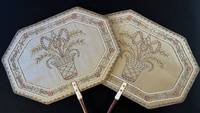
1830ref. 4479France 1830. Two matching embroidered pole fire screens oblong octagonals 202 x 290 mm. sides of silk over thin boards or scaleboards the decorated side of beige satin silk with a large central flowerpot containing sprigs and a large pink bow within ornate floral border between two white braided thread borders outermost gilt ribbon border with tiny loops; the designs composed of metallic thread pink flat sequins molded white or silvery sequins and couched gilt leaves: embossed leaves on the plant and flat leaves in the border; the reverse sides covered in plain dark rose silk contemporary bone and wood handles with small screws on back. One screen lacking a tiny embossed leaf the other screen lacking four of the same and with one leaf almost detached. A handsome pair of embroidered hand-held fire screens probably from the first decades of the 19th century in fine condition. "A beautiful addition to any room decorative pole screens served an important function in the 18th century: The tall thin screens shielded people's faces from the direct heat of the fire. In the 17th and 18th centuries both men and women wore makeup to hide blemishes. It was said that before he turned fifty the Prince Regent's face had turned waxen and copper colored from make up. The cosmetic preparation worn to hide small pox was thick and made up of wax and white lead. The lead was toxic especially when warmed and the heat from a fire could be life threatening. A pole screen protected the face from intense heat and prevented the wax from melting and the cosmetics from interacting with the skin. The earliest panels were made of wicker but these were replaced with beautiful needlework or embroidered panels that came in many shapes and sizes - oval heart-shaped rectangular etc. By the late 18th century skin disfiguration caused by plagues was no longer as prevalent as before and smaller polescreens became more fashionable."- Jane Austen's World website viewed 4-6-26. unknown books
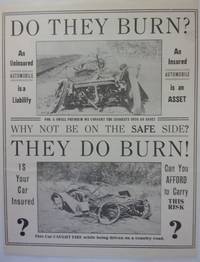
ref. 40711AUTOMOBILE FIRE INSURANCE NATIONAL SECURITY FIRE INSURANCE COMPANY. Two-page Monthly Fiscal Bulletin for Omaha Nebraska Insurance Company with Flyer for Automobile Insurance Company aimed at covering fire insurance for Automobiles. Omaha: March 1917. Quarto Two-sheet typed Bulletin on company letterhead with two-sided printed and illustrated flyer promoting automobile fire insurance. Rare automobile ephemera on automobile insurance the Monthly Bulletin No. 16 March 1917 with typed report to "Stockholders of the National Fire Insurance Company" on the status of their finances. The company letterhead with automobile and horse driven fire equipment exiting fire house. Included is a printed flyer promoting the need to buy fire insurance for your car "Do they burn" "They do Burn!" with two half-tone photographs of a wrecked automobile and another one of an automobile destroyed by fire. Printed for the Automobile Insurance Company of Lincoln Nebraska. Very good. 40711. unknown books
1906ref. List821San Francisco 1906. Thirty-one silver gelatin prints measuring 4 x 3 inches with four accompanying sheets measuring 8 x 5 ½ inches identifying the images. Also included is the original envelope to an illegible recipient or possibly crediting the images. Fading to images else about fine very good minus overall. Many photographers amateur and professional alike took to the streets of San Francisco to document devastation caused by the earthquake and subsequent fire of 1906. Collected here are thirty-one images taken by one such photographer - likely an amateur based on the image quality and perspectives. What is unusual about the collection here is that the photographer took meticulous notes on each image and the images as found in a rather illegible envelope included several sheets explaining the location of each image. The photographer travelled through most of downtown with varied locations represented. The title is likely misleading as the fire raged for several days and the pictures were likely taken several days after the 18th of April. The envelope has the name "Mrs H. Thof illegible" which suggests that perhaps the photographer was a woman or possibly that these were given to the same as a gift by another photographer. Overall a scarce survival of images of which we find no other copies. unknown books
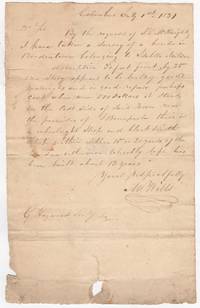
1831ref. 45385Columbus NJ 1831. Very good folded edge wear & tear light soiling minor fading. 1 pp. 6.5 x 10.5 inches. July 1st 1831 with integral address to G Haywood Secretary of the Mount Holly Fire Insurance Company. Signed survey for the home of Isabella Neilson of Bordentown. The Mount Holly Fire Insurance Company was incorporated in 1831. "By the request of J.L.W. Knight I have taken a Survey of a house in Bordentown belonging to Isabella Neilson. description 30 feet front by 25 one story appears to be built of good materials and in good repair perhaps cost when new 500 Dollars it stands on the East Side of said Town near the premises of Bonnparl their is a wheelwright Shop and black smith within 15 or 20 yards of the house otherwise tolerably safe has been built about 12 years." unknown books
1974ref. 121131Australia: Genealogical Society of Victoria 1974. Softcover. Very Good. Very good in wrappers. Book browned on spine and back cover. Genealogical Society of Victoria unknown books
2002ref. 253264New York: Warner Books 2002. Softcover. Very Good. First edition. Very good in wrappers. Some light rubbing to spine ends and panel edges. Foredges are slightly browned. Warner Books unknown books