2.966 resultados
1842ref. 1674Leipzig, A. F. Böhme, 1842. 15 S. Ungeheftet.- Rapp 22 / Am 6, Nr. 3; Heckscher I, S. 126.
1983ref. 40459Berlin, Verlag Neues Leben, 1983. 30 Seiten , 20 cm, kartoniert
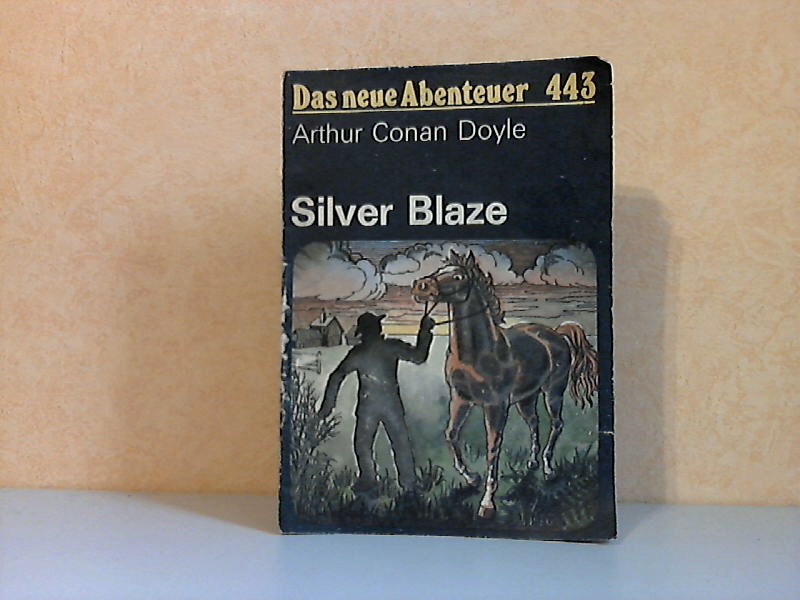
1990ref. 43727Berlin, Verlag Neues Leben, 1990. 5. Auflage 370 Seiten , 24 cm Pappeinband
1950ref. 7545Karlsruhe. (Um 1950). 4 Seiten. Mit 21 Abbildungen. Zweifarbiger Druck. (An den Rändern etwas beschädigt) 30x21 cm
1976ref. 234Frankfurt Pinguin Umschau, 1976. 96 S. 82 fast seitengroße tlw. Farb. Abb. 8° Opbd
1978ref. 168393N.p.: N.p. 1978. Softcover. Vol. 3 No. 12. Comprises an interview with art critic and poet Donald B. Kuspit. Near Fine comprised of 14 leaves and a black front wrapper bound with a single staple at the top edge. N.p. unknown books
1962ref. 162018N.p.: N.p. 1962. Vintage reference photograph of Blaze Starr from the 1962 film here under its alternative release title "Nature Girl." Famed stripper Blaze Star escapes from the pressure of stardom by becoming a member of a nudist colony much to the dismay of her manager and boyfriend who worries she may loose her acting contract. The only feature to feature the famed Baltimore stripper. Shot on location in Homestead Florida. 8 x 10 inches. Very Good with even toning and faint creasing overall with two pinholes in the lower left margin. N.p. unknown books
1874ref. 142501874. FARMERS' MUTUAL FIRE ASSURANCE ASSN. OF NEW JERSEY. Charter and By-Laws of the Farmers' Mutual Fire Assurance Association of New Jersey. Brooklyn 1874. Cover titrle 16 p. Wrappers rear chipped and a bit scruffy. "Edition of 1874. unknown books
2001ref. 9010170Chicago: Emperor's Press 2001. 1st. Hardcover. Book fine Dust jacket fine. The dust jacket has a chip to the bottom edge of the front cover. Emperor's Press hardcover books
1756ref. 60002Stuttgart: Cotta 1756. 19 pp. 1 vols. Small folio. Later drab wrappers. Dampstaining along top edge. Very good. 19 pp. 1 vols. Small folio. Cotta unknown books
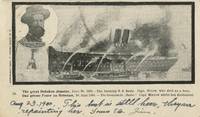
1900ref. BK0100New York: Franz Huld and Arthur Livingston 1900. Three illustrated private mailing cards approximately 3 ¼ x 5 ½ inches each with manuscript messages and Hoboken postmarks dated August 23 1900 addressed to J. H. McNally of Lowell Massachusetts. Minor handling wear and soiling very good. Three postcards depicting the destruction caused by the June 30 1900 North German Lloyd pier fire at Hoboken mailed from the city less than two months later by a man signing himself "Jim" to his brother in Lowell. Two are Franz Huld cards nos. 31 and 32 showing the North German Lloyd docks the day after the fire and the burning S.S. Saale; the third published by Arthur Livingston shows the ruins at the entrance to the company's docks. The sender adds brief observations from Hoboken to the printed disaster views. On the view of the ruined docks he writes "The fire is still smoking." Of the Saale: "This boat is still here they are repairing her." The third explains the group: "I saw these cards today and I thought you would like them. Everything is O.K." The fire swept through the North German Lloyd piers and several vessels in the harbor killing more than 300 people. Postcard historian George Miller has described it as "the first major disaster recorded on postcards" noting at least sixteen American postcard issues and an exceptionally rapid response by publishers; the earliest known copyright was registered only five days after the fire.1 The present cards were mailed while its physical aftermath remained visible on the Hoboken waterfront. 1 George Miller "The first major disaster recorded on postcards" Postcard History October 25 2021 https://postcardhistory.net/2021/10/the-first-major-disaster-recorded-on-postcards-the-hoboken-pier-fire-june-30-1900/. . Franz Huld and Arthur Livingston unknown books
1901ref. 70838Roanoke VA: The church Lookabill's Ptg. House Roanoke 1901. Program for the service. Bifolium title verso of first leaf a four-verse each eight lines "greeting" adapted from "Our Firemen by Rev. Dr. Vedder" and four officers of the Junior Hose Company printed recto of integral leaf. Very good. The church (Lookabill's Ptg. House, Roanoke) unknown books
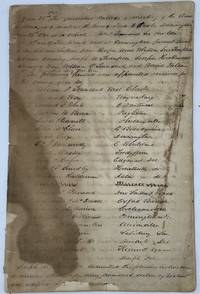
1849ref. 70885Chester Co. PA 1849. Stitched sheets 30 cm. 36 pp. in ink first and last pages detached some chipping around edges a tender copy. Old staining to gutters extending into the text occasionally obscuring some words on the first few leaves else in a clear clerical hand. Manuscript notes a record of the meetings of the Board of Managers for this Fire Insurance Company from Sept. 23 1846 to Oct. 15 1849. A close look at the inner workings of a small local fire insurance company. The first entry called a meeting of the Board of Managers at the house of Jacob E. Parke Downington and recorded the names of the members including Morris Cope Solomon Lukens Davis Hoopes Morris Whitson Jno. Templeton Charles Downing Joseph M. Thompson Joseph Hickman Bernard also spelled Baynard Way William P. Townsend and David Wilson. This is followed by a long list of 21 names and locations of the persons appointed receivers for the coming year. The Treasurer Joseph M. Thompson gave "instructions to receivers" for collecting payment of dues for depositing those fees in a secure banking institution and for accurate reporting of the payments to the company. For their efforts they were to deduct a one percent commission on their collections. The notes also record officers' salaries and the payments to committee members appointed to fix premiums of one dollar a day plus 5 cents a mile for travel. Over the course of the other meeting notes mention is made of the claims of several of the insured for payments for fire damage to dwellings barns and businesses. In January 1847 Rebecca W. Lukens received $25 "to be distributed among the persons who were usefully active in extinguishing the fire in the rolling Mill of said R.W. Lukens sometime ago." Louis Bachman of North Coventry Township Wm. McCullough of Cecil Co. and Jacob Emery of Salisbury Township all recovered claims for partial damage to their dwellings in these years. One case related to the loss of Hayes Clark's Cotton Factory was disputed because he had not paid the initial interest due on his policy before a conflagration took the entire operation on Doe Run. Details of the dispute resurface in several meetings. The company eventually paid his claim. The meeting notes also established premium amounts for various structures rating buildings as first second third and fourth class; differentiating between costs to insure stone or brick barns and those built of wood; and accounting for variations in types of businesses insured including cabinet makers smith shops taverns and book sellers. An end of the year financial accounting for 1847 reported 2194 perpetual policies issued and advance amounts of money thereon as $3788.64. In 1848 premiums were adjusted for property situated within 200 yards of any railroad on which locomotives ran. A long list of increases in premium rates for affected dwellings and businesses followed. In January 1849 a resolution was passed to make alterations to one of the company's fire proof safes to make it capable of holding copies of their insurance policies. John Smith Futhey in his book "History of Chester County Pennsylvania with Genealogical and Biographical Sketches" Phila. PA: 1881 p.391 describes the history of this fire insurance company. Chartered by the Pennsylvania Legislature on April 21 1840 it was organized that May with Joseph M. Thompson as President Enoch Harlan as secretary and Amos Fredd as treasurer. It began issuing policies of five years duration members being assessed to meet losses occuring each insurer being a member. At the end of the five years the company proving successful perpetual policies began to be issued substituting for the "first or five-year ones. To furnish insurance at the lowest possible cost has been the aim of the company and its success in that direction is perhaps without a parallel in the history of fire insurance." In an article in The Jeffersonian newspaper of Jan. 25 1848 the "Report of the Board of Managers of the Mutual Fire Insurance Company of Chester Co." appears with details of the company's finances. The company "went into operation" in 1840 and had since paid out over $26000 for losses by fire. It also stated that if things continued as they had been going they estimated they would soon be able to reduce the annual payment due from members from 6% "to such less percentage as may be deemed sufficient. unknown books
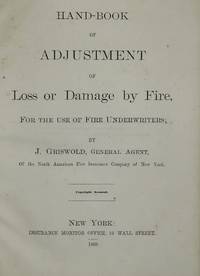
1868ref. 56003New York: Insurance Monitor Office 1868. First edition. Small 4to. 105 3 pp. Introduction: "It is a collection of scattered fragments of insurance wisdom collated from a great variety of sources freely appropriated and brought into an aggregated form whence the tyro in the profession can gather the fruits divested of technicalities." With a southern ownership signature "Jno. R. Long Agt. / Columbus Miss." OCLC locates six copies Buffalo/Erie County Public New York Public Library of Congress Smithsonian North Carolina Brown. Original gilt-stamped blue cloth spine ends and corners rubbed. Very good. 2525. Insurance Monitor Office unknown books
ref. UBLALEB00lhLibrairie Theatrale ND. Good. Blaze Castil. Le Barbier de Seville. Paris: Librairie Theatrale ND. 103pp. 16mo. Paper wraps. Book condition: Good. Slightly wavy. Wraps are slightly loose. Librairie Theatrale paperback books
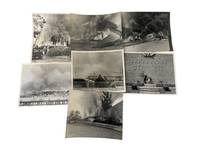
1963ref. 235671963. Pikesville Volunteer Fire Company fire disaster photograph group documenting the destruction of a volunteer fire station and firefighting apparatus in Baltimore County Maryland on August 7 1963. The photographs show an active structural fire involving a firehouse complex and fire equipment captured by Baltimore freelance photographer J. K. Stevenson at the height of the emergency. The images record the vulnerability of volunteer fire organizations whose stations apparatus communications equipment and community functions were concentrated in a single building making a major station fire both an operational and civic crisis. Photo archive of 7 large silver gelatin photographs each approx 8 x 10 inches Pikesville Maryland August 7 1963. The photographs show a large frame building engulfed in heavy smoke as firefighters direct elevated streams from an aerial ladder truck; fire apparatus and debris consumed by flames; firefighters operating hose lines from an elevated platform; collapsed roofing and structural wreckage burning amid dense black smoke; and the aftermath of extensive fire damage. One photograph depicts a man posed beside a ceremonial bell in front of a brick building marked "Pikesville Volunteer Fire Co." providing a visual contrast between the company's public identity and the destruction shown elsewhere in the group. The photographs bear the stamp of Baltimore freelance photographer J. K. Stevenson and are dated August 7 1963 on the versos. The images emphasize smoke conditions suppression efforts structural collapse and the destruction of equipment rather than casualties or victims. The photographs document a period when volunteer fire companies remained central institutions in suburban Maryland communities serving as emergency responders social organizations and public gathering spaces. The Pikesville Volunteer Fire Company founded in 1897 had long served Baltimore County's expanding suburban corridor making the loss of a station or apparatus a significant operational event for the community it protected. The group is particularly effective as a visual sequence moving from active suppression to structural collapse and aftermath while preserving large-format contemporary photographs produced by a named local photojournalist rather than later commemorative reproductions. Light surface wear minor curling and occasional handling marks; overall very good condition. A concentrated visual record of a major fire emergency affecting one of Baltimore County's long-established volunteer fire companies during the suburban growth era of the early 1960s. unknown books
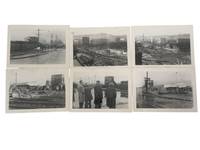
1948ref. 232471948. Seattle freight yard fire photo archive documenting the destruction and emergency aftermath of a rail served maritime industrial site in 1948. The photographs center a burned yard associated with the American Hawaiian Steamship Company a major intercoastal carrier that linked Pacific ports with Atlantic and Gulf Coast trade and maintained a substantial presence on Seattle's waterfront during the first half of the twentieth century. Rather than isolating a single ruined structure the group shows the working system around it: street access fire response rail lines lumber storage cargo handling space and the industrial buildings that tied Seattle's urban growth to port commerce. Photo archive of 6 black and white photographs each 3" x 4.5" Seattle Washington studio stamp en verso dated December 4 1948. The images show a broad debris field of charred timbers collapsed framing burned posts pooled water and smoke rising across a freight yard crossed by railroad tracks. Two views prominently include the sign for American Hawaiian S.S. Co. while another visible sign reads Keystone Steel & Wire Company placing the site within Seattle's maritime industrial district. One street view shows fire hoses snaking across wet pavement toward the still smoking yard and another frames a group of men in long overcoats and hats standing at the edge of the destruction surveying the scene. Utility poles warehouse buildings sidings stacked material and the hillside cityscape beyond the yard anchor the fire within a dense industrial section of Seattle shaped by port traffic and rail distribution. Seattle's maritime industry shaped the city from its earliest waterfront settlement into a major Pacific port where rail lines piers warehouses and steamship companies made Elliott Bay the engine of urban growth and commercial expansion. Minor edgewear and curling. Overall very good condition. These photographs preserve a short concentrated record of emergency aftermath on a working Pacific Coast waterfront at the start of the postwar shipping era when Seattle remained a major junction of rail and ocean transport and steamship firms still occupied prominent waterfront facilities. unknown books
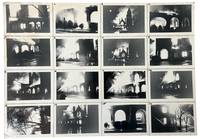
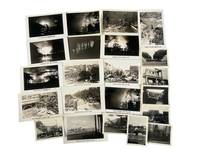
1968ref. 233001968. Fire destruction of Trinity United Methodist Church on South 2nd Street in Clearfield Pennsylvania photographed during the active overnight blaze of December 21 1968 in a dramatic sequential record of one of the borough's largest twentieth century urban fires. The archive captures the church while fully engulfed preserving flames erupting through the roofline smoke pouring from the arcaded façade hose streams striking the structure from darkened streets and the silhouette of the church tower rising above the fire. The photographs record not only the destruction of a major downtown religious landmark led at the time by Rev. Oliver H. R. Krapf but also the operational reality of late 1960s volunteer firefighting systems in small town Pennsylvania where borough police volunteer companies ladder apparatus hydrant pressure and regional mutual aid networks were rapidly assembled in an effort to contain a spreading structural fire. The blaze was first spotted around 2:10 a.m. by taxi driver Billy Knepp after which Fire Chief William Swisher summoned neighboring companies to prevent the fire from spreading beyond the church into the surrounding civic center. Photo archive of 16 silver gelatin photographs mounted to a large cardstock sheet measuring approximately 20" x 14" each image roughly 3.5" x 5" Clearfield Pennsylvania December 1968. Each photograph is numbered by hand from 1 to 16 and together they function almost cinematically moving through different stages and vantage points of the firefight. The images center the church's cut stone arcades and bell tower as bright interior firelight blows outward through the large arched openings and flames tear across the roof structure above. Several photographs show powerful hose streams cutting diagonally across the frame toward the burning façade while others pull back into wider nighttime street scenes where bare winter trees utility poles parked cars wet pavement and gathered onlookers remain visible beneath smoke and reflected firelight. One frame includes a firefighter seen from behind at street level facing the inferno while another captures a bicyclist or passerby entering the foreground as the church burns behind him. Multiple views emphasize the repetition of the long arcade row transforming the church exterior into a glowing sequence of arches illuminated by active fire inside the structure. The resulting series preserves not only the destruction itself but the visual atmosphere of the emergency response: steam smoke glare darkness reflective pavement and shifting vantage points from the surrounding streets as firefighters attempted to control the blaze. The archive is especially significant as documentation of pre modernized municipal fire response during a period when Pennsylvania boroughs depended heavily on intercompany volunteer assistance for major structural fires. The identified responding companies from Lawrence Township Hyde Curwensville Philipsburg and Chester Hill gives the group great specificity within the history of regional mutual aid firefighting networks. At the same time the photographs preserve the loss of an architecturally prominent early twentieth century Methodist church before widespread sprinkler retrofitting and later fire protection standards transformed many American religious and civic structures in the decades that followed. Mount toning with expected contrast loss and glare in several high intensity night exposures. Overall good condition. unknown books
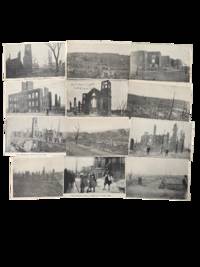
1908ref. 232131908. Chelsea fire real photo postcard archive documenting the destruction of civic religious medical and financial institutions in Chelsea outside of Boston Massachusetts after the November 1908 fire one of the most destructive urban fires in early twentieth century New England. This collection displays not only the ruined architecture but on the functions that had to be reestablished after the fire including places of worship schooling banking and medical care. Not only do these images display a developing New England city in ruins but the involvement of the surrounding community that was left displaced to pick up the pieces. Photo archive of 12 silver gelatin real photo postcards each 3" x 5.5" Chelsea Massachusetts circa 1908. The cards show skeletal masonry walls roofless church towers leveled residential blocks ash fields and streets lined with stripped tree trunks and scattered debris. Printed captions identify multiple sites including "Ruins of Unitarian Church Chelsea Mass." "Universalist Church Fourth & Chestnut St." "Ruins of Fay School Chelsea Mass." "Ruins of Public Library" "Central Church from Broadway Chelsea Mass." "Ruins of Williams School & First Universalist Church Chelsea Mass." and "Remains of Frost Hospital." Several views are wide panoramas taken from elevated ground or across open lots showing block after block reduced to foundations and chimneys while others isolate single institutional buildings left standing as shells. Human figures appear throughout as scale markers and witnesses with pedestrians moving through cleared streets and one especially important card showing uniformed cadets and coast artillery guards with rifles outside the Chelsea Savings Bank. The Great Chelsea Fire burned through a substantial section of the city in 1908 and displaced thousands making it one of the most destructive urban fires in New England in its period. These postcards preserve the public facing record created immediately after the disaster when churches schools hospitals libraries and banks were photographed not as isolated ruins but as essential parts of a city whose institutional framework had to be defended and rebuilt. Some edge and corner wear; minor toning. Overall very good condition. A concentrated record of urban destruction emergency security and civic reconstruction in Chelsea Massachusetts. unknown books
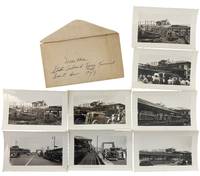
1946ref. 234361946. Photographs documenting the emergency response to the nine-alarm fire that destroyed the St. George ferry and railway terminal on Staten Island in June 1946 recording fire apparatus a hospital ambulance crew and rescue workers amid the smoking wreckage. The fire began at 2:30 in the afternoon of June 25 1946 under a car and spread to the terminal's wooden support pilings. Nine alarms were transmitted within half an hour summoning fifty land companies and six fireboats; three civilians were killed and more than 250 firemen and 30 civilians were injured or overcome by smoke. Photo archive of 8 silver gelatin snapshot photographs approximately 5 x 3 inches Staten Island New York with the original mailing envelope inscribed in ink "Martha Staten Island Ferry Terminal burnt down June 1947." One image centers a panel-body ambulance lettered "St. Vincent's Hospital" and "Staten Island" parked beside an open rear ambulance where attendants in white tend a patient. Another shows workmen uniformed officers and helmeted firemen clustered around the rescue vehicles below the gutted upper story. Several frames show pairs of wooden and steel rapid transit cars standing scorched on the rails beneath the twisted collapsed ribs of the train shed windows blown out and roofs caved in. A trackside view captures fire engines lined nose to tail along the roadway. The nine alarms transmitted within thirty minutes the fifty land companies and the Manhattan units racing through the Holland Tunnel show standard FDNY multi-borough mutual aid working at full stretch recorded by a bystander close enough to walk the platforms. The St. George fire ranks among the worst in Staten Island history and FDNY commanders called it one of the most stubborn blazes they had faced the burning rooted deep in the terminal's wooden pilings over the water. The destroyed structure was replaced by an entirely new $21 million terminal that opened in 1951. Overall in very good condition. A direct on-the-ground record of a multi-borough emergency response to a fatal nine-alarm fire that erased a major New York transit terminal. unknown books
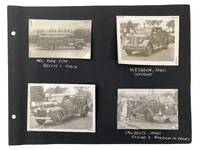
1910ref. 233921910. TechnologyRescue Operations American fire engine modernization archive documenting the transition from horse drawn steam engines to motorized trucks and rescue wagons in Massachusetts and across the Northeast between the 1910s and 1940s. Fire departments across the U.S. began to transition from horses and steam pumpers to gasoline powered apparatus to account for urban growth taller buildings electrical wiring and automobile traffic changing the speed and scale of emergency response. The archive records identified departments and apparatus makers including Mack GMC Ford Seagrave Studebaker American LaFrance and Maxim mostly showing departments across Massachusetts departments and with additional images from New York Pennsylvania New Jersey Rhode Island and Vermont. Photo archive of 33 silver gelatin photographs many with captions ranging from 2 x 3 to 4 x 6 inches chiefly Massachusetts with additional material from Vermont Pennsylvania New York New Jersey and Rhode Island 1910s to 1940s. Fire engines and firefighters appear in station fronts street parades apparatus portraits airport grounds and active fire scenes. Captions identify New York City Rescue 1 Mack; Syracuse Rescue 1 GMC; Highland Park Pennsylvania Rescue 2 Mack; Plainfield New Jersey Rescue GMC; Chelmsford Massachusetts Emergency No. 7 Studebaker; Camp Edwards Massachusetts Mack Engine 4; Needham Massachusetts Mack Engine 3; Lawrence Massachusetts Engine 3 American LaFrance; Boston Ladder 8 Ladder 9 and Ladder 21; Cambridge Engine 3; Canton Massachusetts Mack engine; Shrewsbury Massachusetts Engine 3 and Ladder 3; Barrington Vermont; Stoneham Massachusetts Bell Block; River Street Boston; First Scientist Church Somerville; and Fort House Somerville. Horse drawn apparatus appears outside Hope No. 1 in Pittsburgh and in a parade scene while motorized ladder trucks carry long wooden extension ladders hose reels searchlights bells sirens polished pumps and side mounted tools. The images provide a side by side record of old and new fire protection: horse teams exposed steam machinery open cab ladder trucks and later motorized emergency vehicles. Chas. E. Beckwith's Fire Dept. Photographer stamp connects at least part of the group to a specialist working for Massachusetts fire departments. Photographs stapled to eight disbound black album pages; scattered fading handling wear with legible captions. Some with additional handwritten captions on versos. Overall in good condition. unknown books
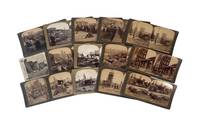
1906ref. 221651906. Fifteen stereoview photographs document the destruction and emergency relief that followed the April 18 1906 San Francisco earthquake and fires. The images record leveled downtown blocks collapsed masonry burned buildings displaced residents military personnel laborers food distribution and temporary shelters preserving contemporary visual evidence of both the physical destruction of the city and the organized response to widespread displacement. Several views place survivors and relief workers directly within the ruined streetscape while others show the scale of destruction through broader panoramas that include recognizable civic landmarks such as the damaged City Hall. Archive of 15 stereoview photograph cards comprising albumen and hand colored prints on curved mounts. San Francisco California: Underwood & Underwood Keystone View Co. and other publishers circa 1906. Each measures approximately 7 x 3.5 inches; many retain detailed printed captions on the versos. Subjects include panoramic views across devastated downtown districts collapsed and fire damaged masonry streets filled with rubble military personnel and civilians moving through the ruins temporary relief camps improvised kitchens food lines and shelters constructed from corrugated iron and salvaged materials. One hand colored view gives the wreckage added visual definition through applied color. Another card shows people waiting for food beneath the caption "The bread line-at world's gift of food to the victims of earthquake and fire" directly recording the distribution of outside relief to survivors. Commercial stereoview publishers rapidly circulated images of the San Francisco disaster to audiences beyond California using paired photographs viewed through a stereoscope to create an illusion of three dimensional depth. This group records subjects extending beyond architectural destruction to the practical consequences of the catastrophe: housing displacement food distribution military supervision improvised shelter and the movement of residents and workers through damaged neighborhoods. The cards therefore preserve evidence of how the earthquake and fires altered both the built environment and daily life during the immediate aftermath. Some edge wear and light soiling to the mounts; photographic images retain strong contrast and clarity. Very good condition overall. unknown books
1940ref. 220171940. Panama Latin America Panama's Great Fire of Colón Photo Archive This rare photographic archive documents the catastrophic fire that ravaged the city of Colón Panama on April 13-14 1940-an event that left over 25 city blocks in ruins and displaced thousands. Archive of 22 original silver gelatin prints and real photo postcards 10 of the 22 are captioned real photo postcards this collection offers a powerful visual narrative of both the inferno and its human aftermath. Each measure between 3.5" x 5.5" to 2.5" x 3.5". The fire which broke out in the commercial district and rapidly spread through Colón's densely packed wooden buildings destroyed much of the city's historic core. Several of the images in this archive capture the conflagration itself: nighttime exposures show buildings engulfed in flames with thick smoke billowing skyward and firefighting efforts visibly overwhelmed. Other photos reveal the skeletal remains of businesses and residences twisted signage and storefronts reduced to charred shells. The RPPCs are cleanly captioned "Great Fire of Colon April 13-14 1940" and depict both panoramic and street-level views of the destruction. One RPPC of a fiery building is taken from one of the original photos in the lot. One photo shows a massive crowd gathered around a relief station in front of the statue of Columbus; another shows refugee encampments set up in the city's parks including orderly rows of tents and makeshift shelters. One striking image captures a line of uniformed soldiers patrolling the rubble-strewn streets likely part of the U.S. military or Panamanian National Guard underscoring the strategic importance of Colón as the Atlantic gateway to the Panama Canal Zone. Several other images uncaptioned depict interior views of still-burning structures and nighttime firefighting scenes with silhouettes and reflections rendered in stark chiaroscuro. The photographic style is consistent with local press and professional freelance documentation of the time. The fire struck during a tense period of Panamanian history when U.S. influence over the Canal Zone inflamed nationalist tensions and Colón's working-class Afro-Caribbean population-many of whom descended from West Indian laborers brought during canal construction-struggled for political inclusion and economic security. The destruction of working-class housing in Colón exacerbated long-standing issues of racial and economic segregation and the government's response was criticized as inadequate. This archive not only captures the physical devastation but also offers an unfiltered glimpse into class race and imperial infrastructure in crisis. Very minor edge wear. Overall very good condition. A vivid scarce visual record of one of the most significant disasters in 20th-century Panamanian history. unknown books
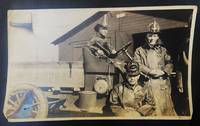
1912ref. 177181912. Fire department photo album ca 1912 a visual record of early motorized firefighting that documents the transition from horse drawn apparatus to mechanized emergency response in California. The album centers on a small town department identified by the uniform insignia "CCFD" capturing a moment when motor vehicles were beginning to replace traditional equipment even as many larger cities still relied on horse drawn engines. The presence of specialized vehicles and organized crews reflects the modernization of municipal and volunteer fire services in the early twentieth century as departments adopted new technologies to improve response speed and operational capacity. Photo album containing 42 silver gelatin photographs housed in original string bound black leather covers. Images depict firefighters posed with motorized apparatus including vehicles associated with Kissel an early automobile manufacturer known for producing service and utility vehicles. Several photographs show crews at fire scenes alongside the charred remains of structures while others document equipment group portraits and operational contexts. One loose photograph bears the caption "This Rig is used for carrying back dirty hose. The other three are useless" providing a candid comment on equipment function and intra crew perspective. Additional imagery includes a woman seated on a Kissel automobile indicating the broader presence of early motor vehicles within the community. The album documents a transitional phase in firefighting history when mechanization reshaped emergency services reducing reliance on animal power and enabling more complex logistical coordination. Departments adopting motorized equipment during this period often represented early adopters of automotive technology within their communities and their visual documentation provides insight into both technological change and local organization of public safety. The combination of posed and candid images captures both formal representation and everyday practice within a fire brigade adapting to new tools and methods. Covers show light wear with secure string binding; photographs remain clear and well preserved. Overall very good condition. unknown books
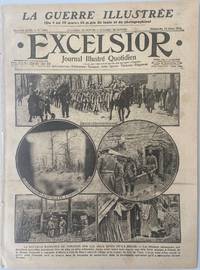
1916ref. 179091916. World War I Excelsior La Guerre Illustree. 1916. in French. Measures 14" x 10.5" inches. French newspaper reports on British girls learning fire fighting tactics to save lives during air raids. Front page of paper shows photographs of prisoners being led by soldiers. Back page shows young girls practicing lifesaving skills for air raids. In one image they help each other down a ladder in another one carries the other across her shoulders in a fireman's carry. In a dramatic shot a girl jumps from a second story window with a group of others waiting below holding a wide piece of thick fabric to catch her. 1916 was a turning point in World War I when Allied economies were mobilized to ramp up military power so that soldiers could break the deadlock on the western front. Citizens were active participants in the war effort both economically and by training as volunteers in domestic war efforts. Some light toning does not affect text or images. Overall good condition. unknown books