7.799 resultados
1828ref. 604227Heidelberg, Winter, 1828. XIV, 436 S. Grüner Ppbd der Zeit mit rotem Rückenschild.
ref. 07220241.expVery Good. Complete in eight volumes. Boards show only light surface and shelf wear. Bindings intact. Text remains crisp clean and unmarked. hardcover
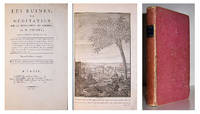
1792ref. 000262Paris: Desenne. Volland. Plassan. Libraires 1792. Hardcover. See Description. New and corrected edition First edition printed in France. 8vo. pp. xvi 295 1. With plate depicting the ruins of Palmyra and 2 fold out plates illustrating 1. the eastern hemisphere and 2. the astrological constellations ceil astrologique des anciens. Bound in original pink paste paper boards - some wear to the outer hinges and extremities. Pages are clean; occasional speck of marginal foxing. Volney's book of meditations on the rise and fall of empires was influential on the Romantic movement and on the Hudson River school of painting. Chapters also discuss ancient religions and mysticism. Desenne... Volland... Plassan.... Libraires hardcover
1799ref. 48206(Halle, Rengerschen Buchhandlung, 1799). Without wrappers. In ""Annalen der Physik. Herausgegeben von Ludwig Wilhelm Gilbert"", Bd. 2, Erstes Stück. (The entire issue offered). 1-118 a. 2 folded engraved plates. Cavendish's paper: pp. 1-62. (the torsion balance of Michell shown on the plates).
1799ref. 48206Halle Rengerschen Buchhandlung 1799. Without wrappers. In "Annalen der Physik. Herausgegeben von Ludwig Wilhelm Gilbert" Bd. 2 Erstes Stück. The entire issue offered. 1-118 a. 2 folded engraved plates. Cavendish's paper: pp. 1-62. the torsion balance of Michell shown on the plates. First German edition of Cavendish's famous paper in which he calculated the weight of the earth and determined its mass. He also as the first observed gravitational motion of minute portions of matter. He estimates the earth's mass to 66 x 10 to the potential of 24 kg. The original paper "Experiments to determine the Density of the Earth" appeared in Philosophical Transaction 1798."Cavendish published five papers between 1784 and 1809.With one exception they were comparatively minor productions.The exception was his determination of the density of the earth or weighing of the world in 1798 by means of John Michell's torsion balance. The apparatus consisted of two lead balls on either end of a suspended beam; these movable balls were attracted by a pair of stationary lead balls. Cavendish calculated the the force of attraction between the balls fro the observed period of oscillation of the balance and deduced the density of the earth from the force. He found it to be 5.48 times that of water. Cavendish was the first to observe gravitational motions induced by comparatively minute portions of ordinary matter.By weighing the world he rendered the law of gravitation complete. The law was no longer a proportionally statement but a quantitatively exact one; this was the most importent addition to the science of gravitation since Newton."DSB III p. 158.The issue contains further papers by Ritter Chladni et al. unknown
1729TWO RARE BOOKS BOUND TOGETHER: 18th-century comprehensive study book for painters and printmakers, with many b&w illustrations and frontispiece, and a guidebook for correct lacquer usage. Title printed in red and black. 175x110mm. [XVI+544] + [144] pages. Contemporary leather Hardcover. Text block edges dyed red. Cover worn, stained and creased. Cover and spine edges bumped. Cover upper corners and spine upper edge peeling. Small worm-mark on front inner cover. Worm-marks on rear inner cover. Endpapers coming loose from cover. Ink inscriptions on rear whitepage. Small ink inscription on title page bottom corner. Pages yellowing and wavy. [FIRST TITLE]: Binding partly loose between frontispiece and title page. Page 81/82 bottom edge slightly tattered. [SECOND TITLE]: Several small wormholes on some pages with minimal damage to few letters of the text. [SUMMARY]: These two extremely rare 18th-century guidebooks for painters and printmakers have sustained some damage over the years, but are still in good reading condition.
ref. 26383England. Dating from at least between 1963 and 1975. The collection is in good condition on lightly aged and worn paper and can be grouped into three sections. ONE: Complete typewritten draft 3 44pp. 4to of Sussman's unpublished monograph on Bloch is contained in a large brown envelope with the following note by Sussman on the front: '2ND COPY without illustrations of "Ernest Bloch - Music's Prophet" JS'. It includes the contents list of illustrations introduction and two-page 'Key and Bibliography'. In seven chapters with titles including: '"Blochian" - The Hebraic idiom' 'The nationalist paradox' and 'Voice in the wilderness'. The monograph clearly went through a long process of revision and also present are a number of typescript drafts of various sections with extensive autograph emendations. These total 56pp. 4to with some sections disordered. TWO: Autograph 'Surrey County Council' notebook in Sussman's close handwriting and with extensive emendations is 93pp. 8vo with a further 45pp. 8vo loosely inserted. THREE: Approximately 70pp. 4to of miscellaneous autograph notes by Sussman mainly on traditional Jewish music together with four leaves torn from the 'Synagogue Review' November and June 1951. Sussman lived at 62 St Quintin Avenue London W10. There is no record of his having published any of his music criticism. In 1949 'The Gramophone' carried an advertisement in which he offered 'thorough tuition in Pianoforte playing and theoretical musical subjects'. England. Dating from at least between 1963 and 1975. unknown
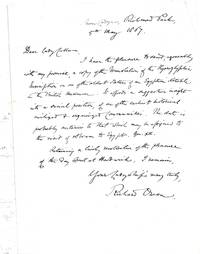
ref. 22391Owen's letter to Lady Cullum dated from Sheen Lodge Richmond Park 5 May 1867. Transcription of Birch's letter to Owen dated from British Museum London 9 July 1860. An interesting item in the field of Victorian Egyptology. The subject is what Owen describes here as 'one of the oldest Statues of an Egyptian Notable in the British Museum'. Its current Museum Number is EA103 and it has been in the Museum since 1835 but the details of its acquisition are unclear. In his translation Birch calls the sitter 'the Royal Scribe Amenhelp' but the current BM description begins: 'Scribal statue of Amenhotep son of Hapu: of black grano-diorite. Hieroglyphic texts are inscribed on the papyrus unrolled on his lap and on the statue plinth. His right hand now broken held a pen as if writing while his left hand holds the papyrus roll. .' At the time of writing Owen and Birch were colleagues at the British Museum Owen as Superintendent of the Natural History Department and Birch as head the Egyptian and Assyrian branch see the entries on both men in the Oxford DNB. The recipient of Owen's covering letter to Birch's translation is Lady Ann Cullum 1807-1875 widow of Sir Thomas Gery Cullum 1777-1855 of Hardwick House. As a palaeontologist Owen opposed Darwin's theory of evolution with a biblical view of creation and his interest in Ancient Egypt bound up with his Christian beliefs is apparent in the letter in an elegant assessment of the significance of the statue and in his annotation of Birch's translation. The letter and translation are on four 4to pages of the same paper. In good condition with light signs of age and wear. The letter is on the recto of the first leaf of a bifolium and the first page of the translation on the recto of the second leaf but they have now been inverted by folding with the two leaves carrying the other two pages of the translation tipped-in at the front resulting in the material being presented in reverse order. ONE: Covering Autograph Letter Signed from Owen to Lady Cullum with good firm signature addressed from 'Sheen Lodge Richmond Park 5th May 1867.' 1p 4to. The letter reads: 'Dear Lady Cullum I have the pleasure to send agreeably with my promise a copy of the Translation of the hyeroglyphic sic Inscription on one of the oldest Statues of an Egyptian Notable in the British Museum. It affords a suggestive insight into a social position of one of the earliest historical civilized & organized Communities. The date is probably anterior to that which may be assigned to the visit of Abram to Egypt. Gen. XII. Retaining a lively recollection of the pleasure of the day spent at Hardwick I remain Your Ladyship's very truly Richard Owen.' TWO: Manuscript translation described in Owen's letter. 3pp 4to. Written out in an unknown hand with the first of the five sections titled: 'Translation of the Inscription on the Garment and Papyrus which he is unrolling.' The other four sections of the translation are: 'Inscription In Front of the base' 'Running to the left of the figure' 'right Side' and 'Left side'. At the head of the first page in Owen's autograph: 'Hyeroglyphics sic on the Statue of the Seated Royal Scribe “Amenhelp” in the British Museum.' On the third page at the end of the translation and in the same unknown hand is written out a 'Copy of letter from Samuel Birch Esqre: F.S.A. &c. Keeper of Antiquities in the British Museum enclosing the above Translation to Professor Owen: -'. Birch's letter is dated from the British Museum 9 July 1860. It reads: 'My dear Professor Enclosed is the Translation of the Inscriptions on the Granite Statue of the Seated Scribe. It Consists of the Dedication of the Statue to the Royal Scribe Amenhelp and of his prayers to the God Amen-Ra – the Theban Jupiter. Believe me Yours very truly signed Samuel Birch'. The translation carries tem marginal annotations in Owen's autograph indicating an interest in and knowledge of the subject. The two of Owen's annotations read: 'His territorial Title: Baron Shamer like all the Nobility of Egypt was a priest: the condition is now parallel'd at the Court of Rome.' and 'the Upper & Lower Provinces of Egypt paralleling the Heavens & the Earth.' See Image of Owen's letter. Owen's letter to Lady Cullum dated from Sheen Lodge, Richmond Park, 5 May 1867. Transcription of Birch's letter to Owen dated fr unknown
1868(Codice MT/1896) In 8° 403 pqges. + 5 grandes planches rempliées illustrées de nombreuses figures; la 5° en partie manquante. Envoi de l'auteur au "Géneral Menabrea" au faux-titre. Reliure époque, demi toile, titre doré, bien serrée mais plutot fatiguée: mors fendillés, epidermures, bords frottés. Intérieur: très frais, grandes marges; insignifiantes jaunissures et traces d'usage. ~~~ SPEDIZIONE IN ITALIA SEMPRE TRACCIATA
1901ref. 5127340Leipzig: Verlag von Wilhelm Engelmann 1901. XI, (1), 48 Seiten. 8° (22 x 14 cm). Orig.-Umschlag (Hinterdeckel erneuert) mit Rahmen- und Titelprägung auf dem Vorderdeckel.
ref. 7748E. Plon & Cie, Imprimeurs-Editeurs, Paris, 1876. In-8, demi-reliure, dos titré avec quatre fleurons dorés, 445 pp. Préambule - Belgique : I. Le musée de Bruxelles. - II. Les maîtres de Rubens. - III. Rubens au musée de Bruxelles. - IV. Rubens à Malines. - V. La Descente de croix et La Mise en croix. - VI. ...
1770(Codice AN/3062) Three volumes in 8° (205x130 mm), XXIV-398-[2], [4]-432-[2], [4]-493-[3] with copper-engraved portrait, 3 title vignettes and 3 headings (battle scenarios vignettes). Complete with 41 engraved large folding plates, all in perfect shape. Ancient dedication and owner's signatures on title-pages, minor dampmark to margin of volume I. Period leather binding with raised bands, compartments gilt & title-labels, marbled endpapers, red edges. Spines damaged and partly missing (vol. III), hinges partly creased, corners/edges lightly worn; however still firmly bound, internally looks unread, text & plates are in mint conditions. ~~~ SPEDIZIONE IN ITALIA SEMPRE TRACCIATA
13 S. + 2 Falttafeln. 8°. Ecken gering fransig. Selten. RISM Ecrits Imprimées BVI, I, S. 152. Fétis, Biographie universelle des musiciens, I:435.
1799ref. 43865Halle, Rengerschen Buchhandlung, 1799. Without wrappers. In ""Annalen der Physik. Herausgegeben von Ludwig Wilhelm Gilbert"", Bd. 2, Erstes Stück. (The entire issue offered). Titlepage to vol. 2. Pp. 1-118 a. 2 folded engraved plates. Cavendish's paper: pp. 1-62. (the torsion balance of Michell shown on the plates).
1803ref. 44129Halle, Rengerschen Buchhandlung, 1803. Without wrappers as extracted from ""Annalen der Physik. Herausgegeben von Ludwig Wilhelm Gilbert"", Bd. 12. Pp. 310-318 a. pp. 385-395.
1759ref. 45126(Berlin, Haude et Spener, 1759). 4to. No wrappers, as issued in ""Mémoires de l'Academie Royale des Sciences et Belles Lettres"", Année 1757, tome XIII, pp. a. 1 engraved plate.
1821ref. 59163London, Baldwin, Cradock, and Joy, 1821. Contemp. Hcalf. Minor scratches to spine. In: ""Annals of Philosophy"" or, Magazine of Chemistry, Mineralogy, Mechanics, Natural History... By Thomas Thomson."", New series Vol. I. VIII,479 pp. a. 7 engraved plates. (Entire volumes offered). Herapath's papers: pp. 273-293, 340-351 a. 401-416.
1852ref. 43564Leipzig, Johann Ambrosius Barth, 1852. Without wrappers as issued in ""Annalen der Physik und Chemie. Hrsg.von Poggendorff"", Dritte Reihe Bd. 26, Achtes Stück.(= Heft No. 8 of 1852). (The entire issue (No. 8) offered). Titlepage to vol. 26. Pp. 501-600. Helmholtz's paper: pp. 501-523. Clean and fine.
1799ref. 43865Halle Rengerschen Buchhandlung 1799. Without wrappers. In "Annalen der Physik. Herausgegeben von Ludwig Wilhelm Gilbert" Bd. 2 Erstes Stück. The entire issue offered. Titlepage to vol. 2. Pp. 1-118 a. 2 folded engraved plates. Cavendish's paper: pp. 1-62. the torsion balance of Michell shown on the plates. First German edition of Cavendish's famous paper in which he calculated the weight of the earth and determined its mass. He also as the first observed gravitational motion of minute portions of matter. He estimates the earth's mass to 66 x 10 to the potential of 24 kg. The original paper "Experiments to determine the Density of the Earth" appeared in Philosophical Transaction 1798."Cavendish published five papers between 1784 and 1809.With one exception they were comparatively minor productions.The exception was his determination of the density of the earth or weighing of the world in 1798 by means of John Michell's torsion balance. The apparatus consisted of two lead balls on either end of a suspended beam; these movable balls were attracted by a pair of stationary lead balls. Cavendish calculated the the force of attraction between the balls fro the observed period of oscillation of the balance and deduced the density of the earth from the force. He found it to be 5.48 times that of water. Cavendish was the first to observe gravitational motions induced by comparatively minute portions of ordinary matter.By weighing the world he rendered the law of gravitation complete. The law was no longer a proportionally statement but a quantitatively exact one; this was the most importent addition to the science of gravitation since Newton."DSB III p. 158. unknown
1803ref. 44129Halle Rengerschen Buchhandlung 1803. Without wrappers as extracted from "Annalen der Physik. Herausgegeben von Ludwig Wilhelm Gilbert" Bd. 12. Pp. 310-318 a. pp. 385-395. First German edition of both papers constituting the first 2 papers in his "Experimental Essays on the constitution of mixed gases." 1802 in which he formulated his famous gas laws and raised the foundation of the atomic theory in chemistry.The publication of these papers gave him at once international reputation they tried to explain why the gases of the atmosphere remain mixed instead of segregating with the heaviest element at the bottom it states that the maximum density of a vapour in contact with its liquid remains the same whether other gases be present or not and the vies that the particles of everykind of elastic fluid are elastic only with regard to their own kind and that the total pressure of the atmosphere equals the sum of the pressures exerted by the individual gases each of which excerts its pressure independently of the others. This was the first step toward his atomic theory of in chemistry. unknown
1840ref. 47109Paris Bachelier 1840 4to. No wrappers. In: "Comptes Rendus Hebdomadaires des Séances de L'Academie des Sciences" Tome X No 5 entire issue offered. Pp. 143- 207. Dumas' paper: pp. 149-178. First appearance of this paper which was published the same year in 'Annales de Chimie et de Physique' is the most importent on the theory of structural types and the nomenclature of organic compounds refuting the electrochemical theory of Berzelius. "The development of this idea type organique into what is sometimes called the "Older Type Theory" as distinguished from Gerhardt's Type heory is contained in Dumas' importent memoir on the substitution and the theory of types presented on 3 febriary 1840."Partington IV p. 365. "Jean Baptiste Dumas advances a theory that the chemical properties of an organic compound are determined by its structure and not as seems to be the case with inorganic compounds by its electrical properties. he illustrates the concept with the example that the basic qualitative properties of acetic acid are retained even after replacing three fourths of the hydrogen by chlorine. As a consequence he calls for a revision of chemical nomenclature for organic compounds basing terms on common features not on elemental composition."Parkinson "Breakthroughs" 1840 C. unknown
1758ref. 42952Berlin Haude et Spener 1758. 4to. No wrappers as issued in "Memoires de l'Academie Royale des Sciences et Belles Lettres". tome XII 1756. Pp. 165-234 a. 1 folded engraved plate. First printing of Euler's importent large memoir in which he develops the mathematical theory of windmills and generates analytically the equations of the effects of winds on duoble-bended surfaces in relation to mechanical work. - Together with d'Alembert and Daniel Bernoully Euler laid the foundation of mathematical physics. - Enestroem E 233. unknown
1759ref. 45126Berlin Haude et Spener 1759. 4to. No wrappers as issued in "Mémoires de l'Academie Royale des Sciences et Belles Lettres" Année 1757 tome XIII pp. a. 1 engraved plate. First printing of an importent paper in which Euler shows how to manufacture catoptrical telescopes and microscopes in accordance with general rules and founded on his own experiments. - The calculation concerning light ray aberrations brought about due to the sphericty of the glass is a masterpiece of analysis of the highest order and he also incorporates the mathematical theory of achromatic combination of lenses which was first realized by Dollond in the same year 1757. unknown
1852ref. 43564Leipzig Johann Ambrosius Barth 1852. Without wrappers as issued in "Annalen der Physik und Chemie. Hrsg.von Poggendorff" Dritte Reihe Bd. 26 Achtes Stück.= Heft No. 8 of 1852. The entire issue No. 8 offered. Titlepage to vol. 26. Pp. 501-600. Helmholtz's paper: pp. 501-523. Clean and fine. First appearance of this founding paper in the modern theory of colour in which Helmholtz proved the surprising fact that there are only two among the colours of the spectrum yellow and indigo-blue which together yields pure white that is are complementary to each other whereas their combination had always been supposed to produce green."Helmholtz turned to the intricate problems of color vision in 1852 with an attack on Sir David Brewster's new theory of light. Brewster had maintained the objective reality of three primary colors by supposing in opposition to Newton that there exist three distinct kinds of light each of which excites in the eye one of the sensations red yellow or blue. Helmholtz regarded the theory as still another confusion of physical stimulus and subjective responce.He also revived Young's theory of color visoin.only to refute it. He had discovered that spectral colors when mixed always yield a duller color of less-than-spectral saturation. Therefore the whole idea that all colors may be obtained from mixtures of three primary colors must be incorrect he concluded for the spectral colorss at least can never be obtained in their full saturation by mixing any three of their number.Although Helmholtz dismissed Young's theory in 1852 by 1858 he had changed his mind and become its formost advocate. In order to save Ypoung's theory.Helmholtz asumed that Young's physiological primaries are not spectral colors att all but colors of far greater-than-spectral saturation."DSB VI pp. 246-247. Garrison & Morton 1508. unknown
1821ref. 59163London Baldwin Cradock and Joy 1821. Contemp. Hcalf. Minor scratches to spine. In: "Annals of Philosophy; or Magazine of Chemistry Mineralogy Mechanics Natural History. By Thomas Thomson." New series Vol. I. VIII479 pp. a. 7 engraved plates. Entire volumes offered. Herapath's papers: pp. 273-293 340-351 a. 401-416. First printing of these contoversial papers where Herapath revived the kinetic theory of gases. His theory was more or less neglected by the scientific community at his time. The kinetic theory remained dormant and forgotten after Euler's and Bernouilli's work "until 1816 when Herapath proposed a theory which is essential Bernoulli's. Unfortunately he chose to define temperature as being proportional to the momentum rather than the kinetic energy of molecules. Herapath was the first to show more or less that kinetic theory can provide simple explanations for the changes of state diffusion and the propagation of sound."Trousdell "Essayas in the History of Mechanics" pp. 283 ff. unknown