7799 risultati
1862rif. 43530Leipzig, Johann Ambrosius Barth, 1862. Without wrappers as issued in ""Annalen der Physik und Chemie. Hrsg. von J.C. Poggendorff"", 115. Bd., 1. issue (""Heft"" No 1, 1862). Titlepage to vol. 115. Pp. 1-176 a. 1 folded engraved plate. (The entire issue offereed (""Heft"" 1)). Clausius' paper: pp. 1-56. Some brownspots to right marginon some leaves.
1768rif. 44804(Berlin, Haude et Spener, 1768) 4to. No wrappers, as issued in ""Mémoires de l'Academie Royale des Sciences et Belles-Lettres"", tome XXII, Année 1766. Pp. 119-170 , pp. 171-201 and 2 folded engraved plates., pp. 202-212 and 1 folded engraved plate.
1769rif. 44803(Berlin, Haude et Spener, 1769) 4to. No wrappers, as issued in ""Mémoires de l'Academie Royale des Sciences et Belles-Lettres"", tome XVIII, Année 1762. Pp. 195-225 and 1 folded engraved plate. + Pp. 226-248.
1799rif. 43872(Halle, Rengerschen Buchhandlung, 1799). Without wrappers. In ""Annalen der Physik. Herausgegeben von Ludwig Wilhelm Gilbert"", Bd. 1 Viertes Stück und Bd. 2, Drittes Stück. (The entire issues offered). Pp. 379-518 a. 2 folded engravd plates + pp. 249-368 a. 2 folded engraved plates. Rumford's papers: pp. 436-463 a. pp. 249-286.
1853rif. 50167London Richard Taylor and William Francis 1853 4to. No wrappers as extracted from "Philosophical Transactions" 1853 Vol. 143. Pp. 397-406. First appearance of this importent paper by Adams - famous for his co-discovery with Le Verrier of Neptune in 1846 - in which he introduces new mathematical methods in dealing with the pertubations of the Moon raising a sharp scientific controversy and correcting Laplace's great memoir of 1788."He Adams was elected a fellow of Pembroke College in 1853 and shortly afterward he presented to the Royal Society a remarkable paper on the secular acceleration of the moon’s mean motion. This quantity was thought to have been definitively investigated by Pierre Simon de Laplace in 1788 but Adams showed that Laplace’s solution was incorrect. In particular Laplace had ignored a variation in solar eccentricity that introduces into the differential equations for the moon’s motion a series of additional terms. Adams calculated the second term of the series on which the secular acceleration depends as 3771/64m4 the value computed from Laplace’s work was 2187/128 m4. The effect of the correction was to reduce the figure for the moon’s secular acceleration by about half from 10.58 to 5.70.This paper caused a sharp scientific controversy marked by angry chauvinism on the part of several French astronomers. Their attacks stimulated a number of independent investigations of the subject all of which confirmed Adams’ result. The matter was definitely settled in his favor by 1861 but not without hard feelings."DSB. unknown
1853rif. 42763London Richard Taylor and William Francis 1853 4to. No wrappers as extracted from "Philosophical Transactions" 1853 Vol. 143 - Part III. Pp. 397-406. Clean and fine. First appearance of this importent paper by Adams - famous for his co-discovery with Le Verrier of Neptune in 1846 - in which he introduces new mathematical methods in dealing with the pertubations of the Moon raising a sharp scientific controversy and correcting Laplace's great memoir of 1788."He Adams was elected fellow of Pembroke College in 1853 and shortly afterwards he presented to the Royal Society a remarkable paper the paper offered on the secular accleration of the moon's mean motion. This quantity was thought to have been definitively investigated by Pierre Simon de Laplace in 1788 but Adams showed that Laplace's solution was incorrect. In particular Laplace had ignored a variation in solar eccentricity that introduces into the diffrential equations for the moon's motion a series of additional terms. Adams calculated the second term of series on which the secular acceleartion depends.This paper caused a sharp scientific controversy marked by angry chauvinism on the part of several French astronomers. Their attack stimulated a number of independent investigations of the subject all of which confirmed Adams' results. The matter was definitely settles in his favor by 1861 but not without hard feelings."DSB I p. 54b. unknown
1923rif. 48873Braunschweig u. Berlin Vieweg & Sohn Julius Springer 1923. Contemp. hcloth. . Stamp on titlepage. In "Zeitschrift für Physik. Hrsg. von Karl Scheel" Bd. 13. IV406 pp. Bohr's paper: pp. 117-165. Clean and fine. First edition. As Bohr in his 1918 paper The quantum theory of line spectra had discussed the expectation that there was a necessary connection between the classical and the future theory in the limit of large quantum numbers and in a later paper 1920 named it "Korrespondenzprincip" Principle of Correspondance Bohr now in the paper offered discussed again the fundamental principles of Quantum Theory in connection with the Principle of Correspondence.Rosenfeld No 29. hardcover
1862rif. 43530Leipzig Johann Ambrosius Barth 1862. Without wrappers as issued in "Annalen der Physik und Chemie. Hrsg. von J.C. Poggendorff" 115. Bd. 1. issue "Heft" No 1 1862. Titlepage to vol. 115. Pp. 1-176 a. 1 folded engraved plate. The entire issue offereed "Heft" 1. Clausius' paper: pp. 1-56. Some brownspots to right marginon some leaves. First printing of this importent paper the seciond of C's papers in the working out of the Kinetic Theory of Gases. In the paper he states that he found an error in Maxwell's theory of gases an error Maxwell was to admit as far more serious. "In his initial approach to the conduction of heat in gases Maxwell drew a brilliant analogy between diffusion a transfer of mass and conduction a transfer of kinetic energy thereby making it possible to use the form of his diffusion equation to represent conduction simply replacing the mass of a molecule with its kinetic energy. Clausius critized this adoption of the diffusion equation because given the assumptions mass transfer would accompany the heat conduction and the process would not be one of energy transfer alone. He then offered a revised theory of conduction. "DSB III p. 308."Clausius was one of the founders of the kinetic theory of gases and of the science of thermodynamics. He and Lord Kelvin at about the same time and independently announced the Second Law of thermodynamics. Clausius particularly developed the theory of thermodynamics by applying it to the study of gases and vapors."Magie in "A Source Book in Physics" p. 228. unknown
1840rif. 45032Paris Fortin Masson et Cie 1840. 8vo. Without wrappers. Extracted from 'Annales de Chimie et de Physique' 2e Series tome 73. Pp. 73-103 incl. Note de Liebig pp. 100-103 and pp. 113-166. Some scattered brownspots. This paper which was published at the same year in "Comptes Rendues" 3 Fevrier is the most importent on the theory of structural types and the nomenclature of organic compounds refuting the electrochemical theory of Berzelius. "The development of this idea type organique into what is sometimes called the "Older Type Theory" as distinguished from Gerhardt's Type heory is contained in Dumas' importent memoir on the substitution and the theory of types presented on 3 febriary 1840."Partington IV p. 365. In the second paper Stas and Dumas record the first use of 'potash-lime' the precursor of soda-lime an invaluable reagent in organic chemistry."Jean Baptiste Dumas advances a theory that the chemical properties of an organic compound are determined by its structure and not as seems to be the case with inorganic compounds by its electrical properties. he illustrates the concept with the example that the basic qualitative properties of acetic acid are retained even after replacing three fourths of the hydrogen by chlorine. As a consequence he calls for a revision of chemical nomenclature for organic compounds basing terms on common features not on elemental composition."Parkinson "Breakthroughs" 1840 C. unknown
1768rif. 44804Berlin Haude et Spener 1768 4to. No wrappers as issued in "Mémoires de l'Academie Royale des Sciences et Belles-Lettres" tome XXII Année 1766. Pp. 119-170 pp. 171-201 and 2 folded engraved plates. pp. 202-212 and 1 folded engraved plate. First printing of three importent Euler-papers on the construction of composite lenses in order to avoid confusion. Euler presents the mathematical theory to explain the effects. The third paper describe how to analyze refraction phenomena in glasses by way of prisms. - Eneström E 359 E 360 E 361. unknown
1769rif. 44803Berlin Haude et Spener 1769 4to. No wrappers as issued in "Mémoires de l'Academie Royale des Sciences et Belles-Lettres" tome XVIII Année 1762. Pp. 195-225 and 1 folded engraved plate. Pp. 226-248. First printing of two importent Euler-papers on the mathematical theory of dioptrics and how to avoid the confusions of lenses. - Eneström E 379 a. 380. unknown
1839rif. 59127Paris Crochard 1839. Entire October-issue with original printed yellow wrappers wrappers loose. In:"Annales de Chimie et de Physique Par MM. Gay-Lussac et Arago." tome 72 Series 2. Entire volume octobre-issue offered. Pp. 113-222. Gerhardt's paper: pp. 184-214.Clean and fine. First printing of a classic paper in organic chemistry in which Gerhardt breaks with the conceptions of dualism and pre-existing radicals and sets forth his "Theory of Residues". The October-issue also contains Gerhards paper "Recherches chimiques sur l'Hellénine" pp. 163-183. A subject for his doctoral thesis in 1840. "A new aspect was given to the substitution-type theory by Gerhardt who explained the formation of organic compounds as due to "pairing" or "copulation" of residues."Findlay "A Hundred years of Chemistry" p. 30 ff. unknown
1834rif. 43361Leipzig Johann Ambrosius Barth 1834. Without wrappers as issued in "Annalen der Physik und Chemie. Hrsg.von Poggendorff" 1. Bd. 31. Bd. der Reihe No. 21 22 a. 23. Pp. 321-368. Liebig's paper: Titlepage to 1. Bd. pp. 321-360. Clean and fine. First appearance - the paper was published at the same time in "Annalen der Pharmacie" - of an importent paper on Radicals in which he regards alcohol as a hydrate of the ethyl radical and ether as the oxide of the ethyl radical. The paper is also relevant for the discovery and development of ether as an anaesthesia. unknown
1799rif. 43872Halle Rengerschen Buchhandlung 1799. Without wrappers. In "Annalen der Physik. Herausgegeben von Ludwig Wilhelm Gilbert" Bd. 1 Viertes Stück und Bd. 2 Drittes Stück. The entire issues offered. Pp. 379-518 a. 2 folded engravd plates pp. 249-368 a. 2 folded engraved plates. Rumford's papers: pp. 436-463 a. pp. 249-286. First German editions of Rumford's central essays on heat flows in liquids describing his DISCOVERY OF THE CONVECTION OF HEAT and his experiments that led to his theory of the CONVECTION CURRENTS IN THE OCEAN. The papers appeared originally in the Philosophical Transactions in 1798. unknown
1800(Codice AN/2767) Oblong in 4º (27x35 cm) 308 pp. Edition de musique entèrement gravée sur cuivre, papier à la cuve, épais et cracquant, sans jaunissures; grandes marges avec de très légères mouillures et mince trace de poinçon. Page de titre gravée. Demi toile époque defraichie mais solide, titre doré // Entirely copper engraved music edition, original half cloth slithly worn, gilted title, internally very good. ~~~ SPEDIZIONE IN ITALIA SEMPRE TRACCIATA
1768(Codice AN/3306) In 8° (21x15,5 cm) VIII-237 pp. Edizione prima e unica. Su carta forte, completo con quattro grandi tavole in rame ripiegate fuori testo. Frontespizio mancante dell'angolo inferiore esterno, con perdita dei dati editoriali, timbrini di biblioteca estinta. Grandi margini, ottimo stato. Volume leggermente allentato, solida legatura in cartone d'attesa con titolo a penna. Allegata fotocopia del frontespizio integrale, di altro esemplare, con i dati editoriali. ~~~ SPEDIZIONE IN ITALIA SEMPRE TRACCIATA
1858xviii, 224 S. 4°. Dazu: 2. Band: Exempelbuch: Exempel in LXII und LX Kupfertafeln zur Abhandlung von der Fuge. Ibid., PN 442, 1858. 4°. OPp. Gering fleckig. Selten.
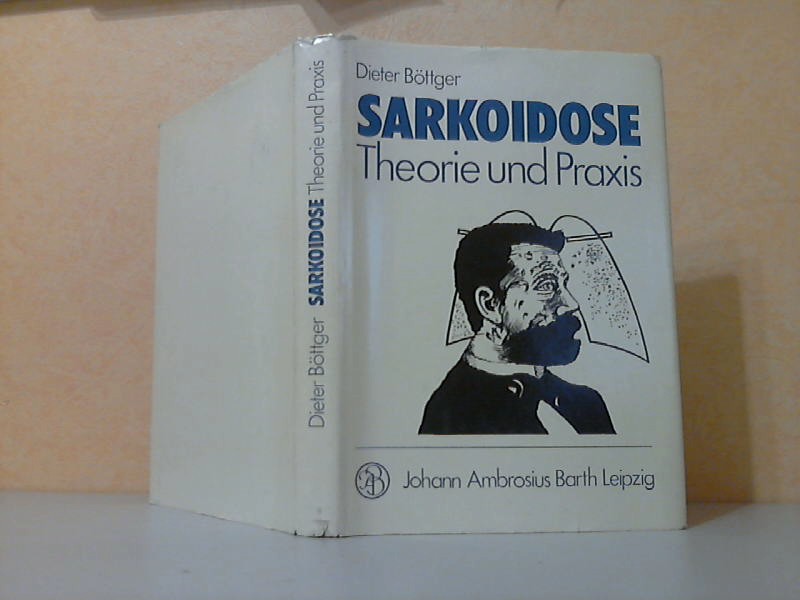
1982rif. 49244Leipzig, Johann Ambrosius Barth, 1982. 301 Seiten , 25 cm, Leinen
rif. 17292Paris, 1649. 34 pp. 4to. Modern half vellum, marbled boards, gilt lettering to spine. Moreau 1837; not in Welsh. Based on theories of François Hotman as exposed in his Franco-Gallia and on ideas expressed by Du Plessis Mornay in his Vindiciae contra tyrannos, this piece provoked quite some polemical replies. It is considered to be one of the most important pieces of the Mazarinades.
rif. 17291Paris, 1649. 34 pp. 4to. Modern half vellum, marbled boards, green label with gilt lettering to spine. Moreau 1837; not in Welsh. Based on theories of François Hotman as exposed in his Franco-Gallia and on ideas expressed by Du Plessis Mornay in his Vindiciae contra tyrannos, this piece provoked quite some polemical replies. It is considered to be one of the most important pieces of the Mazarinades.
1931rif. 14792BKassel, Bärenreiter, 1931. (Nachdruck der Ausgabe: Berlin 1768)., Quart (23,2 x 18,2 cm), 3 Blatt, 291 Seiten; 4 Blatt, XX, 185 (14) (4) Seiten, Zahlr. Figuren und Tabellen Halblederband der Zeit mit Rückentitel Frakturschrift Kl. Stempel Titel verso; Exlibris
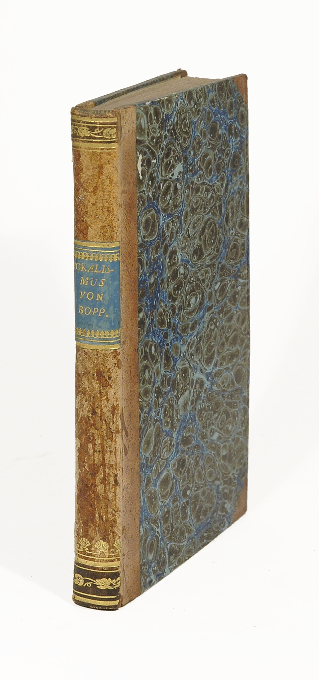
1836rif. 39226Berlin, Nicolai, 1836. 8°. X, 253 (1) S., HLdr. d. Zt. m. etw. Rückenverg., goldgepr. Rückentitel u. dreiseitigem Farbschnitt.
Acquaforte misure: mm 333 x 430 Incisore italiano formatosi inizialmente sotto il padre stampatore, libraio e autore di almanacchi e calendari popolari. Successivamente Gaetano frequenta l'accademia di Brera con Vincenzo Vangelisti (Firenze 1740 - Milano 1798) che dal 1790 è direttore della Scuola d'incisione. Particolarmente attivo tra il 1790 e il 1825 viene ricordato per le illustrazioni del volume Dell’arte dei giardini inglesi (pubblicato a Milano, 1801) di Ercole Silva (Milano 1756 - Cinisello 1840) scrittore e architetto del paesaggio italiano, ma anche per le tavole poi confluite nel volume Atlas geologique ou vues d’amas de colonnes basaltiques….Milano 1818 di Scipion Breislak (Roma 1750 - Milano 1826) geologo di origini svedesi. Interessanti sono anche le sue incisioni popolari sulla creazione del mondo. In questa stampa viene rappresentata l'idea che l'artista ha del mondo, un'elaborata allegoria densa di dettagli. La composizione è divisa in due parti ben distinte raccordate al centro dalla raffigurazione della Torre di Babele sullo sfondo. Le due zone raffigurano rispettivamente la vita dominata dall'Inganno e quella dominata dal Disinganno. Sulla sinistra, in un paesaggio collinare, contraddistinto tra templi e città ordinate vediamo la figura di Cristo predicatore appoggiato ad una croce e circondato da diversi famiglie di fedeli in preghiera, in primo piano donne che filano rappresentano l'operosità e il lavoro. Un mondo laborioso, ordinato e pio si contrappone alla parte destra della stampa. Qui tumulti, disordine, uomini e donne che si abbandonano ai piaceri, ai vizi, mangiano suonano e adorano Lucifero seduto sul suo trono tra le fiamme. In alto e in basso, oltre l'immagine, un testo descrive l'immagine rappresentata. Impressione eccellente, fresca e con inchiostratura dai toni grigio-argentei. Ottimo stato di conservazione, eccetto minimo foxing sparso. Ampi margini oltre la battuta del rame. Bibliografia: G. Milesi, Dizionario degli incisori, Bergamo 1989, p. 273
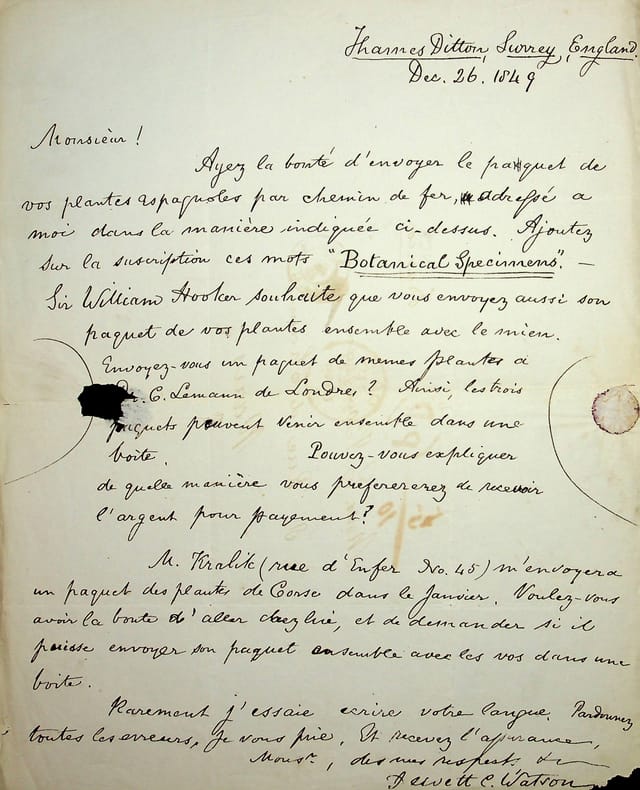
rif. 017269Hewett Cottrell Watson (1804-1881), botaniste anglais, partisan de la théorie de l'évolution. L.A.S., Thames Ditton (Angleterre), 26 décembre 1849, 1p in-4. Au botaniste français Eugène Bourgeau (1813-1877). Lettre en français, retranscrite avec les petites erreurs de Watson qui s'en excuse en fin de lettre : « Monsieur ! Ayez la bonté d'envoyer le paquet de vos plantes espagnoles par chemin de fer, adressé à moi dans la manière indiquée ci-dessus. Ajoutez sur la suscription ces mots "Botanical Specimens". Sir William Hooker souhaite que vous envoyez aussi son paquet de vos plantes ensemble avec le mien. Envoyez-vous un paquet de mêmes plantes à M. C. Lemann de Londres ? Ainsi, les trois paquets peuvent venir ensemble dans une boite. Pouvez-vous expliquer de quelle manière vous préférerez de recevoir de l'argent pour payement ? M. Kralik (rue d'Enfer N°45) m'envoyera un paquet des plantes de Corse dans le janvier. Voulez-vous avoir la bonté d'aller chez lui, et de demander si il puisse envoyer son paquet ensemble avec les vos dans une boite. Rarement j'essaie écrire votre langue. Pardonnez toutes les erreurs, je vous prie. Et recevez l'assurance, Monsieur, des mes respects &c. Hewett C. Watson ». La lettre mentionne donc William Jackson Hooker (1785-1865), Charles Morgan Lemann (1806-1852), autres botanistes anglais et Jean-Louis Kralik (1813-1892), autre botaniste français. Petit manque de papier mangeant une lettre, dû au cachet qui fermait le courrier. Beau courrier, rare lettre en français. [133]
rif. 2453Gauthier-Villars, Paris, 1882 et 1883