INTERNATIONAL CONFERENCE ON INFORMATION SYSTEMS AND DEVELOPMENT: METHODS AND TOOLS THEORY AND PRACTIBiblio.com
SYSTEMS DEVELOPMENT METHODS FOR THE NEXT CENTURY
1997réf. Adhya-9780306456930SPRINGER 1997. HB. New. SPRINGER hardcover
7 833 résultats
1900réf. 49800Berlin Johann Ambrosius Barth 1900. Later full buckram. Stamp on verso of titlepage. Narrow inner margins binding style with cords in margin. In: "Annalen der Physik" Vierte Folge Band 1. VIII 792 pp. 3 folded engraved plates.Entire volume offered. Planck's papers: pp. 69-122; 621-624;719-737. Internally fine and clean. First edition of these fundamental and highly influential Planck-papers in which he defines his concept of entropy and heat radiation and hereby ANTICIPATES HIS FAMOUS SEMINAL PAPER OF 1900 which redefined physics and took it to the 20th century. - The first two papers "Ueber irreversible Strahlungsvorgänge" were rewritten for the "Annalen" and was first introduced in "Sitzungsberichte d.k. Akad. Wissensch. zu Berlin"."By invoking the hypothesis of natural radiation Planck not only succeeded in obtaining a relation between the energy of the resonator and the intensity of radiation for a given wavelength or frequency but also in defining the entropy of radiation by a proper expression such that the change of the total entropy was always a positive quantity". Mehra Jagdish. The historical development of quantum theory 2001 p. 36. These results found in the period 1894-00 culminated in the present paper "Ueber irreversible Strahlungsvorgänge" and for the first time incorporates the concept of natural radiation and made a purely electromagnetic definition of entropy and of temperature. hardcover
1932réf. 92109210437xbvkMoscow, 'Federatsija' (Federation), 1932. 94 (2) pages on fine paper. - Publisher's color-illustrated (by A. Levina) hardcover binding titled in russian cyrillic; 8vo.(ca. 16 x 11,5 cm).
1997réf. Adhya-9780306456930SPRINGER 1997. HB. New. SPRINGER hardcover
1997réf. Adhya-9780306456930SPRINGER 1997. HB. New. SPRINGER hardcover
2008Paperback This a new rleased book that ships from publishers. Pls. allow a minimum of 4 - 6 weeks for deliervy.
1816réf. 46878London, Baldwin, Cradock, and Joy, 1816 a. 1821. Bound in 2 uniform contemp. moiré boards. Light wear along edges and a fes smaller scratches. In: ""Annals of Philosophy"" or, Magazine of Chemistry, Mineralogy, Mechanics, Natural History... By Thomas Thomson."", Vol. VIII and New series Vol. I. VIII,479 pp. a. 9 engraved plates, VIII,479 pp. a. 7 engraved plates. (Entire volumes offered). Herapath's papers: pp. 56-60 (1816) a. pp. 273-293, 340-351 a. 401-416.
1858réf. 43056Leipzig Johann Ambrosius Barth 1858. Contemp. hcalf. 5 raised bands gilt spine and gilt lettering to spine. A few scratches to spine. Small stamp on verso of first -and general- titlepage. In: "Annalen der Physik und Chemie. Hrsg. von J.C. Poggendorff" Vierte Reihe Bd. 15 =Poggendorff Bd. 105. X636 pp. and 4 folded lithographed plates. Clausius's paper: pp. 239-258. The entire volume offered. Fine and clean. First printing of this main paper in the working out of the Kinetic Theory of Gases in which Clausius announced his determination of the equation governing the mean free path lenght of a molecule moving freely in gases. By this he inscribed his name as one of the founders of the Kinetic Theory of Gases."Clausius was one of the founders of the kinetic theory of gases and of the science of thermodynamics. He and Lord Kelvin at about the same time and independently announced the Second Law of thermodynamics. Clausius particularly developed the theory of thermodynamics by applying it to the study of gases and vapors."Magie in "A Source Book in Physics" p. 228."In order to analyze the process of molecular collisions Clausius adopted a simplified model for his admittedly complicated molecule. He assumed that whatever the actual patterns on intermolecular forces one could suppose that there is some advantage distance between the centers of molecules which would represent a general boundary between attractive and repulsive forces. If two molecules were to approach each other within that boundary repulsion would generally occur. Thus the very complex problem of intermolecular action was reduced to a "billiard ball" model." DSB III p. 307-06. - Parkinson Breakthroughs C/P 1858. hardcover
1858réf. 43056Leipzig, Johann Ambrosius Barth, 1858. Contemp. hcalf. 5 raised bands, gilt spine and gilt lettering to spine. A few scratches to spine. Small stamp on verso of first -and general- titlepage. In: ""Annalen der Physik und Chemie. Hrsg. von J.C. Poggendorff"", Vierte Reihe Bd. 15, (=Poggendorff Bd. 105). X,636 pp. and 4 folded lithographed plates. Clausius's paper: pp. 239-258. The entire volume offered. Fine and clean.
1816réf. 46878London Baldwin Cradock and Joy 1816 a. 1821. Bound in 2 uniform contemp. moiré boards. Light wear along edges and a fes smaller scratches. In: "Annals of Philosophy; or Magazine of Chemistry Mineralogy Mechanics Natural History. By Thomas Thomson." Vol. VIII and New series Vol. I. VIII479 pp. a. 9 engraved plates VIII479 pp. a. 7 engraved plates. Entire volumes offered. Herapath's papers: pp. 56-60 1816 a. pp. 273-293 340-351 a. 401-416. First printing of these contoversial papers where Herapath revived the kinetic theory of gases. His theory was more or less neglected by the scientific community at his time. The kinetic theory remained dormant and forgotten after Euler's and Bernouilli's work "until 1816 when Herapath proposed a theory which is essential Bernoulli's. Unfortunately he chose to define temperature as being proportional to the momentum rather than the kinetic energy of molecules. Herapath was the first to show more or less that kinetic theory can provide simple explanations for the changes of state diffusion and the propagation of sound."Trousdell "Essayas in the History of Mechanics" pp. 283 ff.Euler Bernoulli Herapath and Waterston may be considered the principal scientists who prior to 1850 attempted a more or less complete mathematical treatment of gases based on a set of molecular postulates. Jamie Wisniak."Having published a preliminary notice of his theory in the Annals of Philosophy in 1816 Herapath submitted a detailed account to the Royal Society in 1820. Davy who was elected to the presidency of the Society in November of that year was primarily responsible for the fate of the paper. Although Davy was already known as an advocate of the qualitative idea that heat is molecular motion he found Herapath’s quantitative development too speculative and complicated; he rejected the hypothesis of an absolute temperature implying an "absolute zero" of cold. Having been told that his paper would not be accepted for publication in the Philosophical Transactions Herapath withdrew it and published it instead in the Annals of Philosophy in 1821. Five years later he launched an attack on Davy in the Times of London accusing him of circulating unfounded criticisms of his experimental work which prevented its publication. Although Davy ignored a series of letters and challenges published in the Times Herapath later claimed Davy’s resignation from the presidency of the Royal Society 1827 as a victory for himself."DSB. hardcover
réf. 17498Paris, EDHIS 1981. Bound together in 7 volumes. 8vo. Imitation leather. All published. Well executed reprint of this rare and important revolutionary journal. The organ of the 'Cercle Social', defenders of the 'tribuns' of the people. The primary function was to reprint the minutes of the Cercle Social meetings and discuss issues relevant to the club's concerns. Worthy of special mention are Fauchet's weekly commentaries on Rousseau's Contrat Social, many of Etta Palm's feminist writings, speeches by Condorcet on political matters, a debate over Voltaire's place among the Revolutionary patriarchs, and a letter by Madame Roland advocating inheritance law reform. During the spring of 1791, the journal reprinted many documents from the burgeoning democratic movement, including several Cordeliers Club petitions. Among the other authors published in this journal were Cloots and Thomas Paine (Historical Dictionary of the French Revolution, 1789-1799, vol. 1, p. 112).
1781réf. 4873CBGeneve, 1781. 12°. 448 (2) S. Lederband der Zeit mit verblasster Rückenvergoldung und dreis. Goldschnitt. + Wichtig: Für unsere Kunden in der EU erfolgt der Versand alle 14 Tage verzollt ab Deutschland / Postbank-Konto in Deutschland vorhanden +
1909réf. 8328Bienne, Ph. Robert, 1909. In-folio de 45-[3]pages et 18 pl. sous serpentes légendées, pleine toile verte d'éditeur ornée au premier plat du titre estampé en deux teintes. Coiffe supérieure frottée, toile un peu passée, petite marque au second plat. Intérieur sans aucuns défauts.
1859réf. 5vCf0047New York: D. Appleton and Company 1859. Book. Very Good. Decorative Hardcover Canvas. Entered Accordint to Act of Congress in the Year 1859 by C.C. Marsh in the Clerk's Office of the District Court of the United States for the Southern District of New York. 8vo or 8° Super Octavo: 7" x 11" tall. 142 pp. A very rare hard-to-find out-of-print scarce true collectible gem! A wonderful copy! An excellent addition to any collection! Considering the book nearly two centuries old it is in very good state. Clean text with very light pencil markings on first free front-end page. Very minor fraying on top of spine. Spine solid and intact. No dust jacket. Over-sized and/ or over weight book; may require additional postage. Please note that large and/ or heavy items may incur extra shipping charge for both domestic and/or international shipments. Pictures of actual copy -not displayed here!- available upon request. . D. Appleton and Company Hardcover
réf. BN90651Quintessenz Verlag. Die keramikverblendete NEM-Konuskrone: Theorie Klinik Technik Lenz Jürgen; Schindler Hans J and Pelka Hubert Die keramikverblendete NEM-Konuskrone: Theorie Klinik Technik Lenz Jürgen; Schindler Hans J and Pelka Hubert Die keramikverblendete NEM-Konuskrone: Theorie Klinik Technik Lenz Jürgen; Schindler Hans J and Pelka Hubert Quintessenz Verlag unknown
1821réf. 38060Leipzig, Breitkopf & Härtel, 1821. 8°. Mit 5 gefalt. lithogr. Tafeln. XVI, 180 S., Ppbd. d. Zt. m. etw. Rückenverg. u. goldgepr. Rückenschild.
1698In-4°; pp. 166 (i.e. 164, dalla numerazione saltano pp. 161-162), (6), 1 cb., in antiporta un grande legno con un leggio che sostiene un libro, due cherubini che reggono un cartiglio con motto “alter ad alterum”; una tavola fuori testo che raffigura la mano di Guido con le note (la mano guidoniana fu un sistema mnemotecnico adottato dai cantori per la lettura a prima vista, messo a punto sembra da Guido Monaco (Guido d’Arezzo); nel testo molte parti di musica. Legatura coeva in piena pergamena con titolo manoscritto al dorso. Buona copia. Frezza dalle Grotte fu probabilmente lui stesso maestro di coro. Come presentato dall’autore, l’opera è suddivisa in quattro libri (”s’aggiongerà la quinta parte.... ma separata dal presente libro”, che pare non fu poi stampata), che attraverso varie lezioni insegnano a Leggere le note, i Toni e le intonazioni, i modi di intonare tutti i generi di canto, di unire l’organo al coro, e le Regole di comporre nel Canto Fermo, la melodia di base cui vengono aggiunte le altre parti nella musica polifonica.
réf. 5b31Kluwer Academic Publishers Hingham 1996. 316/298 pages in total. Paperback. Quart. - very good condition/complete - paperback
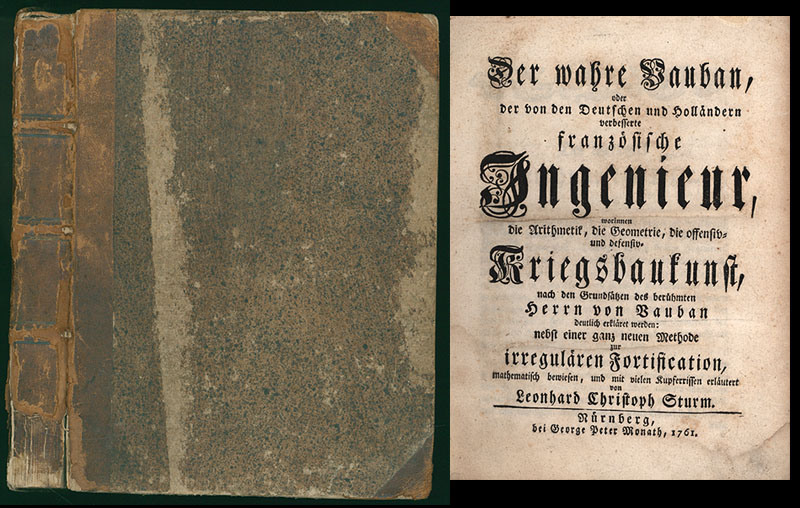
1761réf. 4422EBNürnberg, George Peter Monath, 1761. Groß-8°. 23,5 cm. 4 Blatt, 157 (1) Seiten, 5 Blatt, 56 Seiten, 35 zwischengebundene Faltblätter mit Kupfern. Halblederband der Zeit. [6 Warenabbildungen]
1781réf. 4873CBGeneve, 1781. 12°. 448 (2) S. Lederband der Zeit mit verblasster Rückenvergoldung und dreis. Goldschnitt.
1850réf. 5694Leipzig: Otto Wigand 1850. First Edition. Original printed wrappers bound in place in later three quarter leather binding. Very good; small repaired tear in front wrapper inoffensive; some light dustiness. 8vo x 234 pp. Wagner's work of art theory that is the basis for all of his later music and architectural ideas used in the construction of his theatre at Bayreuth. This copy has the original printed wrappers bound in place in a handsome somewhat later three-quarter leather binding by Wood of London. See Wagner Companion 231. Otto Wigand hardcover books
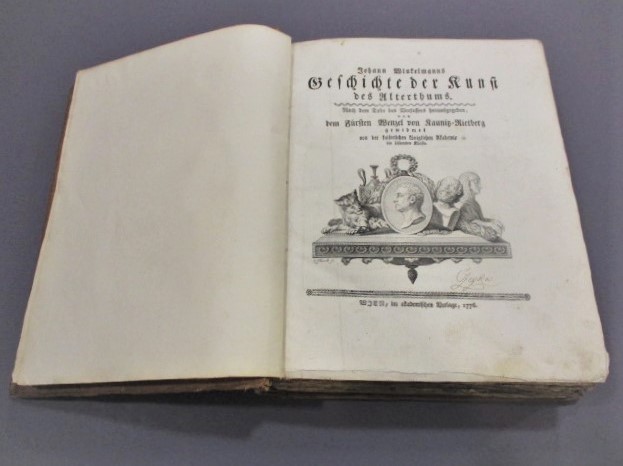
1776réf. 3067Wien, Akademie, 1776. 7 Bll., LXXII, 618 S., 1 Bl., S. 619 - 881, 28 Bll. (Register) mit 2 gestochenen Titelvignetten und 20 halbseitigen Textkupfern. 4°. Ldr. um 1920 mit Rückenschild, Rückenvergoldung und Deckeltitel (fleckig, kl. Gebrssprn.). [5 Warenabbildungen]
1900réf. 48173Berlin, Johann Ambrosius Barth, 1900. Contemp. hcloth. over marbled boards, gilt title to spine. Housed in a fine black morocco slicase, gilt borders on sides, spine with raised bands and gilt lettering. In: ""Annalen der Physik"", Vierte Folge, Band 1. VIII, 792 pp. + 3 folded engraved plates.(Entire volume offered). Planck's papers: pp. 69-122" 621-624"719-737. A very fine and clean copy. With the bookplate of Andras Gedeon on inside frontcover.
1798réf. 52947Åbo Frenckellska Boktryckeriet 1798. Orig. blanke kartonomslag. Håndskrevet rygtitel. Lidt rifter i rygpapiret. 41502 pp. Lidt spredte brunpletter. De sidste 5 blade med en skjold øverst. Originaludgaven. First edition. "His Inleding till chemien 1798 was the first Swedishlanguage textbook written in the spirit of the new combustion theory. Although he accepted the phlogiston theory early in his career Gadolin attempted to understand Lavoisier’s ideas. In a paper published in 1788 he tried to define phlogiston and admitted that the French explanation of combustion was superior to some phlogiston theories but for a long time he was not wholly converted. His lectures always made use of the new chemistry and he eventually became the spokesman in Scandinavia for Lavoisier’s nomenclature and combustion theory often encountering Berzelius opposition."DSB.Poggendorff I 827. - Neville I p. 496. unknown
1900réf. 48173Berlin Johann Ambrosius Barth 1900. Contemp. hcloth. over marbled boards gilt title to spine. Housed in a fine black morocco slicase gilt borders on sides spine with raised bands and gilt lettering. In: "Annalen der Physik" Vierte Folge Band 1. VIII 792 pp. 3 folded engraved plates.Entire volume offered. Planck's papers: pp. 69-122; 621-624;719-737. A very fine and clean copy. With the bookplate of Andras Gedeon on inside frontcover. First edition of these fundamental and highly influential Planck-papers in which he defines his concept of entropy and heat radiation and hereby ANTICIPATES HIS FAMOUS SEMINAL PAPER OF 1900 which redefined physics and took it to the 20th century. - The first two papers "Ueber irreversible Strahlungsvorgänge" were rewritten for the "Annalen" and was first introduced in "Sitzungsberichte d.k. Akad. Wissensch. zu Berlin"."By invoking the hypothesis of natural radiation Planck not only succeeded in obtaining a relation between the energy of the resonator and the intensity of radiation for a given wavelength or frequency but also in defining the entropy of radiation by a proper expression such that the change of the total entropy was always a positive quantity". Mehra Jagdish. The historical development of quantum theory 2001 p. 36. These results found in the period 1894-00 culminated in the present paper "Ueber irreversible Strahlungsvorgänge" and for the first time incorporates the concept of natural radiation and made a purely electromagnetic definition of entropy and of temperature. hardcover
1971CONTAINS AN ORIGINAL LITHOGRAPH AND SEVEN LINOCUTS BY PABLO PICASSOÁ. RARE issue of the prestigious art publication "XXe siècle". This issue is dedicated to the work of Pablo Picasso, and features numerous articles written by his friends, both artists and art critics. The texts are accompanied by numerous color and b&w reproductions of his works. 320x250mm. 138 pages [+2]. Red cloth Hardcover with illustrated dust-jacket. Jacket slightly rubbed, dirty and yellowing. Jacket upper corners and edge wrinkled. Cover edges dirty. Cover corners and spine edges slightly bumped. [SUMMARY]: This extremely rare issue of an influential art periodical, which features an original lithograph and seven linocuts by one of 20th-century most illustrious artists, is in good condition.