7 970 résultats
réf. 7748E. Plon & Cie, Imprimeurs-Editeurs, Paris, 1876. In-8, demi-reliure, dos titré avec quatre fleurons dorés, 445 pp. Préambule - Belgique : I. Le musée de Bruxelles. - II. Les maîtres de Rubens. - III. Rubens au musée de Bruxelles. - IV. Rubens à Malines. - V. La Descente de croix et La Mise en croix. - VI. ...
1770(Codice AN/3062) Three volumes in 8° (205x130 mm), XXIV-398-[2], [4]-432-[2], [4]-493-[3] with copper-engraved portrait, 3 title vignettes and 3 headings (battle scenarios vignettes). Complete with 41 engraved large folding plates, all in perfect shape. Ancient dedication and owner's signatures on title-pages, minor dampmark to margin of volume I. Period leather binding with raised bands, compartments gilt & title-labels, marbled endpapers, red edges. Spines damaged and partly missing (vol. III), hinges partly creased, corners/edges lightly worn; however still firmly bound, internally looks unread, text & plates are in mint conditions. ~~~ SPEDIZIONE IN ITALIA SEMPRE TRACCIATA
13 S. + 2 Falttafeln. 8°. Ecken gering fransig. Selten. RISM Ecrits Imprimées BVI, I, S. 152. Fétis, Biographie universelle des musiciens, I:435.
2021réf. 2110502151006128Keibun-do 2021. Soft Cover. Fine. Number of books: 29 Keibun-do paperback
réf. 2091202133212949Not Available N.A. Soft Cover. Fine. Number of books: 9 Not Available paperback
1799réf. 43865Halle, Rengerschen Buchhandlung, 1799. Without wrappers. In ""Annalen der Physik. Herausgegeben von Ludwig Wilhelm Gilbert"", Bd. 2, Erstes Stück. (The entire issue offered). Titlepage to vol. 2. Pp. 1-118 a. 2 folded engraved plates. Cavendish's paper: pp. 1-62. (the torsion balance of Michell shown on the plates).
1803réf. 44129Halle, Rengerschen Buchhandlung, 1803. Without wrappers as extracted from ""Annalen der Physik. Herausgegeben von Ludwig Wilhelm Gilbert"", Bd. 12. Pp. 310-318 a. pp. 385-395.
1759réf. 45126(Berlin, Haude et Spener, 1759). 4to. No wrappers, as issued in ""Mémoires de l'Academie Royale des Sciences et Belles Lettres"", Année 1757, tome XIII, pp. a. 1 engraved plate.
1852réf. 43564Leipzig, Johann Ambrosius Barth, 1852. Without wrappers as issued in ""Annalen der Physik und Chemie. Hrsg.von Poggendorff"", Dritte Reihe Bd. 26, Achtes Stück.(= Heft No. 8 of 1852). (The entire issue (No. 8) offered). Titlepage to vol. 26. Pp. 501-600. Helmholtz's paper: pp. 501-523. Clean and fine.
1821réf. 59163London, Baldwin, Cradock, and Joy, 1821. Contemp. Hcalf. Minor scratches to spine. In: ""Annals of Philosophy"" or, Magazine of Chemistry, Mineralogy, Mechanics, Natural History... By Thomas Thomson."", New series Vol. I. VIII,479 pp. a. 7 engraved plates. (Entire volumes offered). Herapath's papers: pp. 273-293, 340-351 a. 401-416.
1799réf. 43865Halle Rengerschen Buchhandlung 1799. Without wrappers. In "Annalen der Physik. Herausgegeben von Ludwig Wilhelm Gilbert" Bd. 2 Erstes Stück. The entire issue offered. Titlepage to vol. 2. Pp. 1-118 a. 2 folded engraved plates. Cavendish's paper: pp. 1-62. the torsion balance of Michell shown on the plates. First German edition of Cavendish's famous paper in which he calculated the weight of the earth and determined its mass. He also as the first observed gravitational motion of minute portions of matter. He estimates the earth's mass to 66 x 10 to the potential of 24 kg. The original paper "Experiments to determine the Density of the Earth" appeared in Philosophical Transaction 1798."Cavendish published five papers between 1784 and 1809.With one exception they were comparatively minor productions.The exception was his determination of the density of the earth or weighing of the world in 1798 by means of John Michell's torsion balance. The apparatus consisted of two lead balls on either end of a suspended beam; these movable balls were attracted by a pair of stationary lead balls. Cavendish calculated the the force of attraction between the balls fro the observed period of oscillation of the balance and deduced the density of the earth from the force. He found it to be 5.48 times that of water. Cavendish was the first to observe gravitational motions induced by comparatively minute portions of ordinary matter.By weighing the world he rendered the law of gravitation complete. The law was no longer a proportionally statement but a quantitatively exact one; this was the most importent addition to the science of gravitation since Newton."DSB III p. 158. unknown
1803réf. 44129Halle Rengerschen Buchhandlung 1803. Without wrappers as extracted from "Annalen der Physik. Herausgegeben von Ludwig Wilhelm Gilbert" Bd. 12. Pp. 310-318 a. pp. 385-395. First German edition of both papers constituting the first 2 papers in his "Experimental Essays on the constitution of mixed gases." 1802 in which he formulated his famous gas laws and raised the foundation of the atomic theory in chemistry.The publication of these papers gave him at once international reputation they tried to explain why the gases of the atmosphere remain mixed instead of segregating with the heaviest element at the bottom it states that the maximum density of a vapour in contact with its liquid remains the same whether other gases be present or not and the vies that the particles of everykind of elastic fluid are elastic only with regard to their own kind and that the total pressure of the atmosphere equals the sum of the pressures exerted by the individual gases each of which excerts its pressure independently of the others. This was the first step toward his atomic theory of in chemistry. unknown
1840réf. 47109Paris Bachelier 1840 4to. No wrappers. In: "Comptes Rendus Hebdomadaires des Séances de L'Academie des Sciences" Tome X No 5 entire issue offered. Pp. 143- 207. Dumas' paper: pp. 149-178. First appearance of this paper which was published the same year in 'Annales de Chimie et de Physique' is the most importent on the theory of structural types and the nomenclature of organic compounds refuting the electrochemical theory of Berzelius. "The development of this idea type organique into what is sometimes called the "Older Type Theory" as distinguished from Gerhardt's Type heory is contained in Dumas' importent memoir on the substitution and the theory of types presented on 3 febriary 1840."Partington IV p. 365. "Jean Baptiste Dumas advances a theory that the chemical properties of an organic compound are determined by its structure and not as seems to be the case with inorganic compounds by its electrical properties. he illustrates the concept with the example that the basic qualitative properties of acetic acid are retained even after replacing three fourths of the hydrogen by chlorine. As a consequence he calls for a revision of chemical nomenclature for organic compounds basing terms on common features not on elemental composition."Parkinson "Breakthroughs" 1840 C. unknown
1758réf. 42952Berlin Haude et Spener 1758. 4to. No wrappers as issued in "Memoires de l'Academie Royale des Sciences et Belles Lettres". tome XII 1756. Pp. 165-234 a. 1 folded engraved plate. First printing of Euler's importent large memoir in which he develops the mathematical theory of windmills and generates analytically the equations of the effects of winds on duoble-bended surfaces in relation to mechanical work. - Together with d'Alembert and Daniel Bernoully Euler laid the foundation of mathematical physics. - Enestroem E 233. unknown
1759réf. 45126Berlin Haude et Spener 1759. 4to. No wrappers as issued in "Mémoires de l'Academie Royale des Sciences et Belles Lettres" Année 1757 tome XIII pp. a. 1 engraved plate. First printing of an importent paper in which Euler shows how to manufacture catoptrical telescopes and microscopes in accordance with general rules and founded on his own experiments. - The calculation concerning light ray aberrations brought about due to the sphericty of the glass is a masterpiece of analysis of the highest order and he also incorporates the mathematical theory of achromatic combination of lenses which was first realized by Dollond in the same year 1757. unknown
1852réf. 43564Leipzig Johann Ambrosius Barth 1852. Without wrappers as issued in "Annalen der Physik und Chemie. Hrsg.von Poggendorff" Dritte Reihe Bd. 26 Achtes Stück.= Heft No. 8 of 1852. The entire issue No. 8 offered. Titlepage to vol. 26. Pp. 501-600. Helmholtz's paper: pp. 501-523. Clean and fine. First appearance of this founding paper in the modern theory of colour in which Helmholtz proved the surprising fact that there are only two among the colours of the spectrum yellow and indigo-blue which together yields pure white that is are complementary to each other whereas their combination had always been supposed to produce green."Helmholtz turned to the intricate problems of color vision in 1852 with an attack on Sir David Brewster's new theory of light. Brewster had maintained the objective reality of three primary colors by supposing in opposition to Newton that there exist three distinct kinds of light each of which excites in the eye one of the sensations red yellow or blue. Helmholtz regarded the theory as still another confusion of physical stimulus and subjective responce.He also revived Young's theory of color visoin.only to refute it. He had discovered that spectral colors when mixed always yield a duller color of less-than-spectral saturation. Therefore the whole idea that all colors may be obtained from mixtures of three primary colors must be incorrect he concluded for the spectral colorss at least can never be obtained in their full saturation by mixing any three of their number.Although Helmholtz dismissed Young's theory in 1852 by 1858 he had changed his mind and become its formost advocate. In order to save Ypoung's theory.Helmholtz asumed that Young's physiological primaries are not spectral colors att all but colors of far greater-than-spectral saturation."DSB VI pp. 246-247. Garrison & Morton 1508. unknown
1821réf. 59163London Baldwin Cradock and Joy 1821. Contemp. Hcalf. Minor scratches to spine. In: "Annals of Philosophy; or Magazine of Chemistry Mineralogy Mechanics Natural History. By Thomas Thomson." New series Vol. I. VIII479 pp. a. 7 engraved plates. Entire volumes offered. Herapath's papers: pp. 273-293 340-351 a. 401-416. First printing of these contoversial papers where Herapath revived the kinetic theory of gases. His theory was more or less neglected by the scientific community at his time. The kinetic theory remained dormant and forgotten after Euler's and Bernouilli's work "until 1816 when Herapath proposed a theory which is essential Bernoulli's. Unfortunately he chose to define temperature as being proportional to the momentum rather than the kinetic energy of molecules. Herapath was the first to show more or less that kinetic theory can provide simple explanations for the changes of state diffusion and the propagation of sound."Trousdell "Essayas in the History of Mechanics" pp. 283 ff. unknown
1897réf. 41482Berlin 1897. 4to. Uncut and unopened in original printed wrappers. Fresh copy fine and clean. Near mint. The entire "Heft" II: Pp. 35-81. Planck's paper pp.35-46. Max Planck is considered to be the founder of the quantum theory and was awarded the Nobel Prize in Physics in 1918. "Über irreversible Strahlungsvorgänge" is a mathematical description of the electromagnetic radiation emitted from a black-body."Über irreversible Strahlungsvorgänge was published in five parts in the period 1897-1901 the present volume being number 1."With the Kirchhoff-Wien-Boltzmann work as a background Max Planck began his attack on the black-body problem in 1897. He labored under the erroneous impression for some time that Wien's formula was the only one which harmonized with the second law of thermodynamics. The experiments on black-bodies due to Lummer and Pringsheim Rubens and Kurlbaum forced him from that position." Planck Max. Catalogue 258 Interlibrum Vaduz "I had already been struggling with the problem of the equilibrium of matter and radiation for some years without success; I knew the problem is of fundamental significance for Physics." The significance was unparallelled when he in December 1900 delivered a paper entitled "On the Theory of the Energy Distribution Law in the Normal Spectrum" before the German Physical Society which today is considered the birth of quantum physics. The present volume constitutes a precursor to this work. - Akademie No 33 unknown
1897réf. 41482Berlin, 1897. 4to. Uncut and unopened in original printed wrappers. Fresh copy, fine and clean. Near mint. The entire ""Heft"" II: Pp. 35-81. Planck's paper pp.35-46.
réf. BN66266Stabilitätsprüfung in der Pharmazie: Theorie und Praxis Der Pharmazeutische Betrieb Grimm Wolfgang; Harnischfeger Goetz and Tegtmeier Martin unknown
1960réf. 100979AB1960. Yale / London / and others MacMillan / and others c. 1960 - c. 2000. Octavo. More than 3000 pages. Original Softcover and Hardcover bindings. All Volumes with signs of external wear but overall in very good condition. In addition the collection also includes a few publications on Administration Policy. From the library of an irish Councilman and University lecturer. Includes for example the following essays: paperback
197, S. + 1 S. Druckfehlerverz. 12°. Mod. marm. PBd. Sehr selten.
1777réf. 60572Magdeburg-Leipzig, Joachim Ernst Scheidhauer, 1777. 8°. Mit gest. Frontispiz von D. Berger nach D. Chodowiecki. XIV, 716 S. - Angeb. - Ders. Theorie der Beweise im Civilproceß. Ebda., 1780. VIII, 256 S., HLdr. d. Zt. m. etw. Rückenverg. u. goldgepr. Rückenschild.
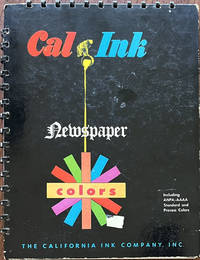
1950réf. 64391San Francisco West Berkeley & Los Angeles CA: California Ink Co. Inc. ca. 1950. 4to. 6 pp unpaginated. on thick boards w/ metal-comb bindings at gutter margin & upper fore-edge w/ 66 gradated colour swatches organized into 4 columns on two leaves; w/ 63 handy “Tear-off Swatches” showing the Cal Ink colour chart and available for swatches to be torn off and matched w/ all present except for original base piece of “M704” showing that it was a popular colour for Cal Ink clients. Self-printed colour-illustrated boards colour wheel on front cover covers printed & illustrated in colour minor scuffing remnants of old label partially affecting colour wheel slight scuffing edgewear still VG bright copy. First edition thus of this wonderfully printed and inventive colour ink sample catalogue for colour newspaper inks developed specially for the newly introduced American Newspaper Publishers Association & American Association Advertising Agencies colour standards. Prior to their initial studies and reports newspapers were often published with muddy misaligned and very inaccurate colours and formed a committee which by 1951 had produced specific standards on colour inks for comics cartoon strips and colour advertising in newspapers. This catalogue advertises with the California Ink Company’s Process Standard Colours Intermix Colours and finally the Cal Ink Standard R.O.P. Run-of-Paper colours. The section on “Handy Tear-off Swatches” provides an excellent colour chart as well as actual colour samples which could be ordered at the time from California Ink.The firm was founded in 1891 in Los Angeles as a Union Oil Co. subsidiary and moved to San Francisco in 1896 by E.L. Hueter and managed by Lewars b. 1866 who along with others in the company opened the office in their factory at West Berkeley following the 1906 Earthquake & Fire which destroyed their records. In 1919 the company was reincorporated and purchased by Graham Shattuck Reed & Nathan. They developed a white ink for marking bees perfumed ink for use in advertising were main suppliers of pigment colours and varnishes on the West Coast and developed the first “Litho Red” ink made in the U.S.k and developed the first magnetic inks for check imprinting in 1950. No copies located in Worldcat; See: Susan Cerny California Ink Co. Industrial Site 1326-1404 Fourth Street Berkeley CA Berkeley Landmarks 2019. California Ink Co., Inc. hardcover
1978111 VOLUMES IN 10 Portfolios. 36 KG. 365X280 mm. Soft cover. In good condition. PLEASE NOTE: This item is overweight. We may ask for extra shipping costs.