Sturm, Leonhard ChristophAntiquariat.de
7970 risultati
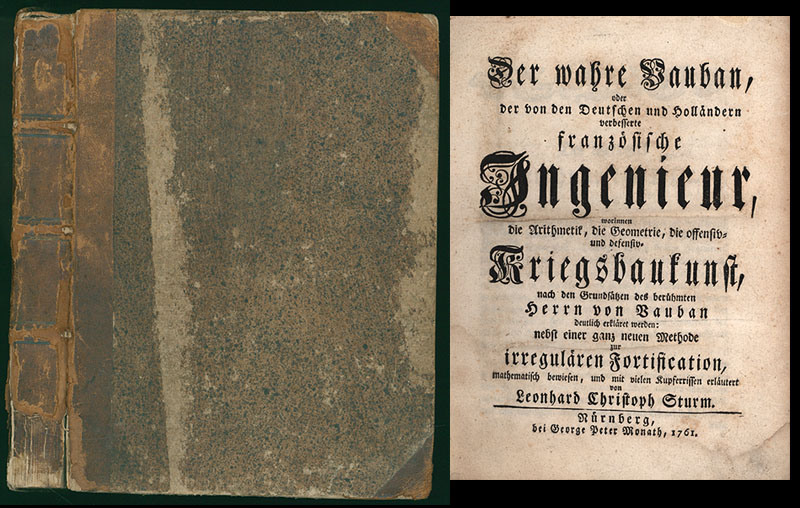
1761rif. 4422EBNürnberg, George Peter Monath, 1761. Groß-8°. 23,5 cm. 4 Blatt, 157 (1) Seiten, 5 Blatt, 56 Seiten, 35 zwischengebundene Faltblätter mit Kupfern. Halblederband der Zeit. [6 Warenabbildungen]
1781rif. 4873CBGeneve, 1781. 12°. 448 (2) S. Lederband der Zeit mit verblasster Rückenvergoldung und dreis. Goldschnitt.
1850rif. 5694Leipzig: Otto Wigand 1850. First Edition. Original printed wrappers bound in place in later three quarter leather binding. Very good; small repaired tear in front wrapper inoffensive; some light dustiness. 8vo x 234 pp. Wagner's work of art theory that is the basis for all of his later music and architectural ideas used in the construction of his theatre at Bayreuth. This copy has the original printed wrappers bound in place in a handsome somewhat later three-quarter leather binding by Wood of London. See Wagner Companion 231. Otto Wigand hardcover books
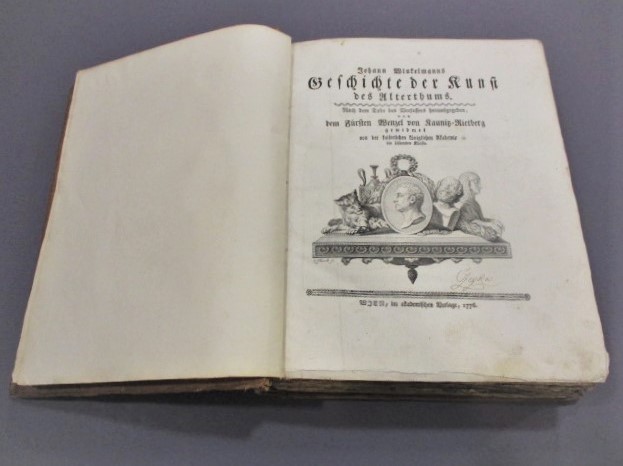
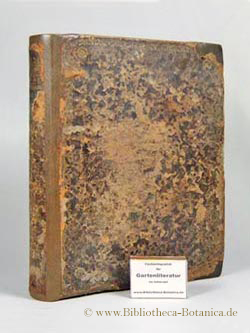
1776rif. 3067Wien, Akademie, 1776. 7 Bll., LXXII, 618 S., 1 Bl., S. 619 - 881, 28 Bll. (Register) mit 2 gestochenen Titelvignetten und 20 halbseitigen Textkupfern. 4°. Ldr. um 1920 mit Rückenschild, Rückenvergoldung und Deckeltitel (fleckig, kl. Gebrssprn.). [5 Warenabbildungen]
1900rif. 48173Berlin, Johann Ambrosius Barth, 1900. Contemp. hcloth. over marbled boards, gilt title to spine. Housed in a fine black morocco slicase, gilt borders on sides, spine with raised bands and gilt lettering. In: ""Annalen der Physik"", Vierte Folge, Band 1. VIII, 792 pp. + 3 folded engraved plates.(Entire volume offered). Planck's papers: pp. 69-122" 621-624"719-737. A very fine and clean copy. With the bookplate of Andras Gedeon on inside frontcover.
1798rif. 52947Åbo Frenckellska Boktryckeriet 1798. Orig. blanke kartonomslag. Håndskrevet rygtitel. Lidt rifter i rygpapiret. 41502 pp. Lidt spredte brunpletter. De sidste 5 blade med en skjold øverst. Originaludgaven. First edition. "His Inleding till chemien 1798 was the first Swedishlanguage textbook written in the spirit of the new combustion theory. Although he accepted the phlogiston theory early in his career Gadolin attempted to understand Lavoisier’s ideas. In a paper published in 1788 he tried to define phlogiston and admitted that the French explanation of combustion was superior to some phlogiston theories but for a long time he was not wholly converted. His lectures always made use of the new chemistry and he eventually became the spokesman in Scandinavia for Lavoisier’s nomenclature and combustion theory often encountering Berzelius opposition."DSB.Poggendorff I 827. - Neville I p. 496. unknown
1900rif. 48173Berlin Johann Ambrosius Barth 1900. Contemp. hcloth. over marbled boards gilt title to spine. Housed in a fine black morocco slicase gilt borders on sides spine with raised bands and gilt lettering. In: "Annalen der Physik" Vierte Folge Band 1. VIII 792 pp. 3 folded engraved plates.Entire volume offered. Planck's papers: pp. 69-122; 621-624;719-737. A very fine and clean copy. With the bookplate of Andras Gedeon on inside frontcover. First edition of these fundamental and highly influential Planck-papers in which he defines his concept of entropy and heat radiation and hereby ANTICIPATES HIS FAMOUS SEMINAL PAPER OF 1900 which redefined physics and took it to the 20th century. - The first two papers "Ueber irreversible Strahlungsvorgänge" were rewritten for the "Annalen" and was first introduced in "Sitzungsberichte d.k. Akad. Wissensch. zu Berlin"."By invoking the hypothesis of natural radiation Planck not only succeeded in obtaining a relation between the energy of the resonator and the intensity of radiation for a given wavelength or frequency but also in defining the entropy of radiation by a proper expression such that the change of the total entropy was always a positive quantity". Mehra Jagdish. The historical development of quantum theory 2001 p. 36. These results found in the period 1894-00 culminated in the present paper "Ueber irreversible Strahlungsvorgänge" and for the first time incorporates the concept of natural radiation and made a purely electromagnetic definition of entropy and of temperature. hardcover
1971CONTAINS AN ORIGINAL LITHOGRAPH AND SEVEN LINOCUTS BY PABLO PICASSOÁ. RARE issue of the prestigious art publication "XXe siècle". This issue is dedicated to the work of Pablo Picasso, and features numerous articles written by his friends, both artists and art critics. The texts are accompanied by numerous color and b&w reproductions of his works. 320x250mm. 138 pages [+2]. Red cloth Hardcover with illustrated dust-jacket. Jacket slightly rubbed, dirty and yellowing. Jacket upper corners and edge wrinkled. Cover edges dirty. Cover corners and spine edges slightly bumped. [SUMMARY]: This extremely rare issue of an influential art periodical, which features an original lithograph and seven linocuts by one of 20th-century most illustrious artists, is in good condition.
1999rif. 2091202133200535Kaitaku-sha 1999. Soft Cover. Fine. Number of books: 20 Kaitaku-sha paperback
1713rif. 8808ABParis, Jean Mariette, 1713. 25 x 20 cm. (5) Bl., 293 (1) S., (6) Bl. Mit 33 [von 38] Kupfertafeln und zahlreichen Holzschnitten und Vignetten. Die (fehlenden) 5 Tafeln (A1-A5) sind als gute Farbkopien beigefügt. Leder. Alter beschabter und beriebener Einband mit neuem Leder ergänzt. Rücken unter Verwendung des alten erneuert. [9 Warenabbildungen] Nouvelle Edition. Ordentlicher Zustand nach Restaurierung. Seiten teils angefleckt u. m. Eck-Knicken. Tafeln angefleckt, Ausklapptafeln m. Quetschfalten u. teils angerändert. Tafeln verso teils mit gärtnerischen Handzeichnungen in Blei. Zwei Tafeln mit amateurhafter alter
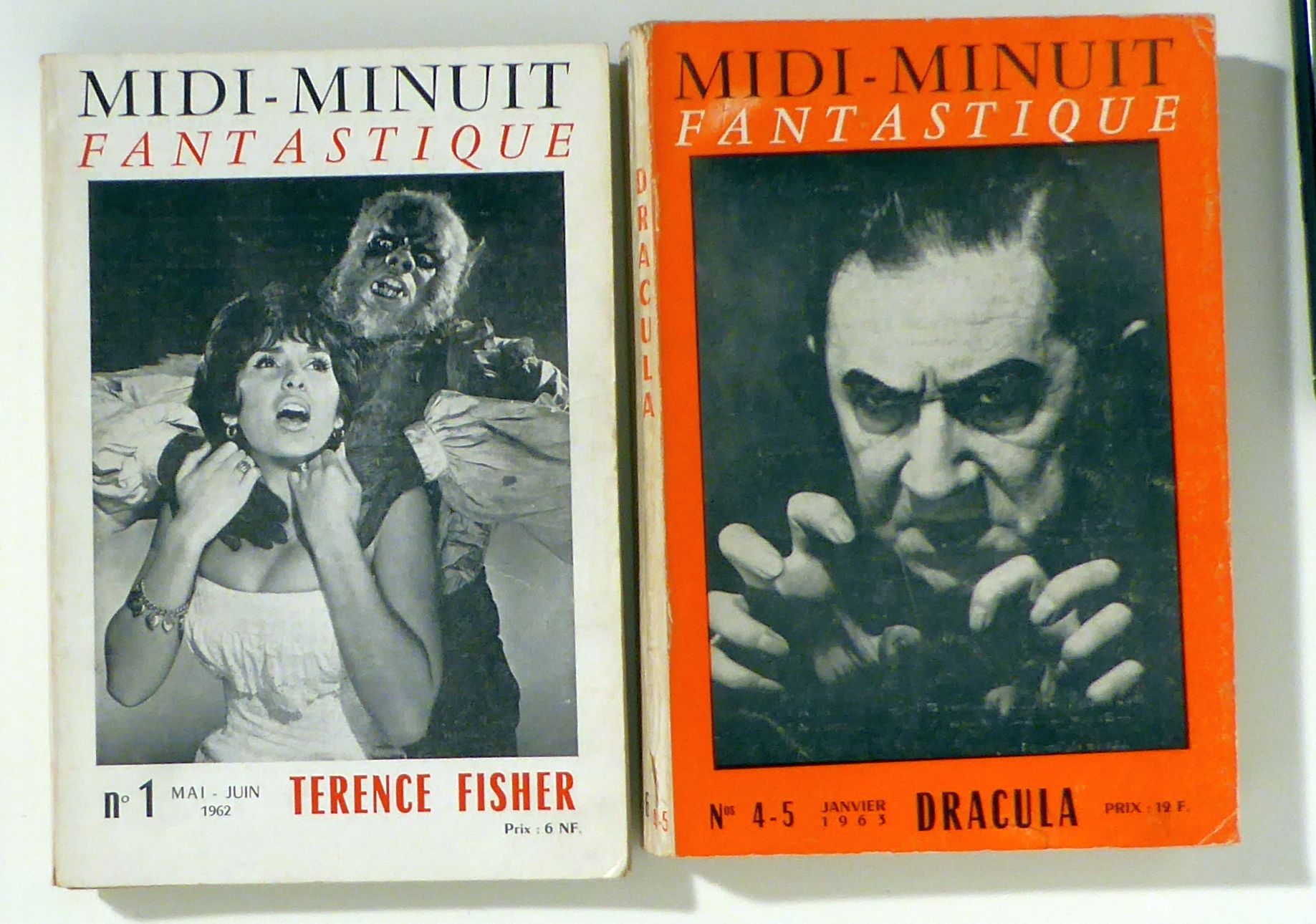
1962rif. 166909Paris, Le terrain vague, 1962-1971. 24 Nummern in 20 Heften, mit zahlreichen s/w Illustrationen nach Filmbildern. Original-Broschur, 8°; 4°. Herausgegeben von Eric Losfeld. Komplett, erste Serie Nr. 1-13 in 8°, zweite Serie Nr. 14-24 in 4°. [5 Warenabbildungen] Softcover Guter Zustand. Midi-minuit fantastique, Nr. 1-24
1890In 4 (cm 25 x 31), pp. XI + (1b) + 141 con 29 tavole fuori testo in cromolitografia (1 all'antiporta e 28 in fine). Legatura editoriale in piena tela con titolo oro al piatto anteriore. Lievi sfilacciamenti della tela ai tagli e agli angoli. Belle le tavole con quadri ottici in scale di colore che presentano centinaia di opzioni di colori differenti. Le tavole vennero realizzate con una tecnica di stampa innovativa. Edizione originale di questo studio sui colori basato sul sistema delle scale di colore e sulla teoria di Brewster del rosso, del giallo e del blu come colori primari. L'opera e' dedicata allo studioso francese della teoria dei colori Chevreul. Lacouture teorizza un metodo pratico per l'implementazione della teoria del colore di Chevreul nell'arte e nella stampa.
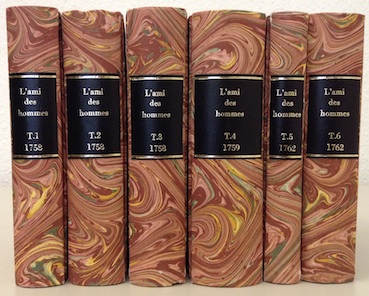
1762rif. 630639La Haye, Gibert, 1758-1762. Mit 6 Tafeln (Tableaux économiques, falsch in Band 4 gebunden). Moderne Pappbände mit schwarzem Lederrückenschild, Buchblöcke unbeschnitten.
1769rif. 49805(Berlin, Haude et Spener, 1769). 4to. No wrappers as issued in ""Memoires de L'Academie Royale des Sciences et Belles Lettres"", tome XXIII, pp. 165-310. Clean and fine.
1769rif. 49805Berlin Haude et Spener 1769. 4to. No wrappers as issued in "Memoires de L'Academie Royale des Sciences et Belles Lettres" tome XXIII pp. 165-310. Clean and fine. First edition of a fundamental paper in the Theory of Numbers in which Lagrange gives a solution in integers of indeterminate equations of the second degree - a remarkable turning point in Diophantine analysis. - Fermat had asserted that he could determine when the more general equation x2-Ay2=B was solvable in integers and that he could solve it when solvable but Lagrange solved it in this paper and furthermore he gives the complete solution to the problem of giving all integral solutions of a general equation where the coefficients are integers. - Cajori calls Lagrange "One of the greatest mathematicians of all times." - Poggendorff I:1344. unknown
1860rif. 48140Paris Mallet-Bachelier 1860. 4to. No wrappers. In: "Comptes Rendus Hebdomadaires des Séances de L'Academie des Sciences" Tome 50 No 6 a. No 19 Tome 51 No 10 a. No 19. 4 entire issues offered. Pasteur's papers: pp. 303-307 849-854 tome 50 pp. 348-352 675-678 tome 51. First appearance of the suite of the 4 groundbreaking papers marking the downfall of the theory of spontaneous generation and all of Pasteur's later work in this field can be seen as an extension elaboration and defence of the principles and methods set forth here. It is from these conclusions all modern bacteriology and immunology have developed. Pasteur was awarded the Zecker Price 1861 for these discoveries. "Pasteur's publications on the subject of spontaneous generation consists chiefly of communications to the Academy of Sciences in Paris and published in abstracts in the Comptes rendus. the paper offered. In these communication he dealt with the collection and demonstration of erms in the air the origin of ferments the distribution of germs in nature and many other questions. These reports were finally expanded in his famous "Memoire sur les corpuscules organisés qui existent dans l'atmosphere. Examen de la doctrine de génerations spontanées" which was published in 1861. Bullocdh "The History of Bacteriology" p. 96.Printing and the Mind of Man No 336 b - Garrison & Morton No. 2474. unknown
1909rif. 20444Bienne, Ph. Robert, 1909. In-folio de 45-[3]pages et 18 planches sous serpentes légendées, pleine toile verte d'éditeur ornée au premier plat du titre estampé en deux teintes. Étui de l'éditeur, titré au premier plat.
2004EIGHTEEN VOLUME SET. Contains color and b&w plates. 310x240mm. Gilt hardcover. All volumes are in good condition. PLEASE NOTE: This item is overweight. We may ask for extra shipping costs.
1927rif. 47023London, Harrison And Sons, Ltd., 1927. Royal8vo. Contemp. full cloth. A small stamp on verso of titlepage. In: ""Proceedings of the Royal Society of London"", Series A, Vol. 114. VI,IX,748 pp. (entire volume offered). Dirac's papers: pp. 243-265 a. pp. 710-728. Clean and fine.
1927rif. 47023London Harrison And Sons Ltd. 1927. Royal8vo. Contemp. full cloth. A small stamp on verso of titlepage. In: "Proceedings of the Royal Society of London" Series A Vol. 114. VIIX748 pp. entire volume offered. Dirac's papers: pp. 243-265 a. pp. 710-728. Clean and fine. First appearance of these milestone papers in Quantum Physics constituting the first step in Quantum Field Theory and the invention of the Second Quantifization Method. By these papers Dirac "gave the foundation for that theory quantum electrodynamics"Pais."A New Radiation Theory. Dirac liked his transformation theory because it was the outcome of a planned line of research and not a fortuitous discovery. He forced his future investigations to fit it. The first results of this strategy were almost miraculous. First came his new radiation theory in February 1927 which quantized for the first time James Clerk Maxwell’s radiation in interaction with atoms. Previous quantum-mechanical studies of radiation problems except for Jordan’s unpopular attempt retained purely classical fields. In late 1925 Jordan had applied Heisenberg’s rules of quantization to continuous free fields and obtained a light-quantum structure with the expected statistics Bose Einstein and dual fluctuation properties. Dirac further demonstrated that spontaneous emission and its characteristics—previously taken into account only by special postulates—followed from the interaction between atoms and the quantum field. Essential to this success was the fact that Dirac’s transformation theory eliminated from the interpretation of the quantum formalism every reference to classical emitted radiation contrary to Heisenberg’s original point of view and also to Schrödinger’s concept of as a classical source of field.This work was done during Dirac’s visit to Copenhagen in the winter of 1927. Presumably to please Bohr who insisted on wave-particle duality and equality Dirac opposed the "corpuscular point of view" to the quantized electromagnetic "wave point of view." He started with a set of massless Bose particles described by symmetric waves in configuration space. As he discovered by’ playing with the equations ’ this description was equivalent to a quantized Schrödinger equation in the space of one particle; this’ second quantization’ was already known to Jordan who during 1927 extended it into the basic modern quantum field representation of matter. Dirac limited his use of second quantization electromagnetic to radiation: to establish that the corpuscular point of view once brought into this form was equivalent to the wave point of view."DSB. hardcover
1769rif. 41682Berlin Haude et Spener 1769. 4to. No wrappers as issued in "Mémoires de l'Academie Royale des Sciences et Belles-Lettres" tome XIX. 2 =halftitle Mémoires.141-220. 1.memoir pp. 141-179 a. 1 enraved plate. - 2. pp. 180-193. - 3. pp. 194-220. - 4. pp. 221-234 a. 1 plate. First printing of these 4 fundamental papers on the perturbations of the moon as Euler was the first to use of the Calculus on the motion of the moon in relation to the attractive powers of the Moon the Earth and the Sun. The theories laid down here is also called Euler's second theory and it is the most interesting. It was of the greatest importtence as a basis for later developments."He applied his mathematics to astronomy working out the nature of some perturbations being in this respect the precursor of Lagrange and Laplace. He began to replace the geometric methods of proof used by Galileo and Newton with the algebraic a tendency carried to its conclusion by Lagrange. In particular he worked on lunar theory that is on the analysis of the exact motion of the moon the complications of which have been the despair of astronomers and mathematicians since the time of Kepler. - Eneström: 398 399 400 a. 401. unknown
1843rif. 42922Paris Imprimerie de Bachelier 1843. 4to. No wrappers as extracted from "Journal de Mathématiques pures et appliquées.Publié par Joseph Liouville" tome VIII. Pp. 273-360. Clean and fine. First appearance of Le Verrier's provisional theory on the motion of Mercury his studies of which eventually did much to demonstrate the validity of Einstein's Theory of Relativity. The planetary orbits should agree with the predictions of the General Theory of relativity but as Einstein pointed out in his "Erklärung der Perihelbewegung des Merkurs aus der allgemeinen Relativitätstheorie" from 1915 the divergences predicted were too small to be observed except in the case of the nearest planet Mercury where the perihelion advance according to the formula reaches the value of 43"" per 100 years being in full agreement with the calculations of Le Verrier who found this unexplained rest in the perihelion advance of Mercury per century if the perturbations due to the other planets are deduced.- Einstein tells in a letter to a friend that for several days he was in a 'state of delirious joy' by this wonderful astronomical confirmation of his theory."Le Verrier first began to study Mercury on the suggestion of Arago in 1840. Astronomers realized that Mercury's perihelion the point at which the orbit of a planet is closest to the sun advanced along its orbit at a rate of 566 seconds per century. Le Verrier calculated that even when taking into account the forces exerted by other planets in the solar system there still existed a discrepancy between calculation and observation. Le Verrier's accurate calculations showed that the planet's perihelion.did indeed advance forty seconds of an arc per century more than could be accounted for by Newton's theory of gravitation even after the minor pertubing effects of the other planets had been allowed for." Asimov. - Le verrier published these findings in the present work carefully as to the mass of the planet comparison with other orbits of planets and their perihelia. At the time Le Verrier put down the discrepancy to mis-observation or mis-calculation.- Sparrow Milestones of Science No. 133. unknown
1993rif. 13830BLaaber, Laaber-Verlag, 1993-2006. 4°, Zusammen 9302 Seiten, 2177 Notenbeispiele, 1.361 Abb. OLn. mit illustr. OU
1929rif. 48904Berlin, Julius Springer, 1929 u. 1930. Bound in 2 contemp. uniform hcloth. Spine ends a bit worn, cloth broken on fronthinge to vol. 56. (binding not loose).. In: ""Zeitschrift für Physik. Herausgegeben von Karl Scheel"", 56. und 59. Band. VII,867 pp. u. VII,874 pp. (2 entire volumes offered). Heisenberg & Pauli's paper: pp. 1-61 a. pp. 168-190. Internally clean.
1929rif. 48904Berlin Julius Springer 1929 u. 1930. Bound in 2 contemp. uniform hcloth. Spine ends a bit worn cloth broken on fronthinge to vol. 56. binding not loose. In: "Zeitschrift für Physik. Herausgegeben von Karl Scheel" 56. und 59. Band. VII867 pp. u. VII874 pp. 2 entire volumes offered. Heisenberg & Pauli's paper: pp. 1-61 a. pp. 168-190. Internally clean. First appearance of these two papers of seminal importence as Heisenberg and Pauli here laid the foundation by using a new method for the quantum field theory and gave the "relativistic formulation of quantum electrodynamics in the presence off charges and currents"Pais. They were the first to attempt a general formulation of quantum electrodynamics by setting up a general scheme for the quantization of fields which they hoped would be applicable to the Maxwell field.In the papers they also introduced what is today called "gauge fixing" which from then on are among the precious tools of field theory."Heisenberg and Pauli thus established the basic structure of QFT which can be found in any introduction to QFT up to the present day" Stanford Encyclopaedia of Philosophy. hardcover