7799 risultati
1860rif. 48140Paris Mallet-Bachelier 1860. 4to. No wrappers. In: "Comptes Rendus Hebdomadaires des Séances de L'Academie des Sciences" Tome 50 No 6 a. No 19 Tome 51 No 10 a. No 19. 4 entire issues offered. Pasteur's papers: pp. 303-307 849-854 tome 50 pp. 348-352 675-678 tome 51. First appearance of the suite of the 4 groundbreaking papers marking the downfall of the theory of spontaneous generation and all of Pasteur's later work in this field can be seen as an extension elaboration and defence of the principles and methods set forth here. It is from these conclusions all modern bacteriology and immunology have developed. Pasteur was awarded the Zecker Price 1861 for these discoveries. "Pasteur's publications on the subject of spontaneous generation consists chiefly of communications to the Academy of Sciences in Paris and published in abstracts in the Comptes rendus. the paper offered. In these communication he dealt with the collection and demonstration of erms in the air the origin of ferments the distribution of germs in nature and many other questions. These reports were finally expanded in his famous "Memoire sur les corpuscules organisés qui existent dans l'atmosphere. Examen de la doctrine de génerations spontanées" which was published in 1861. Bullocdh "The History of Bacteriology" p. 96.Printing and the Mind of Man No 336 b - Garrison & Morton No. 2474. unknown
1840rif. 51504Paris Bachelier 1840. 4to. No wrappers. In: "Comptes Rendus Hebdomadaires des Séances de L'Academie des Sciences" Tome X No 5 entire issue offered. Pp. 143- 207. Dumas' paper: pp. 149-178. With half-title to Tome X. First appearance of this paper which was published the same year in 'Annales de Chimie et de Physique' is the most importent on the theory of structural types and the nomenclature of organic compounds refuting the electrochemical theory of Berzelius. "The development of this idea type organique into what is sometimes called the "Older Type Theory" as distinguished from Gerhardt's Type heory is contained in Dumas' importent memoir on the substitution and the theory of types presented on 3 February 1840."Partington IV p. 365. "Jean Baptiste Dumas advances a theory that the chemical properties of an organic compound are determined by its structure and not as seems to be the case with inorganic compounds by its electrical properties. he illustrates the concept with the example that the basic qualitative properties of acetic acid are retained even after replacing three fourths of the hydrogen by chlorine. As a consequence he calls for a revision of chemical nomenclature for organic compounds basing terms on common features not on elemental composition."Parkinson "Breakthroughs" 1840 C. unknown
1772rif. 44755Berlin C.F. Voss 1772. 4to. Without wrappers as extracted from "Nouveaux Mémoires de l'Academie Royale des Sciences et Belles-Lettres" Annee 1770. With titlepage to 1770 with engraved vignette. Pp. 327-342. First appearance of this importent paper in which Lambert established a mathematical theory of order in all sorts of classifications. He treats the problem of order and its measures not only in relation to natural history or any domain of particulars but abstractly as a problem of epistemology in general. He attempts to create a new mathematics of ordered systems and to measure by a fraction the elements to which any collection of items departed from the ordered system and he carries his mathematical ideal even into taxonomy and systematics. unknown
1769rif. 49807Berlin Haude et Spener 1769. 4to. No wrappers as issued in "Mémoires de l'Academie Royale des Sciences et Belles Lettres" Année 1767 tome XXIII pp. 131-164 a. 1 engraved plate. First printing dealing with compound lenses for making telescopes and the mathematical theory.Enestroem: E 383. unknown
1759rif. 46432Berlin Haude et Spener 1759. 4to. No wrappers as issued in "Mémoires de L'Academie Royale des Sciences et belles-Lettres" tome XIII 1757. With titlepage to the year 1757 with engraved titlevignette and pp. 125-159 and 1 folded engraved plate. A Stamp to titlepage. First appearance of this paper which expands his prize-winning memoir from the Petersbourg Academy. He is now convinced by Aepinus of the importence of Franklin's distinction between positive and negative electricity. He elaborates his theory of the identity of the electrical fluid with the ether. unknown
1759rif. 45126Berlin Haude et Spener 1759. 4to. No wrappers as issued in "Mémoires de l'Academie Royale des Sciences et Belles Lettres" Année 1757 tome XIII pp. a. 1 engraved plate. First printing of an importent paper in which Euler shows how to manufacture catoptrical telescopes and microscopes in accordance with general rules and founded on his own experiments. - The calculation concerning light ray aberrations brought about due to the sphericty of the glass is a masterpiece of analysis of the highest order and he also incorporates the mathematical theory of achromatic combination of lenses which was first realized by Dollond in the same year 1757. unknown
1929rif. 48182Berlin Julius Springer 1929 u. 1930. Bound in 2 contemp. uniform hcloth over marbled boards. A stamp to top of titlepages. Gilt lettering to spine. In: "Zeitschrift für Physik. Herausgegeben von Karl Scheel" 56. und 59. Band. VII867 pp. u. VII874 pp. 2 entire volumes offered. Heisenberg & Pauli's paper: pp. 1-61 a. pp. 168-190. Internally clean and fine. First appearance of these two papers of seminal importence as Heisenberg and Pauli here laid the foundation by using a new method for the quantum field theory and gave the "relativistic formulation of quantum electrodynamics in the presence off charges and currents"Pais. They were the first to attempt a general formulation of quantum electrodynamics by setting up a general scheme for the quantization of fields which they hoped would be applicable to the Maxwell field.In the papers they also introduced what is today called "gauge fixing" which from then on are among the precious tools of field theory."Heisenberg and Pauli thus established the basic structure of QFT which can be found in any introduction to QFT up to the present day" Stanford Encyclopaedia of Philosophy. hardcover
1885rif. 35224Kjøbenhavn Jacob Lund 1885. Orig. bogtrykt omslag. Løs i heftningen og omslaget med rifter og pletter. 491 pp. Indvendig pæn. First edition. The most importent Danish work in psychology. It is a psychophysiological study on vasomotor disturbances and conditioned reflexes during period of emotional stress - known as the James-Lange-theory. unknown
1901rif. 44710Leipzig Veit & Comp. 1901-03. Lex8vo. Bound in 2 contemp. hcalf spines gilt and with gilt lettering. Spines slightly rubbed. XII648;XIV752 pp. textillustrations and 12 colourplates. Internally fine and clean. First edition og this classic work in genetics where de Vries further develops the theory of mutations.- "De Vries experimental work in the 1890' led to the rediscovery of Mendel's laws and the discovery of the phenomenon of mutation. The rediscovery of Mendel's laws was announced almost simultabeously by de Vries Correns and Tschermak-Seysenegg - in that order.The results of his more than ten years of experimentation and study were laid down in de Vries's "Die Mutationstheorie.1901-1903 in which he described in detail his work on the segregation laws on phenomena of variation and on plant mutations. The book made him famous and he was recognized as one of the foremost botanists of his time."DSB."De Vries discovered revealed and proved the importence of Mendel's work. Advanced the theory of "mutations" or discontinous change in the character of species." Horblit. One Hundred Books famous in Science No. 73 b. - Dibner. Heralds of Science No 36. - Garrison & Morton No 240. - Sparrow. Milestones of Science No 194. unknown
1853rif. 50167London Richard Taylor and William Francis 1853 4to. No wrappers as extracted from "Philosophical Transactions" 1853 Vol. 143. Pp. 397-406. First appearance of this importent paper by Adams - famous for his co-discovery with Le Verrier of Neptune in 1846 - in which he introduces new mathematical methods in dealing with the pertubations of the Moon raising a sharp scientific controversy and correcting Laplace's great memoir of 1788."He Adams was elected a fellow of Pembroke College in 1853 and shortly afterward he presented to the Royal Society a remarkable paper on the secular acceleration of the moon’s mean motion. This quantity was thought to have been definitively investigated by Pierre Simon de Laplace in 1788 but Adams showed that Laplace’s solution was incorrect. In particular Laplace had ignored a variation in solar eccentricity that introduces into the differential equations for the moon’s motion a series of additional terms. Adams calculated the second term of the series on which the secular acceleration depends as 3771/64m4 the value computed from Laplace’s work was 2187/128 m4. The effect of the correction was to reduce the figure for the moon’s secular acceleration by about half from 10.58 to 5.70.This paper caused a sharp scientific controversy marked by angry chauvinism on the part of several French astronomers. Their attacks stimulated a number of independent investigations of the subject all of which confirmed Adams’ result. The matter was definitely settled in his favor by 1861 but not without hard feelings."DSB. unknown
1927rif. 47023London Harrison And Sons Ltd. 1927. Royal8vo. Contemp. full cloth. A small stamp on verso of titlepage. In: "Proceedings of the Royal Society of London" Series A Vol. 114. VIIX748 pp. entire volume offered. Dirac's papers: pp. 243-265 a. pp. 710-728. Clean and fine. First appearance of these milestone papers in Quantum Physics constituting the first step in Quantum Field Theory and the invention of the Second Quantifization Method. By these papers Dirac "gave the foundation for that theory quantum electrodynamics"Pais."A New Radiation Theory. Dirac liked his transformation theory because it was the outcome of a planned line of research and not a fortuitous discovery. He forced his future investigations to fit it. The first results of this strategy were almost miraculous. First came his new radiation theory in February 1927 which quantized for the first time James Clerk Maxwell’s radiation in interaction with atoms. Previous quantum-mechanical studies of radiation problems except for Jordan’s unpopular attempt retained purely classical fields. In late 1925 Jordan had applied Heisenberg’s rules of quantization to continuous free fields and obtained a light-quantum structure with the expected statistics Bose Einstein and dual fluctuation properties. Dirac further demonstrated that spontaneous emission and its characteristics—previously taken into account only by special postulates—followed from the interaction between atoms and the quantum field. Essential to this success was the fact that Dirac’s transformation theory eliminated from the interpretation of the quantum formalism every reference to classical emitted radiation contrary to Heisenberg’s original point of view and also to Schrödinger’s concept of as a classical source of field.This work was done during Dirac’s visit to Copenhagen in the winter of 1927. Presumably to please Bohr who insisted on wave-particle duality and equality Dirac opposed the "corpuscular point of view" to the quantized electromagnetic "wave point of view." He started with a set of massless Bose particles described by symmetric waves in configuration space. As he discovered by’ playing with the equations ’ this description was equivalent to a quantized Schrödinger equation in the space of one particle; this’ second quantization’ was already known to Jordan who during 1927 extended it into the basic modern quantum field representation of matter. Dirac limited his use of second quantization electromagnetic to radiation: to establish that the corpuscular point of view once brought into this form was equivalent to the wave point of view."DSB. hardcover
1907rif. 44822Leipzig Barth 1907. No wrappers. Extracted from "Annalen der Physik" Vierte Folge Bd. 23. Pp. 989-990 a. pp. 991-996. The leaves is punched in inner margins after cords. Fine and clean. First edition of Laue's importent paper in which he gives an experimental proof of the non-addition and non-subtraction phenomena in respect of the velocity of light. - Laue was awarded the Nobel Prize in 1914."Einstein’s special theory of relativity dispensed with the addition or subtraction of the velocities hitherto assumed to be self-evident and applied instead a special "addition theorem." In 1907 Laue demonstrated that this theorem readily yields Fizeau’s formula with the previously enigmatic Fresnel drag coefficient: u = c/n ± v1 - 1/n2. Laue thereby furnished Einstein’s theory with an important experimental proof which along with the Michelson-Morley experiment and arguments from group theory contributed to early acceptance of the theory. Having thus proved himself an expert in relativity theory in 1910 Laue wrote the first monograph on the subject. He expanded it in 1919 with a second volume on the general theory of relativity; the work went through several editions."DSB. unknown
1792rif. 48909Paris Rue et Hotel Serpente 1792. 8vo. 2 contemp. hcalf. Spines gilt. Light wear to spines. In: "Annales de Chimie" tome 13 14. 336 pp. 2 plates and pp. 335 2 plates. 2 entire volumes offered.Hassenfratz' papers: pp. 178-192 318-330 tome 13 and pp. 55-85 tome 14. Stamps to verso of titlepages. Scattered brownspots some leaves in vol. 13 with a faint dampstain to upper margins. First printing of these 3 memoirs in which Hassenfratz set forth the "Humus theory of vegetation". From Hassenfratz' theory Thaer later derived his theoretical basis for plant nutrition.The volumes also contains Hassenfratz's importent paper on chemical affinities "Explications de quelques Phénomenes qui paroissent contrarier les loix des affinités chimiques" 1.-2. memoir pp. 3-25 a. 25-38. Also papers by Pelletier Vauquelin van Mons Berthollet Fourcroy Haüy etc. unknown
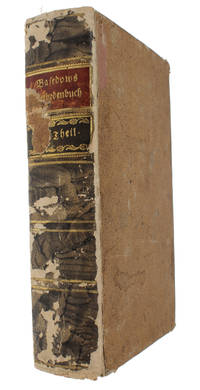
1770rif. 50344Altona und in der Cramerischen Handlung in Bremen 1770. 8vo. Contemp. marbled boards. The marbled paper on covers gone scratches to marbled paper on spine. Binding fully intact. Title-and tomelabels in leather with gilt lettering. A stamp on foot of title-page. 6XXIV56032;VIII112 pp. Some scattered brownspots mainly to "Verbesserungen des ersten Theiles" and to title-pages. Very scarce first edition of Basedow's main work in educational theory meant to explain his "Elementarwerk".He was strongly influenced by Rousseau's ideas on education in Emile and he proposed the reform of schools and of the common methods of instruction the establishment of an institute for qualifying teachers and solicited subscriptions for the printing of a new illustrated book Elementarwerk "Elementary Book" where his principles were to be explained at length assisted by "Das Methodenbuch".Basedow was called to Denmark in 1753 to become professor at Soroe Akademi where he stayed for 8 years. He was dismissed to Altona in 1761 caused by his theological views going against the prevailing orthodoxy. While he stayed in Soroe he published his "Praktische Philosophie für alle Stände" 1758. hardcover
1855rif. 49133Paris: Gauthier-Villars 1855. 4to. No wrappers. In: "Comptes Rendus Hebdomadaires des Seances de l'Academie des Sciences" Vol 40 No 5 6. Pp. 205- 260 a. pp. 261- 324. 2 entire issue offered. Hermite's paper's: pp. 249-256 a. 304-309. First printing of Hermite's importent paper in which he created the theory of transformations."Another topic on which Hermite worked and made important contributions was the theory of quadratic forms. This led him to study invariant theory and he found a reciprocity law relating to binary forms. With his understanding of quadratic forms and invariant theory he created a theory of transformations in 1855. His results on this topic provided connections between number theory theta functions and the transformations of abelian functions.""Hermite’s 1855 results became basic for the transformation theory of Abelian functions as well as for Camille Jordan’s theory of "Abelian" groups. They also led to Herrnite’s own theory of the fifth-degree equation and of the modular equations of elliptic functions."DSB. unknown
1862rif. 43530Leipzig Johann Ambrosius Barth 1862. Without wrappers as issued in "Annalen der Physik und Chemie. Hrsg. von J.C. Poggendorff" 115. Bd. 1. issue "Heft" No 1 1862. Titlepage to vol. 115. Pp. 1-176 a. 1 folded engraved plate. The entire issue offereed "Heft" 1. Clausius' paper: pp. 1-56. Some brownspots to right marginon some leaves. First printing of this importent paper the seciond of C's papers in the working out of the Kinetic Theory of Gases. In the paper he states that he found an error in Maxwell's theory of gases an error Maxwell was to admit as far more serious. "In his initial approach to the conduction of heat in gases Maxwell drew a brilliant analogy between diffusion a transfer of mass and conduction a transfer of kinetic energy thereby making it possible to use the form of his diffusion equation to represent conduction simply replacing the mass of a molecule with its kinetic energy. Clausius critized this adoption of the diffusion equation because given the assumptions mass transfer would accompany the heat conduction and the process would not be one of energy transfer alone. He then offered a revised theory of conduction. "DSB III p. 308."Clausius was one of the founders of the kinetic theory of gases and of the science of thermodynamics. He and Lord Kelvin at about the same time and independently announced the Second Law of thermodynamics. Clausius particularly developed the theory of thermodynamics by applying it to the study of gases and vapors."Magie in "A Source Book in Physics" p. 228. unknown
1740rif. 46843Paris L'Imprimerie Royale 1740. 4to. Without wrappers. Extracted from "Mémoires de l'Academie des Sciences. Année 1737". Pp. 205-227 a. 2 folded engraved plates. First appearance of this extremely importent paper in which Clairaut directly confirms the rotation and the orbital movement of the Earth around the Sun and giving an indirect proof of the axiom that the velocity of light does not depend on whether the light source moves away or toward the observer. The Earth does move after all !!In 1728 James Bradley trying to measure the stellar parallax discovered stellar aberration - the angular displacement of the apparent direction of starlight due to the earth's motion - and attributed it to the combined effect of the finite velocity of light and the earth's orbital velocity. But Bradley had not given any theoretical proof but Clairaut did in the offered paper.Aberration is "the apparent change in direction of a source of light caused by an observers component of motion perpendicular to the impinging rays. During this time the telescope has moved a short distance causing the photons to reach a spot on the focal plane displayed from the former image position. This discovery provided the first direct physical confirmation of the Copernican theory. A second importent application of aberration has been its clear-cut demonstration that as is axiomatic to special relativity light reaching the earth has a velocity unaffected by the relative motion of the source toward or away from earth."McGraw-Hill "Concise Encyclopedia.". unknown
1852rif. 43564Leipzig Johann Ambrosius Barth 1852. Without wrappers as issued in "Annalen der Physik und Chemie. Hrsg.von Poggendorff" Dritte Reihe Bd. 26 Achtes Stück.= Heft No. 8 of 1852. The entire issue No. 8 offered. Titlepage to vol. 26. Pp. 501-600. Helmholtz's paper: pp. 501-523. Clean and fine. First appearance of this founding paper in the modern theory of colour in which Helmholtz proved the surprising fact that there are only two among the colours of the spectrum yellow and indigo-blue which together yields pure white that is are complementary to each other whereas their combination had always been supposed to produce green."Helmholtz turned to the intricate problems of color vision in 1852 with an attack on Sir David Brewster's new theory of light. Brewster had maintained the objective reality of three primary colors by supposing in opposition to Newton that there exist three distinct kinds of light each of which excites in the eye one of the sensations red yellow or blue. Helmholtz regarded the theory as still another confusion of physical stimulus and subjective responce.He also revived Young's theory of color visoin.only to refute it. He had discovered that spectral colors when mixed always yield a duller color of less-than-spectral saturation. Therefore the whole idea that all colors may be obtained from mixtures of three primary colors must be incorrect he concluded for the spectral colorss at least can never be obtained in their full saturation by mixing any three of their number.Although Helmholtz dismissed Young's theory in 1852 by 1858 he had changed his mind and become its formost advocate. In order to save Ypoung's theory.Helmholtz asumed that Young's physiological primaries are not spectral colors att all but colors of far greater-than-spectral saturation."DSB VI pp. 246-247. Garrison & Morton 1508. unknown
1914rif. 48028Braunschweig Friedr. Vieweg & Sohn 1914. Lex8vo. Contemp hcloth gilt spine. Lower spine end a bit frayed otherwise very fine. In: "Verhandlungen der deutschen Physikalischen Gesellschaft im Jahre 1914" 16. Jahrgang. IX1072 pp. Franck & Hertz' papers: pp. 457-467 a. 512-517 textillustr. Fine and clean. First apperance of the famous Franck-Hertz Experiment which is considered as a new and independent support not only of Planck's quantum theory and Einstein's light-quantum hypothesis but also of Bohr's theory of the atom with stationary states of discrete energies.Franck and Hertz were awarded the Nobel Prize in Physics in 1925 for this work and Franck concluded his Nobel lecture with the words "We know only to well that we owe the wide recognition that our work received to contact with the great concepts and ideas of M. Planck and in particular Niels Bohr.""In their famous experiments Franck and Hertz' showed that electrons could impart energy to a mercury atom only if they had a kinetic energy exceeding 4.9 ev. and that exactly this quantum of energy was taken up by the mercury atom causing it to emit light of the resonance line Å 2537. It was the first direct proof of the quantized nature of the energy transfer and of the connection of the quantum DeltaE of energy with the frequency p = DeltaE/h of the light emitted as the result of the transfer. These experiments are rightly regarded as the first decisive proof of the reality of the quantized energy levels that had just been postulated by Niel’s Bohr." DSB.See: Siegmund Brandt "The Harevest of a Century. Discoveries of Modern Physics in 100 Episodes" Episode 25 The Franck-Hartz Experiment 1914 pp. 102-104.The volume contains another importent paper ALBERT EINSTEIN "Beiträge zur Quantentheorie" pp. 820-828. First edition. "In this paper. two considerations are given which are interrelated by a common goal inasmuch as it is attempted to derive two of the most importent achievementss of quantum theory viz. Planck's radiation law and Nernst's third law of thermodynamics in a new manner. The proofs do not involve Boltzmann's equation and are thus based enterely on macroscopic thermodynamics. They do introduce however the quantum hupothesis. Einstein points out that the alleged 'proofs' which try to derive the theorem of Nernst from the mere fact that the heat capacity of all substances goes to zero at absolute zero temterature are not genuine." Cornelius Lanczos.Weil No 67. hardcover
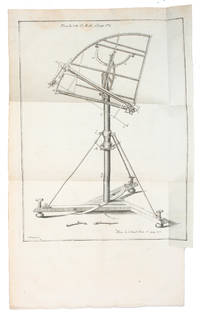
1751rif. 42770Berlin Haude et Spener 1751. 4to. No wrappers as issued in "Mémoires de l'Academie Royale des Sciences et Belles-Lettres" tome V Année 1749 pp. 339-372 1 folded geometrical plate to the first paper and 3 fine double-page folded engraved plates showing the quadrant. Kies was one of the first to propagate Newton's discoveries in Germany and dedicated two of his works to the Englishman. The crater Kies on the Moon is named after him.The paper on the instrument describes and depicts the large quadrant in the Berlin observatory invented by Hadley described in Transactions of the Royal Society in 1732."From 1742 to 1754 at the recommendation of the mathematician Leonhard Euler he Kies was made professor of mathematics at Berlin's Academy of Sciences and astronomer at its observatory. His reports from this time include De la Situation la plus avantageuse des planètes pour découvrir les irrégularités de leurs mouvemens Sur les Éclipses des étoiles fixes par la lune and Description d'un instrument qui se trouve ." unknown
1834rif. 42833London Richard Taylor 1834 4to. No wrappers as extracted from "Philosophical Transactions" 1834 - Part I. Pp. 123-126 a. pp. 127-141. First appearance of Lubbock's "Lunar-Theory""John Lubbock 1803-65 was an astronomer and mathematician. He made a special study of tides and of the lunar theory and developed a method for calculating the orbits of comets and planets. In mathematics he applied the theory of probability to life insurance problems." unknown
1791rif. 48147Paris 1791. Contemp. hcalf. Gilt spine. Spine a bit rubbed. Wear to top of spine. A dampstain to lower right corners on the first 15 leaves of the volume. Stamps to verso of titlepage. In: "Annales de Chimie ou Recueil de Mémoires concernant la Chemie" Tome 9. 355 pp. a. 1 engraved plate. Entire volume offered. Hassenfratz's paper: pp. 261-274. First printing of a classic paper in physiology."Hassenfratz a pupil of Lagrange maintained that the oxidation of carbon and hydrogen took place in the blood and not in the lungs as taught by others."Garrison & Morton: 926. unknown
1897rif. 41482Berlin 1897. 4to. Uncut and unopened in original printed wrappers. Fresh copy fine and clean. Near mint. The entire "Heft" II: Pp. 35-81. Planck's paper pp.35-46. Max Planck is considered to be the founder of the quantum theory and was awarded the Nobel Prize in Physics in 1918. "Über irreversible Strahlungsvorgänge" is a mathematical description of the electromagnetic radiation emitted from a black-body."Über irreversible Strahlungsvorgänge was published in five parts in the period 1897-1901 the present volume being number 1."With the Kirchhoff-Wien-Boltzmann work as a background Max Planck began his attack on the black-body problem in 1897. He labored under the erroneous impression for some time that Wien's formula was the only one which harmonized with the second law of thermodynamics. The experiments on black-bodies due to Lummer and Pringsheim Rubens and Kurlbaum forced him from that position." Planck Max. Catalogue 258 Interlibrum Vaduz "I had already been struggling with the problem of the equilibrium of matter and radiation for some years without success; I knew the problem is of fundamental significance for Physics." The significance was unparallelled when he in December 1900 delivered a paper entitled "On the Theory of the Energy Distribution Law in the Normal Spectrum" before the German Physical Society which today is considered the birth of quantum physics. The present volume constitutes a precursor to this work. - Akademie No 33 unknown
1843rif. 42922Paris Imprimerie de Bachelier 1843. 4to. No wrappers as extracted from "Journal de Mathématiques pures et appliquées.Publié par Joseph Liouville" tome VIII. Pp. 273-360. Clean and fine. First appearance of Le Verrier's provisional theory on the motion of Mercury his studies of which eventually did much to demonstrate the validity of Einstein's Theory of Relativity. The planetary orbits should agree with the predictions of the General Theory of relativity but as Einstein pointed out in his "Erklärung der Perihelbewegung des Merkurs aus der allgemeinen Relativitätstheorie" from 1915 the divergences predicted were too small to be observed except in the case of the nearest planet Mercury where the perihelion advance according to the formula reaches the value of 43"" per 100 years being in full agreement with the calculations of Le Verrier who found this unexplained rest in the perihelion advance of Mercury per century if the perturbations due to the other planets are deduced.- Einstein tells in a letter to a friend that for several days he was in a 'state of delirious joy' by this wonderful astronomical confirmation of his theory."Le Verrier first began to study Mercury on the suggestion of Arago in 1840. Astronomers realized that Mercury's perihelion the point at which the orbit of a planet is closest to the sun advanced along its orbit at a rate of 566 seconds per century. Le Verrier calculated that even when taking into account the forces exerted by other planets in the solar system there still existed a discrepancy between calculation and observation. Le Verrier's accurate calculations showed that the planet's perihelion.did indeed advance forty seconds of an arc per century more than could be accounted for by Newton's theory of gravitation even after the minor pertubing effects of the other planets had been allowed for." Asimov. - Le verrier published these findings in the present work carefully as to the mass of the planet comparison with other orbits of planets and their perihelia. At the time Le Verrier put down the discrepancy to mis-observation or mis-calculation.- Sparrow Milestones of Science No. 133. unknown
1769rif. 44803Berlin Haude et Spener 1769 4to. No wrappers as issued in "Mémoires de l'Academie Royale des Sciences et Belles-Lettres" tome XVIII Année 1762. Pp. 195-225 and 1 folded engraved plate. Pp. 226-248. First printing of two importent Euler-papers on the mathematical theory of dioptrics and how to avoid the confusions of lenses. - Eneström E 379 a. 380. unknown