RABIESBiblio.com
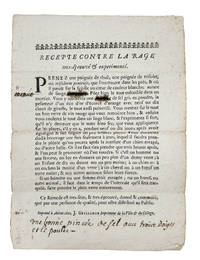
Recepte contre la rage tres-éprouvé & experimenté.
rif. 20275Printed sheet 234 x 170 mm. Trace of folding. Remarkable printing of a "popular" remedy against rabies issued by the printer of Autun Jacques Guillimin at the end of the reign of Louis XIV. The remedy begins with rue as its principal ingredient. In England where the plant was known as herb of grace its leaves were traditionally used in the treatment of rabies; they were also strewn on household floors and along window ledges to guard against infection and plague. The recipe also includes sage cloves "the weight of a gold écu of orange peel" and a good glass of red wine which must be stirred well. After all the ingredients have been mixed and crushed the preparation is to be strained through a white cloth; the liquid is to be kept for drinking while the dry residue is applied to the wounds. The remainder of the text is devoted to dosage instructions specifying that the drink must be administered only on an empty stomach and taken as soon as possible after the bite of a rabid dog or "other beast" to a man or a woman gives a little more than half a glass; to a child of ten or twelve years a little less; to a dog or a pig half a glass. But beware: "Si un homme ou une femme était enragée il faut faire prendre le plein verre entierement" if a man or a woman is already rabid take the full glass. Several manuscript corrections appear: the sage must be "finely chopped" and the salt dosage refined as "a good pinch of salt taken with three fingers." We have been unable to trace any other surviving copies of this ephemeral publication. Rabies was endemic in Burgundy at the turn of the 17th and 18th centuries with episodic outbreaks. Authorities regularly issued ordinances for the destruction of stray dogs. The town printer of Autun Jacques Guillimin thus found himself distributing this recipe to the public. The printer also notes: "Ce remède est très sûr & très éprouvé donné & communiqué par une personne de qualité pour être distribué au public" This remedy is very certain and well tested given and communicated by a person of quality to be distributed to the public. A telling witness to how society confronted a feared disease combining popular remedies municipal action and printed dissemination. Autun, J. Guillimin, Imprimeur de la Ville & du Collège, [c. 1680-1700].
Erasmushaus Ltd. · Svizzera3000,00 CHF≈ 3247,81 €