rif. DADAX9500726084New unknown
1849rif. 283685Utica 1849. unbound. very good. Fine content A.L.S. 4to. 2 pages Utica New York July 6 1849 in part: ". Dear Father . we think of you these Cholera times and particularly as we hear that it has visited Rome and sometimes wish you could all be here again as the city is comparatively healthy but we must all endeavor to keep cool. with caution" ".We have all been well except Brother Bob who has been complaining a little for a few days though not of anything bearing the nature of the epidemic - we have induced him to remain quiet and I believe he has mostly if not entirely recovered." Boldly written with extremely light mailing folds. unknown
rif. 3659270571.Gpaperback. Good. Access codes and supplements are not guaranteed with used items. May be an ex-library book. paperback
2012rif. DADAX3659270571LAP Lambert Academic Publishing 2012-10-13. paperback. New. 5.91x0.64x8.66. Buy with confidence. Excellent Customer Service & Return policy. LAP Lambert Academic Publishing paperback
1831rif. 003913London: George Eyre and Andrew Spottiswoode 1831. Single sided broadside approximately 440mm x 570mm in size. Chipped to extremities with some loss to margins creased from old folds with minor loss to the middle of a few words of a sentence in the centre 'appeared and broken out' but with no loss of sense. Extensive Japanese tissue repairs to reverse faint blue pencil marks to right hand margin. An uncommon survival allowing for the removal of persons or goods 'nuisances' on ships "arriving and having any infectious Disease or Distemper on board" including the plague or spasmodic cholera. BL and Wellcome only in Library Hub. First Edition. Unbound. Fair. Elephant Folio. Broadside. George Eyre and Andrew Spottiswoode paperback
rif. BN314805Editions du Cygne. Softcover. La nudité: Pratiques et significations La nudité: Pratiques et significations Christophe Colera Editions du Cygne paperback
rif. 9276Circa 1849. 4to 36 pp and a manuscript title-page. All texts clear and complete. Disbound from a commonplace book and apparently complete. Fair on aged brittle gilt-edged paper with a few closed tears in particular to the last couple of leaves. The book is presumably in Mrs Macdonald's hand and the only indication to her identity is the final note see below signed 'F. M. M.' which shows her to have been an educated member of the middle classes. Divided into three parts. The first part is 'Useful Remarks for the Mistress of a House' 25 pp paginated from 1 to 23. The first page carrying remarks on Tea Loaf Sugar Moist Sugar Eggs and Spices with the last two annotated 'Experientia docet!' The first entry reads: 'Tea should be kept in a dry place and any store should be in Tin Canisters wrapt in flannel. Two spoonful is the quantity given to work-women for breakfast or Tea.' Extensive sections on Pickles and Preserves. Also Raspberry Vinegar Candles Soap 'Lay in also an annual stock' and Coals the latter annotated 'Since the above was written Coals are sold by the Ton'. Long sections on 'Poultry yard' 'Pidgeons' 'Rabbits' 'If the Doe is weak during her accouchement give her beer caudle or warm fresh grains' 'Ornamental Supper dishes' 'Flummery' including 'Green Melon in Flummery' The second part comprising 6 pp of French recipes: 'Soupe a la Bonne-Femme' 'Roux Blanc white Thickening' 'Roux brun brown thickening' 'Sauce Tournee' Sauce a l'Allemande German sauce' 'Sauce au Maitre d'Hotel' 'Sauce du Maitre d'Hotel au maigre' 'To boil Artichokes the French way' 'French melted butter only good with Artichokes in my opinion'. The third part 6 pp containing miscellaneous recipes beginning with a long 'Anti-Cholera diet' and ending with 'Lord Ponsonby's Cure for Cholera. 1849.' 'It is asserted by Lord Ponsonby's Agent that the patient is immediately cured before a Medical Man arrives.' This is dated 'June 24: 1849' and is followed by a note signed 'F. M. M.' reading 'The above receipt was given to me by a Man of the name of Poole a Poulterer at Alston near Cheltenham who saw it tried in his House by his Brother in Law who was seized with all the symptoms of Cholera and had the Medicine made up to be ready at a moment and was quite well and able to return to his home some miles distant perfectly recovered the next Morning.' [Circa 1849.] unknown
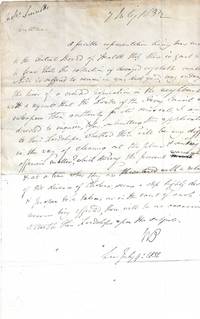
rif. 26909Lambeth 7 July 1832. Four pages folio bifolium tipped onto card minor damage not affecting text crude repair with sellotape on 'spine' aged fair condition. A. The 'Petition' two pages folio in a tidy handwriting commencing: "We the undersigned regret to have occasion to trouble your Lordship but under the present alarming apprehension of that dreadful disease of Cholera we intreat your Lordships assistance in the removal of a monstrous nuisance in our immediate neighbourhood. The dust yard of Messrs Sinott situate in Belvedere Road Lambeth is the receptacle for the refuse of the vegetables from Covent Garden market where it is as well as much other very offensive matter suffered to remain till far advanced in decomposition long thought the source of cholera the effluvia from which especially during the present warm weather is almost unbearable and we fear unless abated will materially endanger the lives of many in our populous neighbourhood ." They ask for his Lordship's interference to deal with a longstanding problem. Signed by Thomas Langton Samuel Cross John Barnard John Chas Stahlschmidt and ten others. B. Final page of the bifolium copy of letter presumably sent to Sinnottsalso dated 7 July 1832 tipped on to card with loss of a letter or two initialled discussing the source of effluvia affecting the lives of people a "crowded population" and its connection to cholera. See Image. Notes: a. "Lord Melbourne William Lamb 2nd Viscount Melbourne was heavily involved in the government's response to the first major cholera epidemic in Britain during his time as Home Secretary in the early 1830s" AI; b. "The 1832 Cholera Outbreak in LambethConditions: Lambeth situated along the Thames was a hub of industry and a magnet for poor migrant workers living in cramped filthy conditions with no proper sewerage systems.Water Supply: Residents including those in Lambeth drank directly from the heavily contaminated Thames accelerating the spread of the disease.Impact: By February 1832 cases were reported in London with Lambeth and Southwark among the early affected areas. By the end of 1832 the epidemic had killed over 32000 people across Britain."Miasma" Theory: At the time officials like Edwin Chadwick and the Central Board of Health believed cholera was caused by "miasma"—poisonous air arising from decomposing matter." AI Lambeth, 7 July 1832 unknown
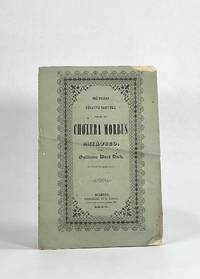
1850rif. 10296Mexico: R. Rafael 1850. Original Wrappers. near Very Good binding. Octavo. 16 pp. Stitched in original wrappers. Horizontal crease through the center of the pamphlet from accidental folding; light edgewear including folded leaf corners; rear wrapper soiled; wormholes through the entire pamphlet that touch the occasional letter not impacting comprehension. Uncommon pamphlet in which the author a self-professed retired physician identifies how to diagnose cholera which had reemerged as a serious problem during and after the Mexican-American War. We've not been able to find other references to work by Duck. Fairly uncommon. While this is not an ideal copy given the condition it is fairly good. Sutro p. 858. R. Rafael unknown
1832rif. 22939Montreal. A la Librairie de E.R. Fabre & Cie. Juin 1832 1832. Hardcover. 24mo 13cm 16p. in the original plain boards fine n12 A book of prayers in response to a cholera epidemic outbreak in Lower Canada in 1832 which was brought by immigrants from Britain. At the time it was not understood how the disease spread nor how to treat it. Six thousand people were believed to have died. Montreal. A la Librairie de E.R. Fabre, & Cie. Juin 1832 hardcover
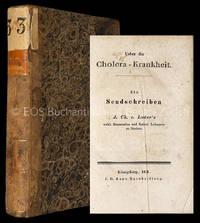
1831rif. 2684BB1831. Königsberg J.H. Bon's Buchhandlung 1831. 8°. 60 S. 48 S. Zusätze. Halblederband aus der Zeit. Beigebunden: Schnurrer Friedrich: Die Cholera morbus ihre Verbreitung ihre Zufälle die versuchten Heilmethoden . Stuttgart und Tübingen Gotta'schen Buchhandlung 1831. X 2 79 S. Mit 1 gef. Karte. Beigebunden: Hegetschweiler Joh.: Ueber den Charakter die Cur und die Verhütung der ostindischen Brechruhr Cholera mit besonderer Berücksichtigung der Verhältnisse der Schweiz. Zürich Orell Füssli 1831. 52 S. Beigebunden: Köchlin J. R.: Ueber die Cholera oder den Brechdurchfall und die dagegen gerichteten Schutz- und Hülfsmittel. Zürich Schulthess 1831. 74 S. Beigebunden: Bastler Anton Dominik: Die Cholera in Wien. Wien Strauss 1832. 1 Bl. 134 S. - Sammlung div. Beiträge über die Cholera in einem Buch gebunden. - Mit Bibliotheksnummern. Der Einband berieben. unknown
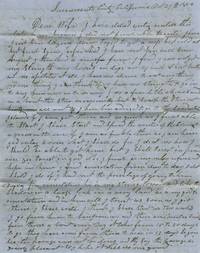
1850rif. BK0017Sacramento City California 1850. Autograph letter signed "Sam'l Locke" to his wife in Belfast Maine. 6 pp. Stampless folded letter with clear circular "SACRAMENTO CITY / CAL." postmark and "40" rate handstamp; manuscript notation recording receipt in Maine on December 19 1850. Light soiling; very good. A bleak California Gold Rush letter written during the 1850 Sacramento cholera epidemic by Samuel Locke a Maine emigrant suffering from prolonged fever and unable to regain his strength. Surrounded by sickness failed mining ventures violent crime and men too poor or ill to return home Locke plans to seek recovery in the Sandwich Islands while relying upon his religious faith for consolation. Locke had been ill since August and was now so weak that ordinary work exhausted him: "My limbs or legs are very weak short breath and no appetite at all. I have no desire to eat anything not one thing I can think of. I have no strength to go into any business or to do any. I do a few little chores round or about the store occasionally but to sweep the store it beats me all out . O how I long to get out of this place. Can't get any strength don't know as I can anywhere but I long to try." Friends advised him to spend the winter in the Sandwich Islands. He expected to travel first to San Francisco and then make the fifteen- to twenty-day passage to Hawaii though he feared that continued illness might leave him unable either to support himself there or return to Maine. He states that he will "trust in providence yes trust in God who I feel is my only refuge". Locke gives a grim account of California's climate and the spread of cholera through Sacramento claiming that the climate in California prevented the sick from recovering their strength as the "air is very light & bad middle of the day very hot and nights very cool." The previous week's report had stated forty dead but "nothing near all the cases were reported" with Locke himself knowing of several unreported cases personally. A local blacksmith died overnight after his companions borrowed Locke's syringe and "We can hardly see a healthy looking individual in the streets." The letter also records the uncertain fortunes of men from Locke's home region scattered through the mines. William Beckett and his partners had spent the summer constructing a mining dam had struck gold on the first day and then immediately "the dam was washed away so they lost all their summer's labor." Other acquaintances had moved to Kelsey's Bar the southern mines or Oregon or were preparing to return east by way of Panama. Some remained convinced that California would reward perseverance while others had "seen enough" after accomplishing nothing. Locke regarded success as largely accidental: "Thousands are here and in the mines who want to get home and cannot-not able to do seamen's duty and no money to pay but they have got to stay in the mines and do the best they can. Some it is true have been lucky. It is all luck. If they happen to hit a good place they do well." News that cholera had entered the mining districts increased his alarm. Locke feared especially for men living in tents as the rainy season approached with poor food and little protection from exposure. Sacramento itself was marked by nightly violence: "There are murders or robberies about every night. One man killed in front of our house a few nights ago. We heard him holler and heard the blows. Next morning he died. His head was dreadfully mangled." Locke closes with an emotional message to his wife and children. His health finances and prospects all appeared uncertain and he repeatedly asked his family and church to pray for him: "Tell the dear Children to be good and if they never see me again when I am gone they will have the satisfaction . of knowing they acted as thy Father requested . Pray for me ask the Church to pray for me indeed I know I have your prayers and you have mine often." A particularly bleak account of the human cost of the California Gold Rush documenting epidemic disease physical collapse failed mining schemes violent crime religious faith and the predicament of emigrants unable to escape California after their health and resources were exhausted. . unknown
1893rif. 40Very rare Second enhanced edition No copy of any edition of this title recorded in WorldCat Uncut Oliveti Torquato. Della morte apparente nei cholerosi del modo di farli risorgere e della sola cura giovevole nel cholera asiatico / Torquato Oliveti. Savignano : Tipografia dei Filopatridi 1893 8° 185 x 120 mm original paper binding with title page printed on front board pp. 116. Very rare second edition of Torquato Olivetti treatise on Asian cholera and the phenomenon of apparent death in the sufferers of cholera The treatise published in First Edition in Naples in 1886 organised as a practical manual to be used by doctors during an epidemic of cholera deals with the causes and symptoms of the disease the most effective cures and deals with the phenomenon of the apparent death of some sick people on how to recognise this symptom and how to raise the apparent dead. Olivetti a doctor and lawyer from Emilia formed his experience on cholera during the terrible plague epidemic that broke out in Naples in 1884. In the summer of 1884 a devastating cholera epidemic was recorded in Naples. The difficult housing situation in the popular neighbourhoods and poor sanitation conditions favoured the rapid proliferation of the disease. In the space of a few weeks the death toll exceeded 7000. To prevent the recurrence of other similar tragedies the mayor Nicola Amore with the support of King Umberto I and Prime Minister Depretis started the "gutting" of the ancient city with a massive recovery plan. CONDITION: Amazing copy with no defects; uncut. Tipografia dei Filopatridi paperback