435 résultats
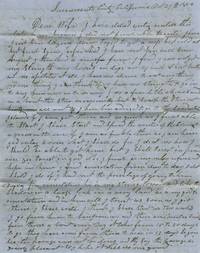
1850réf. BK0017Sacramento City California 1850. Autograph letter signed "Sam'l Locke" to his wife in Belfast Maine. 6 pp. Stampless folded letter with clear circular "SACRAMENTO CITY / CAL." postmark and "40" rate handstamp; manuscript notation recording receipt in Maine on December 19 1850. Light soiling; very good. A bleak California Gold Rush letter written during the 1850 Sacramento cholera epidemic by Samuel Locke a Maine emigrant suffering from prolonged fever and unable to regain his strength. Surrounded by sickness failed mining ventures violent crime and men too poor or ill to return home Locke plans to seek recovery in the Sandwich Islands while relying upon his religious faith for consolation. Locke had been ill since August and was now so weak that ordinary work exhausted him: "My limbs or legs are very weak short breath and no appetite at all. I have no desire to eat anything not one thing I can think of. I have no strength to go into any business or to do any. I do a few little chores round or about the store occasionally but to sweep the store it beats me all out . O how I long to get out of this place. Can't get any strength don't know as I can anywhere but I long to try." Friends advised him to spend the winter in the Sandwich Islands. He expected to travel first to San Francisco and then make the fifteen- to twenty-day passage to Hawaii though he feared that continued illness might leave him unable either to support himself there or return to Maine. He states that he will "trust in providence yes trust in God who I feel is my only refuge". Locke gives a grim account of California's climate and the spread of cholera through Sacramento claiming that the climate in California prevented the sick from recovering their strength as the "air is very light & bad middle of the day very hot and nights very cool." The previous week's report had stated forty dead but "nothing near all the cases were reported" with Locke himself knowing of several unreported cases personally. A local blacksmith died overnight after his companions borrowed Locke's syringe and "We can hardly see a healthy looking individual in the streets." The letter also records the uncertain fortunes of men from Locke's home region scattered through the mines. William Beckett and his partners had spent the summer constructing a mining dam had struck gold on the first day and then immediately "the dam was washed away so they lost all their summer's labor." Other acquaintances had moved to Kelsey's Bar the southern mines or Oregon or were preparing to return east by way of Panama. Some remained convinced that California would reward perseverance while others had "seen enough" after accomplishing nothing. Locke regarded success as largely accidental: "Thousands are here and in the mines who want to get home and cannot-not able to do seamen's duty and no money to pay but they have got to stay in the mines and do the best they can. Some it is true have been lucky. It is all luck. If they happen to hit a good place they do well." News that cholera had entered the mining districts increased his alarm. Locke feared especially for men living in tents as the rainy season approached with poor food and little protection from exposure. Sacramento itself was marked by nightly violence: "There are murders or robberies about every night. One man killed in front of our house a few nights ago. We heard him holler and heard the blows. Next morning he died. His head was dreadfully mangled." Locke closes with an emotional message to his wife and children. His health finances and prospects all appeared uncertain and he repeatedly asked his family and church to pray for him: "Tell the dear Children to be good and if they never see me again when I am gone they will have the satisfaction . of knowing they acted as thy Father requested . Pray for me ask the Church to pray for me indeed I know I have your prayers and you have mine often." A particularly bleak account of the human cost of the California Gold Rush documenting epidemic disease physical collapse failed mining schemes violent crime religious faith and the predicament of emigrants unable to escape California after their health and resources were exhausted. . unknown books
1849réf. 283685Utica 1849. unbound. very good. Fine content A.L.S. 4to. 2 pages Utica New York July 6 1849 in part: ". Dear Father . we think of you these Cholera times and particularly as we hear that it has visited Rome and sometimes wish you could all be here again as the city is comparatively healthy but we must all endeavor to keep cool. with caution" ".We have all been well except Brother Bob who has been complaining a little for a few days though not of anything bearing the nature of the epidemic - we have induced him to remain quiet and I believe he has mostly if not entirely recovered." Boldly written with extremely light mailing folds. unknown books
réf. DADAX143701173XNew unknown
réf. DADAX1436977428New unknown
réf. 9788414325049New. unknown
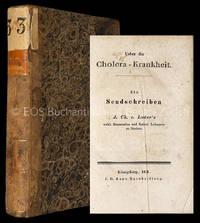
1831réf. 2684BB1831. Königsberg J.H. Bon's Buchhandlung 1831. 8°. 60 S. 48 S. Zusätze. Halblederband aus der Zeit. Beigebunden: Schnurrer Friedrich: Die Cholera morbus ihre Verbreitung ihre Zufälle die versuchten Heilmethoden . Stuttgart und Tübingen Gotta'schen Buchhandlung 1831. X 2 79 S. Mit 1 gef. Karte. Beigebunden: Hegetschweiler Joh.: Ueber den Charakter die Cur und die Verhütung der ostindischen Brechruhr Cholera mit besonderer Berücksichtigung der Verhältnisse der Schweiz. Zürich Orell Füssli 1831. 52 S. Beigebunden: Köchlin J. R.: Ueber die Cholera oder den Brechdurchfall und die dagegen gerichteten Schutz- und Hülfsmittel. Zürich Schulthess 1831. 74 S. Beigebunden: Bastler Anton Dominik: Die Cholera in Wien. Wien Strauss 1832. 1 Bl. 134 S. - Sammlung div. Beiträge über die Cholera in einem Buch gebunden. - Mit Bibliotheksnummern. Der Einband berieben. unknown
1848réf. ZB450528Sevilla: Imprenta del Diario de Sevilla 1848. small 12mo iv. 160 p. old leather now worn and scuffed textually quite good. - If you are reading this this item is actually physically in our stock and ready for shipment once ordered. We are not bookjackers. Buyer is responsible for any additional duties taxes or fees required by recipient's country. Sevilla: Imprenta del Diario de Sevilla hardcover
réf. BN314805Editions du Cygne. Softcover. La nudité: Pratiques et significations La nudité: Pratiques et significations Christophe Colera Editions du Cygne paperback
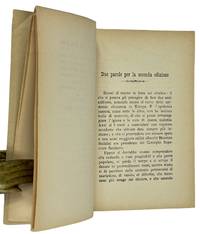
1893réf. 40Very rare Second enhanced edition No copy of any edition of this title recorded in WorldCat Uncut Oliveti Torquato. Della morte apparente nei cholerosi del modo di farli risorgere e della sola cura giovevole nel cholera asiatico / Torquato Oliveti. Savignano : Tipografia dei Filopatridi 1893 8° 185 x 120 mm original paper binding with title page printed on front board pp. 116. Very rare second edition of Torquato Olivetti treatise on Asian cholera and the phenomenon of apparent death in the sufferers of cholera The treatise published in First Edition in Naples in 1886 organised as a practical manual to be used by doctors during an epidemic of cholera deals with the causes and symptoms of the disease the most effective cures and deals with the phenomenon of the apparent death of some sick people on how to recognise this symptom and how to raise the apparent dead. Olivetti a doctor and lawyer from Emilia formed his experience on cholera during the terrible plague epidemic that broke out in Naples in 1884. In the summer of 1884 a devastating cholera epidemic was recorded in Naples. The difficult housing situation in the popular neighbourhoods and poor sanitation conditions favoured the rapid proliferation of the disease. In the space of a few weeks the death toll exceeded 7000. To prevent the recurrence of other similar tragedies the mayor Nicola Amore with the support of King Umberto I and Prime Minister Depretis started the "gutting" of the ancient city with a massive recovery plan. CONDITION: Amazing copy with no defects; uncut. Tipografia dei Filopatridi paperback
réf. PR121592Original publication 205 x 16 cm. Printed on laid paper. Regulations on how to deal with cholera disease. unknown
2012réf. DADAX3659270571LAP Lambert Academic Publishing 2012-10-13. paperback. New. 5.91x0.64x8.66. Buy with confidence. Excellent Customer Service & Return policy. LAP Lambert Academic Publishing paperback
réf. 2-846981379XANAYA EDUCACIÓN. Paperback. New. 336 pages. Spanish language. 11.18x8.74x0.63 inches. ANAYA EDUCACIÓN paperback
réf. 2-8469813536Anaya Educación. Paperback. New. 336 pages. Spanish language. 11.42x8.86x0.59 inches. Anaya Educación paperback
réf. 48106Amsterdam Van der Post Novembre 1848. 61 pages. 1 feuillet. 20x19 Cm. Dérelié. Taches. L'auteur préconise l'utilisation du Chlore pour combattre le choléra. Références au Chloroforme que Morton venait de découvrir et à son utilisation en Angleterre contre cette maladie. Document très bien conservé. Amsterdam, Van der Post, Novembre 1848. unknown
réf. 9788467824056New. unknown
réf. B9781020158070Hardback. New. hardcover
1850réf. BK0017Sacramento City California 1850. Autograph letter signed "Sam'l Locke" to his wife in Belfast Maine. 6 pp. Stampless folded letter with clear circular "SACRAMENTO CITY / CAL." postmark and "40" rate handstamp; manuscript notation recording receipt in Maine on December 19 1850. Light soiling; very good. A bleak California Gold Rush letter written during the 1850 Sacramento cholera epidemic by Samuel Locke a Maine emigrant suffering from prolonged fever and unable to regain his strength. Surrounded by sickness failed mining ventures violent crime and men too poor or ill to return home Locke plans to seek recovery in the Sandwich Islands while relying upon his religious faith for consolation. Locke had been ill since August and was now so weak that ordinary work exhausted him: "My limbs or legs are very weak short breath and no appetite at all. I have no desire to eat anything not one thing I can think of. I have no strength to go into any business or to do any. I do a few little chores round or about the store occasionally but to sweep the store it beats me all out . O how I long to get out of this place. Can't get any strength don't know as I can anywhere but I long to try." Friends advised him to spend the winter in the Sandwich Islands. He expected to travel first to San Francisco and then make the fifteen- to twenty-day passage to Hawaii though he feared that continued illness might leave him unable either to support himself there or return to Maine. He states that he will "trust in providence yes trust in God who I feel is my only refuge". Locke gives a grim account of California's climate and the spread of cholera through Sacramento claiming that the climate in California prevented the sick from recovering their strength as the "air is very light & bad middle of the day very hot and nights very cool." The previous week's report had stated forty dead but "nothing near all the cases were reported" with Locke himself knowing of several unreported cases personally. A local blacksmith died overnight after his companions borrowed Locke's syringe and "We can hardly see a healthy looking individual in the streets." The letter also records the uncertain fortunes of men from Locke's home region scattered through the mines. William Beckett and his partners had spent the summer constructing a mining dam had struck gold on the first day and then immediately "the dam was washed away so they lost all their summer's labor." Other acquaintances had moved to Kelsey's Bar the southern mines or Oregon or were preparing to return east by way of Panama. Some remained convinced that California would reward perseverance while others had "seen enough" after accomplishing nothing. Locke regarded success as largely accidental: "Thousands are here and in the mines who want to get home and cannot-not able to do seamen's duty and no money to pay but they have got to stay in the mines and do the best they can. Some it is true have been lucky. It is all luck. If they happen to hit a good place they do well." News that cholera had entered the mining districts increased his alarm. Locke feared especially for men living in tents as the rainy season approached with poor food and little protection from exposure. Sacramento itself was marked by nightly violence: "There are murders or robberies about every night. One man killed in front of our house a few nights ago. We heard him holler and heard the blows. Next morning he died. His head was dreadfully mangled." Locke closes with an emotional message to his wife and children. His health finances and prospects all appeared uncertain and he repeatedly asked his family and church to pray for him: "Tell the dear Children to be good and if they never see me again when I am gone they will have the satisfaction . of knowing they acted as thy Father requested . Pray for me ask the Church to pray for me indeed I know I have your prayers and you have mine often." A particularly bleak account of the human cost of the California Gold Rush documenting epidemic disease physical collapse failed mining schemes violent crime religious faith and the predicament of emigrants unable to escape California after their health and resources were exhausted. . unknown
2016réf. 2-8469825755ANAYA EDUCACIÓN 2016. Paperback. New. Spanish language. 11.34x8.90x0.63 inches. ANAYA EDUCACIÓN paperback
réf. 2-846981270XAnaya Educación. Paperback. New. 288 pages. Spanish language. 11.42x8.90x0.71 inches. Anaya Educación paperback
1830réf. 7290London The Religious Tract Society c.1830. 1830 8 p. Written in the form of a letter signed R.K. St. Petersburg 8th September 1830. 18cm. Bound with approximately 60 tracts mostly issued by the Religious Tract Society. contemporary tree calf. Front board detached and the other board held by an old amateur repair. The contents clean and tight. London, The Religious Tract Society unknown
1998réf. 122784Anaya 1998. tapa blanda. 2ª Mano/2ª Mano. Anaya. 1998. Nuestro Mundo. Con diskete de 3 1/2. Sin firmas ni anotaciones. Incluye las soluciones de los apartados Hazlo tu. Las de actividades propuestas en los desarrollos. de los temas y de los ejercicios y problemas Tapa blanda 480 p. ; 27x21 cm Anaya unknown
2011réf. 141018Anaya 2011. tapa blanda. 2ª Mano/2ª Mano. Anaya. 2011. Matematicas Euskera. alguna marca de ant prop incluye CD Rom 400 p. 28x21 cm. 1 CD-ROM tapa blanda Anaya unknown
1889réf. 8195AB1889. Washington Government Printing Office 1889. 13 chromolithogr. Taf. 3 Lichtdruck-Taf. 197 S. Lwd. d. Zt. Erste Ausgabe dieser Monographie. - 'The greater part of the detailed study of the disease the planning of experiments and the bacteriological investigations have been carried out by Dr. Theobald Smith while the conducting of the experiments the care of the experimental animals and the general management of the experiment station have been under the direction of Dr. F. L. Kilborne' Letter of Transmittal. - Die sorgfältig lithographierten Tafeln mit Abbildungen von Organen nach Cholerabefall. - Innenspiegel mit eingeklebter Komplimentkarte von D. E. Salomon Unterzeichner des Vorworts zusammen mit Norman J. Colman. Vorsätze mit zeitgenössischen Eintragungen in Tinte und Bleistift. unknown
réf. 2-8469821210ANAYA EDUCACIÓN. Paperback. New. 296 pages. Spanish language. 11.42x8.82x0.59 inches. ANAYA EDUCACIÓN paperback
2017réf. 2-8448941861Editorial Barcanova 2017. Paperback. New. Spanish language. 11.42x9.06x0.79 inches. Editorial Barcanova paperback