ROSEN DE ROSENSTEIN (Nils)Livre Rare Book

5 116 résultats
1778réf. 002691Paris, Pierre-Guillaume Cavelier, 1778
1807réf. 30140DBParis, Chomei, 1807. 8°. (2) Bl., XL S., 6 S., 2 S., 214 S. Mit 2 gestochenen Farbkupfern. Halblederband aus der Zeit mit goldgeprägtem Rückentitel und Rückenvergoldung. + Wichtig: Für unsere Kunden in der EU erfolgt der Versand alle 14 Tage verzollt ab Deutschland / Postbank-Konto in Deutschland vorhanden +, 30140DB|30140DB_2 [2 Warenabbildungen]
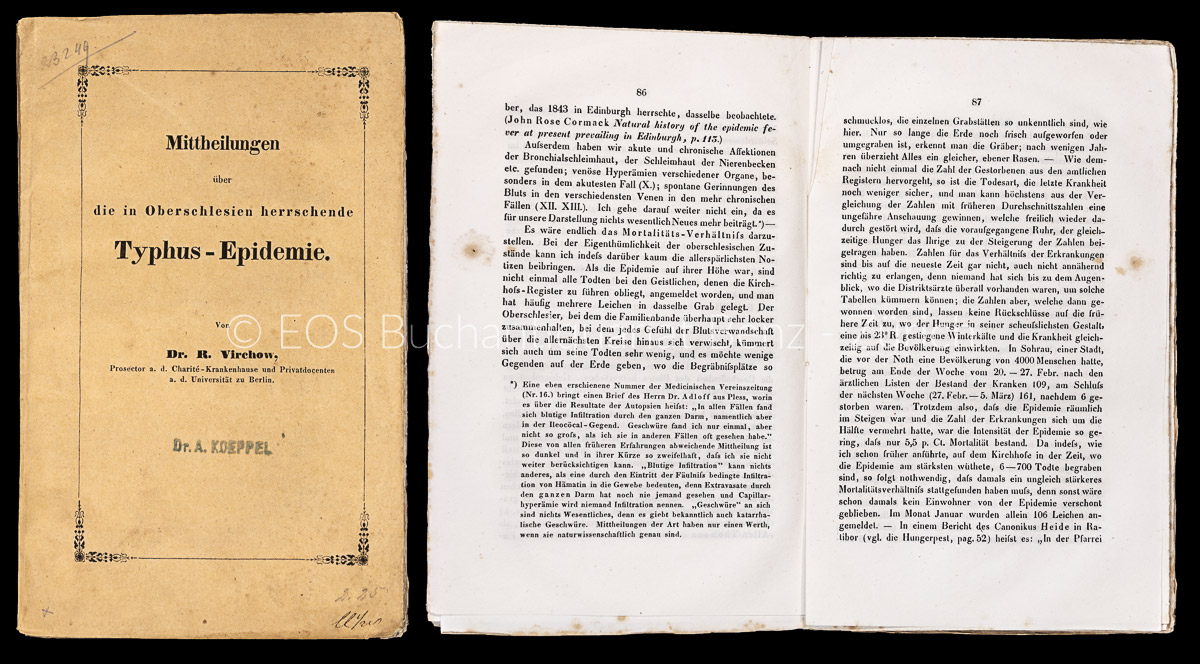
1848réf. 5105CBBerlin, R. Reimer, 1848. 8°. 182, (2) S. Orig.-Broschur. + Wichtig: Für unsere Kunden in der EU erfolgt der Versand alle 14 Tage verzollt ab Deutschland / Postbank-Konto in Deutschland vorhanden +, A
réf. P41265, 3 works bound together in 1 volume (cart.cover), texts in gotic german, 20cm., VG, [content: I."Die Lustseuche" : Wien, 1827, 3rd edition, xxxii + 228pp. // II."Die Kinderkrankheiten" : Wien, 1832, xvi + 388pp., 2nd ed. (Zweite mit den Beobachtungen der neusten Zeit vermehrte Ausgabe) // III."Die Hülfe bey Vergiftungen" : Breslau, Wilhelm Gottlieb Korn, 1818, xvi + 180pp., 1st edition]
3 works bound together in 1 volume (cart.cover), texts in gotic german, 20cm., VG, [content: I."Die Lustseuche…" : Wien, 1827, 3rd edition, xxxii + 228pp. // II."Die Kinderkrankheiten…" : Wien, 1832, xvi + 388pp., 2nd ed. (Zweite mit den Beobachtungen der neusten Zeit vermehrte Ausgabe) // III."Die Hülfe bey Vergiftungen…" : Breslau, Wilhelm Gottlieb Korn, 1818, xvi + 180pp., 1st edition]
réf. SONG140517014XUsed: Good unknown
1998réf. 85515Fort Detrick MD: US Army Medical Research Institute of Infectious Diseases Public Health Training Network Centers for Disease Control and Prevention and the Food and Drug Administration 1998. Presumed First Edition of this compilation. Box with participant materials included. Box is approximately 9 inches by 12 inches. Very good. Box has slight wear and soiling. Contents in very good condition. Unclear is some are reprints or produced for this satellite broadcast training. This includes a Dear Participant letter from the Office of the Commander US Army Medical Research Institute of Infectious Diseases Colonel Gerald W. Parker dated July 7 1998; Key Information sheet of Dates of Broadcasts and Taped Rebroadcast Dates and Time Telephone Call-in Instructions and Fax Instruction Forms; Optical Scan Forms Instruction Sheets; List of State and Territorial Health Departments; Student Booklet for Satellite Broadcasts on Tuesday September 22 1998 Wednesday September 23 1998 and Thursday September 24 1998; Student Booklet for Taped Rebroadcasts Saturday October 3 1998 and Sunday October 4 1998; Handout on Packaging and Shipping Infectious Materials; Case Definitions for Infectious Conditions Under Public Health Surveillance CDC Morbidity and Mortality Weekly Report May 2 1997 Vol. 46 No. RR-10 approximately 60 pages; NATO Handbook on the Medical Aspects of NBC Defensive Operations AMedP-6B Part II - Biological FM 8-9 NVMED-P-509 AFJMAN 44-151V1V2V3 February 1996 Approximately 100 pages; Medical Management of Biological Casualties Handbook Third Edition July 1998 approximately 150 pages plus fold-outs Format is approximately 4.5 inches by 6.25 inches; Defense Against Toxin Weapons by David Franz approximately 5.5 inches by 8.5 inches approximately 50 pages; Booklet at Open At Final Exam Time seal still intact--unopened. The United States Army Medical Research Institute of Infectious Diseases USAMRIID; pronounced: you-SAM-rid is the U.S Army's main institution and facility for defensive research into countermeasures against biological warfare. It is located on Fort Detrick Maryland near Washington D.C. and is a subordinate lab of the U.S. Army Medical Research and Development Command USAMRDC headquartered on the same installation. USAMRIID is the only U.S. Department of Defense DoD laboratory equipped to study highly hazardous viruses at Biosafety Level 4 within positive pressure personnel suits. USAMRIID employs both military and civilian scientists as well as highly specialized support personnel totaling around 800 people. In the 1950s and '60s USAMRIID and its predecessor unit pioneered unique state-of-the-art biocontainment facilities which it continues to maintain and upgrade. Investigators at its facilities frequently collaborate with the Centers for Disease Control and Prevention the World Health Organization and major biomedical and academic centers worldwide. USAMRIID was the first bio-facility of its type to research the Ames strain of anthrax determined through genetic analysis to be the bacterium used in the 2001 anthrax attacks. By U.S. Department of Defense DoD directive as well as additional U.S. Army guidance USAMRIID performs its "biological agent medical defense" research in support of the needs of the three military services. This mission and all work done at USAMRIID must remain within the spirit and letter of both President Richard Nixon's 1969 and 1970 Executive Orders renouncing the use of biological and toxin weapons and the U.N. Biological Weapons Convention of 1972. During the period of Desert Shield and Desert Storm 1990-91 USAMRIID provided the DoD with expert advice and products vaccines and drugs to ensure an effective medical response if a medical defense were required. USAMRIID scientists trained and equipped six special laboratory teams for rapid identification of potential BW agents which fortunately never appeared. Following the conflict USAMRIID physicians and engineers were key members of a United Nations Special Commission UNSCOM Inspection Team that evaluated the BW capabilities in Iraq during the 1990s. US Army Medical Research Institute of Infectious Diseases ,Public Health Training Network, Centers for Disease Control and Preve unknown
réf. DADAX0471980897New unknown
réf. SONG0198508654Used: Good unknown
réf. 63074Paris, Hérissant, 1771. Trois volumes in-8, pleines reliure de l'époque en basane marbrée. Dos à nerfs, pièce de titre en maroquin rouge. deux coiffes manquantes, quelques épidermures. Une planche. Bon état.
réf. SONG0071417486Used: Good unknown
1831réf. 2684BBKönigsberg, J.H. Bon's Buchhandlung, 1831. 8°. 60 S., 48 S. (Zusätze). Halblederband aus der Zeit.
1807réf. 30140DBParis, Chomei, 1807. 8°. (2) Bl., XL S., 6 S., 2 S., 214 S. Mit 2 gestochenen Farbkupfern. Halblederband aus der Zeit mit goldgeprägtem Rückentitel und Rückenvergoldung.
1848réf. 5105CBBerlin, R. Reimer, 1848. 8°. 182, (2) S. Orig.-Broschur.
1790réf. 16333Paris, imprimé aux frais de M. de Latude et chez Lejay fils, 1790 ; 3 tomes reliés en un volume petit in-8 ; veau fauve marbré, dos décoré "à la grotesque", pièce de titre grenat, filet sur les coupes, tranches rouges (reliure de l’époque) ; (4), 240 ; (2), 225, (1) bl. ; (2), 174 pp., portrait en frontispice, sur lequel on le voit pointer du doigt la Bastille en train d’être démolie, dessiné par Vestier et gravé par Canu.
réf. DADAX1420073125New unknown
réf. DADAX0471492418New unknown
réf. SONG0721696473Used: Good unknown
1998réf. x-0471980897John Wiley & Sons Inc 1998. Hardcover. New. 1st edition. 218 pages. 9.50x6.50x0.75 inches. John Wiley & Sons Inc hardcover
1810réf. 63501810 París: Chez Charles Barrois, Libraire, 1810 (Tomo I) (Imprimerie de Doublet) trés rare en edition originale . Tomo I : XVI, 438 p., 20x13,5 cm.Le tome 2 ne sera publié qu'en 1818, Ouvrage en bon état, sauf que, la reliure du dos est manquante sur une grande surface, le reste de la reliure est solide et propre .
1904réf. 002539Paris, Librairie C. Reinwald, Schleicher Frères & Cie, Editeurs, 1904
1825réf. 250211825 Bruxelles : Auguste Wahlen : Par J. Cloquet, 1825, calcographie royale de J. Goubaud à Bruxelles,.Deuxieme édition, enrichie d'appendices; il faut 56 planches.
1863réf. 48186(Paris, Mallet-Bachelier), 1863 a. 1864. 4to. No wrappers. In: ""Comptes Rendus Hebdomadaires des Séances de L'Academie des Sciences"", Tome 57, No 23 a. Tome 58, No 3. Pp. (925-) 964 a. pp. (141- 180. (2 entire issues offered). Pasteur's paper: pp. 936-942 a. 142-150 and 1 engraved plate (Maladies des Vins - leurs Fermets..).
1863réf. 48186Paris Mallet-Bachelier 1863 a. 1864. 4to. No wrappers. In: "Comptes Rendus Hebdomadaires des Séances de L'Academie des Sciences" Tome 57 No 23 a. Tome 58 No 3. Pp. 925- 964 a. pp. 141- 180. 2 entire issues offered. Pasteur's paper: pp. 936-942 a. 142-150 and 1 engraved plate Maladies des Vins - leurs Fermets. First appearance of these famous papers initiating Pasteur's renowned studies on wine and its "diseases" being his most importent papers on wine."In December 1863 Pasteur published the first of the papers that culminated in his Études sur le vin 1866; 2nd ed. 1873. In that first paper dealing with the role of atmospheric oxygen in vinification he sought to establish that the aging of wine resulted from the slow penetration of atmospheric oxygen through the porous wook casks into which new wine was decanted. By virtue of this slow oxidation he claimed new wine grows less harsh and acid to the taste as it becomes clearer and lighter from the to the taste as it becomes clearer and lighter from the precipation of dark coloring matters. In his second paper January 1864 Pasteur examined the "alterations" or "diseases of wine especially wine from the Jura his native department. Reviewing the familiar disease of "turned" "acid" "ropy" or "oily " wine he associated each with a microscopic organism. He summarized the results of his first two papers by nothing that "wine which is proudced by a cellular vegetation acting as a ferment namely yeast is altered only by the influence of other vegetations of the same order; and once removed from the effects of their parasitism it is made or matured principally by the action of atmospheric oxygen penetrating slowly through the staves of the casks."DSB. unknown
Vol. I only, xii, 260pp. 8vo (220 x 135 mm), 3 works in one, presentation inscription "Dr Samuel Peach, Presented by D. C. Newman for the class of 83", library stamp and blind stamp to title, bookplate of Lane Medical Library, some light foxing, cont. calf, rubbed, upper joints cracked and holding by cords, red morocco title label to spine. 3 works from the Dunglison's American Medical Library series.