6,127 results
ref. 02645London: R. Ackermann 1820. Don't Cry For Me Argentina & Uruguay You Were One of Only Fifty Large Paper Copies VIDAL Emeric Essex. Picturesque Illustrations of Buenos Ayres and Monte Video Consisting of Twenty-Four Views: accompanied with descriptions of the scenery and of the costumes manners &c. of the inhabitants of those cities and their environs. By E.E. Vidal Esq. London: Published by R. Ackermann.Printed by L. Harrison 1820. First edition. One of fifty large paper copies. Atlas quarto 15 5/8 x 12 1/2 inches; 397 x 317 mm. xxviii 115 1 blank pp. Twenty-four very fine hand-colored aquatint plates four of which are double-page and folding including one with two views. The plates include: "General View of Buenos Ayres from the Plaza de Toros;" "Landing Place;" "Market Place;" "Milk Boys;" "South Matadero Public Butchery;" "Church of San Domingo;" "Pampa Indians;" "Estantia Farm on the River San Pedro;" "Balling Ostriches;" "Guachos Rustics of Tucuman;" "Convoy of Wine Mules;" "Paolistas Soldiers of the East Bank of the Plata;" "A Quinta Farm;" and "A Horse Race." Text and plates watermarked 1818 and 1820. Publisher's green morocco-grain cloth with covers decoratively stamped in blind and spine decoratively stamped and lettered in gilt. Yellow coated endpapers. Very slight wear to upper joint inner hinges strengthened. Housed in a green cardboard slipcase. A wonderful copy. "In 1820 began a series of books dealing with travel and scenery. The first was Picturesque Illustrations of Buenos Ayres and Monte Video with descriptions of scenery customs and manners by E.E. Vidal. The book was issued in six monthly parts seven hundred and fifty copies on elephant paper and fifty on atlas.The twenty-four aquatints all after drawings by Vidal four of them being large folded plates are engraved by G. Maile J. Bluck T. Sutherland and D. Havell.and possess a subtle charm of their own apart from their historical and geographical value" Martin Hardie. "Not an uncommon book but owing to the importance of its subject and the fact of its being the only notable colour plate book in English dealing with the Argentine it always commands a high price" Tooley. Emeric Essex Vidal ca. 1788-1861 born into a naval family joined the Navy in 1808 and spent much of his career as a purser. He was stationed in 1820-1821 at St. Helena as secretary to Admiral Lambert on H.M.S. Vigo. Vidal was a distinguished painter and many of his fine drawings like those of his brother Alexander were adapted for the engraved vignettes on early issues of certain British Admiralty charts. Abbey describes only a red cloth binding on his large paper copy. The green cloth of the present copy with slightly different tooling on the spine without the phrase "24 plates coloured" is obviously a variant. Abbey Travel 698. Colas 3000. Hiler p. 878. Martin Hardie pp. 107 and 312. Prideaux pp. 355 and 375. Sabin 99460. Tooley 495. London: R. Ackermann, 1820 unknown books
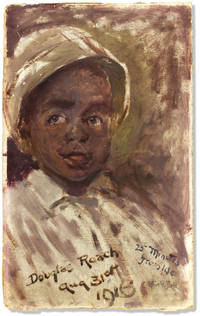
ref. 3731995Provincetown “Douglas Roach August 31st 1916”. Oil painting on masonite board 20 x 12 inches. Unframed some scuffing along bottom edge verso with old staining. A previously-unknown portrait of Douglas Roach 1909–1938 as a seven year-old Provincetown boy by the Cape Cod artist Arthur Vidal Diehl. Described as a “lost American hero” by historian Tukufu Zuberi Roach would grow up to become “one of the best machine gunners in the entire Spanish war. Franco had nobody like him and he was an army by himself.” “Episode 902 Story 2 – Spanish Civil War Eulogy.” History Detectives PBS At Cape Cod’s tip Provincetown claims Roach as one of its distinguished citizens and one of the few Black Americans who lived there in the early twentieth century. Roach’s father was an émigré whaler from St. Vincent. He arrived on the Cape in the nineteenth century and became a farmer. Douglas Roach was one of the few African-Americans to attend UMass Amherst in 1929 where he was a star wrestler. He then worked as a carpenter in the merchant marines and joined the International Seamen’s Union. Afterwards he became the secretary of the Communist Party’s Provincetown Unit arguing forcefully and publicly at one point that the Constitution protected free speech and allowed its citizens to petition its government to redress grievances. In 1936 when the Spanish Civil War began Roach joined the Abraham Lincoln Brigade which held the first non-segregated units in U.S. military history. A subunit the Lincoln Battalion counted ninety African-Americans. Roach then twenty-eight was among them. A comrade-in-arms stated: “Doug was proud of his race. He felt deeply the oppression under which it struggles and gladly gave his aid to help free it. He knew that the cause of the Spanish people was the cause of his own people the cause of all the oppressed races of the world. He spoke many times of his plans to work among the American Negroes when he got back how he was really beginning to see the tremendous role they must play in the fight to preserve democracy in America. He bitterly resented not having done more when he was home.” Building Provincetown According to Benjamin J. Davis Jr.’s eulogy Roach was “one of the first Americans to volunteer in defense of Spanish democracy in the early days of the Madrid siege. An outstanding member of the Tom Mooney machine gun company he often carried his machine gun single-handedly during long marches.” In a letter sent home published as “Douglas Roach Tells of War in Spain” within The Advocate Sept. 30 1937 Roach stated: “I believe the fight for democracy in Spain is connected with the fight against reaction everywhere against aggressive countries such as Italy Germany and Japan who are dragging the world into another world war. I hope that the people of Provincetown will defend Americanism in this country as bravely as the Spanish people are defending their democratic rights: a government of their own choice freedom of speech freedom of assembly and freedom of worship. I hope that we will not allow our American traditions of liberty and justice to be distorted by reactionaries who preach Americanism and practice the opposite.” At Brunete Roach received shrapnel wounds: He was “treated at a makeshift Brigade hospital and furloughed to the States. When he got to New York the State Department interrogated him and confiscated his passport before allowing him to return home to Provincetown . He died of pneumonia July 13 1938 . After a memorial service at the Mother A.M.E. Zion Church conducted by Benjamin Robeson Paul Robeson’s brother two Lincoln vets Walter Garland and Paul Burns brought his body home to Provincetown.” “Douglas Roach Biography” via Provincetown History Project Created in “25 minutes from life” Roach’s portraitist Arthur Vidal Diehl exhibited at the Royal Academy 1899 and came to New York c. 1891. “He was best known for his paintings of Cape Cod—and was known to have completed his pictures rapidly from memory while carrying on conversations with prospective customers and onlookers at his studio.” Falk Painted in the fleeting youth of Roach’s boyhood this portrait documents and commemorates Roach’s brief but remarkable twenty-nine-year life of this African American hero. Refs. Roach Douglas Bryan – The Abraham Lincoln Brigade Archives and Building Provincetown… both accessed online. Davis “The Death of a Black Communist” within Black Americans in the Spanish People’s War Against Fascism 1936–1939. Note: Several online sources state that Roach was born in 1900. This is incorrect. He was born June 1 1909. unknown