6384 risultati
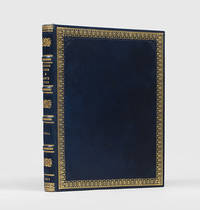
1891rif. 75163Sous étui bordé. Reliure plein maroquin grenat, dos à nerfs janséniste, doublures de peau de vélin illustré de deux aquarelles signées de Pierre VIDAL et datées, 1912, dans un encadrement de roulettes et filets dorés, gardes de soie tissée lie de vin, doubles gardes de papier marbré. Toutes tranches dorées sur témoins. Couvertures et dos conservés. Reliure signée par NOULHAC. Quelques légitimes décharges en regard des aquarelles mises à part.
1820rif. 001307London: R. Ackermann 1820. xxviii 115pp 1; 24 plates. Handsomely rebound by Temple Bookbinders in full morocco raised flat bands spine in six panels title and author labels to second and fourth panels remaining panels gilt covers with double panel design inner panel with black onlay elaborate gilt borders gilt to inner edges with marbled endpapers. Internally some light soiling and offsetting some plates with faint offsetting from text but generally clean folding plates a little creased at outer edge plates with stab-holes to outer margins. Twenty-four colour aquatint plates by T.Sutherland G. Maile and J. Bluck after Vidal four folding. Housed in a modern morocco-backed cloth drop-back box with raised bands spine in six panels title in gilt to second panel author to third date to foot with silver flower device to fourth and fifth panels. "English interest in South America flourished after the capture of Buenos Aires by Commodore Sir Home Popham and Colonel Beresford in 1806 . Ackermann exploited the widespread and substantial interest in South American affairs that these events had aroused through a number of fine publications including these views" Thomson - The Exotic and the Beautiful.Tooley 495 the "only notable colour plate book dealing with the Argentine"; Abbey Travel 698; Thomson 31; Colas 3000; Brunet V:1182/83. First Edition. Hardback. Very Good. Folio. R. Ackermann Hardcover
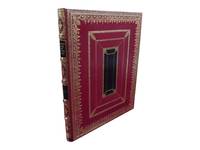
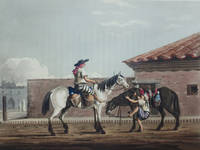
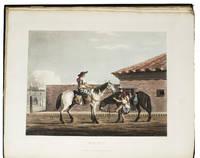
1820rif. 179207London: R. Ackermann 1820. Stunning views of South America First edition a desirable copy with pre-publication watermarks dated 1818 of "the only notable colour plate book in English dealing with the Argentine" Tooley. The hand-painted aquatints offer some of the finest depictions of early 19th-century life customs and architecture in the Río de la Plata region. The English sailor Vidal 1791-1861 joined the Royal Navy in 1808 serving as a purser for the next five decades. The plates in his book were based on drawings he made when he visited South America with HMS Hyacinth in 1816-8 as secretary to the admiral on the South American Station. They constitute "the main source of pictorial information about early Argentina" Speake p. 39 and "possess a subtle charm of their own apart from their historical and geographical value" Hardie. Some of the scenes included are "Monte Video" "Church of San Domingo" "Beggar on Horseback" "Pampa Indians" "General View of Buenos Ayres from the Plaza de Toros" "Balling Ostriches" "Guachos of Tucman" and "A Horse Race". Vidal depicts the inhabitants of the Pampas and Rio de la Plata Regions outdoor markets and plazas and buildings. "Through E. Vidal's watercolours. you get a sense of the city house facades Vidal never painted any interiors made not of rare stone but of baked adobe bricks called chorizos - sausages" Wilson p. 13. The work was first published in six monthly parts between May and October 1820. The early watermarks here suggest that this volume was possibly bound from the parts rather than from later book-form issues. Ackermann announced 750 small paper and 50 large paper copies. A comparison with the Abbey copy indicates that this example is from the smaller format. Large quarto 325 x 250 mm. With 24 hand-coloured aquatint plates 1 double-page 3 folding. Twentieth-century blue morocco to style spine with raised bands gilt lettering and decoration in compartments covers bordered with blind and gilt frames board edges and turn-ins elaborately gilt grey endpapers edges gilt. Light damp staining to margins of 3 folding plates tape repair on verso of "Buenos Ayres" plate offsetting to contents faintly toned but clean. A very good copy. Abbey Travel 698; Martin Hardie p. 107; Sabin 99460; Tooley 495. Jennifer Speake ed. Literature of Travel and Exploration An Encyclopedia 2014; Jason Wilson Buenos Aires: A Cultural and Literary Companion 1999. hardcover
1820rif. 13762London: R. Ackermann 1820. 355x293mm. 14x11½". London R. Ackermann 1820. Ejemplar en gran papel en folio mayor 355 x 293mm. xxviii-115 pp. 24 finas láminas coloreadas en acuarela 4 de ellas a gran tamaño y plegadas. Encuadernación de principios del siglo veinte en marroquén verde estilo jansenista. Primera edición ejemplar en gran papel de esta apreciada publicación ilustrada con 24 bellas láminas grabadas y coloreadas a mano al aguatinta representando vistas de Argentina y Uruguay todas diseñadas por Emeric Essex Vidal 1778-1861. Cuatro de ellas plegadas a gran tamaño. Las láminas fueron ejecutadas por diferentes grabadores a partir de 1820 y distribuidas junto con el texto en seis entregas mensuales durante ese mismo año. La edición se limitó a 750 ejemplares. Se trata de una obra importante y la mejor de todas cuantas se habían realizado para ilustrar el paisaje argentino y las costumbres de sus habitantes. En 1820 empezaron una serie de publicaciones relativas a viajes y costumbres de diferentes países la primera de ellas fue Picturesque Illustrations of Buenos Ayres and Monte Video que resultó también ser la mejor. Muy buen ejemplar. R. Ackermann unknown
rif. 52249Sous étui bordé. Reliure plein maroquin janséniste de diverses couleurs (bleu, orange, rouge, vert, havane, etc.). Dos à nerfs avec date dorée au talon. Plats décorés de fleurs dorées et mosaïquées aux angles, dentelle intérieure. Tranches dorées sur témoins. Couvertures conservée. Reliure signée NOULHAC. Quelques dos sont très légèrement éclaircis.
rif. 02645London: R. Ackermann 1820. The Great Color-Plate Book of Early Argentina One of Only Fifty Atlas Large-Paper Copies of Ackermann's Magnificent Buenos Ayres and Monte Video VIDAL Emeric Essex. Picturesque Illustrations of Buenos Ayres and Monte Video Consisting of Twenty-Four Views; accompanied with Descriptions of the Scenery and of the Costumes Manners &c. of the Inhabitants of those Cities and their Environs. London: Published by R. Ackermann. Printed by L. Harrison 1820. First edition. One of only fifty Atlas large-paper copies. Atlas quarto 15 5/8 x 12 1/2 inches; 397 x 317 mm. xxviii 115 1 blank pp. Twenty-four magnificent hand-colored aquatint plates including four double-page folding panoramas one incorporating two views. Text and plates watermarked 1818 and 1820. Publisher's original green morocco-grain cloth covers elaborately blocked in blind spine decoratively stamped and lettered in gilt yellow coated endpapers. Very slight wear at the upper joint inner hinges neatly strengthened. Housed in a green cloth slipcase. A beautiful unusually fresh copy. One of the masterpieces of nineteenth-century travel illustration and unquestionably the most important English color-plate book devoted to the Río de la Plata during the formative years of Argentine independence. Issued by Rudolph Ackermann at the height of his publishing career Vidal's Picturesque Illustrations combines superb aquatint engraving with brilliant contemporary hand-coloring to create one of the finest visual records of early nineteenth-century South America. Emeric Essex Vidal served with the Royal Navy in the Río de la Plata between 1816 and 1818 only a few years after the region had broken from Spanish rule. Unlike many travel artists who relied upon second-hand sketches or romantic invention Vidal drew directly from life recording Buenos Aires Montevideo and the surrounding pampas with exceptional accuracy sympathy and artistic accomplishment. His views preserve an emerging nation at a pivotal historical moment before the rapid political and economic transformation of the nineteenth century forever altered its landscape and society. The twenty-four aquatints form an unrivaled pictorial survey of the region. Sweeping panoramas of Buenos Aires and Montevideo are complemented by intimate scenes of daily life: bustling marketplaces churches and public squares gauchos estancias soldiers indigenous peoples horse races ostrich hunts wine mule convoys rural laborers and the famous South Matadero. Together they constitute one of the earliest and most comprehensive ethnographic portraits of Argentina and Uruguay ever published remarkable both for their documentary precision and for their extraordinary artistic beauty. The present copy belongs to the Atlas issue limited to only fifty copies produced on substantially larger paper for the most discerning collectors and institutions. Martin Hardie records that the ordinary edition consisted of 750 copies making the Atlas issue one of the rarest deluxe publications produced by Ackermann. The generous margins dramatically enhance the visual impact of the plates particularly the four spectacular folding panoramas which rank among the finest achievements of the English aquatint tradition. The binding itself appears to represent an unrecorded publisher's variant. Abbey describes only the large-paper issue bound in red cloth whereas the present copy retains its original green morocco-grain cloth decorated with a slightly different spine design omitting the wording "24 Plates Coloured." Such variants are seldom encountered and add further bibliographical interest to an already exceptional copy. Martin Hardie rightly regarded the aquatints as possessing "a subtle charm of their own apart from their historical and geographical value." That judgment has only strengthened with time. Today Vidal's work is recognized not merely as one of Ackermann's greatest travel books but as the definitive visual record of the Río de la Plata in the years immediately following independence - a cornerstone of South American iconography and one of the supreme achievements of the English color-plate book. References: Abbey Travel 698; Colas 3000; Hiler p. 878; Hardie pp. 107 312; Prideaux pp. 355 375; Sabin 99460; Tooley 495. London: R. Ackermann, 1820 unknown
rif. 02645London: R. Ackermann 1820. The Great Color-Plate Book of Early Argentina One of Only Fifty Atlas Large-Paper Copies of Ackermann's Magnificent Buenos Ayres and Monte Video VIDAL Emeric Essex. Picturesque Illustrations of Buenos Ayres and Monte Video Consisting of Twenty-Four Views; accompanied with Descriptions of the Scenery and of the Costumes Manners &c. of the Inhabitants of those Cities and their Environs. London: Published by R. Ackermann. Printed by L. Harrison 1820. First edition. One of only fifty Atlas large-paper copies. Atlas quarto 15 5/8 x 12 1/2 inches; 397 x 317 mm. xxviii 115 1 blank pp. Twenty-four magnificent hand-colored aquatint plates including four double-page folding panoramas one incorporating two views. Text and plates watermarked 1818 and 1820. Publisher's original green morocco-grain cloth covers elaborately blocked in blind spine decoratively stamped and lettered in gilt yellow coated endpapers. Very slight wear at the upper joint inner hinges neatly strengthened. Housed in a green cloth slipcase. A beautiful unusually fresh copy. One of the masterpieces of nineteenth-century travel illustration and unquestionably the most important English color-plate book devoted to the Río de la Plata during the formative years of Argentine independence. Issued by Rudolph Ackermann at the height of his publishing career Vidal's Picturesque Illustrations combines superb aquatint engraving with brilliant contemporary hand-coloring to create one of the finest visual records of early nineteenth-century South America. Emeric Essex Vidal served with the Royal Navy in the Río de la Plata between 1816 and 1818 only a few years after the region had broken from Spanish rule. Unlike many travel artists who relied upon second-hand sketches or romantic invention Vidal drew directly from life recording Buenos Aires Montevideo and the surrounding pampas with exceptional accuracy sympathy and artistic accomplishment. His views preserve an emerging nation at a pivotal historical moment before the rapid political and economic transformation of the nineteenth century forever altered its landscape and society. The twenty-four aquatints form an unrivaled pictorial survey of the region. Sweeping panoramas of Buenos Aires and Montevideo are complemented by intimate scenes of daily life: bustling marketplaces churches and public squares gauchos estancias soldiers indigenous peoples horse races ostrich hunts wine mule convoys rural laborers and the famous South Matadero. Together they constitute one of the earliest and most comprehensive ethnographic portraits of Argentina and Uruguay ever published remarkable both for their documentary precision and for their extraordinary artistic beauty. The present copy belongs to the Atlas issue limited to only fifty copies produced on substantially larger paper for the most discerning collectors and institutions. Martin Hardie records that the ordinary edition consisted of 750 copies making the Atlas issue one of the rarest deluxe publications produced by Ackermann. The generous margins dramatically enhance the visual impact of the plates particularly the four spectacular folding panoramas which rank among the finest achievements of the English aquatint tradition. The binding itself appears to represent an unrecorded publisher's variant. Abbey describes only the large-paper issue bound in red cloth whereas the present copy retains its original green morocco-grain cloth decorated with a slightly different spine design omitting the wording "24 Plates Coloured." Such variants are seldom encountered and add further bibliographical interest to an already exceptional copy. Martin Hardie rightly regarded the aquatints as possessing "a subtle charm of their own apart from their historical and geographical value." That judgment has only strengthened with time. Today Vidal's work is recognized not merely as one of Ackermann's greatest travel books but as the definitive visual record of the Río de la Plata in the years immediately following independence - a cornerstone of South American iconography and one of the supreme achievements of the English color-plate book. References: Abbey Travel 698; Colas 3000; Hiler p. 878; Hardie pp. 107 312; Prideaux pp. 355 375; Sabin 99460; Tooley 495. London: R. Ackermann, 1820 unknown books
1820rif. 17039London 1820. Elephant 4to 36.5 x 30 cm. R. Ackermann printed by L. Harrison 20th-century gold-tooled black goatskin morocco sewn on 4 recessed cords but with 5 false bands on the spine each board with 2 frames of fillets the inner one with 4 fleur-de-lis cornerpieces marbled endpapers. With 24 unnumbered hand-coloured aquatint plates including 4 folding plate size: 30 x 25 & 32.5 x 50.5 cm; image size mostly: 26 x 20 & 26.5 x 47.5 cm all drawn by Vidal and executed by G. Maile T. Sutherland G. Bluck and D. Havell. XXVIII 115 pp. First printing of beautiful hand-coloured aquatint views of Argentina all conceived and drawn from life by Emeric Essex Vidal in the years 1816 to 1818 accompanied by descriptions of the scenery costumes and habits of the peoples and regions depicted. The plates were executed by various engravers between May and October 1820 and first issued in 6 monthly parts. 750 copies including the present were issued in Elephant 4to format. There was also an issue in Atlas folio and apparently a reprint in large and small 4to still dated 1820 not normally distinguished in the literature from the present first printing Palau and Sabin describe the work as a folio but the Elephant 4to is often described as a folio. Tooley notes "the importance of its subject" and describes this publication as "the only notable colour plate book in English dealing with the Argentine". With the red leather Beeleigh Abbey armorial bookplate of William Alfred Foyle 1885-1963. With two stitching holes from the previous binding in the margins. With old folds in some of the folding plates and occasional minor browning but still in very good condition and largely untrimmed with most deckles intact. With a tiny tear in the morocco of one corner but binding otherwise fine. First printing of beautiful views of life in Argentina in the period 1816 to 1818.l Abbey Travel 698; Palau 363371; Sabin 99460; Tooley 495. ABE CAT Anthropology & Ethnography hardcover
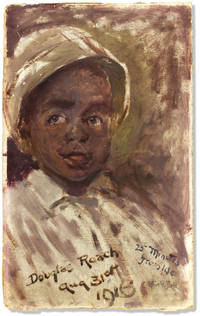
rif. 3731995Provincetown “Douglas Roach August 31st 1916”. Oil painting on masonite board 20 x 12 inches. Unframed some scuffing along bottom edge verso with old staining. A previously-unknown portrait of Douglas Roach 1909–1938 as a seven year-old Provincetown boy by the Cape Cod artist Arthur Vidal Diehl. Described as a “lost American hero” by historian Tukufu Zuberi Roach would grow up to become “one of the best machine gunners in the entire Spanish war. Franco had nobody like him and he was an army by himself.” “Episode 902 Story 2 – Spanish Civil War Eulogy.” History Detectives PBS At Cape Cod’s tip Provincetown claims Roach as one of its distinguished citizens and one of the few Black Americans who lived there in the early twentieth century. Roach’s father was an émigré whaler from St. Vincent. He arrived on the Cape in the nineteenth century and became a farmer. Douglas Roach was one of the few African-Americans to attend UMass Amherst in 1929 where he was a star wrestler. He then worked as a carpenter in the merchant marines and joined the International Seamen’s Union. Afterwards he became the secretary of the Communist Party’s Provincetown Unit arguing forcefully and publicly at one point that the Constitution protected free speech and allowed its citizens to petition its government to redress grievances. In 1936 when the Spanish Civil War began Roach joined the Abraham Lincoln Brigade which held the first non-segregated units in U.S. military history. A subunit the Lincoln Battalion counted ninety African-Americans. Roach then twenty-eight was among them. A comrade-in-arms stated: “Doug was proud of his race. He felt deeply the oppression under which it struggles and gladly gave his aid to help free it. He knew that the cause of the Spanish people was the cause of his own people the cause of all the oppressed races of the world. He spoke many times of his plans to work among the American Negroes when he got back how he was really beginning to see the tremendous role they must play in the fight to preserve democracy in America. He bitterly resented not having done more when he was home.” Building Provincetown According to Benjamin J. Davis Jr.’s eulogy Roach was “one of the first Americans to volunteer in defense of Spanish democracy in the early days of the Madrid siege. An outstanding member of the Tom Mooney machine gun company he often carried his machine gun single-handedly during long marches.” In a letter sent home published as “Douglas Roach Tells of War in Spain” within The Advocate Sept. 30 1937 Roach stated: “I believe the fight for democracy in Spain is connected with the fight against reaction everywhere against aggressive countries such as Italy Germany and Japan who are dragging the world into another world war. I hope that the people of Provincetown will defend Americanism in this country as bravely as the Spanish people are defending their democratic rights: a government of their own choice freedom of speech freedom of assembly and freedom of worship. I hope that we will not allow our American traditions of liberty and justice to be distorted by reactionaries who preach Americanism and practice the opposite.” At Brunete Roach received shrapnel wounds: He was “treated at a makeshift Brigade hospital and furloughed to the States. When he got to New York the State Department interrogated him and confiscated his passport before allowing him to return home to Provincetown . He died of pneumonia July 13 1938 . After a memorial service at the Mother A.M.E. Zion Church conducted by Benjamin Robeson Paul Robeson’s brother two Lincoln vets Walter Garland and Paul Burns brought his body home to Provincetown.” “Douglas Roach Biography” via Provincetown History Project Created in “25 minutes from life” Roach’s portraitist Arthur Vidal Diehl exhibited at the Royal Academy 1899 and came to New York c. 1891. “He was best known for his paintings of Cape Cod—and was known to have completed his pictures rapidly from memory while carrying on conversations with prospective customers and onlookers at his studio.” Falk Painted in the fleeting youth of Roach’s boyhood this portrait documents and commemorates Roach’s brief but remarkable twenty-nine-year life of this African American hero. Refs. Roach Douglas Bryan – The Abraham Lincoln Brigade Archives and Building Provincetown… both accessed online. Davis “The Death of a Black Communist” within Black Americans in the Spanish People’s War Against Fascism 1936–1939. Note: Several online sources state that Roach was born in 1900. This is incorrect. He was born June 1 1909. unknown