Ullmann's Industrial ToxicologyBiblio.com
Kevin in ToxicologyBiblio.com
Toxicological Effects of Veterinary Medicinal Products in Humans Volume 1
2013réf. Manohar-9781849734172RSC Publishing 2013. Hardcover. New. RSC Publishing hardcover
626 résultats
réf. DADAX3527312471New unknown
réf. SONG1498708749Used: Good unknown
réf. DADAX0124158137New unknown
réf. DADAX0471974293New unknown
réf. DADAX0471970867New unknown
réf. DADAX0873712889New unknown
réf. SONG0471727601Used: Good unknown
réf. DADAX0824753232New unknown
2013réf. Manohar-9781849734172RSC Publishing 2013. Hardcover. New. RSC Publishing hardcover
2013réf. Manohar-9781849734172RSC Publishing 2013. Hardcover. New. RSC Publishing hardcover
1644réf. 26764Lyon Pierre Ravaud 1644 fort vol. in-12 vélin souple, dos lisse [Rel. de l'époque], des mouillures marginales en début et fin d'ouvrage
réf. 4786Tres bel ensemble de 13 volumes , contenant chacun les publications d'une année de recherches de la SHNA, premier tome : l'année 1888 (la premiere publication) jusqu'à l'année 1899 , tres belles reliures demi maroquin rouge dos à nerfs decorés de filets dorés , titre , numerotation, et année , parfait etat comme neuf, photos sur demande , interieur tres frais : comme neuf , nombreuses illustrations
réf. SONG0824304225Used: Good unknown
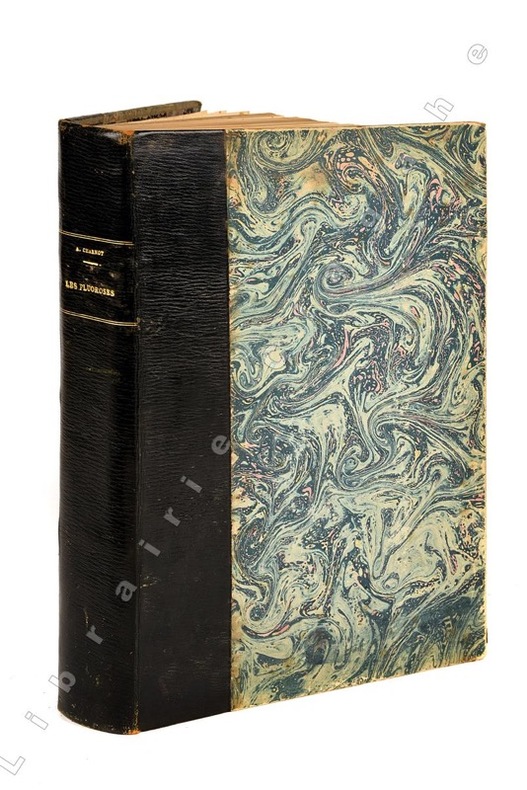
1934réf. 20803- Le Darmous humain. (en collaboration avec M. Gaud et M. Langlais.) Extrait du Bulletin de l’Institut d’Hygiène du Maroc (N°I et II 1934) ; 82 pp., [1] f.bl. sur vergé teinté et [8] ff. de photos et documents sur papier glacé, présence du papillon d’errata.- Données nouvelles sur l’étiologie et la pathologie du darmous (en collaboration avec H. Velou). Extrait du Bulletin de l’Institut d’Hygiène du Maroc (N°I et II 1938) ; 26 pp.- Le Fluorure de calcium, son assimilation, son élimination. (s.n.l.d.) ; pp. 45-66 et [1] p.- Note sur le “Darmous”, fluorose chronique des zones phosphatées (en collaboration avec Dr Gaud) ; extrait Bull. mens. Office International Hyg. Publique Tome XXX, 1938, fasc. N°6, pp. 1280-1293, 2 planches de photographies de dentitions, [1] p. ; Laval, imprimerie (Barnecrol) (in-8).- Syndromes osseux du type hyperparathyroidien, provoqués par l’intoxication par les divers sels de fluor et des intoxications minérales associées (en collaboration avec M. Speden de Casablanca) ; Extrait du Maroc Médical, N°185 du 15 novembre 1937, in-8, [4] pp., 3 photographies de radiologie.- Chondrification, Ossification et Calcification cardiaques chez le cheval (en collaboration avec L. Faure). Extrait du Bul. de l’Inst. d’Hyg. du Maroc (N°I-II 1936) ; pp. 50-56.- Procédé de révélation des empreintes digitales sur papier. s.d. (extrait du Bulletin de l’Institut d’Hygiène du Maroc) ; pp. 65-67, 1 f. de planche photo, [2] ff. blancs.- Les scorpions du Maroc. Leur venin ; leur danger pour l’homme et les animaux (en collaboration avec L. Faure) ; extrait Bull. Inst. Hyg. Maroc (N°IV 1934); 72 pp., 4 ff. de photographies et courbes, 2 tableaux dépliants, [1] f.bl.- Pharmacodynamie de l’émetine. Extrait Bull. Inst. Hyg. Maroc (N°IV 1936) ; 28 pp.- La désinsectisation rapide des vêtements par l’acide cyanhydrique (en collaboration avec M. Bonjean) ; extrait Bull. Inst. Hyg. Maroc (N°I-II 1939) ; 7 pp., 4 p. 1/2 de photographies et croquis.
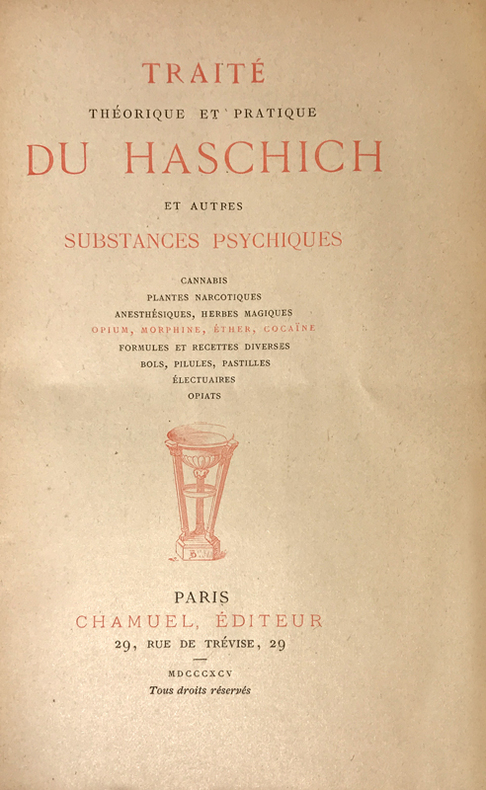
1895réf. 15352Paris, Chamuel, 1895 ; in-12, broché ; 177 pp., (1 bl.), (2) pp. de catalogue, couverture crème rempliée, illustrée, imprimée en vieux-rose et noir, petites figures.
1785réf. 5666Vienna: R Graeffer 1785. First German Edition. Later paste paper boards. . Good; signature clipped from the front free endpaper; some toning and occasional spotting. 8vo 10 11 - 302 7 - index 1 - blank pp. One of Plenck's elusive titles. It is a comprehensive view of poisons derived from animal mineral and vegetable sources along with consideration of the antidotes. There are also notes on the use of items as medicines when concentrations are dilute. An interesting book. Wellcome IV 402 - incorrect pagination. R Graeffer hardcover books
1855Very Good Turkish, Ottoman (1500-1928) Modern cloth bdg. Marbled boards. Foolscap 8vo. (18 x 12 cm). In Ottoman script (Old Turkish with Arabic script). 83 p. Traditionally framed text. Very calligraphic head title in very decorative heart-shaped border and traditional flowers, a couple of scepters with two snakes. Orthography with 'haraka' [i.e. Arabic diacritics]. The heads of each chapter are surrounded by very decorative flowers and borders. An early printed lithographed book designed as a manuscript with its 'kataba' [i.e. imprint]. Slightly stained on pages, minor chipped on upper corners of two pages. Otherwise a very good and very clean copy. Lithographed edition. First and only edition of the first printed Turkish book on the antidotes and poisons. It's written by Mirliva Mustafa Hâmi Pasha, one of the early Ottoman physicists, during the reign of Sultan Abdulmecid II. Hami Pasha served as a military physicist, botanist, and doctor in the Ottoman army in the first half of the 19th century in Hejaz and Yemen. He joined an Ottoman Military expedition to Yemen. The aim of this expedition was to bring Yemen under Ottoman control again. On 23 March 1849, the expeditionary corps marched out of Jeddah. He as a trained medical man practicing in Yemen, also concerned himself with various illnesses. The existence of poisonous animals and plants in the book is mostly based on their experiences in Yemen and Hejaz. His purpose of writing this treatise which he started with prayer and praise to Sultan Abdulmecid II, was the need to explain that it is not good for all poisons, what the real antidotes are, contrary to the belief of a stone known as the "antidote stone" among the people. After the chapter of Muqaddima [i.e. Introduction], poisoning caused by mines and their antidotes is explained in the first chapter. In other chapters, poisons consisting of plant and animal substances, poisons in flowing and air, and in addition to these, the first interventions to be made with plants that have an antidote effect on drowning in water, convulsion, drowning by hanging, drowning from the smell of flowers, freezing are explained. Hami Pasha, who decided to collect this information in a book right after his participation in the 1849 Yemen Expedition (the flora and fauna in his book mostly based on Yemen and its around), printed his book as a lithograph in 1855 at the Amire Printing House, with the encouragement of Sultan Abdülmecid II (who read the manuscript of this text) and the efforts of typographer Muhammed Recai. Only one copy in OCLC in Aga Khan Library in London: 1124680097.; Özege 16131.
réf. SONG1560327952Used: Good unknown
réf. SONG0849383870Used: Good unknown
réf. 64988aafLugduni Batavorum (Leiden), apud Gerardum Potvliet, 1733, in-8vo, 8 Bll., Titelbl. in Rot u. Schwarz + 481 SS. + 13 SS. (Index) + 6 (5 mehrf. gefalt.) Kupfertaf., auf etwas gutem Papier gedruckt, marmor. Lederband mit Rverg. u. Rsch., vord. Spiegel teils hs. bezeichnet, beide mit Wurmspuren, Rücken stärker betroffen, Fehlstellen an den Kapitalen, Rotschnitt. Hübsches Exemplar.
réf. SONG1420092251Used: Good unknown
réf. SONG0123864542Used: Good unknown
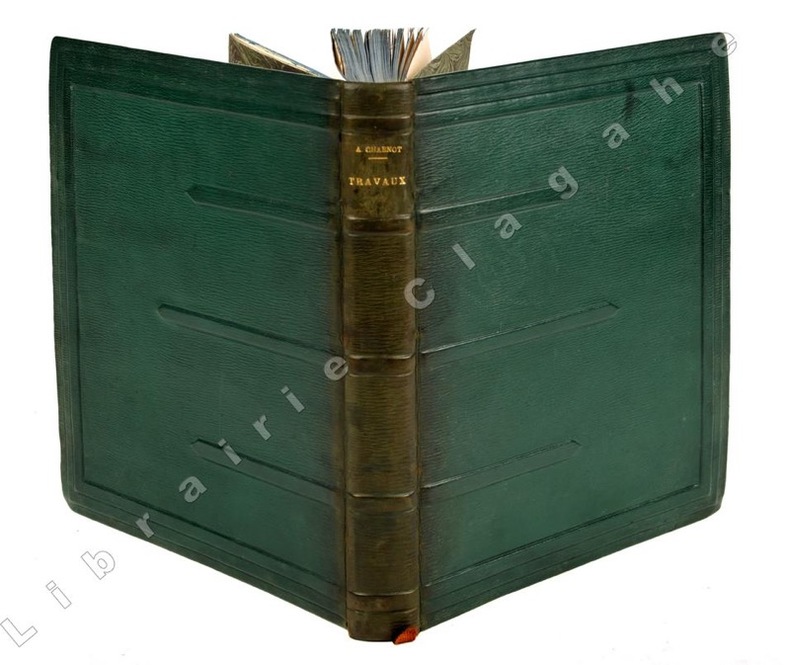
réf. 20796Tapuscrit in-folio (297 mm), nombreuses et quelquefois importantes annotations, suppressions, ajouts manuscrits, de 338 ff. recto, reliés en un volume, demi-maroquin vert foncé, titre doré au dos ; nombreuses photographies imprimées ou clichés originaux et autres documents (statistiques, courbes, etc.).
réf. 50247aafStuttgart, Hoffmann, 1845, lg. in-8vo, XII + 329 S.+ 72 Handkolorierte lithogr. Tafeln, Textbl. mit stockflecken. (Handcoloured lithogr. plates), text pages foxed in places, plates generally clean, half calf, spine decorated with gilt and blindstamped lining. Fine copy.
réf. DADAX0070349630New unknown