125 results
1922ref. 5441Berlin, Verlag von Julius Springer, 1922 ; in-8, broché ; 4 ff. , 113 pp., (2) pp. de catalogue de l’éditeur.
First edition, 8vo (200 x 130 mm), xviii, [2], 451, [1]pp., frontis., portrait, numerous illustrs., orig. blue cloth lettered in gilt, a little rubbed, gilt stamp of the Birmingham Medical Institute to base of spine, a very good copy. Lyttelton Stewart Forbes Winslow (1844-1913) was a British psychiatrist famous for his involvement in the Jack the Ripper and Georgina Weldon cases during the late Victorian era. Provenance: Presentation label of Christopher Marlin to the Birmingham Medical Institute on front paste-down.
1918Index. Name at top of front pastedown. Wear and small loss top edge of front and back cover. Loss to top of spine and base of spine bumped. Top edges greyed with dust marks.
ref. DADAX0674952901New unknown
1992ref. 015500Paris Grasset 1992 Broché Dédicacé par l'auteur
1990ref. 015501Paris Grasset 1990 In-8 Broché Dédicacé par l'auteur
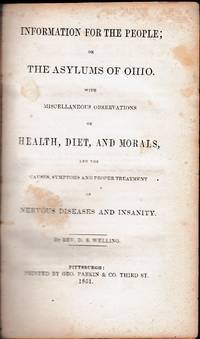
1851ref. 24095Pittsburgh: Geo. Parkin & Co. 1851. First Edition. Publisher's black ribbed cloth. Good; rebacked with almost all of the original spine laid down; some spotting. 12mo 4 - adverts 8 13 - 376 pp. An unusual and scarce book. It is written in the epistolary format. Welling's purpose is to alert the public to the "peculiarities" of the disordered minds that are his subject and the necessity of benevolence towards them. He is specific about the cruelties toward the insane within asylums. A detailed work. Absent from Atwater. Geo. Parkin & Co. hardcover books
ref. DADAX0415147875New unknown
ref. 0365859605.Gpaperback. Good. Access codes and supplements are not guaranteed with used items. May be an ex-library book. paperback
ref. 0366361511.Ghardcover. Good. Access codes and supplements are not guaranteed with used items. May be an ex-library book. hardcover
1823ref. 665091 brochure in-8, Imprimerie de J.-B. Henry, Valenciennes, 1823, 3 ff. blancs, 1 f., 24 pp., 1f. n. ch. et 3 ff. n. ch. avec 2 planches hors texte
First edition, 4to (276 x 220 mm), large paper copy, xx, [21]-227, [1, errata]pp., engraved frontispiece of the North front vie of the Retreat, quite heavily offset onto title as usual, small oval oil stain to lower blank margin of title and prelims, loss to top corner of P1 removing one letter from margin header, 2 engraved ground plans, nineteenth-century half calf, marbled boards, leather spine label, slightly rubbed. In 1791 a Quaker woman, Hannah Miles, died in suspicious circumstances in the York Asylum (later Bootham Park Hospital). William Tuke was appalled, and when his daughter Ann asked why there could not be an establishment for such persons within the Quaker Society he was immediately taken with the idea. His wife hated the whole idea and the Society of Friends and initially disapproved of the whole scheme, but despite all obstacles the basic principle of The Retreat was formerly laid down. It was to be 1796 before The Retreat first opened its doors to patients and the first three arrived in May of that year. At the time of The Retreat's foundation many patients in other institutions were chained or manacled to starve them to reduce their strength. Many madhouses were filled with stench and patients were cruelly beaten to fit in with the common philosophy that the rule of fear was the only way to control patients. Tuke's philosophy was vastly different and, in 1813 his grandson Samuel published this book. It was to have a profound effect on the conceptions of how to deal with the mentally ill, and was instrumental in bringing about reforms at York Asylum. With intense interest aroused the House of Commons set up a Select Committee to report on 'Madhouses' in 1815 as a direct result. Tuke gave evidence to a second report and his 'mild method' of looking after the mentally ill eventually won support and gave rise to new legislation. The Retreat was to evolve new and far reaching methods of humane treatment of the mentally ill and leave a lasting impression on the theory and practice of other establishments both nationally and internationally. Garrison-Morton, 4925.1; Hunter & Macalpine, pp. 684-90; Norman, 2109.
ref. SONG085224407XUsed: Good unknown
ref. 27866Paris, Robert Laffont, 1981. 13 x 21, 344 pp., broché, bon état.
ref. DADAX0791429520New unknown
ref. DADAX0521114691New unknown
ref. DADAX0060175966New unknown
ref. DADAX0415301742New unknown
ref. SONG0198152450Used: Good unknown
ref. DADAX0198152450New unknown
ref. DADAX1138526703New unknown
ref. DADAX0415770068New unknown
ref. SONG0313222029Used: Good unknown
ref. DADAX0802111696New unknown
ref. DADAX0275970523New unknown