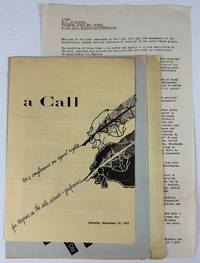
1951réf. 12896New York: New York Council of the Arts Sciences and Professions 1951. Three items stapled together at top left corner together with a separate leaflet totaling seven pages. Minor edge wear one item with a short closed tear. Overall very good. A group of four printed items pertaining to an effort by New York arts professionals to encourage equality for African American arts professionals in midcentury United States where the lower half of the country was still mired in Jim Crow laws. The most notable of these items is a four-panel program detailing the conference with introductory text describing the ways in which racism limits the opportunities of Black artists and scientists and the failure to put recent anti-racist court decisions into actual practice. The program for the conference lists such themes as the effects of Jim Crow policy on the arts and representation of Black subjects the deleterious effects of racism on health and welfare and how cultural standards are lowered and violence encouraged by discrimination. According to the speakers list on the fourth page of the program participants in the conference included Oliver Harrington Jacob Lawrence Julian Mayfield Paul Robeson and other artists educators scientists and musicians. Attached to this program are two handbills; one is an invitation to an opening night event featuring new works of ballet chorus calypso and drama the night before the conference. This performance took place at the Pythian on November 9 1951. The other handbill announces the program for the Annual Convention of the New York Council which appears to have been a more general event on the day after the conference on equal rights. The text on this handbill notes the suppression of free speech under McCarthyism. The last item is an 8.5-x-14-inch handbill probably a press release of sorts announcing the conference also titled "A Call to a Conference on Equal Rights for Negroes in the Arts Sciences and Professions." The language of this handbill is the same as the second page of the four-page brochure but is dated a month before the conference in October 1951. Some of the language in the program introduction and handbill merit quoting here: "In the sciences and professions the majority of Negroes are deprived of equal educational opportunities by segregation and quota systems denied employment in the professions restricted to the most menial occupations confined to ghetto areas for their private practice and thus prevented from making a full contribution to the welfare of the nation. Blacklisting character assassination political inquisitions and other forms of censorship against white artists scientists and professionals cannot be ended - so long as discrimination against Negroes and other minority group members is maintained For those who violate the Constitution and foster a policy of discrimination against Negroes are the very same persons who are responsible for censorship blacklisting and the debasement of our science and culture. It is they who tolerate and promote the campaigns of violence and brutality against the Negro people as exhibited in Cicero in the bombing of the home of a world-renowned Negro chemist in the refusal of platforms to the most outstanding American Negro artists in the ‘legal lynchings’ of many young men guilty of nothing more than being Negroes. American culture Cannot live in the face of such terror against a large segment of our people. Standards of truth and humanism cannot be maintained in our cultural media so long as the truth of the Negro people's lives is denied expression. Nor can there be decent standards for white professionals in many fields so long as a reservoir of Negro unemployed is used to depress salaries and rates." Surprisingly OCLC is silent on any material from the conference though we doubt this group of ephemera is a unique survival. New York Council of the Arts, Sciences and Professions unknown books
1899réf. 246396Washington: The Academy. Very Good. 1899-1911. Complete in 13 volumes 1899-1911 some with several parts ; most in original wrappers with vols 4 5 6 & 7 bound in maroon cloth. In 1911 the name was changed to "Journal of the Washington Academy of Sciences" with a new vol. 1 no. 1 issued on July 19 1911. . The Academy hardcover books
1742réf. SS13441London:: Printed for John and Paul Knapton. . . 1742-53. 1742. 5 volumes. 8vo. Vol.1: 4 x 11-456 16; Vol.2: 2 407 15 10; Vol.3: 2 422 16; Vol.4: 2 410 14 11-26; Vol.5: 2 426 14 pp. The first 10 pages of the "Addenda" are bound at the end of vol.2 pp.11-26 are bound at the end of vol.4. 44 of 45 engraved plates mostly folding I: 17; II: 6; III: 6; IV: 6; V: 9 of 10 plates pl. 10 supplied in facs. see p. 422 TOTAL: 44 2 folding tables vol. I tables some folding addenda indexes; 2nd wasp plate vol. V with small scrape effecting some of the image. Original speckled calf; rebacked and with later endleaves vols. I III & V with joints gently mended with kozo. PROVENANCE: Bookplates of Henry and Carol Faul mounted on top of the following engraved bookplate for the American Academy of Arts & Sciences: "Sub libertate Florent" dated 1780 "The Gift of . . ." -- also with their gilt-stamp applied to the foot of the later spines "American Academy"; Rubber stamps discarded of the Linda Hall Library Kansas City MO. Very good. HENRY FAUL'S COPY -- WORKED FOR ENRICO FERMI & BIKINI ATOLL TEST. A collection of early scientific papers from leading figures all belonging to the Royal Academy of Sciences at Paris the French equivalent to the Royal Society of London. The abridged papers all appeared between 1699 and 1720 and include diverse topics such as anatomy apiculture astronomy incl. Moon chemistry electricity entomology gases geography geology herpetology invertebrates magnetism medicine meteorology mineralogy monsters music mollusks natural history optics physics scientific instruments including the barometer microscope zoology and more. / AMONG THE NUMEROUS CONTRIBUTORS OR NOTABLES MENTIONED: Agricola Amontons Baert Juan de Barros Bernoulli Bignon Borelli Bouvet Robert Boyle Carre Cassini Chazelles Chevalier Coronelli Dampier Descartes Dodart Fermat Fontenay Fontenelle Galileo Gandolphe Gassendi Gesner Gouye Halley Van Helmont de la Hire du Hamel Huygens Jeaugeon Kepler Kircher Leibnitz Lemery Leuwenhoek Malpighi de Marca Mariotte Mollard Gregory Nazianzen Isaac Newton de Nointel Ortelius Parent Picard Renau Riccioli Sanctorius Strabo Tournefort Varignon etc. PROVENANCE: 1 American Academy of Arts & Sciences bookplate: The Academy seal features Minerva the goddess of wisdom science and trade and the arts. Her temple on the Aventine Hill was a meeting place for skilled craftsman writers and actors. She is also depicted as a warrior a symbol appropriate for an organization created in the midst of the American Revolution. Around Minerva are representations of the new country—on her right a field of Indian corn a stand of oaks and the outline of a town; at her feet a hoe a plow and a sickle; on her left a quadrant and a telescope a ship heading for shore and the sun completely risen above the cloud. Over the whole is the motto SUB LIBERTATE FLORENT which suggests that arts and sciences flourish best in. -- 2 Rubber stamps discarded of the Linda Hall Library Kansas City MO. -- 3 Henry and Carol Faul. Henry Faul was a geologist working on Enrico Fermi's team at the University of Chicago. He was responsible for prospecting uranium ore in Colorado and Utah. He also travelled to Manhattan Project sites at Los Alamos and in Washington DC. Following the war Faul continued to work on nuclear projects and participated in the Bikini Atoll test. He received his M.S. from the University of Chicago during the war and went on to get his Ph.D. from the Massachusetts Institute of Technology. ESTC T131275. Printed for John and Paul Knapton. . . , 1742-53. unknown books
réf. 18077FIRST EDITIONS. Publisher’s cloth many covered in protective brown paper. From the library of Robert S. Mullikan 1896-1986 winner of the 1966 Nobel Prize for chemistry. He was primarily responsible for the early development of molecular orbital method of computing the structure of molecules. His signature appears in Volumes 29-39. First printings. The biographical memoirs include a photograph and short biography of recently-deceased members of the National Academy of Sciences. Columbia University Press printed the Memoirs on behalf of the Academy through 1974; thereafter the Academy’s own press in Washington began publishing the books. Biographies of all members that passed away are included; we find such luminaries as Enrico Fermi Thomas Hunt Morgan Robert Andrew Millikan Leo Loeb William Castle Arthur Compton Robert Yerkes Herbert Hoover Leo Szilard Edwin Hubble Ernest Lawrence Herbert Evans Herbert Spencer Jennings Harlow Shapley Vannevar Bush and even Albert Einstein. All were members of the Academy. unknown books
1734réf. D4425Paris: Par La Compagnie des Libraires 1734. Hardcover. Very Good. Three volumes comprising Vol. III parts I to III of Memoires de lAcadémie Royale des Sciences depuis 1666 jusquà 1699. Paris: Par La Compagnie des Libraires 1733-1734. Part I: 231pp.; Part II: 294pp.; Part III: 215pp. 97 engraved folding plates depicting animals and skeletal diagrams. Engraved portrait frontispiece of Claude Perrault in first volume. Contemporary French calf spines gilt edges red; some occasional browning; repairs to joints some rubbing. Unidentified armorial bookplate to front pastedown beneath monogrammed bookplate D.P. with chipmunk and two mice. A later reduced format edition of Perraults Memoires of 1671-1676 Perraults study of this nature was first published in 1669 with the results of investigations of five animals and later expanded with studies of over forty animals. Prior to 1670 most descriptions of animals paid little attention to their internal structure and there were very few images in natural history encyclopedias that depicted skeletons or muscles. That changed with the establishment of the Académie des Sciences in Paris in 1666 by Jean-Baptiste Colbert with the approval of King Louis XIV. The Academy functioned with neither statutes nor regulations until 1699. At that time the Academy used the term mathématique to encompass the fields that are now called astronomy mathematics and physics and the term physique to encompass the fields that are now called anatomy botany zoology and chemistry. In January 1699 Louis reorganized the Academy giving it first regulations. The effect was to give the King more control over their activities in exchange for becoming an official institution under his protection with the new name Académie Royale des Sciences. One of the original academicians the physician Claude Perrault organized regular sessions at which participants could dissect deceased animals from Louis XIVs royal menagerie and record all they observed. Lions chameleons bears gazelles wolves ostriches crocodiles monkeys eagles tigers porcupines and salamanders among some were all laid open by the academics scalpels. These superb folding plates record in great detail the pioneering work at the Academy. These three volumes in three parts focus on the transformative and foundational years of the French Royal Academy of Sciences and Claude Perraults efforts which had made comparative anatomy a vital tool for the classifying naturalist. Par La Compagnie des Libraires hardcover books
1740réf. 14160Paris: de L’Imprimerie Royale 1740. Complete with errata’s and original blank leaves two of three finely engraved frontispieces chapter vignettes ornamental head and tail pieces and 82 folding plates. Full mottled calf rebacked the corners a bit worn. Interior is lightly toned with some browning on the preliminaries and last leaves. Generally this is an excellent set. First editions of these three volumes from a series published by the Academy of Sciences. It is a summary of the activities and inventions that have been made and contains the most important discoveries of the time. These periodicals which were at the forefront of scientific development during the Enlightenment contain works produced by an elite class of French scientist for the years 1722 1731 and 1740. Each volume provided an overview of advancements in math and science for each year and the writings therein shaped the world’s understanding of physics mathematics astronomy anatomy and other fields of science. They further provide invaluable historical data such as meteorological and astrological records for each year. The memoirs for 1722 include data recorded on both a lunar and solar eclipse as well as other astronomical observations by Jacques Cassini 1677-1756 best know for completing his fathers work on determining the meridian of Paris. The distinguished astronomer provided further research on lunar eclipses in the memoirs of 1731 where he is in great company alongside distinguished mathematicians Alexis-Claude Clairaut 1713-1765 Pierre Bouguer 1698-1758 known for his work in physics photometry and hydrography and the foremost proponent of the Newtonian movement in France Pierre de Maupertuis 1698-1759. Of special note in the 1731 memoirs is Maupertuis’s ballistic arithmetic which was used to try to better understand the movement of the earth and its gravity. Too an article by Clairaut on new formulas for finding the center of gravity. These articles contributed greatly to a better understanding of the earth’s shape and the mechanics of its rotation particularly Bouguer’s essay on the tendency of objects set in motion to move in a curvilinear fashion. The 1740 edition contains Cassini De Thury’s De la Maridienne de Paris. which was an important step in the process of mapping the shape of the earth. Cassini 1714-1784 representing the third generation of the distinguished family of astronomers was the first to question Picard’s measurements which had been used to map the Maridian of Paris. Clairaut’s essay on integral calculus in the same volume which established the existence of an integrating factor for linear differential equations was an important step in the history of mathematics and Mairan’s treatise on reflection and refraction of light and the human eye was essential to the advancement of optics. Mairan 1678-1771 would set the foundation for optical theory with this treatise. de L’Imprimerie Royale unknown books

