93 results
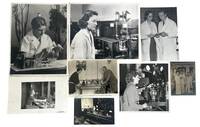
1910ref. 231321910. Women in STEM Women's scientific and technical employment photo archive documenting female laboratory labor from the early twentieth century through the 1940s historically significant for showing how women entered academic industrial and commercial research settings in roles that ranged from student and aide to biologist technician and physician at a period when scientific work remained overwhelmingly male and women's access to professional authority was still sharply constrained. The group includes five press photographs and three non press photographs with women pictured not as incidental clerical staff but as active operators of instruments handlers of test animals readers of charts and participants in experimental procedure establishing direct visual evidence of women's expanding place within the infrastructure of American science industrial testing and laboratory employment. Photo archive of 8 silver gelatin photographs ranging from 3.5 x 5.5 to 8 x 10 inches various U.S. locations circa 1910 to 1940s. The archive spans classroom laboratory and industrial interiors. One 1910 photograph shows two men and one woman standing in a laboratory identified as "three scientists or science students" an early image of mixed gender scientific training. A 1937 press photo titled "aviation biologist works with hatchlings" shows Dr. Manisera in a lab coat hand feeding two week old canaries with a third bird perched on her head turning animal handling and experimental care into a public image of female scientific expertise. Another press photo shows Sally Wulff identified on the verso as an engineering aide with a science degree from the University of Iowa seated at a control bench calibrating experimental instruments at Wright Field. A 1938 non press image shows Dr. Marie D'Amour and Fred D'Amour studying a chart before a blackboard covered with formulas and technical notations linking the photograph to mammalian physiology research. A Hoboken New Jersey press photo depicts a female technician in the chemical division of the United States Testing Company operating a Fisher titrimeter "for performing volumetric analyses by electronic means" while a 1939 press photo from Newton Massachusetts shows a laboratory worker testing newly developed Permatron tubes used in high frequency welding and power transmission. Another press image captioned "A 'noise machine' used in experiments in the Colgate laboratory" shows a woman and man positioned on either side of the apparatus and a separate 1940s laboratory group photograph places a single woman among five men before a long demonstration bench and blackboard diagrams underscoring both women's presence and their numerical isolation within technical settings. Several versos retain typed caption slips editorial markings and reference stamps consistent with press photo circulation. Across the first half of the twentieth century women entered scientific work through normal schools universities wartime research demand industrial laboratories and auxiliary technical appointments yet their advancement was often channeled into subordinate or specialized designations even when their work required substantial training. This archive makes that structure visible through named and captioned examples of women conducting measurement instrument calibration physiological research electronics testing and experimental animal work across corporate academic and applied research environments. Minor residue on versos from former press labels or caption attachments; otherwise clean and well preserved. Overall very good condition. As a record of women's early technical labor the archive supplies concrete visual evidence of the pathways limits and visibility of women's participation in American scientific work before the full opening of postwar professional opportunity. unknown books
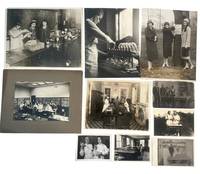
1900ref. 235831900. Women in laboratory sciences photo archive circa 1900 to 1946 documenting women's movement into chemistry bacteriology hospital medicine and classroom experiment at a time when scientific training and professional advancement remained largely organized around men with barriers of entry for women. The group begins with a pharmacological laboratory where one woman stands among men predating suffrage in the United States and continues through school laboratories hospital laboratories press photographs and postwar images of young women handling test tubes and glassware. World War I drew women chemists into schools universities analytical laboratories and war work while World War II accelerated laboratory demand again through bacteriology antibiotics and industrial drug production. Photo archive of 11 mixed phtoographic mediums including albumen silver gelatin and real photo postcard photographs various sizes ranging 5 x 4 inches to 8 x 10 inches United States and Europe early 20th century. The images show women and girls conducting experiments at benches lined with burners flasks pipettes test tubes reagent bottles and laboratory stands; a large pharmacological classroom with nearly all male staff and students and one woman present; high school girls in an early science classroom; two nuns or a nun and nurse working in a laboratory at Saint Anthony's Hospital Rockford Illinois identified on verso as early 1930s; and a bacteriological laboratory scene dated October 2 1923. A 1926 Acme press photograph identifies "Miss Virginia Trelease chemist student at Northwestern University Evanston Ill." using liquid oxygen from a Heylandt liquefier to fry an egg over "burning ice." Other images show two young women captioned "Resa Yusko and Bla Pesala" in 1946 smiling while handling laboratory equipment and a 1927 press photograph of Mrs. August Rus Oppenheim Mrs. Oswald Jimenis and Mrs. Arthur Bunker of the Southern Women's Educational Alliance posting a Metropolitan Opera benefit notice evidence of women's educational fundraising alongside the scientific scenes. The photographs trace women's scientific labor from gendered access to instruction into wartime necessity and postwar professional visibility. In the early twentieth century women who entered chemistry and medicine often worked through teaching nursing hospital laboratories and applied science fields that admitted them more readily than elite research posts while still relying on their technical skill. During World War II penicillin moved from laboratory microbiological study in 1940 to mass production by 1945 a shift that depended on fermentation work laboratory handling and industrial coordination rather than discovery alone. Light surface wear toning occasional creasing press stamps captions and handling marks; some images faded or rubbed. Overall good condition. A concentrated visual record of women learning demonstrating and performing laboratory science across the decades when modern medicine and chemistry increasingly required their work while still limiting their recognition. unknown books
1905ref. 006666New York: Charles Scribner's Sons 1905. Book. Near Fine. Decorative Cloth. First Edition. 8vo - over 7¾" - 9¾" tall. SCARCE in such lovely condition. Near Fine small inked letter bottom corner front end page gilt at spine a bit rubbed to publisher's name at bottom edge. In the original green cloth gilt titles and decorations bright tissue-guarded frontispiece with elephants vii-xv 310 pp. with 4 pp. publisher's catalog illustrated with numerous black and white full-page photographs. Charles Scribner's Sons Hardcover books
1998ref. 164761998. Softcover. VG some soiling/pencil on cover. White wraps. 14 pp. 5 color 7 bw plates. paperback books
1899ref. 246396Washington: The Academy. Very Good. 1899-1911. Complete in 13 volumes 1899-1911 some with several parts ; most in original wrappers with vols 4 5 6 & 7 bound in maroon cloth. In 1911 the name was changed to "Journal of the Washington Academy of Sciences" with a new vol. 1 no. 1 issued on July 19 1911. . The Academy hardcover books
1955ref. 60529New Haven: Human Relations Area Files 1955. Paperback. Very Good. maps xi 389p. Softcover in original wrapper. 28cm. Name on title-page. Subcontractor's Monograph HRAF-19. Title also appears as "Aspects of Contemporary Belorussia. Human Relations Area Files paperback books
1959ref. 200076Fayetteville Arkansas: College of Arts and Sciences University of Arkansas 1959. Paperback. Fair wraps with Good interior Wraps are heavily worn/foxed/toned/smudged; textblock edges are lightly worn/toned/scuffed; some interior pages are dog-eared; interior is clean with some light foxing or smudging; binding appears solid. Grey illustrated stapled wraps with black and blue lettering; 55 pp.; richly illustrated. This volume includes a color woodcut by Robert Rorex. College of Arts and Sciences, University of Arkansas paperback books
1983ref. 36759Little Rock: Porbeck Printing Co. 1983. First edition. Stapled paper wrappers. Spine soiled else near fine. 42 pp. Illus. with duotone reproductions. Sq. 8vo. Porbeck Printing Co. unknown books
1898ref. 006693New York: D. Appleton and Co. 1898. Book. Near Fine. Half-Leather. Later Edition. 8vo - over 7¾" - 9¾" tall. Authorized Edition 1898. Near Fine in Half-Leather over marbled boards leather a few small rubs most pages yet uncut. A quite handsome copy. D. Appleton and Co. Hardcover books
1924ref. 560022Garden City New York: Doubleday Page & Co 1924. Hardcover. Very Good. First edition. Introduction by Blanche Colton Williams. Contemporary owner name on front fly sunned spine with light creases very good lacking the dust jacket. First publication of "Phantom Adventure" by Floyd Dell. Doubleday, Page & Co hardcover books
1924ref. 141001PA: Academy 1924. Fine. First edition. Fine. Academy unknown books
1971ref. 42862Staten Island NY: Staten Island Museum 1971. First edition. Stapled paper wrappers. A very good copy with light soiling along bottom margin of front wrapper contents clean. Unpaged 28 pp. Illus. with b/w plates. 8vo. Staten Island Museum unknown books
1933ref. 006566Oslo Norway: H. Aschehoug & Co. 1933. Book. Very Good. Printed Wrappers. First Edition. 8vo - over 7¾" - 9¾" tall. SCARCE. From the collection of noted semiotician and linguist Thomas A. Sebeok his signature in ink front end pages of all 3 volumes. A Professor Emeritus at Indiana University Sebeok was among the founders of biosemiotics and editor-in-chief of the journal Semiotica the leading periodical in the field. Very Good chips to edges of wrappers corner chips rear end pages. H. Aschehoug & Co. Paperback books
1921ref. 232279New York: Doubleday Page & Co 1921. Hardcover. Very Good. Later. Very good. Hardcover is rubbed at spine ends and corners cover and foredges soiled gold stamping on front cover and faded spine front hinge cracked inside front cover. Doubleday, Page & Co hardcover books
1921ref. 232280New York: Doubleday Page & Co 1921. Hardcover. Very Good. Later. Very good. Hardcover is rubbed at spine ends and corners cover and foredges soiled gold stamping on front cover and faded spine. Doubleday, Page & Co hardcover books
2002ref. 23834Boston: Little Brown. Fine in Fine dust jacket. 2002. Hardcover. 0316713317 . First printing. Fine in a fine dust jacket. . Little, Brown hardcover books
1992ref. 75341992. Softcover. VG orange label on cover. Wraps. 8 pp. 1 color 7 bw plates. Extensive essay written by Pamela D. King with notes. Catalogue lists 39 sculptures. paperback books
2001ref. 22873Moscow: Nauka 2001. First edition. Hardcover. vg. Lg 4to. White paper dust-jackets over faux leather boards with gilt lettering on front and spine. Color-coordinated by year. Yearly publication by the Russian Academy of Sciences reporting on Literature Art and Archeology research projects performed by the members of the Academy. Each year's work is summarized in 1 volume replete with ample b&w illustrations photographic reproductions and charts. Research areas for the most part centered around Western and Eastern Russia Central Asia former Soviet Union and Eastern Europe but also occasionally incorporating Western Europe. Research includes a wide cross-section of both ancient and modern topics for example the 1992 topics range from Chekhov to Meyerhold to Machiavelli to ancient archaeology of the Solovetsky Islands off the coast of Archangel. 10 vols total between 1989-2001. Missing years: 1991 1998 1999. Text in Russian. Corners of dust jackets and boards slightly bumped Interiors in fine. 1990 missing dust-jacket. Set overall in near fine condition. Nauka hardcover books
1740ref. 14160Paris: de L’Imprimerie Royale 1740. Complete with errata’s and original blank leaves two of three finely engraved frontispieces chapter vignettes ornamental head and tail pieces and 82 folding plates. Full mottled calf rebacked the corners a bit worn. Interior is lightly toned with some browning on the preliminaries and last leaves. Generally this is an excellent set. First editions of these three volumes from a series published by the Academy of Sciences. It is a summary of the activities and inventions that have been made and contains the most important discoveries of the time. These periodicals which were at the forefront of scientific development during the Enlightenment contain works produced by an elite class of French scientist for the years 1722 1731 and 1740. Each volume provided an overview of advancements in math and science for each year and the writings therein shaped the world’s understanding of physics mathematics astronomy anatomy and other fields of science. They further provide invaluable historical data such as meteorological and astrological records for each year. The memoirs for 1722 include data recorded on both a lunar and solar eclipse as well as other astronomical observations by Jacques Cassini 1677-1756 best know for completing his fathers work on determining the meridian of Paris. The distinguished astronomer provided further research on lunar eclipses in the memoirs of 1731 where he is in great company alongside distinguished mathematicians Alexis-Claude Clairaut 1713-1765 Pierre Bouguer 1698-1758 known for his work in physics photometry and hydrography and the foremost proponent of the Newtonian movement in France Pierre de Maupertuis 1698-1759. Of special note in the 1731 memoirs is Maupertuis’s ballistic arithmetic which was used to try to better understand the movement of the earth and its gravity. Too an article by Clairaut on new formulas for finding the center of gravity. These articles contributed greatly to a better understanding of the earth’s shape and the mechanics of its rotation particularly Bouguer’s essay on the tendency of objects set in motion to move in a curvilinear fashion. The 1740 edition contains Cassini De Thury’s De la Maridienne de Paris. which was an important step in the process of mapping the shape of the earth. Cassini 1714-1784 representing the third generation of the distinguished family of astronomers was the first to question Picard’s measurements which had been used to map the Maridian of Paris. Clairaut’s essay on integral calculus in the same volume which established the existence of an integrating factor for linear differential equations was an important step in the history of mathematics and Mairan’s treatise on reflection and refraction of light and the human eye was essential to the advancement of optics. Mairan 1678-1771 would set the foundation for optical theory with this treatise. de L’Imprimerie Royale unknown books
1974ref. 42825Binghamton NY: Robertson Center for the Arts and Sciences 1974. First edition. Stapled paper wrappers. A very good copy with sunned and scuffed wrappers contents clean. Unpaged 19 pp. Illus. with b/w photos. Sm. Obl. 4to. An exhibition from March 10-April 21 1974 on New York State handicrafts. OCLC locates 5 copies all but one in New York. Robertson Center for the Arts and Sciences unknown books
1987ref. 50343New York: Skidmore College 1987. Softcover. Near Fine. First edition. No. 73 Winter 1987. Near fine in wrappers with a small crease on the rear wrapper. Skidmore College unknown books
1951ref. 004685Cambridge MA: Harvard University Press 1951. Book. Very Good. Cloth. SIGNED AND INSCRIBED BY AUTHORS. First Edition. 8vo - over 7¾" - 9¾" tall. Presentation Copy SIGNED AND INSCRIBED BY THE AUTHORS "Eleanor Maccoby with the sincere regards of Talcott Parsons Clyde Kluckhorn S.A. Stouffer Robert R. Sears Gordon W. Allport Harry Murray" A unique Association Copy Eleanor Maccoby was a noted psychologist best known for her contributions to developmental psychology and the psychology of sex differences. The signees were a Who's Who of eminent sociologists psychologists and anthropologists. Talcott Parsons career was entwined with the development of sociology as an academic discipline at Harvard and in this book he was refining his "general theory of action". In 1931 Parsons was one of the inaugural faculty members in the Dept. of Sociology at Harvard. Gordon W. Allport is known as one of the founding figures of personality psychology and along with Harry Murray were faculty in the Psychology Dept. at Harvard. Robert R. Sears was head of the Psychology Dept. at Stanford University Samuel Stouffer a Professor of Sociology at Harvard and Clyde Kluckhorn a Professor of Anthropology at Harvard. Book is Very Good no dustjacket corner crease bottom corners last 10 pages of book and top corners title page into contents page cloth a bit rubbed. The signatures of all 6 of these gentlemen are SCARCE individually and as a group along with the Association to Eleanor Maccoby this represents a RARE and unique opportunity in the academic collecting world !. Harvard University Press Hardcover books
1964ref. acs247Springfield Illinois: Charles C. Thomas 1964. Octavo blue cloth hardcover gilt lettering xxvii 124 pp. Fine in a Fine mylar protected dust jacket with “American Lecture Series.” From dust jacket: It is only possible to understand life in all its forms by understanding it at its origin and in its development. by studying and reproducing the processes by which it arose. In this classic monograph Doctor Oparin describes in as great detail as achievements of contemporary science will allow the three stages in the evolution of organic substances which preceded the appearance of life on Earth. The emergence of the most primitive organic compounds the hydrocarbons and cyanides and their nearest oxygen nitrogen sulphur and phosphorus derivatives with comparatively low molecular weights. Further elaboration of these compounds associated with a progressive increaase in the size of their molecules owing to the polymerisation and condensation of organic substances in the waters of the primaeval seas and oceans the primaeval nutrient broth. Formation within the hydrosphere of multimolecular systems which arise by the association of different high-molecular organic substances into supra-molecular complexes marked off from their environment by a definite boundary of separation but capable of reacting with it as an open system Charles C. Thomas, 1964. hardcover books
1988ref. 164131988. Softcover. VG very slight wear on cover. White wraps. 21 pp. 11 color 4 bw plates. paperback books
1963ref. 149981963. Softcover. VG. White wraps. 18 pp. 17 bw plates. Catalogue lists 112 works with a list of the prize winners and many fine illustrations. paperback books