Arthur, Andrew John; Geological Survey of Canada; Smith, Paul L.; Monger, W.H.; Tipper, Howard W.MareMagnum

211 résultats
199362 pages. "This detailed study of the lithostratigraphy and biostratigraphy of the strata permits a reconstruction of much of the history of sedimentation, volcanism, plutonism, uplift and erosion during Mesozoic time in the Coast Mountains, an area commonly devoid of stratigraphic sections with reliable fossil control. In this bulletin several fossil groups are used to date the various lithological units that can be traced into the plutonic complex." - from Preface. Two figures stored in pocket. Light wear. Minimal library markings. A quality copy. Book
1956viii, [1], 162 pages. Attractively colour-illustrated maroon boards. Two maps in pocket inside back board. Printed upon glossy stock. Black and white photos, illustrations, graphs and tables. "Seven of the papers are devoted to discussion of stratigraphy and stratigraphic problems, three are discourses on structural problems, two are concerned with economic geology, and one with the development of hydroelectric power in the Bow River drainage basin. Begins with a brief sketch of the human history of the area being studied." - Preface. Intended to serve as a useful and valued part of every geologist's library. Moderate wear. Clean and unmarked. Binding intact. A quality vintage copy. Book
198549 pages. Black and white illustrations. Four fold-up figures enclosed in pocket. "The present evidence suggests that hydrocarbon reserves may be encountered in the subsurface in northern Graham Island, southern Hecate Strait, and Queen Charlotte Sound. These potential resources involve mesozoic oil within the Jurassic or Cretaceous rocks, or escape oil of Mesozoic age in Tertiary sandstone units." - from Preface. Moderate wear. Few library markings. A sound copy. Book
198890 pages. "Provides the first detailed account of stratigraphy of the Windermere Supergroup in the northern Rocky Mountains; the significance of basement gneiss and Windermere strratigraphy to Proterozoic tectonics; and the Mesozoic and Cenozoic metamorphic and structural evolution. An analysis of detailed and regional structures has led to a new conceptual model for the transfer of displacement from one transcurrent fault to another that is applicable to other major strike-slip fault systems in the world." - from Preface. Two separate figure enclosed in pocket. Few library markings. Moderate wear. A sound copy. Book
1985108 pages. Reproductions of black and white photos. "Provides substantial new information and data on the Kootenay Group in the form of text, isopach maps and cross-sections, and numerous illustrations of lithofacies, lithofacies relationships, age, correlation, rank, distribution and continuity of coal seams, sedimentology, and the major environment of depositioni in the Rocky Mountain Foothills and Front Ranges." - from Preface. Extensively references. Fold-up figures 5 through 11 stored with book in original envelope. Usual library markings. Moderate wear. A sound copy. Book
1992105 pages. References. Reproductions of black and white photos. "Describes the geology of the Hulcross and Boulder Creek formations in northeastern British Columbia, and provides new detailed information on the lithofacies, lithofacies relationships, age, and depositional environments. The occurence and distribution of coal and the potential for hydrocarbon reservoirs in the Boulder Creek Formation are evaluated and discussed." - from Preface. All separate fold-up figures (9 through 14) present. Moderate wear. Usual library markings. A sound copy. Book
1880réf. 1263781880 Lyon, Librairie Henri Georg / Paris, Librairie J.-B. Baillière et Fils - 1880 - Complet en 2 volumes in-8; reliure demi-chagrin; plats percalines; dos à 4 nerfs portant titre, auteur, fleurons et tomaison en doré; toutes tranches mouchetées - 5 planches hors-texte en N&B in fine du tome premier
1859réf. 1263921859 Paris, Librairie Victor Masson - MDCCCLIX (1859) - Complet en 2 volumes in-4, reliure demi-basin, plats percalines, dos à nerfs portant titre, auteur, fleurons et tomaison en doré, tranches mouchetées - 508 + 327 pages - Avec 3707 figures dans le tome I et 1236 dans le tome II, dans le texte et certaines en couleurs
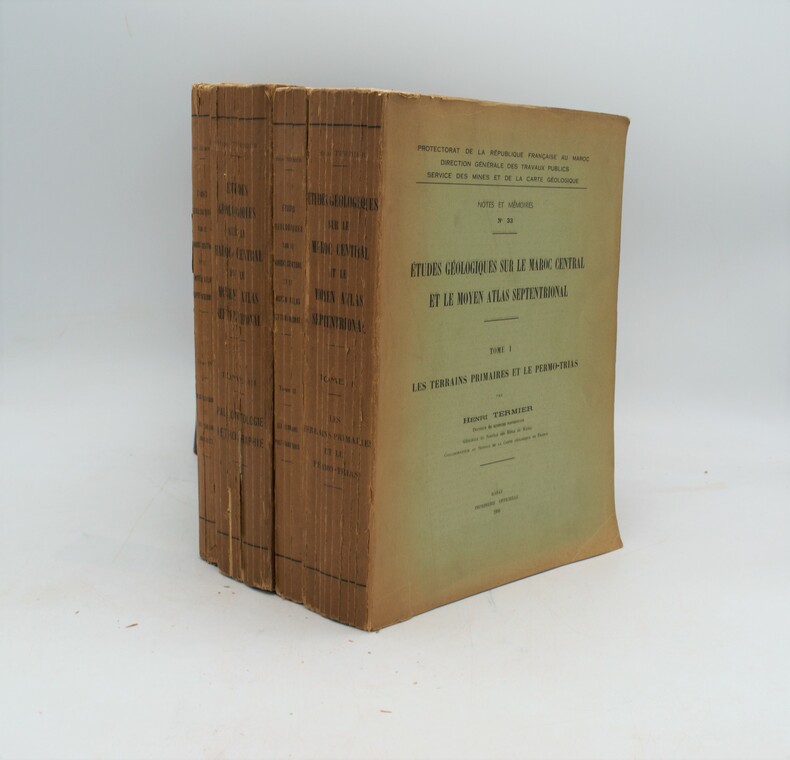
1936réf. PHO-1188Rabat, Imprimerie officielle, Protectorat de la République Française au Maroc , 1936 ,4 volumes in-4,brochage éditeur ,T1-743pp.,T2-744pp.,T3-1083-1566 pp. 30 Planches H.T. (17 bis et 23 bis) et 4 tableaux dépliants, T4-Atlas des figures et des tableaux hors texte (contient 19 tableaux synoptiques, 17 schémas dépliants, 17 planches de dessins et de coupes, 3 planches de photographies)
réf. 73929aafLisbonne, Impr. de l'Académie Royale des Sciences, 1894, in-4to, 288 p. + 40 planches lithogr., demi-toile (bibl.).
1835X-[1]-742 pages, une planche, un tableau et une carte en couleurs, le tout dépliant demi-basane cerise, dos lisse et orné, tranches marbrées 1835, 1835, in-8, X-[1]-742 pages, une planche, un tableau et une carte en couleurs, le tout dépliant, demi-basane cerise, dos lisse et orné, tranches marbrées, Seconde édition, l'originale ayant paru en 1831, de cet ouvrage important et peu courant, contenant l'une des premières cartes géologiques de la France ; Omalius d'Halloy avait dressé la toute première, à petite échelle, en 1822 (parue dans les Annales des Mines). Il en donna une nouvelle édition en 1828, incluant le sud de l'Angleterre, au sein de ses Mémoires pour servir à la description des Pays-Bas, de la France et de quelques contrées voisines. Cette édition fut publiée dans le but de compléter l' "histoire naturelle inorganique" dont il avait publié une première partie (Introduction à la géologie) en 1833. Jean-Baptiste Julien Omalius d'Halloy (1783-1875) joua un rôle majeur dans la transition des systèmes stratigraphiques de Werner ou Guettard vers ceux de la Brèche et Murchison. Ses travaux le conduisirent à élaborer une colonne géologique sophistiquée de la France, qui put servir de base au développement de toute la stratigraphie continentale dans la première moitié du XIXe siècle. Dans ces Éléments de géologie se trouve reproduite une colonne, formée de 22 terrains, accompagnée d'une coupe stratigraphique, qui devait permettre de concevoir une idée de la structure supérieure de l'écorce terrestre. Cet ouvrage lui permet également d'exposer ses vues sur les processus de la formation géologique, refusant les thèses uniformitaristes et fixistes : "His controversial views grew out of his conservative refusal to accept complete uniformitarism in geology. In papers and in his textbook, Élements de géologie, d'Omalius argued that contemporary geological process are not capable of having produced all formations. Reasoning from the traditional hypothesis that the earth was originally a hot mass cooling slowly, he insisted that the deepest structures (...) had been formed by eath agencies no longer intensely active". Ses conceptions contribuèrent à influencer Charles Darwin qui, dans la préface de la troisième édition de l'Origine des espèces, le cite parmi ses prédécesseurs (1861). Ward & Carrozzi, n° 1679 (pour la 3e édition). DSB X, pp. 208 et suiv