1.578 resultados
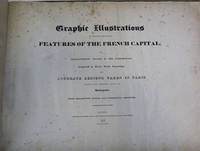
ref. 51-6998London : Harper and Co. successors to Mr. Kearsley 1816. Oblong elephant foilio. Much rarer than the smaller format edition. 69 x 50cm. 27 x 19.5 inches.Original printed boards rubbed and soiled; repaired with new goatskin spine. The more common smaller format is 43x38cm. 17 by 15 inches. .12 engraved plates scattered spotting and marginal browning throughout damp stain to lower margin of one plate one leaf loose repaired tear to final leaf.OCLC Number / Unique Identifier:461746497.Description by Juliette Jestaz.Conservatrice des manuscrits livres rares et plans à la Bibliothèque historique de la Ville de Paris. Référente d'histoire de Paris pour la bibliothèque:."These very discreet graphic illustrations of the most prominent features of the French capital with characteristic figures in the foregrounds bear no artist's name on the title page. The plates themselves are signed “S. Porter sculpsit” “Sparrow sculpsit” “Dadley sculpsit” or “Angus sculpsit.” The latter is probably William Angus 1752–1821 a British draftsman and engraver. We have not been able to identify the other engravers.At least one of the plates is based on a drawing by Pierre-Antoine Demachy 1723–1807 author of numerous views of Paris particularly panoramas of the quays. It is tempting to attribute to him all the aquatint drawings in the collection—a technique decidedly in vogue for veduta at the turn of the century. The drawings of him that are kept at the Musée Carnavalet or in the Destailleur collection of the BnF do not however correspond to those in our album and cannot confirm this attribution.The first edition was published in 1815 by Howlett and Brimmer in London. This edition published by Harper the following year suggests that the album was successful coming just a few months after Waterloo had reopened France to the British after twelve years of closure. These two publishers had previously produced picture albums of the Allied countries: The Costume of the Russian Empire 73 engravings 1803 with descriptions in French the international language at the time and English and Sketches of Military Costume in Spain and Portugal 1810.Like Nattes's album this one does not focus on the Empire's achievements in Paris: neither the Arc de Triomphe du Carrousel nor the Place du Châtelet the Palais de la Chancellerie Hôtel de Salm nor the Louvre's expansions. The buildings depicted on the plates could as in Nattes's work be presented in their state from 1802-1803.The album nevertheless focuses primarily on the heart of Napoleonic power the Louvre-Tuileries-Champs-Élysées district to which eight of the twelve plates are devoted. It also provides two panoramas from the North and the South. The panorama from Montmartre is a classic viewpoint dating back to that captured by Mathieu Merian in 1620.". London : Harper and Co. (successors to Mr. Kearsley), 1816 hardcover
ref. 012311No Binding. Fine. Three scratchboards two 12'x 15" the other 16" x 12" depicting critical scenes from Jean Genet's classic Querelle. Two are uniform in size and are matted and framed in the style of the oblong one which wads originally matted and framed by the artist. The life of Sam Steward 1909 - 1983 the subject of Justin Spring's biography "Secret Historian: The Life and Times of Samuel Steward Professsor; Tattoo Artist and Sexual Renegade "Farrar Strauss Giroux 2010 took Steward from a small town Ohio upbringing to personal friendships with Gertrude Stein and Alice B. Toklas associations with George Platt Lynes Glenway Wescott and other literati and a close relationship with sex researcher Alfred Kinsey. Steward's life may well be most provocatively known for his explicit diaries journals photography and art that both recorded his sexual life in detail and which he shared with Kinsey. Starting out as an English professor at DePaul University with literary aspirations and after writing several commercially unsuccessful books Steward attempted mid-life in the early 1950s to seek approval from Jean Genet to publish his own English translation-with his own original illustrations - of Querelle de Brest. When it became clear to Steward that Genet was disinterested he dropped the project: these three scratchboards the art he he created for it. Steward's pursuit of "serious" literary expression ebbed and later in the 1960s under the pseudonym Phil Andros he authored a series of gay paperback novels STUD The Greek Way etc. regarded as the most literate of homoerotic fiction featuring his alter-ego hustler. He turned his artistic energies to tattooing operating parlors catering to naval and military servicemen in Chicago Milwaukee and finally Oakland. And his sexual activities increasingly involved sadomasochism in which he had always been interested All three of these drawings were reproduced in "An Obscene Diary: The Visual World of Sam Steward" Antonius Press/ Elysium Press 2010. During Steward's lifetime the "Lucky Strike" image was published in the Zurich-based Der Kries an early homophile publication introduced to Steward by Dr. Kinsey and also in the rare anthology of homoerotic art published by Der Kries in 1960 Der Mann in der Zeichnung under one of Steward's pseudonyms Philip von Chicago. Spring writes: "Noteworthy among Steward's many illustrations for Der Kries is one that was originally created for Steward's 1951- 1952 English language translation of Querelle de Brest. Working form Polaroid photographs taken of himself in various poses Steward fashioned three scratchboard illustrations for the story. In the first a man lights a cigarette for a sailor; in the second Querelle strangles the Armenian pederast; in the third Querelle is penetrated by the bartender husband of Madame Lysiane. The illustration of the sailor having his cigarette lit subsequently appeared in Der Kreis under the caption "Lucky Strike." Indeed Steward etched "LUCKY STRIKE" in the cigarette in the picture on the verso it is signed "Sam Steward 1951 1952". The strangulation picture has in Steward's hand on the verso: "From Genet's Querelle de Brest. Querelle strangles the Armenian". In the picture itself Steward etched his signature and date in the design on the Armenian's shirtcuff: "Sparrow Phil 1951". The picture of Querelle and the bartender in sexual union hung on the wall of Steward's apartment for many years. It is pictured in one of Steward's sex Polaroids reproduced in "Obscene Diary". On the verso of it Steward wrote "L'Execution De Querelle 9-19-51" Steward did not work in scratchboard alone. His art was quite versatile: murals in his apartments tempera watercolor pastel pen/ink and some wire sculpture and collage. These drawings could be regarded as the most important of his visual art. While they were motivated by literary aspiration they in effect represented a real turning point in his lif. unknown
ref. 012311No Binding. Fine. Three scratchboards two 12'x 15" the other 16" x 12" depicting critical scenes from Jean Genet's classic Querelle. Two are uniform in size and are matted and framed in the style of the oblong one which wads originally matted and framed by the artist. The life of Sam Steward 1909 - 1983 the subject of Justin Spring's biography "Secret Historian: The Life and Times of Samuel Steward Professsor; Tattoo Artist and Sexual Renegade "Farrar Strauss Giroux 2010 took Steward from a small town Ohio upbringing to personal friendships with Gertrude Stein and Alice B. Toklas associations with George Platt Lynes Glenway Wescott and other literati and a close relationship with sex researcher Alfred Kinsey. Steward's life may well be most provocatively known for his explicit diaries journals photography and art that both recorded his sexual life in detail and which he shared with Kinsey. Starting out as an English professor at DePaul University with literary aspirations and after writing several commercially unsuccessful books Steward attempted mid-life in the early 1950s to seek approval from Jean Genet to publish his own English translation-with his own original illustrations - of Querelle de Brest. When it became clear to Steward that Genet was disinterested he dropped the project: these three scratchboards the art he he created for it. Steward's pursuit of "serious" literary expression ebbed and later in the 1960s under the pseudonym Phil Andros he authored a series of gay paperback novels STUD The Greek Way etc. regarded as the most literate of homoerotic fiction featuring his alter-ego hustler. He turned his artistic energies to tattooing operating parlors catering to naval and military servicemen in Chicago Milwaukee and finally Oakland. And his sexual activities increasingly involved sadomasochism in which he had always been interested All three of these drawings were reproduced in "An Obscene Diary: The Visual World of Sam Steward" Antonius Press/ Elysium Press 2010. During Steward's lifetime the "Lucky Strike" image was published in the Zurich-based Der Kries an early homophile publication introduced to Steward by Dr. Kinsey and also in the rare anthology of homoerotic art published by Der Kries in 1960 Der Mann in der Zeichnung under one of Steward's pseudonyms Philip von Chicago. Spring writes: "Noteworthy among Steward's many illustrations for Der Kries is one that was originally created for Steward's 1951- 1952 English language translation of Querelle de Brest. Working form Polaroid photographs taken of himself in various poses Steward fashioned three scratchboard illustrations for the story. In the first a man lights a cigarette for a sailor; in the second Querelle strangles the Armenian pederast; in the third Querelle is penetrated by the bartender husband of Madame Lysiane. The illustration of the sailor having his cigarette lit subsequently appeared in Der Kreis under the caption "Lucky Strike." Indeed Steward etched "LUCKY STRIKE" in the cigarette in the picture on the verso it is signed "Sam Steward 1951 1952". The strangulation picture has in Steward's hand on the verso: "From Genet's Querelle de Brest. Querelle strangles the Armenian". In the picture itself Steward etched his signature and date in the design on the Armenian's shirtcuff: "Sparrow Phil 1951". The picture of Querelle and the bartender in sexual union hung on the wall of Steward's apartment for many years. It is pictured in one of Steward's sex Polaroids reproduced in "Obscene Diary". On the verso of it Steward wrote "L'Execution De Querelle 9-19-51" Steward did not work in scratchboard alone. His art was quite versatile: murals in his apartments tempera watercolor pastel pen/ink and some wire sculpture and collage. These drawings could be regarded as the most important of his visual art. While they were motivated by literary aspiration they in effect represented a real turning point in his lif. unknown books
