7 913 résultats
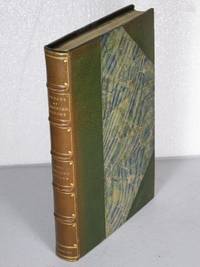
1814réf. 003120London: J Johnson 1814 Bound in later signed 3/4 green morocco over marbled boards aeg 368 pp. 5 plates fine.Magnificent copy quite unlikely to come up at auction again.Rare Book Hub records the last copy at auction in 1945.This copy with some spine fade and touch of wear at tips. J Johnson hardcover
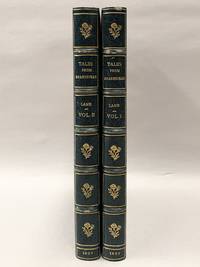
1807réf. 53689London: Thomas Hodgkins 1807. First Edition. Full leather. Fine. 2 volumes 235pp. 261pp. plus 3pp. of advertisements at the end of volume II. Illustrated with 20 copper-engraved plates all present. First issue with the T. Davison imprint on the verso of the title page in volume I and the Hanway Street address listed in the advertisement at the end of volume II. Bound in handsome late 19th century full blue crushed morocco by Riviere with gilt frames gilt compartments all edges gilt and marbled endpapers. A handsome early 20th century bookplate is present in each volume though both of these at some point became detached from the paste-downs and are laid-in with only mild residue evident on the paste-downs. A few tiny abrasions to the raised bands on the spines but still an about fine set internally clean but for a few faint marginal stains and only the faintest foxing to a few of the plates. Fine. Hardcover. The publisher Hodgkins was tasked by William Godwin and his wife Mary to adapt Shakespeare's plays for a juvenile audience a job they hired out to Charles and Mary Lamb. Though only Charles is credited on the title pages his sister Mary adapted fourteen of the twenty plays adapted herein all of the comedies. Her work was only credited to her after the seventh edition. Of the countless editions of Shakespeare this is among the most significant being the first successful attempt to adapt his brilliant complicated stories to a young audience. A very handsome set in pleasing condition and bound by one of the great 19th century English bookbinders. 53689 $4500.00 Thomas Hodgkins hardcover
1807réf. 40066London: Thomas Hodgkins 1807. First edition first issue with the T. Davison imprint on the verso of p. 235 of Volume 1 and the earlier address of Hanway Street on the ads in Volume 2. 20 engraved plates by Blake after drawings by Mulready including frontispieces; 3 pp. of ads at rear of second volume. 2 vols. 12mo. Full crushed blue by Rivière gilt fillet borders spines in 6 compartments richly gilt and lettered gilt dentelles blue marbled endpapers a.e.g. Fine set. First edition first issue with the T. Davison imprint on the verso of p. 235 of Volume 1 and the earlier address of Hanway Street on the ads in Volume 2. 20 engraved plates by Blake after drawings by Mulready including frontispieces; 3 pp. of ads at rear of second volume. 2 vols. 12mo. " . made Shakespeare a familiar and popular author . " Beautiful set of the classic which the Lambs set about writing at the suggestion and encouragement of of William Godwin who hired Thomas Hodgkins to run The Juvenile Library on his behalf. The Lambs' prose adaptations Charles did the tragedies Mary the comedies were written primarily for the benefit of girls for as they state in the Preface "boys are generally permitted the use of their fathers' libraries at a much earlier age than girls are they frequently have the best of Shakespear by heart before their sisters are permitted to look into this manly book.' The result was according to the Cambridge History of English Literature "the first book which appealing to a general audience and to a rising generation made Shakespeare a familiar and popular author . " Roff/Livingston pp. 61ff Thomas Hodgkins unknown books
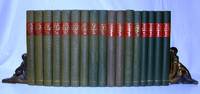
1937réf. 617G1246Victoria British Columbia: The Archives of British Columbia/British Columbia Historical Association. Good. 1937. First Edition. Hardcover. Seventeen volumes individually and uniformly bound in green cloth with with red labels and gilt lettering upon backstrips. Index in each volume. Fold-out maps. Black and white plates. Includes all issues from 1937 through 1945 and 1947 through 1954. Bindings tight. Unmarked. Moderate wear. A magnificent repository of early British Columbia history. Very heavy. Special shipping considerations may apply.; 8vo - over 7¾" - 9¾" tall; British Columbia Quarterly History . The Archives of British Columbia/British Columbia Historical Association hardcover
réf. 13592Paris, Gauthier-Villars, 1864-1884. 20 tomes in-4 reliés en 17 volumes, 39 planches dépliantes hors-texte (certaines en couleurs), quelques figures dans le texte, reliure de l'époque demi-basane, dos ornés (dos frottés, manques à quelques coiffes, rousseurs). Exemplaire du mathématicien Victor Puiseux (1820-1883), un des membres du comité de rédaction de la revue (notes de relieur).
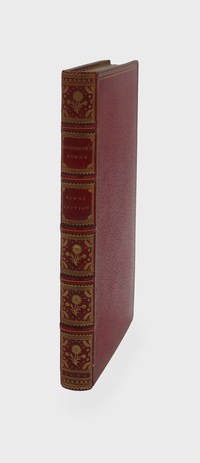
1830réf. WRCLIT57659London: Edward Moxon 1830. vii11501pp. Small octavo. Full olive green straight-grain morocco gilt extra a.e.g. by Tuckett "Binder to the Queen." Pictorial vignette on title. Some occasional modest foxing joints and extremities rubbed with small crack at top of upper joint otherwise a very good copy enclosed in a silk-lined full morocco clamshell box a bit rubbed. First edition of this collection among the first books to appear under Moxon's imprint. A delightful association copy inscribed on the blank prelim: "To Miss E. Hamilton as a parting token of Friendship from Wm. Wordsworth 16th August 1830 Rydal Mount." With the ownership signature in the top margin of the title of "A. Hamilton." It would seem probable that the recipient was the Irish poet Elizabeth Mary Hamilton sister of Wordsworth's close friend mathematician and astronomer William Rowan Hamilton. Elizabeth visited Wordsworth in her brother's company during the summer months of that year. Elizabeth Hamilton is recipient of meaningful praise as a poet in O'Donoghue. With the bookplate of Frank Bemis. LIVINGSTON p. 169ff. O'DONOGHUE p. 94. Edward Moxon unknown books
1796réf. WRCLIT66869London: Printed for G. G. and J. Robinsons and J. Cottel Bookseller Bristol 1796. xvi1884pp. Small octavo. Full crimson morocco by Bedford raised bands spine gilt extra gilt inner dentelles t.e.g. others largely untrimmed. Near fine with the half-title errata and advert leaf. First edition of Coleridge's first published collection of poetry preceded by the rare verse-play THE FALL OF ROBESPIERRE several prose tracts and THE WATCHMAN. Although their presence is not noted on the title four of the sonnets are by Lamb and are signed at their conclusion "C.L." They constitute his first publication in book form. HAYWARD 206. WISE COLERIDGE 8. TINKER 678. ESTC T125613. NCBEL III:215. LIVINGSTON LAMB pp.3-10. Printed for G. G. and J. Robinsons, and J. Cottel, Bookseller, Bristol hardcover books
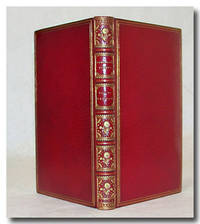
1796réf. 64602London: Printed for G. G. and J. Robinsons and J. Cottel Bookseller Bristol 1796. First Collection of Coleridge's Poems and the First Appearance of Lamb in a Book A very handsome copy of the first edition of Coleridge's first published collection of poetry preceded by the rare verse-play The Fall of Robespierre several prose tracts and The Watchman. Although their presence is not noted on the title four of the sonnets are by Charles Lamb and are signed at their conclusion "C.L." They constitute his first publication in book form. Lamb and Coleridge were lifelong friends and collaborators stemming from their time together at Christ's Hospital School as boys and extending to their respective deaths only a few months apart in 1834. Small octavo. Full crimson morocco by Bedford raised bands spine gilt extra gilt inner dentelles t.e.g. others largely untrimmed. Near fine with the half-title errata and advert leaf. HAYWARD 206. WISE COLERIDGE 8. TINKER 678. ESTC T125613. NCBEL III:215. LIVINGSTON LAMB pp.3-10. hardcover
1710réf. 9656London: Printed for Abel Roper and sold by John Morphew near Stationer's Hall 1710. Octavo 19 x 12 cm. 12 127 12 12 pages. 35 plates mostly folding. The final unnumbered pages include bills of fare and bookseller's advertisements. All edges marbled. FIRST EDITION published a year after the great chef's death. Maclean describes an additional printing of the first edition printed for and sold by Maurice Atkins. "Lamb brought a touch of French snobbery to traditional English recipes for an increasingly prosperous group of wealthy merchants urban professionals and rural gentry. His recipes show a preference for French-style stewed and braised dishes over the boiled staples of seventeenth century England" Anne Willan The Cook Book Library page 197. As cook to five kings and queens of England "few others could possibly afford to emulate the vast spreads of exotic and costly foods which Lamb so often called for in his book of Royal recipes." Eric Quayle Old Cook Books. ~ Internally sound pages a bit darkened throughout. Some plates with browning to some creases or with an early and neat reinforcement at creases. In later full brown calf blind- and gilt-paneled and compartmented with gilt-titled red morroco spine label. New endpapers. Binder's ticket of Period Binders of Bath England pasted-in at rear. OCLC records eighteen copies of this Roper printing and five of the Atkins printing; Bitting page 271 calling for 34 plates only; Cagle 809; Maclean page 88; Pennell page 144; Simon 939 the third edition of 1731; Vicaire page 490; ESTC T91554. Printed for Abel Roper and sold by John Morphew, near Stationer's Hall unknown
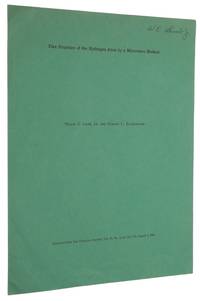
1947réf. 6543Lancaster PA and New York NY: American Institute of Physics 1947. First edition. First edition very rare offprint signed by Lamb who received a half-share of the 1955 Nobel Prize in Physics for this work. The Lamb-Retherford experiment of 1947 was the first to measure what is now known as the Lamb shift-the difference in energy between two energy levels 2S½ and 2P½ of the hydrogen atom-which had not been correctly predicted by the Dirac relativistic wave equation. "The Lamb shift experiment was a landmark in 20th-century physics" Biographical Memoir National Academy of Sciences. "After it was reported at Shelter Island the Lamb-Retherford experiment became the point of departure for the renormalization program" Silvan Schweber. . THE LAMB SHIFT - NOBEL PRIZE IN PHYSICS 1955. First edition very rare offprint signed by Lamb who received a half-share of the 1955 Nobel Prize in Physics for this work. The Lamb-Retherford experiment of 1947 was the first to measure what is now known as the Lamb shift-the difference in energy between two energy levels 2S½ and 2P½ of the hydrogen atom-which had not been correctly predicted by the Dirac relativistic wave equation. "The Lamb shift experiment was a landmark in 20th-century physics" Biographical Memoir National Academy of Sciences. "After it was reported at Shelter Island the Lamb-Retherford experiment became the point of departure for the renormalization program" Silvan Schweber. Lamb 1913-2008 received his doctorate at Berkeley in 1938 under the guidance of J. Robert Oppenheimer. "Unlike many of his generation of physicists Lamb did not follow Oppenheimer into the wartime atom-bomb project. Instead he concentrated on his specialisms - microwaves and radar - at Columbia University in New York performing the experiments that culminated in the observation of the Lamb shift. This shift is a tiny difference in energy between two atomic orbitals in hydrogen denoted 2S and 2P distinguished only by their angular momenta. Quantum theories of the time predicted that these levels should have identical energies. The discovery that they did not demanded a fundamental theoretical rethink - one that was initiated almost immediately by Hans Bethe. The Lamb shift thus became a cornerstone of the modern edifice of quantum electrodynamics QED. This the quantum field theory of the electromagnetic interaction explains the shift as resulting from energy fluctuations in the vacuum that smear out the position of the electron in a hydrogen atom. This process has a greater effect on the Coulomb energy of the electron's binding to the central proton at smaller radii where the 2S state is most likely than at larger radii where the 2P state dominates. Today precise measurements of the Lamb shift have tested QED to an accuracy of better than one part in a million" Sargent. On Lamb's 65th birthday Freeman Dyson wrote "those years when the lamb shift was the central theme of physics were golden years for all the physicists of my generation. You were the first to see that this tiny shift so elusive and hard to measure would clarify in a fundamental way our thinking about particles and fields." Not on OCLC or RBH. Provenance: Willis Lamb signature on front wrapper. Lamb was born in Los Angeles the son of a telephone engineer. He entered the University of California at Berkeley in 1930 where he earned a bachelor's degree in chemistry 1934. Lamb continued at Berkeley as a graduate student in theoretical physics directed by J. Robert Oppenheimer receiving his doctorate in 1938. In that year Lamb joined the faculty at Columbia University New York where he carried out research in microwaves and radar. His defence-related investigations focused on the problem of how to make shorter higher frequency microwave sources for radar. It was this that would eventually lead to a Nobel prize in 1955. Lamb continued working in atomic spectroscopy and laser physics at Stanford University 1951-56 where he devised microwave techniques for examining the hyperfine structure of the spectral lines of helium and then as professor at Oxford 1956-62. He returned to the US in 1962 as Henry Ford II professor of physics at Yale joining the University of Arizona in 1974 until his retirement in 2002. "In the second quarter of the 20th century quantum theory faced some serious challenges including unexplained details of atomic spectra and difficulties in calculating basic properties of charged particles. In 1947 Willis Lamb and Robert Retherford of Columbia University discovered an unexpected detail in the hydrogen spectrum later called the Lamb shift that became an essential clue in solving both problems. The measurement agreed with new calculations and was the first indication that the theoretical approach called renormalization could resolve the mathematical infinities that had threatened to derail the progress of quantum mechanics. "By the 1940s theorists understood a variety of phenomena that had small effects on the energies of atomic electrons such as relativistic corrections and interactions between spin and orbital angular momentum. These effects showed themselves in the so-called fine structure of atomic spectra-the way that many spectral lines corresponding to jumps between electron energy levels are seen on close examination to split into groups of closely spaced lines. "Lamb and graduate student Retherford wanted to measure the hydrogen fine structure by investigating two specific electron states. One was a relatively long-lived S state with a spherically symmetric orbital and the other was a shorter-lived P state with less symmetry. Standard theory predicted that the two states should have equal energy but that applying a magnetic field should influence the states in different ways and induce an energy difference between them. "The team sent a stream of electrons at right angles into a beam of hydrogen atoms exciting a few of them into the S state and also deflecting them slightly from the main beam direction. The excited atoms passed through a region containing both microwave radiation and an adjustable magnetic field and then hit a metal target. The excited atoms would then drop back to the ground state emitting electrons that the team could detect as a current. The key to the experiment was that if the magnetic-field-induced energy difference between the two states was equal to the energy of the microwave photons then the long-lived S state would absorb a photon and turn into the short-lived P state. These atoms would drop back to their ground state before reaching the target and the current in the detector would essentially vanish. "By plotting the critical magnetic-field strength for a variety of microwave frequencies Lamb and Retherford could determine the energy difference between the two states in the absence of a magnetic field. Contrary to expectation the difference was not zero. "This departure from theory became known as the Lamb shift and was a prime topic for discussion at the Shelter Island Conference on Quantum Mechanics that took place in June 1947 at the far end of Long Island New York. Many of the attending theorists argued that the Lamb shift was a result of the 'self-energy' problem in quantum electrodynamics. The problem was that calculations of the interaction of an electron's charge with its own field yielded apparently infinite values for the particle's energy and mass and also threw off calculations of atomic spectra. "It was Hans Bethe on the train ride home who wrote a short paper giving a somewhat sketchy but fairly accurate calculation of the shift. The solution to the self-energy problem proposed by others was to think of the 'bare' electron as having infinite energy that is mostly cancelled out by the infinitely negative energy of its interaction with its own electric field. This so-called renormalization approach leads to a correction to the classical energy that depends on distance. A P-state electron spends a different amount of time close to the nucleus than an S-state electron so they require different corrections. Bethe's estimate for the resulting Lamb shift fit the experimental result remarkably well and demonstrated that renormalization-which is at the core of today's quantum mechanics-could be verified in experiments" Lindley. "Swedish physicist Ivar Waller who made the presentation speech when Lamb was awarded the Nobel Prize in 1955 observed that 'it does not often happen that experimental discoveries exert an influence on physics as strong and invigorating as did your work. Your work led to a re-evaluation and a reshaping of the theory of the interaction of electrons and electromagnetic radiation thus initiating a development of utmost importance to many of the basic concepts of physics a development the end of which is not yet in sight'" Schweber QED and the Men Who Made It p. 218. "Speaking at a conference on the history of particle physics in 1980 Lamb obviously with some pleasure remarked that he had been in contact with the leading figures in the history of fine structure Michelson Sommerfeld and Dirac. When he was still a high-school student he had met Michelson who spent his last years at Caltech at a chess festival in Pasadena. 'We talked a little about the game but not about physics and although I knew that he was famous for the measurement of the velocity of light I did not know of any other reasons.' He never met Sommerfeld but 'in 1950 he sent me a handwritten note that indicated that he had heard of our measurements and he mentioned that he was the '81-year-old great-grandfather' of the hydrogen fine-structure theory.' Lamb met Dirac repeatedly. About one occasion he remembers that Dirac asked him if he had enjoyed participating in the discovery of the fine-structure anomaly. Lamb said he had but added that he would have had much more pleasure if instead he had discovered the Dirac equation. As Lamb recalls after a brief pause Dirac said gently 'Things were simpler then'" Brandt Harvest of a Century p. 306. Lindley 'Quantum Milestones 1947: Lamb Shift Verifies New Quantum Concept' Physics 18 2025 p. 41 ;/a>. Sargent 'Willis E. Lamb Jr 1913-2008' Nature 453 2008 p. 867. 4to 266 x 198 mm pp. 241-243 1 blank. Original printed wrappers a bit ceased at the foot. American Institute of Physics unknown
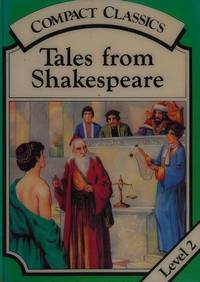
1990réf. SBBI-L-BJL00592-RAG-20240Ward Lock Educational Co Ltd 1990. paperback. Acceptable. Please see the condition note after this for details if this is missing please consider Acceptable to mean poor quality that could include major staining water damage writing missing dustjacket etc etc. Our books are dispatched from a Yorkshire former cotton mill. We list via barcode/ISBN so please note that the images are stock images and may not be the exact copy you receive furthermore the details about edition and year might not be accurate as many publishers reuse the same ISBN for multiple editions and as we simply scan a barcode or enter an ISBN we do not check the validity of the edition data when listing. If you're looking for an exact edition please don't order at least not without checking with us first although we don't always have time to check. We aim to dispatch prompty the service used will depend on order value and book size. We can ship to most countries see our shipping policies. Payment is via Abe only. Ward Lock Educational Co Ltd paperback
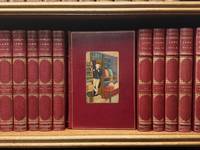
1899réf. 3519London: Macmillan and Co 1899. Edition de Luxe. Leather Bound. Very Good. Edition de Luxe. Leather Bound. 12 vols. Charles Lamb The Life and Works. Edition de Luxe limited to 675 sets. Bound by Birdsall in full red Morocco leather each cover depicting a scene in multicolored onlays. Gilt frames on covers spine panel compartments raised bands and inner dentelles. Silk endpapers top edges gilt and gilt lettering on spines. Published London: Macmillan and Co. 1899. H: 9 1/4" W: 6 1/2" D: 1 1/2". Macmillan and Co unknown
Paris, Impr. Nationale, 1849 - In-4 - Broché - XIII-293 - pages - 14 planches H.T. représentant les animaux primés (avec légende) - bon exemplaire - envoi rapide et soigné