CORDEIRO, AntonioBiblio.com

8 605 résultats
1717réf. ABC_48313Lisboa occidental 1717. Small folio ca. 28 x 21 cm. Na officina de Antonio Pedrozo Galram Gold-tooled brown calf from the first half of the 19th century with the title and year of publication lettered in gold on the spine red pseudo-marbled paper sides yellow end papers. With a woodcut printer's device on the title-page woodcut decorated initials and woodcut head- and tailpieces. 1 1 blank 14 528 pp. First edition of a history of the collection of four archipelagos in the North Atlantic off the coasts of Africa and Europe called Macaronesia and the Azores in particular written by a native of Terceira. The work describes each island separately focussing on its history discovery natural resources and inhabitants. It also gives important information on prominent Azorean families including the author's own. These parts are preceded by shorter parts about the history of Portugal the Canaries Cape Verde and Madeira with references to Brazil and the Americas. This work rarely appears on the market.Antonio Cordeiro 1641-1722 was a Jesuit priest born on Terceira. He based his work on one of the most important pre 17th-century sources on Macaronesia Saudades da terra by historian Gaspar Frutoso ca. 1522-1591. Until its publication the manuscript was kept in the library of the Jesuit College of Ponta Delgada on the island São Miguel in the Azores where Cordeiro probably found it. Cordeiro's work closely follows the structure of the Saudades. Furthermore he used is as a main source for the 16th-century history of the region including the description of the sugarcane industry in Madeira. After sugarcane was introduced there in the 1430s Madeira soon became the most important location for the production of sugar for the Portuguese producing 20000 arrobas a unit of measure similar to 10-15 kg's of the finest grade sugar per year. Unfortunately due to diseases in the sugarcane crops the industry started to decline in the second half of the 16th century. Initially neighbouring islands took over before the production of sugar was eventually moved to Brazil.With a manuscript number on the front pastedown "6770" a round sticker underneath "66" and remnants of a paper label. The edges and corners of the boards are somewhat scuffed and creased. The binding is somewhat scratched with some loss of material on the back board. The first few leaves are slightly browned. Otherwise in very good condition.l De Backer/Sommervogel II 1436; Innocencio I pp. 114; Leclerc 632; Porbase 765570 10 copies; Sabin 16759; Schäffer Portuguese exploration to the West p. 14; not in USTC. ABE CAT Anthropology & Ethnography AFRICA CARTOGRAPHY GEOGRAPHY & TOPOGRAPHY EUROPE EXPLORATION & TRAVEL HISTORY Anthropology & Ethnography Geography North Africa Portugal West Africa hardcover
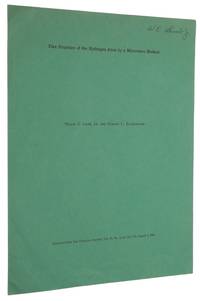
1947réf. 6543Lancaster PA and New York NY: American Institute of Physics 1947. First edition. First edition very rare offprint signed by Lamb who received a half-share of the 1955 Nobel Prize in Physics for this work. The Lamb-Retherford experiment of 1947 was the first to measure what is now known as the Lamb shift-the difference in energy between two energy levels 2S½ and 2P½ of the hydrogen atom-which had not been correctly predicted by the Dirac relativistic wave equation. "The Lamb shift experiment was a landmark in 20th-century physics" Biographical Memoir National Academy of Sciences. "After it was reported at Shelter Island the Lamb-Retherford experiment became the point of departure for the renormalization program" Silvan Schweber. . THE LAMB SHIFT - NOBEL PRIZE IN PHYSICS 1955. First edition very rare offprint signed by Lamb who received a half-share of the 1955 Nobel Prize in Physics for this work. The Lamb-Retherford experiment of 1947 was the first to measure what is now known as the Lamb shift-the difference in energy between two energy levels 2S½ and 2P½ of the hydrogen atom-which had not been correctly predicted by the Dirac relativistic wave equation. "The Lamb shift experiment was a landmark in 20th-century physics" Biographical Memoir National Academy of Sciences. "After it was reported at Shelter Island the Lamb-Retherford experiment became the point of departure for the renormalization program" Silvan Schweber. Lamb 1913-2008 received his doctorate at Berkeley in 1938 under the guidance of J. Robert Oppenheimer. "Unlike many of his generation of physicists Lamb did not follow Oppenheimer into the wartime atom-bomb project. Instead he concentrated on his specialisms - microwaves and radar - at Columbia University in New York performing the experiments that culminated in the observation of the Lamb shift. This shift is a tiny difference in energy between two atomic orbitals in hydrogen denoted 2S and 2P distinguished only by their angular momenta. Quantum theories of the time predicted that these levels should have identical energies. The discovery that they did not demanded a fundamental theoretical rethink - one that was initiated almost immediately by Hans Bethe. The Lamb shift thus became a cornerstone of the modern edifice of quantum electrodynamics QED. This the quantum field theory of the electromagnetic interaction explains the shift as resulting from energy fluctuations in the vacuum that smear out the position of the electron in a hydrogen atom. This process has a greater effect on the Coulomb energy of the electron's binding to the central proton at smaller radii where the 2S state is most likely than at larger radii where the 2P state dominates. Today precise measurements of the Lamb shift have tested QED to an accuracy of better than one part in a million" Sargent. On Lamb's 65th birthday Freeman Dyson wrote "those years when the Lamb shift was the central theme of physics were golden years for all the physicists of my generation. You were the first to see that this tiny shift so elusive and hard to measure would clarify in a fundamental way our thinking about particles and fields." Not on OCLC or RBH. Provenance: Willis Lamb signature on front wrapper. Lamb was born in Los Angeles the son of a telephone engineer. He entered the University of California at Berkeley in 1930 where he earned a bachelor's degree in chemistry 1934. Lamb continued at Berkeley as a graduate student in theoretical physics directed by J. Robert Oppenheimer receiving his doctorate in 1938. In that year Lamb joined the faculty at Columbia University New York where he carried out research in microwaves and radar. His defence-related investigations focused on the problem of how to make shorter higher frequency microwave sources for radar. It was this that would eventually lead to a Nobel prize in 1955. Lamb continued working in atomic spectroscopy and laser physics at Stanford University 1951-56 where he devised microwave techniques for examining the hyperfine structure of the spectral lines of helium and then as professor at Oxford 1956-62. He returned to the US in 1962 as Henry Ford II professor of physics at Yale joining the University of Arizona in 1974 until his retirement in 2002. "In the second quarter of the 20th century quantum theory faced some serious challenges including unexplained details of atomic spectra and difficulties in calculating basic properties of charged particles. In 1947 Willis Lamb and Robert Retherford of Columbia University discovered an unexpected detail in the hydrogen spectrum later called the Lamb shift that became an essential clue in solving both problems. The measurement agreed with new calculations and was the first indication that the theoretical approach called renormalization could resolve the mathematical infinities that had threatened to derail the progress of quantum mechanics. "By the 1940s theorists understood a variety of phenomena that had small effects on the energies of atomic electrons such as relativistic corrections and interactions between spin and orbital angular momentum. These effects showed themselves in the so-called fine structure of atomic spectra-the way that many spectral lines corresponding to jumps between electron energy levels are seen on close examination to split into groups of closely spaced lines. "Lamb and graduate student Retherford wanted to measure the hydrogen fine structure by investigating two specific electron states. One was a relatively long-lived S state with a spherically symmetric orbital and the other was a shorter-lived P state with less symmetry. Standard theory predicted that the two states should have equal energy but that applying a magnetic field should influence the states in different ways and induce an energy difference between them. "The team sent a stream of electrons at right angles into a beam of hydrogen atoms exciting a few of them into the S state and also deflecting them slightly from the main beam direction. The excited atoms passed through a region containing both microwave radiation and an adjustable magnetic field and then hit a metal target. The excited atoms would then drop back to the ground state emitting electrons that the team could detect as a current. The key to the experiment was that if the magnetic-field-induced energy difference between the two states was equal to the energy of the microwave photons then the long-lived S state would absorb a photon and turn into the short-lived P state. These atoms would drop back to their ground state before reaching the target and the current in the detector would essentially vanish. "By plotting the critical magnetic-field strength for a variety of microwave frequencies Lamb and Retherford could determine the energy difference between the two states in the absence of a magnetic field. Contrary to expectation the difference was not zero. "This departure from theory became known as the Lamb shift and was a prime topic for discussion at the Shelter Island Conference on Quantum Mechanics that took place in June 1947 at the far end of Long Island New York. Many of the attending theorists argued that the Lamb shift was a result of the 'self-energy' problem in quantum electrodynamics. The problem was that calculations of the interaction of an electron's charge with its own field yielded apparently infinite values for the particle's energy and mass and also threw off calculations of atomic spectra. "It was Hans Bethe on the train ride home who wrote a short paper giving a somewhat sketchy but fairly accurate calculation of the shift. The solution to the self-energy problem proposed by others was to think of the 'bare' electron as having infinite energy that is mostly cancelled out by the infinitely negative energy of its interaction with its own electric field. This so-called renormalization approach leads to a correction to the classical energy that depends on distance. A P-state electron spends a different amount of time close to the nucleus than an S-state electron so they require different corrections. Bethe's estimate for the resulting Lamb shift fit the experimental result remarkably well and demonstrated that renormalization-which is at the core of today's quantum mechanics-could be verified in experiments" Lindley. "Swedish physicist Ivar Waller who made the presentation speech when Lamb was awarded the Nobel Prize in 1955 observed that 'it does not often happen that experimental discoveries exert an influence on physics as strong and invigorating as did your work. Your work led to a re-evaluation and a reshaping of the theory of the interaction of electrons and electromagnetic radiation thus initiating a development of utmost importance to many of the basic concepts of physics a development the end of which is not yet in sight'" Schweber QED and the Men Who Made It p. 218. "Speaking at a conference on the history of particle physics in 1980 Lamb obviously with some pleasure remarked that he had been in contact with the leading figures in the history of fine structure Michelson Sommerfeld and Dirac. When he was still a high-school student he had met Michelson who spent his last years at Caltech at a chess festival in Pasadena. 'We talked a little about the game but not about physics and although I knew that he was famous for the measurement of the velocity of light I did not know of any other reasons.' He never met Sommerfeld but 'in 1950 he sent me a handwritten note that indicated that he had heard of our measurements and he mentioned that he was the '81-year-old great-grandfather' of the hydrogen fine-structure theory.' Lamb met Dirac repeatedly. About one occasion he remembers that Dirac asked him if he had enjoyed participating in the discovery of the fine-structure anomaly. Lamb said he had but added that he would have had much more pleasure if instead he had discovered the Dirac equation. As Lamb recalls after a brief pause Dirac said gently 'Things were simpler then'" Brandt Harvest of a Century p. 306. Lindley 'Quantum Milestones 1947: Lamb Shift Verifies New Quantum Concept' Physics 18 2025 p. 41 ;/a>. Sargent 'Willis E. Lamb Jr 1913-2008' Nature 453 2008 p. 867. 4to 266 x 198 mm pp. 241-243 1 blank. Original printed wrappers a bit ceased at the foot. American Institute of Physics unknown
1990réf. SBBIH-KSUIXINCYUMJWard Lock Educational Co Ltd 1990. paperback. Acceptable. Please see the condition note after this for details if this is missing please consider Acceptable to mean poor quality that could include major staining water damage writing missing dustjacket etc etc. Our books are dispatched from a Yorkshire former cotton mill. We list via barcode/ISBN so please note that the images are stock images and may not be the exact copy you receive furthermore the details about edition and year might not be accurate as many publishers reuse the same ISBN for multiple editions and as we simply scan a barcode or enter an ISBN we do not check the validity of the edition data when listing. If you're looking for an exact edition please don't order at least not without checking with us first although we don't always have time to check. We aim to dispatch prompty the service used will depend on order value and book size. We can ship to most countries see our shipping policies. Payment is via Abe only. Ward Lock Educational Co Ltd paperback
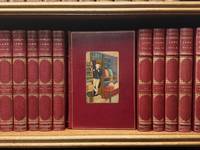
1899réf. 3519London: Macmillan and Co 1899. Edition de Luxe. Leather Bound. Very Good. Edition de Luxe. Leather Bound. 12 vols. Charles Lamb The Life and Works. Edition de Luxe limited to 675 sets. Bound by Birdsall in full red Morocco leather each cover depicting a scene in multicolored onlays. Gilt frames on covers spine panel compartments raised bands and inner dentelles. Silk endpapers top edges gilt and gilt lettering on spines. Published London: Macmillan and Co. 1899. H: 9 1/4" W: 6 1/2" D: 1 1/2". Macmillan and Co unknown
Paris, Impr. Nationale, 1849 - In-4 - Broché - XIII-293 - pages - 14 planches H.T. représentant les animaux primés (avec légende) - bon exemplaire - envoi rapide et soigné