17 539 résultats
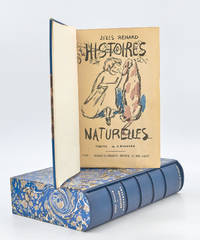
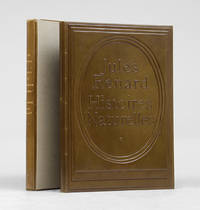
1899réf. 97129Paris: Floury 1899. Toulouse-Lautrec's masterpiece of the illustrated book First edition number 84 of 100 copies only one of the most celebrated and sought-after of all livres d'artiste some of Lautrec's finest illustrations and the prototype of nearly all modern bestiairies Garvey. Lautrec and Jules Renard met first in 1894. The artist asked to illustrate some of the charming and witty portraits of animals and his first sketches were made at the Jardin d'Acclimatation and Jardin des Plantes in 1896. The last two illustrations printed were executed by Lautrec while he was a patient at the Neuilly clinic of Dr Sémalaigne. Renard's Histoire naturelles "contains some of Toulouse Lautrec's most refined draftsmanship and with Yvette Guilbert it is considered one of the masterpieces of the illustrated book. It was Lautrec who requested the pleasure of illustrating Renard's bestiary and Renard agreed hoping for descriptions that 'would please the animals themselves'. The two creative personalities clashed. Lautrec resented the book's limitation to mundane animals while Renard although paid homage to by a cover design of a fox objected to a number of Lautrec's drawings. Today we are amazed that it took Floury twenty years to sell out the edition of 100 copies" Donson/Gripp. Small folio 310 x 220 mm. With an original transfer lithograph to front wrapper on Japan paper and 22 throughout the text on vélin paper by Toulouse-Lautrec. Finely bound in 1973 by Pierre Lucien Martin 1913-1985 in olive green modelled calf titles to covers in raised lettering. Housed in a matching quarter calf chemise and slipcase. Foot of spine lightly rubbed with one small nick contents fresh; slipcase slightly sunned and rubbed. A finely bound copy. Adhémar 333-355; The Artist and the Book 304; Delteil 297-319; Donson/Gripp Great Lithographs by Toulouse-Lautrec nos. 78/79; Garvey 304 "Now one of the greatest rarities of the 19th century. Not only does it contain some of Lautrec's finest illustration but it is the prototype of nearly all modern bestiaries"; Rauch 17; Wittrock Toulouse-Lautrec I 202-224. unknown
1899réf. 48805Paris.: H. Floury Editeur. 1899. Contemporary green morocco-backed marbled boards matching morocco corners spine with gilt title and elaborate decorative tooling marbled endpapers original publisher's tan printed wrappers with Lautrec's lithograph title with illustration of a fox on a wall to front cover preserved t.e.g. Small folio. 318 x 232 mm. Half-title with justification verso printed title and Renard's texts each text 'Coqs' 'La Pintade' 'La Dinde' 'Le Paon' &c. illustrated with an original full-page monochrome lithograph of the subject with Lautrec's monogram and printed title in bistre final leaf with printers' credits. One of Toulouse-Lautrec's most charming and most highly accomplished illustrated books.From the edition limited to 100 copies.Lautrec had met the well-known writer Jules Renard in 1894 and in 1895 told him he would like to do some illustrations for a book Renard was planning Histoires Naturelles. The two did not agree on the choice of illustrations or the design however and the project took a long time to materialise. The final result is a collection of rather poignant observations by Renard each accompanied by a Lautrec illustration. Lautrec's preliminary sketches were begun in 1896 and most of the lithographs executed towards the end of 1898. The pictorial title Lautrec created for the book is a notable visual pun: a fox - the French word for fox like the surname of the author is 'renard' - sits on a wall above Renard's title; Lautrec's own monogram is above the the fox's back like a full moon in a night sky.The full list of animals depicted by Lautrec and Renard are as follows: 'Coqs'; 'La Pintade'; 'La Dinde'; 'Le Paon'; 'Le Cygne'; 'Canards'; 'Les Pigeons'; 'L'Epervier'; 'La Souris'; 'L'Escargot'; 'L'Araignée'; 'Le Crapaud'; 'Le Chien'; 'Les Lapins'; 'Le Boeuf'; 'L'Ane'; 'Le Cerf'; 'Le Bouc'; 'Les Moutons'; 'Le Taureau'; 'Le Cochon'; 'Le Cheval'.Also included inserted loose is the issue of 'Les Hommes d'Aujourd'hui' for 'De Toulouse-Lautrec' 'No. 460' '9e volume' with the caricature of Lautrec by Emile Cohl coloured by hand. The caricature depicts Lautrec seated on a stool on top of another stool palette in hand painting a portrait of himself; the accompanying text is by Charles Donos.'This book one of the great rarities of the late 19th century was received very poorly when published and did not sell out till 1917. Not only does it contain some of Lautrec's finest illustrations but it is the prototype of nearly all modern bestiaries.' The Artist and the Book.Wittrock 202 - 224; The Artist and the Book 304. H. Floury, Editeur. hardcover
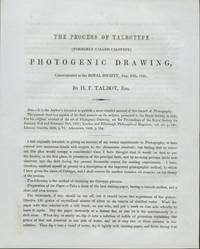
1846réf. 49London: Printed by J. and H. Cox Brothers 74 and 75 Great Queen Street Lincoln’s-Inn Fields 1846. First edition under this title. Privately printed reprint of Talbot’s memoir that was published with variant title and imprint Process of Calotype Photogenic Drawing … London: J. L. Cox & Sons 1841. The printers J. & H. Cox were active from 1844–1846. Housed in blue cloth folder. In fine condition. First edition under this title. Privately printed reprint of Talbot’s memoir that was published with variant title and imprint Process of Calotype Photogenic Drawing … London: J. L. Cox & Sons 1841. The printers J. & H. Cox were active from 1844–1846. Housed in blue cloth folder. 4 p. In this paper Talbot 1800–1877 photographer inventor announced his invention of the photographic process the first permanent negative process on paper that he called Calotype and later – first in print in the title of this paper – Talbotype. His process was the forerunner of most photographic processes of the 19th and 20th century. It also had the advantage of fastness compared to other photogenic drawing processes of the time. An extremely rare and early paper on photography as Talbot printed privately in limited number for presentation to his friends and editors. Printed by J. and H. Cox, Brothers, 74 and 75, Great Queen Street, Lincoln’s-Inn Fields unknown
1562réf. 376729Frankfurt am Main: David Zöpfel 1562. Woodcut title vignette 43 woodcut illustrations some repeated. Title page in red and black. 8 300 leaves. Small 4to 7-3/4 x 5-7/8 inches. Late nineteenth century brown crushed morocco gilt by Frances Bedford marbled endpapers gilt edges. Provenance: William Title inscription dated 1856 on front free endpaper; C. S. Ascherson bookplate and inscription to; Edward Ascherson bookplate. Woodcut title vignette 43 woodcut illustrations some repeated. Title page in red and black. 8 300 leaves. Small 4to 7-3/4 x 5-7/8 inches. The first of two Frankfurt printings by David Zöpfel that year using the same woodcuts. The text is descended from the Low German version Reynke de Vos first printed at Lübeck in 1498. Among the most widely adapted of the beast fables the tales of Reynard the Fox originated in the 12th and 13th centuries with early versions in French Dutch Latin and German being notable. One of the most important secular literary traditions of the Middle Ages Reynard the Fox is at its essence biting satire and parody. The character of Reynard an anthropomorphic fox and trickster has since become almost an archetype in the literatures of many languages. "The supreme 'anti-hero' of medieval fiction" Cambridge Guide to Children's Books in English. This copy from the renowned library of the eminent British architect and book collector Sir William Tite 1798-1873 whose sale at Sotheby's in May-June 1874 took sixteen days certainly one of the greatest collections of the time. [David Zöpfel] unknown
1562réf. 376729Frankfurt am Main: David Zöpfel 1562. Woodcut title vignette 43 woodcut illustrations some repeated. Title page in red and black. 8 300 leaves. Small 4to 7-3/4 x 5-7/8 inches. Late nineteenth century brown crushed morocco gilt by Frances Bedford marbled endpapers gilt edges. Provenance: William Title inscription dated 1856 on front free endpaper; C. S. Ascherson bookplate and inscription to; Edward Ascherson bookplate. Woodcut title vignette 43 woodcut illustrations some repeated. Title page in red and black. 8 300 leaves. Small 4to 7-3/4 x 5-7/8 inches. The first of two Frankfurt printings by David Zöpfel that year using the same woodcuts. The text is descended from the Low German version Reynke de Vos first printed at Lübeck in 1498. Among the most widely adapted of the beast fables the tales of Reynard the Fox originated in the 12th and 13th centuries with early versions in French Dutch Latin and German being notable. One of the most important secular literary traditions of the Middle Ages Reynard the Fox is at its essence biting satire and parody. The character of Reynard an anthropomorphic fox and trickster has since become almost an archetype in the literatures of many languages. "The supreme 'anti-hero' of medieval fiction" Cambridge Guide to Children's Books in English. This copy from the renowned library of the eminent British architect and book collector Sir William Tite 1798-1873 whose sale at Sotheby's in May-June 1874 took sixteen days certainly one of the greatest collections of the time. [David Zöpfel] unknown books
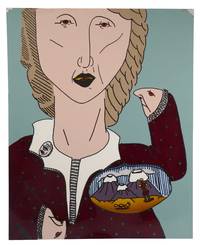
réf. 140949913San Francisco: No publisher 1974. Original reverse painting by Residents' co-founder Hardy Fox on acetate measuring 16 x 19.75". Image of Edweena variant of that used on cover of The Residents' second studio album but shelved until it was released as their fourth album overall Not Available. The back of that album credits it "based on a drawing by a Resident"-- presumably this is either the drawing or a later development of it. In this painting Edweena's skin is a normal hue not green her hair brown as opposed to bright red her eyes red her name is not written along her collar and the background is a sedate turquoise rather than Near Fine with paint loss to upper corners a few tiny flakes along sides. From the estate of Hardy Fox. Not Available is a favorite among Residents fans but also a very dark album. Not surprisingly it came from a very dark place. The fandom wiki for the group states: "Following the commercial failure of Meet The Residents which sold only forty copies in its first year of release the group's lead composer Hardy Fox was in the midst of 'a bit of depression' and simultaneously coming to terms with the growing realisation that he was gay spent a great deal of time alone in The Residents' studio writing and recording 'somber melodies' with an old piano which he later called his 'best friend' at that time . The tensions which had developed among the members of The Residents peaked in the summer of 1974 supposedly culminating in a 'horribly embarrassing' food fight in a Chinese restaurant.Instead of allowing the group to splinter The Residents isolated themselves conducting 'rehearsals' as a form of group therapy. Through these rehearsals inspired by psychodrama a psychotherapy method in which participants act out their emotions through interpersonal interaction within a stage-like setting a stylized and surreal narrative began to develop." That psychodrama informs the album an opera of sorts. Like the music its album cover is distinctively off-putting. It's cartoonish but certainly not cute or comical full of resigned frowning faces and a certain emotionally-drained surrealism. Like the Residents oeuvre it is what it is. No apologies! [No publisher] unknown
réf. 140949913San Francisco: No publisher 1974. Original reverse painting by Residents' co-founder Hardy Fox on acetate measuring 16 x 19.75". Image of Edweena variant of that used on cover of The Residents' second studio album but shelved until it was released as their fourth album overall Not Available. The back of that album credits it "based on a drawing by a Resident"-- presumably this is either the drawing or a later development of it. In this painting Edweena's skin is a normal hue not green her hair brown as opposed to bright red her eyes red her name is not written along her collar and the background is a sedate turquoise rather than Near Fine with paint loss to upper corners a few tiny flakes along sides. From the estate of Hardy Fox. Not Available is a favorite among Residents fans but also a very dark album. Not surprisingly it came from a very dark place. The fandom wiki for the group states: "Following the commercial failure of Meet The Residents which sold only forty copies in its first year of release the group's lead composer Hardy Fox was in the midst of 'a bit of depression' and simultaneously coming to terms with the growing realisation that he was gay spent a great deal of time alone in The Residents' studio writing and recording 'somber melodies' with an old piano which he later called his 'best friend' at that time . The tensions which had developed among the members of The Residents peaked in the summer of 1974 supposedly culminating in a 'horribly embarrassing' food fight in a Chinese restaurant.Instead of allowing the group to splinter The Residents isolated themselves conducting 'rehearsals' as a form of group therapy. Through these rehearsals inspired by psychodrama a psychotherapy method in which participants act out their emotions through interpersonal interaction within a stage-like setting a stylized and surreal narrative began to develop." That psychodrama informs the album an opera of sorts. Like the music its album cover is distinctively off-putting. It's cartoonish but certainly not cute or comical full of resigned frowning faces and a certain emotionally-drained surrealism. Like the Residents oeuvre it is what it is. No apologies! [No publisher] unknown books
1954réf. 17365ZAUBERKREIS 1954. 1. softcover. Weisse Hölle Maloftege! ZAUBERKREIS paperback
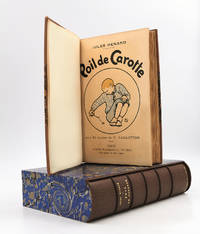
1904réf. 87526Paris: Flammarion 1904. Fine. Flammarion Paris s.d. 1904 11.50 x 19 cm relié sous chemise et étui New edition and first printing of the superb illustrations by Pierre Bonnard one of 20 numbered copies on japon the only deluxe paper issue. Half blue percaline bradel binding with corners smooth spine adorned with a central gilt fleuron and double gilt fillet at the foot chocolate brown shagreen title label with minor scuffing french curl on Turkish patterned paper boards covers and spine preserved contemporary binding signed Carayon. Spine slightly browned corners slightly dulled. Our copy is housed under a half morocco chemise with five raised bands ill. de P. Bonnard stamped in gilt at foot of spine boards of tiger patterned paper and a slipcase bordered with blue Morocco with boards of tiger patterned paper signed T. Boichot. Illustrated with 68 drawings by Pierre Bonnard the second cover is also illustrated with a drawing by Félix Vallotton for the edition of Poil de Carotte published by the same publisher two years earlier. A rare and pleasant copy in a contemporary binding by Carayon. Flammarion hardcover
1841réf. 52094London: Printed by J. & H. Cox Brothers 74 & 75 Great Queen Street Lincoln's-Inn Fields 1841. First edition. 4to. 4 pp. Aside from a few faint pinpoint spots of foxing this is a fine as new copy. Housed in a custom made cloth chemise and slipcase titled in gilt along the spine. Shortly after the presentation of his paper before the Royal Society on 31 January 1839 Talbot at his own expense printed the text as a pamphlet of 14 pages; "Some Account of the Art of Photogenic Drawing."became the world's first separate publication on photography. Through this process an ordinary piece of writing paper was immersed in a sensitizing solution dried placed in a camera and exposed in daylight to a subject for upwards of an hour or longer. Upon examination a tonally reversed rendering of the subject was visible. It was then soaked in a solution of salt and washed and dried then the process was essentially repeated exposing the first print to the new sensitized sheet reversing the tones to produce an image with the tonality as in nature. Through a series of further experiments over the next months Talbot discovered that a "latent" image always existed and that through chemical development it could be brought to life. This allowed for speeding the exposure in the camera to be cut to a mere 30 seconds and the enriched chemical solutions would produce a sharper and tonally richer image. This process he first called the Calotype from the Greek kalos - beautiful. On June 10 1841 Talbot presented the Calotype process at a meeting of the Royal Society and at his own expense he published a four page description of his process. Unlike his earlier publication on Photogenic Drawing here he states in detail the full process. Upon the urging of John Herschel and David Brewster he began to call his process the Talbotype rather than Calotype. His intention was to license this process and likely this printed description was printed to distributed to potential licensees. Aside from changing the name from Calotype to Talbotype in the title of this publication and the slight alteration in the printer's imprint the text of the two issue are identical - the word Calotype remains in the body of the text This is the foundation stone of the negative-positive process that has been in use since it was first published. This printing is much rarer than the Calotype variant with WorldCat locating only Harvard University - Houghton Library and Cornell University. Gernsheim Incunabula No. 655 listing only the Calotype variant. Roosens and Salu No. 10285 listing only the Calotype variant. Weaver HENRY FOX TALBOT SELECTED TEXTS AND BIBLIOGRAPHY No. 87 listing only the Calotype variant. Printed by J. & H. Cox, Brothers, 74 & 75, Great Queen Street, Lincoln's-Inn Fields unknown
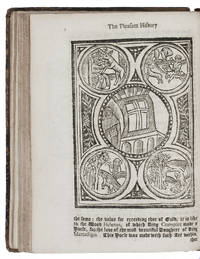
1701réf. 6399London: T. Ilive 1701. Early English editions. Bound together with: The Most Pleasant and Delightful History of Reynard the Fox. The Second Part. Containing Much Matter of Pleasure and Content. Written For the Delight of young Men Pleasure of the Aged and Profit of all. To which is added many Excellent Morals. London: Printed by A.M. and R.R. for Edward Brewster 1681. And: The Shifts of Reynardine The Son of Reynard the Fox Or a Pleasant History of His Life and Death. Full of Variety &c. And may fitly be applied to the Late Times. Now Published for the Reformation of Mens Manners. London: Printed by T.J. for Edward Brewster and Thomas Passenger 1684. Three parts in one small quarto volume 7 5/16 x 5 9/16 inches; 186 x 141 mm. 156 2 table of contents 2 publisher's advertisements; 111 1 publisher's advertisements; 8 160 pp. Mostly black letter with titles and side notes in roman letter. Sixty-two woodcuts in the first part printed from thirty-nine blocks and fifteen woodcuts in the second part five repeated all repeats from the first part. Most cuts signed "E.B." Edward Brewster. Woodcut on C1 recto Part I printed upside down. Some browning occasional light damp staining and soiling. Part I with tiny puncture marks in the lower blank margin through gathering I just touching one letter in the imprint on the title-page six small holes in I3 and one tiny hole in I4 causing loss of a couple of letters. Part III with paper flaw in the upper blank corner of A3 and A4 tiny tear 1/4 inch in the lower blank margin of F4 and paper flaw in the lower blank corner of I2 none affecting text. Contemporary sprinkled sheep. Covers ruled and decoratively tooled in blind spine decoratively tooled in gilt in compartments with two red morocco gilt lettering labels. Some expert restoration to joints and corners. Armorial bookplate of Gloucester on front free endpaper. Bookplate of Hugh Cecil Lowther 5th Earl of Lonsdale 1857-1944 on front pastedown his sale 12 July 1937 lot 445. An excellent copy. Housed in a felt-lined quarter brown morocco clamshell case spine with five raised bands decoratively tooled and lettered in gilt in compartments. Reynard the Fox "hero of several medieval European cycles of versified animal tales that satirize contemporary human society. Though Reynard is sly amoral cowardly and self-seeking he is still a sympathetic hero whose cunning is a necessity for survival. He symbolizes the triumph of craft over brute strength usually personified by Isengrim the greedy and dull-witted wolf. . The main literary tradition of Reynard the Fox descends from the extant French 'branches' of the Roman de Renart about 30 in number nearly 40000 lines of verse. The facetious portrayal of rustic life the camel as a papal legate speaking broken French the animals riding on horses and recounting elaborate dreams all suggest the atmosphere of 13th-century France" Merriam-Webster's Encyclopedia of Literature. There is some variation in chapter number within the early editions: From "Caxton's first edition 1481 to Thomas Gaultier's only edition 1550 the story is divided into 43 chapters" while the anonymous edition 1560-1585 has 58 chapters Varty. By the 17th century when the text is titled The Most Delectable History of Reynard the Fox it appears with only 25 chapters and maintains its image cycle. Early 17th century editions also maintained this "picture cycle" through Edward Brewster's 1662 edition but at this point the Wynkyn de Worde blocks were extremely worn and new set was created Varty. Forty images were used for his second edition 1671 and all contain his initials EB. "He published further illustrated editions in 1676 1681 1694 and 1701. in 1672 he grafted new life onto the old story with A Continuation Or Second Part of the Most Pleasant and Delightful History of Reynard the Fox" Varty for which he eventually created an additional 15 illustrations. In 1684 he would produce an additional sequel following the adventures of Reynard's son Reynardine. Brunet IV cols. 1228-1229. Lowndes p. 2076. Varty Appendix Three: "A Short-Title List of All Extant Illustrated Histories of Reynard the Fox from Wynkyn de Worde c. 1495 to A. Soulby c. 1800 which are kept in United Kingdom libraries based on H. Menke Bibliotheca Reinardiana" 24 18 and 21. Wing S3512 Part II and S3436 Part III. T. Ilive unknown
1701réf. 6399London: T. Ilive 1701. Early English editions. Bound together with: The Most Pleasant and Delightful History of Reynard the Fox. The Second Part. Containing Much Matter of Pleasure and Content. Written For the Delight of young Men Pleasure of the Aged and Profit of all. To which is added many Excellent Morals. London: Printed by A.M. and R.R. for Edward Brewster 1681. And: The Shifts of Reynardine The Son of Reynard the Fox Or a Pleasant History of His Life and Death. Full of Variety &c. And may fitly be applied to the Late Times. Now Published for the Reformation of Mens Manners. London: Printed by T.J. for Edward Brewster and Thomas Passenger 1684. Three parts in one small quarto volume 7 5/16 x 5 9/16 inches; 186 x 141 mm. 156 2 table of contents 2 publisher's advertisements; 111 1 publisher's advertisements; 8 160 pp. Mostly black letter with titles and side notes in roman letter. Sixty-two woodcuts in the first part printed from thirty-nine blocks and fifteen woodcuts in the second part five repeated all repeats from the first part. Most cuts signed "E.B." Edward Brewster. Woodcut on C1 recto Part I printed upside down. Some browning occasional light damp staining and soiling. Part I with tiny puncture marks in the lower blank margin through gathering I just touching one letter in the imprint on the title-page six small holes in I3 and one tiny hole in I4 causing loss of a couple of letters. Part III with paper flaw in the upper blank corner of A3 and A4 tiny tear 1/4 inch in the lower blank margin of F4 and paper flaw in the lower blank corner of I2 none affecting text. Contemporary sprinkled sheep. Covers ruled and decoratively tooled in blind spine decoratively tooled in gilt in compartments with two red morocco gilt lettering labels. Some expert restoration to joints and corners. Armorial bookplate of Gloucester on front free endpaper. Bookplate of Hugh Cecil Lowther 5th Earl of Lonsdale 1857-1944 on front pastedown his sale 12 July 1937 lot 445. An excellent copy. Housed in a felt-lined quarter brown morocco clamshell case spine with five raised bands decoratively tooled and lettered in gilt in compartments. Reynard the Fox "hero of several medieval European cycles of versified animal tales that satirize contemporary human society. Though Reynard is sly amoral cowardly and self-seeking he is still a sympathetic hero whose cunning is a necessity for survival. He symbolizes the triumph of craft over brute strength usually personified by Isengrim the greedy and dull-witted wolf. . The main literary tradition of Reynard the Fox descends from the extant French 'branches' of the Roman de Renart about 30 in number nearly 40000 lines of verse. The facetious portrayal of rustic life the camel as a papal legate speaking broken French the animals riding on horses and recounting elaborate dreams all suggest the atmosphere of 13th-century France" Merriam-Webster's Encyclopedia of Literature. There is some variation in chapter number within the early editions: From "Caxton's first edition 1481 to Thomas Gaultier's only edition 1550 the story is divided into 43 chapters" while the anonymous edition 1560-1585 has 58 chapters Varty. By the 17th century when the text is titled The Most Delectable History of Reynard the Fox it appears with only 25 chapters and maintains its image cycle. Early 17th century editions also maintained this "picture cycle" through Edward Brewster's 1662 edition but at this point the Wynkyn de Worde blocks were extremely worn and new set was created Varty. Forty images were used for his second edition 1671 and all contain his initials EB. "He published further illustrated editions in 1676 1681 1694 and 1701. in 1672 he grafted new life onto the old story with A Continuation Or Second Part of the Most Pleasant and Delightful History of Reynard the Fox" Varty for which he eventually created an additional 15 illustrations. In 1684 he would produce an additional sequel following the adventures of Reynard's son Reynardine. Brunet IV cols. 1228-1229. Lowndes p. 2076. Varty Appendix Three: "A Short-Title List of All Extant Illustrated Histories of Reynard the Fox from Wynkyn de Worde c. 1495 to A. Soulby c. 1800 which are kept in United Kingdom libraries based on H. Menke Bibliotheca Reinardiana" 24 18 and 21. Wing S3512 Part II and S3436 Part III. T. Ilive unknown books
1904réf. 87526Flammarion | Paris s.d. [1904] | 11.50 x 19 cm | relié sous chemise et étui
1902réf. 87525Paris: Flammarion 1902. Fine. Flammarion Paris s. d. 1902 11.50 x 19 cm relié sous chemise et étui Second edition with some parts in first edition with 5 added tales Félix Vallotton's illustrations in first issue one of 20 numbered copies on japon only deluxe issue. Bradel binding brown 3/4 cloth smooth spine with floral motif stamped in gilt at center twice ruled in gilt at foot slightly chafed morocco title-label marbled paper boards original covers and spine preserved contemporary binding signed Carayon. Small clear stains to the top edge of first board one corner slightly rubbed a spot of foxing at foot of the first few pages. Illustrated with 50 drawings by Félix Vallotton. Rare and handsome copy housed in a contemporary binding by Carayon. Renard and Vallotton the foreign nabi had met in the offices of La Revue Blanche a famous avant-garde journal which frequently featured Vallotton's woodcuts and published numerous contributions by Jules Renard. The writer invited Vallotton to illustrate this ""other first edition of Poil de Carotte which includes 5 previously unpublished stories: My dear Vallotton Would it amuse you to illustrate - in complete freedom - Poil de Carotte for Flammarion Renard wrote him in a letter dated June 21 1902. Vallotton was chosen ahead of Toulouse-Lautrec and Alexandre Steinlen two other great artists of the time who had shown an interest in the project. Renard's affinity with Vallotton's style is easy to understand as Vallotton's raw simplicity perfectly matches Poil de Carotte's incisive depiction of a loveless childhood: A few words a few lines are enough for these two artists. They both ruthlessly cut away the superfluous Léon Guichard L'Interprétation graphique cinématographique et musicale des uvres de Jules Renard. Flammarion hardcover
1902réf. 87525Flammarion | Paris s. d. [1902] | 11.50 x 19 cm | relié sous chemise et étui
1701réf. 22642London 1701. 4to. Thomas Ilive for Edward Brewster Late-18th-century sprinkled calf sewn on 5 cords 3 attached to the boards and 2 cut short gold double fillets blind-tooled board edges red morocco spine label in 2nd of 6 compartments red sprinkled edges. With woodcut of King Lion's court on the title page 61 woodcuts in text of part 1 including 23 repeats all signed Edward Brewster and all half-page 7.5 x 10.5 cm to nearly full-page 13 x 9.5 cm and 15 woodcuts in part 2 all repeated from part 1. Further with a large woodcut decorated initial in part 3 and decorations built up from cast fleurons in parts 1 and 2. Set in textura types with incidental roman and italic including Moxon's 1669 Canon roman on the title-page of part 3. 3 parts in 1 volume. 160; 112; 4 160 pp. One of the rare sets of all 3 parts of the English Reynard the Fox the third part here in its first edition. The Reynard stories were already established as a coherent collection in the 12th century and were first printed in 1479 in a Dutch prose edition. They became especially well known when translated into English and adapted for Caxton's 1481 edition in 43 chapters. The publisher Edward Alde in London began work on an extensive revision of Caxton's text with many new additions but he published only the first part probably in 1620 the first edition of the present part 1 containing 25 chapters some corresponding with chapters in Caxton's edition and some not. Although the second part would have to wait 52 years the first part quickly became the standard English version of the Reynard the Fox stories with 8 editions from 1620 to 1671. Its language was modernized giving both a view of the stories as they were known through most of two centuries and insights into English values and culture of the time. In 1684 Brewster added the present first edition of part 3 giving the adventures of Reynard's son Reynardine.With 20th-century woodcut bookplate. The woodcut on C1 of part 1 is printed upside down. In good condition with parts 2 and 3 slightly browned. One front endleaf is detached the spine slightly damaged at the head and the front hinge cracked.l Ebert II 18879; ESTC T60836 R218371 R40614; Kirmse 15; Menke V B c note on pp. 221-222 nos. 35 29 30; Wing S3512 S3436 parts 1-2; not in Prien. LITERATURE & LINGUISTICS English & American Literature Fable Books hardcover
réf. 43728Lausanne, André & Pierre Gonin, 1984. In-4° à l'italienne, 52p. en feuilles, sous couverture imprimée rempliée, chemise et étui.
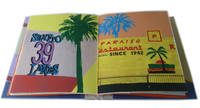
réf. 9647Achill Island Ireland: Rex Fox Press 2014. One of only 69 signed and numbered copies. 24 screen printed pages. 25 x 33 cms. In a superb large enginerred binding by the great British bookbinder Peter Jones of brown tan and green morocco backed wooden and perspex boards with palm tree and signs design in various coloured pape applied to perspex sections. All housed in a superb wooden orange felt lined box perspex windows with original upper wrapper screen print on the upper cover. Original screen printed back wrappers in a pocket at the back. The binding statement declares: Through my choice of materials design and structure I sought to capture the essence of the scenes depicted within the book. The treatment of the spine and adjacent shapes are palm trees with the shapes at the fore-edges being stylised representations of signage viewed from street level. The structure of the binding was devised to cope with the particular demands of a thick single section text block printed on heavy paper. The original covers of the edition binding have been incorporated into the box as the top of the lid.” Peter Jones worked in London as a furniture restorer and leather liner before training in bookbinding at Brighton Polytechnic. He now works as a bookbinder and as a carpenter and his books have a remarkably engineered quality with a great understanding of how to use different material in his work. He has taught bookbinding extensively including at the Universities of Brighton and Roehampton and is a Fellow and Past President of Designer Bookbinders. His work is exhibited internationally and held in numerous collections. Peter mainly works from his studio bindery in Wannock East Sussex. Rex Fox Press hardcover
1975réf. 22502Paris chez l'Artiste 1975 In-8 oblong, maroquin beige entirement recouvert sur les plats d'un dcor gomtrique de filets pousss or et l'oeser noir voquant une superposition de feuilles, dos sans nerfs portant les noms de l'auteur et de l'artiste ainsi que le titre de l'ouvrage pousss l'oeser noir; doublures et gardes de papier beige fonc, tte dore, non rogn, couverture imprime. Chemise, tui (Michel Richard, 1976).Edition originale de ces pomes qui accompagnent 7 aquatintes originales hors texte de Michel Richard. Tirage limit 40 exemplaires numrots sur papier d'Arches, signs par l'auteur et l'artiste. Un des 5 exemplaires hors commerce, comportant toutes les aquatintes signes par l'artiste et un trs grand dessin original excut l'encre et sign par Michel Richard. Exemplaire reli par l'artiste ds la sortie du livre.
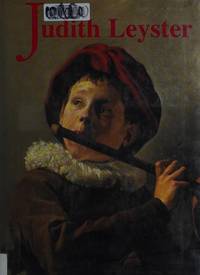
1989réf. 87140Davaco Publishers. New. 1989. Hardcover. 9070288621 . FREE UPGRADE to Courier/Priority Shipping Upon Request - IN STOCK AND IMMEDIATELY AVAILABLE FOR SHIPMENT - FLAWLESS COPY BRAND NEW PRISTINE NEVER OPENED -- - Corresponds to ISBN: 9070288621. Text in English. 300 pages; 176 illustrations. Leijster Catalogue Raisonne Catalog Raisonné Complete Works Life and Work Raisonnee -- with a bonus offer . Davaco Publishers hardcover
1924réf. 29268ABHB NODustjacket March 1924 1st Edition 2ND Printing STATED on Copyright Pg Dates MATCH on Title & Copyright pg VG- Minor damage to the inside of the back cover creating scuffing blankendpaper. Hardcover no dust jacket.VG- condition overall spine and all pages intact. 1st Edition 2nd Printing 1924 SPINE TITLES ARE Gone but Front book is Nice Some wrinkling to Back Cvr New York: Knopf, Plates engraved by Beck Engraving hardcover
réf. 001NY: Charles Scribner's Sons 1903. Very Rare Book. Another indicator of it's rarity is the name of the Publisher. Publisher is Grosset & Dunlap of New York.Grosset & Dunlap is a United States book publisher founded in 1898. Book is in tack. Will need some restoration. Imaging finding a book from the late 1800 with a love note dedicating this book to Miss Carrie Duke. Rare edition thus. Hardcover. Orig. spine that is intact but needs restoration. Front and back cover intact. I searched the internet intensively and found pictures of first editions HOWEVER none of them had the love dedication note or the black trim around the title of the book. Information on Miss Carrie Duke listed below:Woman's Work in Kentucky." by Mrs. Eugenia Dunlap Potts. Publication: Eagle Mary Kavanaugh Oldham ed. The Congress of Women: Held in the Woman's Building World's Columbian Exposition Chicago U. S. A. 1893. Chicago Ill: Monarch Book Company 1894. pp. 562-568. Susannah Hart the aunt of Mrs. Henry Clay raised and pulled the flax which she wove and spun into her wedding gown with an art so clever that she could draw the width through her wedding ring. She belonged to the wealthiest of those early families of note and was the wife of Gov. Isaac Shelby. She died at the age of seventy-two years at "Travelers' Rest" the grand old homestead which has never passed out of the Shelby family. She was the mother of ten children and her descendants are widely scattered. Mary Hopkins Cabell Breckinridge was a contemporary whose work can never die. Hers were not deeds of daring nor of tragic from the lurking Indian. Her power was in her eloquent conversation her strong opinions her decided views of duty. Her sons are orators and statesmen; her daughters are ambitious and progressive. Margaret Breckinridge a granddaughter devoted heart and hands to hospital work during the war of the Blue and the Grey; and by her gentle self-sacrificing ministering was named the "Angel of the hospitals." She said "Shall men die by thousands for their country and no woman risk her life" Still a younger generation is led by Miss Sophronisba Breckinridge who after years of travel in Europe studied law in her father's office. Mrs. Catherine Hunt the chatelaine of one of Lexington's proud homes reigned a queen in her domain. The train of servants the management of her handsome estate and all the demands upon the mistress of such possessions called for executive ability of rare degree. Hers was the thinking head and the guiding hand. The Baroness Burdett Coutts says: "Woman may be allowed to lead in acts of charity" and right nobly has she set this example. This woman Mrs. Hunt used her prerogative here. Sixty-one years ago when cholera wellnigh depopulated the Blue Grass capital she went forth on pious mission bent. Coming upon three desolate little children whose parents lay dead she said to a friend: "What shall we do with them Let us buy them a home." She opened her purse and established the Orphans' Home Lexington's oldest charitable institution where many little feet have found a resting place. Mrs. Henrietta Hunt Morgan was her daughter and the Hon. Francis Kay Hunt of legal celebrity was her worthy son. Mrs. Morgan presided over her household much after the manner of her bringing up. She was the mother of a remarkable family. Her sons were Gen. John Hunt Morgan Col. Calvin Morgan Capt. Charlton Hunt Morgan and Lieut. Thomas Morgan. Her daughters were the wives of Gen. A. P. Hill and of Gen. Basil W. Duke. Behold the evolution of the Kentucky girl if I may so term the greater liberty of today! Mrs. Henrietta Morgan Duke of Louisville Ky. one of our commissioners is a woman of incomparable qualities of heart and brain. She reflects the grandmother and mother in strength of character and in executive ability. Times have changed and she has risen to the demands. Her young daughter Miss Carrie Duke the violin virtuoso represents the fourth generation of this family. The ancient code would have held her captive but the liberty of the present sent her abroad to develop the divine genius that now sways multitudes. Another young descendant of Mrs. Hunt is Miss Lucy Lee Hill a World's Fair Commissioner who bravely and briskly went about the work of collecting exhibits; faithfully she has presided at the state building. Yet another great-granddaughter is Miss Eleanor Howard Morgan daughter of Capt. Charlton Morgan who entered Bryn Mawr College where her scientist brother Dr. Thomas Morgan holds the chair of biology. This young girl perfectly illustrates the fact that developing a woman's brain does not necessarily rob her of feminine charm. No lily of the valley breathing its delicate fragrance far below the gaze of man is more modestly environed; yet her influence pervades all the atmosphere about her. She inherits not the dash of her uncle the cavalry chief but the steady glow of woman's star when lit by the brilliancy of intellectual fire Since I don't have a true value of this book it may be priceless. I have decided to start at $5000.00. Grosset & Dunlap hardcover
réf. 9573Monterey KY: Larkspur Press 2006. Full Leather. Fine binding. Octavo. 4 36 4 pp. Limited edition number 9 of 75 copies on Somerset Book paper there was also an edition of 500 regular copies. Signed by Wendell Berry at the colophon; additionally noted by Fox the year it was bound. In full goatskin binding with a series of leather onlays tooled in gold and blind all creating a fantastic pictorial binding. Accompanying the binding is a fine paper portfolio with publisher's prospectuses samples and associated material; additionally some templates related to Fox's binding. All housed a custom clamshell by Fox. The text offers a lens into the 19th century view of how a native of region assesses the value of the natural wonders. Berry's commentary at the end of Allen's text brings the troubling viewpoint into a modern context: "The chapter is built upon a division of mind which in our time has become terrifying but which Allen believed to be no more than a simple equation. On the one hand in a sentimentally romantic fashion he was sensitive to the natural life of the area which was then still intact. And on the other hand he seems eager for the destruction of this virgin bounty that so inspired him. I say 'the destruction' and not 'the use' for his language is patently that of an exploiter intent upon 'conquering' nature." A sobering volume that will most surely always remain relevant. Larkspur Press unknown
réf. 1381n.p.: n.p. 1671. First Edition . Hardcover. Good. Quarto. 28 pages. A4-C4 D2. First edition. In a modern cloth binding leather title label on spine. ESTC R30372. Title-page mounted. Pages 23 and 24 with a hole in the first three lines affecting some letters. Pages 25 through 28 with a hole extending through seven lines in pages 25 and 26 and eight lines in pages 27 and 28 affecting words and letters. Many leaves silked. An extremely rare item that has not shown up in auctions in several decades. 0 n.p.: n.p., 1671. hardcover
1791réf. 1909070003Florence: Niccolo Pagni and Giuseppe Bardi 1791 & 1795 1791. First Edition. Hardcover. Good. A Monumental Work of 18th century Italian engraving 2 volumes. Large folios 51 x 35 cm 19 3/4 x 13 in. 1st edition. Bound in contemporary 1/2 vellum over marbled boards. Some cover wear. Rear joint of v.1 cracked. Hinges of v. 2 cracked. Text in Italian and French printed in parallel columns. Collation: v.1 Engraved title frontispiece 64 leaves 60 plates. v.2 Engraved title 62 leaves 60 plates. Many of the plates are printed in colored ink: siena shades of brown or green and blue. 120 artists' portraits. A gorgeous and large format work on Tuscan painting beginning with Guido da Siena and considering all the great painters of Florence such as Buffalmaco Cimabue Giotto Paolo Uccello Andrea Verrocchio Masaccio Fra fifilppo Lippi Andrea del Castagno Pollaiolo Botticelli Leonardo da Vinci Michelangelo Andrea del Sarto Antonio Tempesta Giuseppe Grisoni etc. Carlo Lasinio 1759-1838 was responsible for many of the engravings. Other engravers included: Giovanni Francisco Ravenet Marco Lastri Giuseppe Bardi Niccolo Pagni Matteo Carboni Ferdinando Gregori Gaetano Vascellini and Cosomo Colombini. Refs: "Pregevole opera" Cicognara 3387. Cohen-Ricci 366. Thieme-Becker XXII 404. Brunet II 1095. Graesse II 509. Moreni I 509: "Ciascuno di questi volumi racchiude 60 articoli di notizie di altrettanti pittori toscani scritti in italiano da M.L. promotore di questa eccellente impresa e tradotti in francese da Bartolomeo Renard. Ognuno di essi ha una stampa incisa in rame scelta dalle Opere le piu stimate di quel pittore." Armorial bookplates of Paul Beilby Thompson 1784-1852. Thompson was a Whig MP for Wenlock and East Riding; later made a Baron. This is an oversized or heavy book which requires additional postage for international delivery outside the US. Florence: Niccolo Pagni and Giuseppe Bardi, 1791 & 1795 hardcover