Georges-Louis Leclerc, comte de BUFFONBiblio.com
1.238 resultados
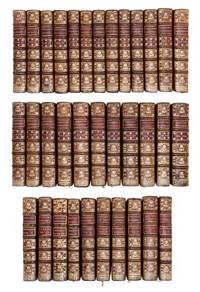
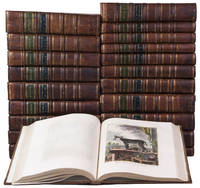
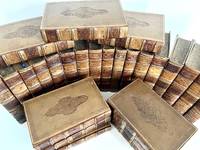
1825ref. 81174Paris: A. Eymery 1825. Fine. A. Eymery Paris 1825 -1828 13.50 x 21 cm longueur totale de la série 103 cm 26 volumes reliés Complete new edition of Buffon's works published in Paris by Eymery between 1825 and 1828 according to the arrangement established by the Comte de Lacépède and completed by the supplementary volume issued in 1828. A handsome complete set in 26 bound volumes 13.5 × 21 cm; total shelf length: 103 cm illustrated with 245 plates: Buffon's portrait engraved by Devéria as the frontispiece 216 hand-coloured plates - some heightened with gold - including 91 devoted to mammals and 126 to birds 13 plates in black and 4 folding maps. Most of the coloured plates were executed by Jean-Gabriel Prêtre the animal painter successively attached to Empress Joséphine's menagerie and to the Muséum national d'histoire naturelle. Contemporary full glazed calf spines with raised bands decorated in blind with gilt-point mosaics gilt rolls at head and foot twin blond calf lettering-pieces; sides with a large central blind-stamped medallion within a matching blind-tooled border. Spines with some fading and small losses to the upper spine-ends of eight volumes vols. 1 5 9 11 23 and 24 tear to the upper joint and lower spine-end of vol. 26. Paper generally fresh occasional scattered foxing; the majority of the plates remarkably fresh a few browned in vols. 3 4 5 and 10; tear to p. 63 in vol. 11. Armorial bookplate of the library of the Comte Chevreau d'Antraigues. Interrupted by Buffon's death in 1788 the vast undertaking of the Histoire naturelle found its natural continuation in Étienne de Lacépède. Called upon during the final years of Buffon's life to carry forward the unfinished sections he successively published the volumes devoted to oviparous quadrupeds and serpents followed by those on fishes and cetaceans before undertaking a new arrangement of the entire work. Begun under his supervision this edition continued after his death in October 1825 concluding with the publication of the supplementary volume in 1828. Its illustration owes much to Jean-Gabriel Prêtre one of the foremost animal painters of his generation. Trained in Geneva before joining Empress Joséphine's menagerie at Malmaison and later the Muséum national d'histoire naturelle he devoted much of his career to depicting newly described species with remarkable accuracy; several still bear his name today. The present copy comes from the library of the Comte Chevreau d'Antraigues as evidenced by its armorial bookplate a recognised provenance on the French antiquarian book market where a number of books from the same library have appeared over the years. One of the finest editions of Buffon's Histoire naturelle bringing together for the first time in a coherent and uniform set the work as finally arranged by Lacépède. A. Eymery hardcover
1750ref. 6103Hamburg and Leipzig: Georg Christian Grund and Adam Heinrich Holle 1750. Contemporary vellum not strictly matching. 4to. With engraved vignette on 16 title-pages engraved headpiece to the dedication engraved headpieces to each part 2 engraved maps folding engraved genealogical table 1 folding letterpress table and 575 engraved plates by J.C.G. Fritzsch J. Haas J.C. Sysang etc. 8 of 11 volumes divided into two parts each. Very rare first edition of the German translation of Buffon's famous Histoire naturelle. Buffon's work presents ''for the first time a complete survey of natural history in popular form'' PMM. The first volume contains Buffon's theoretical essays including his essay on the earth where "for the first time he outlines a satisfactory account of the history of our globe and of its development as a fitting home for living things. In his view the earth had been originally part of the sun which was broken off by the impact of a comet. It gradually condensed from its gaseous state and the forces shaping its continents and mountains are still active'' PMM. This view of the universe not in a steady state but evolving was a revolutionary idea at the time paving the way for Darwin in the following century. In his treatise on humans volume II.1 Buffon ''studied the human species by the same methods that he applied to animal species including the psychological moral and intellectual life of man. From his exhaustive research for the Histoire naturelle des quadrupèdes Buffon came to the conclusion that it was necessary to reintroduce the notion of family. Breaking with the spirit of his time Buffon attempted to separate science from metaphysical and religious ideas. As a disciple of Locke he denied idealistic metaphysics stating that mental abstractions can never become principles of either existence or real knowledge; these can come only as the results of sensation'' DSB. Volumes II-VIII deal with quadrupeds. The German edition was begun in 1750 but discontinued after the three volumes on ornithology in 1782 not included here while the original French which had started in 1749 continued till 1804 and comprised eventually 44 volumes.The first 8 volumes of the German Buffon with an owner's inscription on title-page of the first volume dated 1750. Only some occasional spot but otherwise in very good condition.l Nissen ZBI 709; cf. Anker 79 vols. IX-XI; DSB II pp. 576-582; PMM 198; Wood p. 267. Georg Christian Grund and Adam Heinrich Holle, hardcover
1791ref. 7169Madrid: viuda de Joaquín Ibarra 1791. Second edition. Hardcover Tapa dura. 204x135mm. 8x5¼". Madrid viuda de Ibarra 1791-1805. En 4º menor 204 x 135mm. 21 volúmenes. 487 láminas coloreadas a mano de época. Encuadernación uniforme en piel de época lomera con adornos dorados y dos tejuelos en marroquén. Segunda edición impresa sobre buen papel de hilo ilustrada con 487 láminas grabadas y coloreadas a mano en la época. Se trata de una enciclopedia incluye todo el saber de la época concerniente a las ciencias naturales. La Historia Natural publicada en los albores de la Ilustración tuvo una profunda influencia en el pensamiento científico de la época y en el de las subsecuentes generaciones sobre todo en las ideas de otros grandes naturalistas como Charles Darwin o Jean-Baptiste Lamarck. viuda de Joaquín Ibarra hardcover
1798ref. 017909Paris: Dufart VII-XIII 1798-1805. .nouvelle edition accompagnée de notes et dans laquelle les supplémens sont insérés dans le premier texte à la place qui leur convient. L'on y a ajouté l'histoire naturelle des quadrupèdes et des oiseaux découverts depuis la mort de Buffon celle des reptiles des poissons des insectes et des vers; enfin l'histoire des plantes dont se grand naturaliste n'a pas eu le tems de s'occuper. Ouvrage formant un cours complet d'Histoire naturelle redigé par C.S. Sonnini. 127 volumi 125x20 cm in bella legatura coeva in piena pelle marmorizzata cornice dorata ai piatti dorso liscio ornato e dorato con doppio tassello di titolo e tomagione. --Un volume con rilegatura rifatta a imitazione alcune cuffie mancanti o altri segni d'uso e del tempo ai margini e agli angoli. Risguardie marmorizzate testimoni. Set completo di questa famosa edizione con 1113 tavole quasi tutte colorate a mano e carte geografiche più circa 30 schemi di classificazione e tabelle. Qualche brunitura a macchia o fioriture ma bell'insieme di questa monumentale riedizione e aggiornamento dell'opera di Buffon. L'opera è così divisa: Théorie de la terre 3 tomes; Epoques de la Nature 1 tome; Histoire des Minéraux 12 tomes; Des Animaux 1 tome; De l'Homme 4 tomes; Quadrupèdes 13 tomes; des Singes 2 tomes;; des Oiseaux 28 tomes; Crustacés et Insectes 14 tomes; Mollusques 6 tomes; Reptiles 8 tomes; Plantes 18 tomes; Poissons 14 tomes; Tables analytiques 3 tomes. Non tutte le tavole sono numerate e a volte non sono in sequenza ma corrispondono al testo.Oltre al testo "classico" di Buffon sono assai importanti le integrazioni sulla base delle nuove scoperte scientifiche. Rettili e anfibi sono opera del Dudin con 100 tavole; i molluschi sono di Denis de Monfort con 72 tavole; uccelli e pesci sono sviluppati dal Sonnini; gli insetti da Latrelle. In sostanza i migliori studiosi degli anni a cavallo tra 7 e 8cento furono partecipi dell'opera rara da trovare così completa e in belle condizioni esterne. Dufart
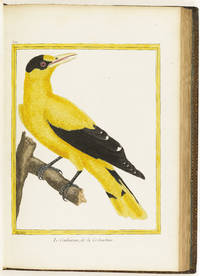
1765ref. B7181Paris c.1765. One plate with small tear at gutter not affecting plate. Interior generally crisp and clean colours vivid. Binding: Half brown calf over marbled paper boards. Spine with 5 raised bands red morocco label in second compartment green morocco label in fourth compartment gilt rolls on bands. Notes: Edme-Louis Daubenton 12 August 1730 – 12 December 1785 was a French naturalist. Daubenton was the cousin of another French naturalist Louis Jean-Marie Daubenton. Georges-Louis Leclerc the Comte de Buffon engaged Edme-Louis Daubenton to supervise the coloured illustrations for the monumental Histoire Naturelle 1749–89. The Planches Enluminee started to appear in 1765 and finally accounted for 1008 plates all engraved by François-Nicolas Martinet 1731–1800 and all painted by hand. The Parisian publisher Panckoucke published a version without text between 1765 and 1783. The Histoire Naturelle générale et particulière avec la description du Cabinet du Roi is an encyclopaedic collection of 36 large quarto volumes written between 1749 and 1789 by the Comte de Buffon. The books cover what was known of the "natural sciences" at the time including what would now be called material science physics chemistry and technology as well as the natural history of animals. A de luxe edition of Histoire Naturelle des Oiseaux 1771–1786 was produced by the Imprimerie royale in 10 folio and quarto volumes with 1008 engraved and hand-coloured plates executed under Buffon's personal supervision by Edme-Louis Daubenton cousin and brother-in-law of Buffon's principal collaborator Louis Jean-Marie Daubenton. The plates were originally issued in 42 cahiers each containing 24 plates and no accompanying text or titles. Size: Folio 460 x 315mm Illustration: A beautifully bound collection of 100 handcoloured plates produced by Daubenton for the Comte de Buffon’s Histoire Naturelle which was issued in multiple parts between 1765 and 1783 and came to encompass over 1000 plates. The numbered plates depict birds from many parts of the world including Africa Canada Mexico France Italy Brazil China and America. The present volume represents an impressive compilation of plates originally issued across different parts the numbering not always chronological. One plate with etched caption crossed and rewritten in contemporary hand. Category: Book Natural History; Book Plate Books Colour; hardcover
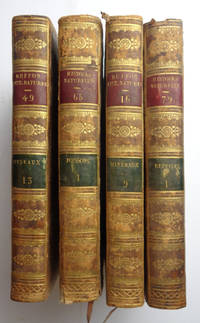
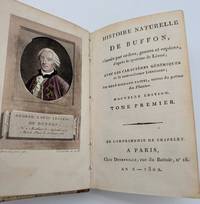
1803ref. 71345Paris: De L'Imprimerie de Crapelet 1803. Nouvelle Édition. Leather Bound. Very Good. Twenty-fourmo 13.5 cm Contemporary 3/4 brown leather with speckled paper over boards. Pale red and green gilt stamped leather spine labels. Six gilt ruled compartments on the spines. Illustrated plates the majority with tissue-guards. This specific set has a frontispiece portrait of Buffon 781 illustrated plates and 5 folding tables the exact number of plates found in each volume is available upon request. Text in French. Extremities very lightly rubbed and soiled. A couple of boards with small red stains. Spines sporadically mottled. Occasional minor chipping to spine ends and a handful of spine labels with loss. Underlying boards peeking through at corners. Endpapers have a previous owner's red ink stamps a small faint ink stamp in black and minute contemporary numerical notations. Stitching visible in gutters here and there. Pp. 125-130 volume 12 are partially detached. Pp. 29-32 volume 44 and pp. 93-96 volume 77 are completely detached but present. Skillful repair to fore-edge margin of p. 169 volume 59. Pages bound out of sequence in volume 59 between p. 136 and p. 185. Periodic printing errors occur in the set's pagination. In a handful of plates the sky in the background appears stained and there is a bit of red staining to plate at p. 258 in volume 70. Two reptile illustrations in volume 42 are a trifle trimmed at the head. Additional Collation Notes: Curiously volumes 56-65 are the only volumes in which the plates are numbered. In volume 58 I believe plate 15 is mislabeled as 13 and it is found between plates 23 and 24. The books are very structurally sound and the pages are strikingly clean and bright. Contents: Théorie de la Terre. Époques de la Nature; Discours Généraux; Quadrupèdes; Oiseaux; Histoire Naturelle des Minéraux; Histoire Naturelle des Poissons; Histoire Naturelle des Reptiles; Histoire Naturelle des Insectes; Histoire Naturelle des Coquilles; Histoire Naturelle des Vers; Histoire Naturelle des Crustacés; Histoire Naturelle des Végétaux. An edition published posthumously of Buffon's most famous work. Buffon's Histoire Naturelle was continued in part by others after his death. It was translated into various languages and read throughout Europe. French naturalist George-Louis Leclerc de Buffon 1707-1788 Comte de Buffon is viewed as the most influential biologist of the 18th century epitomizing the revolutionary changes the Enlightenment brought to the study of nature. The title of Count was bestowed on him by Louis XV in recognition of his accomplishments rather than by birth. He is most famous for Histoire Naturelle a comprehensive work on natural history first begun in 1749. De Buffon began his studies at the College of Godrans in Dijon where he was only an average student. Originally his father wanted him to have a legal career however in 1728 he went to Angers where he studied medicine botany and mathematics. In 1739 he was appointed keeper of the Jardin du Roi the royal botanical garden now the Jardin des Plantes and of the accompanying museum. There he was tasked with creating a catalog of the royal collections in natural history which he transformed into an undertaking to produce a record of the whole of nature. This became his monumental work Histoire Naturelle Générale et Particulière which was the first modern effort to methodically present all existing knowledge in the subjects of natural history geology and anthropology in one publication. Buffon's ideas challenged traditional biological classification and introduced theories of evolutionary thought roughly one hundred years before Darwin. Comte de Buffon is also remembered for his argument that the world had a lengthy history rather than being only a few thousand years old as the naturalists of the 1600s believed. In addition he felt that scientific writing should be energetic and graceful in style thereby allowing his work to be accessible to a wide audience in Europe and beyond. Buffon's work articulated that species were different throughout the world that the planet was much older than the Bible suggested and that plant and animal species were related in intricate ways. Buffon's bold way of looking at the world laid the groundwork for later revolutionary thinkers who are responsible for much of what we know about the natural world. An attractive set of a pivotal work of the Enlightenment richly illustrated with numerous hand-colored plates. De L'Imprimerie de Crapelet unknown
1789ref. 60389Paris l' Imprimerie Royale Plassan 1749 - 1789. 4to 262 x 205 mm. Uniformly bound in 32 contemporary full sprinkled calf bindings with five raised bands and richly gilt spines. Leather tome- and title-labels to all volumes. Edges of boards gilt. Light wear to extremities primarily affecting head and foot of spines corners bumped. Internally with light occassional marginal brownspotting but generally fine. With "J. Collin" Danish zoologist Jonas Collin to top margin of most front free end-papers. An overall nice set comprising the following:Histoire Naturelle Générale et Particulière 15 vols - 578 plates and 2 maps.Supplément à l'Histoire naturelle 6 vols - 141 plates and 2 maps.Histoire naturelle des Oiseaux 9 vols - 257 plates.Quadrupedes Ovipares et des Serpens 2 vols - 66 plates. A total of 1042 plates and 4 maps. Wanting the portrait. The complex collation of this work has not been accurately described by bibliographers. Nissen and Heilbrun differ in the listing of number of plates and misname the descriptions of the plates. First edition of this extensive landmark work in natural science. After his death several other volumes were published making the total number of volumes 44. Together with Diderot's Encyclopaedia this work represents the peak of book printing of the French enlightenment. Buffon was the first to sum up an entire natural history based on science instead of theology; It constitutes one of the first attempts to provide a comprehensive account of the natural world aiming at describing the entire known natural world - including plants animals and minerals - in a single work. Buffon based his work on first-hand observations and scientific analysis rather than on second-hand accounts or mythological beliefs making it a seminal work in the development of modern science. "Buffon's "Natural History General and Particular" presented for the first time a complete survey of natural history in a popular form . he was the first to present the universe as one complete whole and to find no phenomenon calling for any but a purely scientific explanation. In 1739 he was appointed Director of the Jardin du Roi now Jardin des Plantes. It would appear that the 'Natural History germinated in the preparation of a catalogue of the royal collection. Buffon then enlarged its scope to Aristotelian or Plinian proportions and finally transformed it into a conspectus of nature of a breadth and depth previously unknown". … he was the first to present the universe as one complete whole and to find no phenomenon calling for any but a purely scientific explanation." PMM. Buffon's work had a significant impact upon the field of natural history and influenced many other scientists including Charles Darwin; In a part of the work "Des Epoqeus de la Nature" Supplement vol. V 1778 present here Buffon attacked several Christian doctrines on natural science. He saw man as a part of the animal world he objected to earth being only 6000 years old and he dismissed a rigid classification system thus paving the way for Darwin's thoughts a century later:"Georges Buffon set forth his general views on species classification in the first volume of his Histoire Naturelle. Buffon objected to the so-called "artificial" classifications of Andrea Cesalpino and Carolus Linnaeus stating that in nature the chain of life has small gradations from one type to another and that the discontinuous categories are all artificially constructed by mankind. Buffon suggested that all organic species may have descended form a small number of primordial types; this is an evolution predominantly from more perfect to less perfect forms." Parkinson Breakthroughs. "Buffon's work is of exceptional importance because of its diversity richness originality and influence. Buffon was among the first to create an autonomous science free of any theological influence. He emphasized the importance of natural history and the great length of geological time. He envisioned the nature of science and understood the roles of paleontology zoological geography and animal psychology. He realised both the necessity of transformism and its difficulties. Although his cosmogony was inadequate and his theory of animal reproduction was weak and although he did not understand the problem of classification he did establish the intellectual framework within which most naturalists up to Darwin worked." DSB From the library of Danish zoologist Jonas Collin 1840-1905 who issued a new edition of Kjærbølling's "The Birds of Scandinavia" in 1875-1877 See Anker 251 - a work most likely inspired by his knowledge from his i.e. the present copy of Buffon's "Histoire Naturelle".The 'Histoire Générale' was widely reprinted and translated. Sometimes only individual sections were produced other times the complete work appeared. PMM 198.Nissen 672.Brunet I 376.Dibner 193.Sparrow p. 23.Anker 6. hardcover
1802ref. 12697Paris Crapelet and Deterville 1802-1803. Histoire naturelle de Buffon classée par ordres genres et espèces d'après le systeme de Linné; avec les caractères génériques et la nomenclature Linnéenne. In 12° 135 x 83 mm. / 5.12 x 3.15 inch. Complete set of Buffons celebrated natural history in a finely preserved contemporary edition. 80 volumes Paris Crapelet and Deterville 18021803 small 8vo c. 14 cm. Beautifully bound in uniform bindings and illustrated with approximately 800 engraved plates with fine contemporary hand-colouring. The set comprises: 26 volumes of Histoire naturelle vols. 126; 5 volumes Minéraux 2731; 10 volumes Poissons 3241; 4 volumes Reptiles 4245; 10 volumes Insectes 4655; 2 volumes Crustacés 5657; 5 volumes Coquilles 5862; 3 volumes Vers 6365; and 15 volumes Végétaux 6680. An unusually fresh and visually striking copy of this compact Paris edition of Buffons complete natural history notable for the bright contemporary colouring of the plates and the attractive uniform bindings. Complete sets in such condition with uniformly coloured plates are scarce on the market. References: Brunet I 1378; Nissen ZBI. Paris, Crapelet and Deterville unknown
1765ref. 6479Paris: Hôtel de Thou 1765. First Edition Primera edición. Hardcover Tapa dura. 247x186mm. 9¾x7¼". Paris Hôtel de Thou n.d. 1765. En 4º 247 x 186mm. 2 volúmenes. -I: 7 h. 182 láminas. -II: 1 h. 160 láminas. En total 362 láminas grabadas y coloreadas a mano en la época con la representación de animales. Encuadernación de la épocas en piel lomera cuajada de adornos dorados. Primera edición de una de las obras más raras y apreciadas de Buffon dedicada a los animales cuadrúpedos desconocida a Nissen y otra bibliografía especializada. Muy rara publicación separada de los grabados creados para los Animaux quadrupèdes de Buffon y organizados según el sistema linneano. Todas las 362 placas han sido delicadamente coloreadas a mano en el momento de la publicación. La publicación de la monumental Histoire Naturelle de Buffon iniciada en 1749 y continuada por Lacépède abarcó un lapso de más de 50 años. Su éxito fue inmediato y Buffon menciona en su correspondencia que los primeros 3 volúmenes se agotaron después de solo 6 semanas. Al año siguiente vio la luz una edición de menor formato. Sus ilustraciones se basaban en los mismos dibujos pero grabados sobre planchas en formato reducido. El pintor y excelente dibujante Jacques de Sève es el artista que ha realizado la práctica totalidad de las imágenes de esta Histoire naturelle. La mayoría de los dibujos originales están dispersos hoy; en 1791 se vendió una colección de 152 dibujos originales que habían pertenecido a la colección del conde Mirabeau. La calidad de las ilustraciones contribuyó enormemente al éxito universal y la popularidad de la obra prueba de lo cual esta suite publicada por separado. Los cuadrúpedos están aquí clasificados por orden y género en el sistema animal de Linné. Esta colección es de gran rareza y no se menciona en ninguna bibliografía especializada. Para Francia el Catalogue Collectif de France indica dos copias institucionales Bibliothèque nationale de France y Troyes; la base de datos KVK localiza una copia completa en Torino y un solo volumen en la Biblioteca Estatal de Rusia. Hôtel de Thou hardcover
ref. 55079Paris: De l'Imprimerie Royale 1749-1786. FIRST EDITION. 34 vols. 4to. 25.25 x 19.5 cm. Uniformly bound in contemporary marbled calf spines richly gilt in compartments with fleur-de-lis motifs titles to two dark red morocco labels gilt raised bands royal arms of King Louis XV stamped in gilt to upper and lower covers his monogram gilt to each spine panel triple fillet to upper and lower covers gilt inner dentelles gilt original red ribbon page markers red speckled edges marbled endpapers. Complete with 980 full-page engraved plates of which 9 are folding including frontispiece of Buffon 4 folding maps and 1 folding chart. Numerous inter-textual tables engravings and cul-de-lampes throughout. In the Histoire Naturelle plate 14 is misbound in the third volume plates 5 and 6 are swapped in the fifth volume plates 13 and 14 are swapped in the tenth volume and two plates are numbered 46 in the twelfth volume one of which is entitled 46 bis. In the Supplément two plates are numbered 18 in the third volume one of which is entitled 18 bis and plate 41 is misbound in the sixth volume. Ex libris Robinet Fils with his armorial bookplate variably to front and back pastedowns sometimes removed and his old ownership stamp variably to front and back endpapers. A very handsome set. THE COMPLETE RUN OF VOLUMES PUBLISHED AT THE IMPRIMERIE ROYALE FOR WHICH BUFFON WAS EDITOR. This set which comprises 24 volumes of the Histoire Naturelle 6 volumes of the Supplément and 4 volumes of the Mineraux represents the complete run of volumes published at the Imprimerie Royale and for which Buffon acted as editor. Two additional volumes sometimes present are lacking here. They are the fifth and final volume of the Mineraux otherwise known as the Traité de l'aimant published at the Impremerie des Batiments du Roi rather than the Impremerie Royale in 1788 and the seventh and final volume of the Supplément published in 1789 after Buffon's death. After Buffon's death work was carried on by Bernard Germain de Lacépède who published 8 further volumes on egg-laying quadrupeds snakes fishes and cetaceans between 1788 and 1804. The last set to pass through our hands included these 10 additional volumes bound slightly differently - due to the publishing span - to the 34 original volumes such as those offered here. Buffon "was the first to present the universe as one complete whole and to find no phenomenon calling for any but a purely scientific explanation" PMM. "Buffon's work is of exceptional importance because of its diversity richness originality and influence. Buffon was among the first to create an autonomous science free of any theological influence. He emphasized the importance of natural history and the great length of geological time. He envisioned the nature of science and understood the roles of paleontology zoological geography and animal psychology. He realised both the necessity of transformism and its difficulties" DSB. The "most celebrated treatise on animals ever produced" Dinber also represents the birth of evolutionary theory. "Georges Buffon set forth his general views on species classification in the first volume of his Histoire Naturelle. Buffon objected to the so-called 'artificial' classifications of Andrea Cesalpino and Carolus Linnaeus stating that in nature the chain of life has small gradations from one type to another and that the discontinuous categories are all artificially constructed by mankind. Buffon suggested that all organic species may have descended from a small number of primordial types; this is an evolution predominantly from more perfect to less perfect forms" Parkinson. Paris: De l'Imprimerie Royale, 1749-1786. hardcover
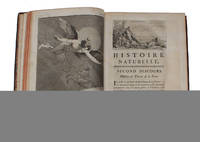
1804ref. 6665Paris: De l'Imprimerie Royale later Imprimerie des Bâtimens du Roi; Hôtel de Thou; Plassan 1804. First edition. First edition a very fine uniformly-bound contemporary set with the separately-issued and frequently-absent atlas to the Minéraux of the first work to present natural history as a continuous secular narrative-from planetary formation through geology and mineralogy to the quadrupeds birds fishes and cetaceans and at last to the human races-and the work in which across fifty-five years and four political regimes the biblical chronology that had organised European natural science since antiquity ceased to be the only frame within which educated readers could discuss the age of the earth. In the Époques de la Nature 1778 Buffon proposed seven epochs of earth history and from cooling experiments in his own forge at Montbard estimated its age at roughly seventy-five thousand years; in unpublished notes his private estimate reaches three million-the order of magnitude Lyell would later extract from stratigraphy and Darwin require for natural selection to operate. . The Founding Treatise of Secular Science. First edition of the first work to present natural history as a continuous secular narrative from planetary formation to the human races and the work in which across fifty-five years and four political regimes the biblical chronology that had organised European natural science since antiquity ceased to be the only frame within which educated readers could discuss the age of the earth. Ernst Mayr called Buffon "the father of all thought in natural history" at his time; the DSB records that he "established the intellectual framework within which most naturalists up to Darwin worked." Buffon was appointed Intendant du Jardin du Roi in 1739 at thirty-two and spent nearly half a century converting the royal cabinet of natural-history specimens into a compendium. At its close under Lacépède's hand in 1804 it comprised forty-four quarto volumes more than twelve hundred engraved plates and a style so supple that Buffon's elegies on individual species remained set texts in French lycées into the twentieth century. Uniformly bound in contemporary French mottled calf and preserving all forty-four text volumes together with the separately-issued and frequently-absent atlas to the Minéraux the present copy is of a completeness and coherence uncommon in a publication whose fifty-five-year issue spanned four successive Parisian imprints. Within thirty years of the final volume Lyell was writing the Principles of Geology; within sixty Darwin the Origin. The publishing history ran for fifty-five years through four imprints. The first three volumes appeared together in the autumn of 1749 from the Imprimerie Royale sold out in six weeks were reprinted three times within the same interval and provoked the Sorbonne's faculty of theology into delivering Buffon a list of propositions judged heretical-to which Buffon submitted a carefully calibrated retraction while continuing to print the offending volumes unchanged. The initial prospectus of 1748 had promised fifteen volumes in three divisions; by the time Buffon died in 1788 thirty-five were in print a thirty-sixth was on the press and the plan of covering the vegetable kingdom had quietly been abandoned. The seventh and final Supplément appeared posthumously in 1789 through Lacépède's editorship; the fifth volume of the Minéraux containing the Traité de l'aimant had issued a year earlier from the Imprimerie des Bâtimens du Roi and was accompanied by a separately-issued atlas of folding maps and tables. Lacépède then continued the animal-kingdom programme with the Quadrupèdes ovipares et Serpens 1788-89 the Poissons 1798-An XII and the Cétacées 1804. The combined output of four imprints across three generations of Parisian printers-the Imprimerie Royale the Imprimerie des Bâtimens du Roi the Hôtel de Thou under Panckoucke and Plassan and Plassan imprimeur-libraire-is the reason a uniformly-bound contemporary set is uncommon. Volume I opens the series with the Premier Discours: De la manière d'étudier et de traiter l'histoire naturelle a forty-page polemic against Linnaean classification that argues from a position of mathematical and empirical rigour rare in the literature of the period that species as Linnaeus conceived them were artificial abstractions imposed on the continuous variability of individuals and that a taxonomy built on stamen-counts and pistil-counts did not correspond to nature. The attack was political as well as philosophical. Linnaeus's Systema Naturae Leiden 1735 had already been adopted as the common grammar of European zoology; Buffon's Discours delivered from within the most prestigious press in France asserted that the Swede's method was a convenience of memory mistaken for a description of the world. The volume continues with the Second Discours: Histoire et théorie de la Terre dated by Buffon himself "à Montbard le 3 octobre 1744" which proposes a cosmogony in which the planets were struck from the sun by the oblique impact of a comet and have been cooling ever since and with the Preuves de la théorie de la Terre in which Buffon develops his theory across seventeen articles and provides two engraved terrestrial maps drawn under his supervision by Robert de Vaugondy fils. These arguments delivered within a volume bearing the royal arms of France on its title-page vignette constituted a public challenge to Mosaic cosmogony. The geological argument reached its mature form a generation later in the fifth Supplément the Époques de la Nature 1778 published when Buffon was seventy-one. Here he proposed seven epochs of the earth's history estimated their combined duration at roughly 75000 years and in unpublished manuscript notes pushed his private estimate to three million-an order of magnitude consistent with the timescales that Lyell would later extract from stratigraphy and that Darwin would require for natural selection to operate. Beyond the number the Époques argues by accumulation: Buffon marshals fossil molluscs at Alpine altitudes the decay of volcanic emissions the rate at which heated iron spheres cool in Buffon's own forge at Montbard and the distribution of living species across climate zones and weaves these into a cumulative inductive case in which each line of evidence corroborates the others. The technique is no longer antiquarian but probabilistic; Buffon had published a French translation of Newton's Method of Fluxions in 1740 and would publish original work on geometric probability. When the Époques reached Edinburgh and Cambridge in the 1780s it announced to Anglophone readers that the earth's antiquity had become a quantitative problem rather than a scriptural one. The core of the programme is the animal kingdom. Volumes 4 through 15 1753-1767 treat the quadrupeds in an arrangement that combines Buffon's natural-historical essays with Daubenton's anatomical descriptions-a division of labour Buffon defended in the Preface to volume IV and that Daubenton eventually came to resent his name disappearing from the later volumes. The Oiseaux volumes 1770-1783 are the work of Buffon with Philibert Guéneau de Montbeillard and the Abbé Bexon and assume decisively that geographic distribution is a datum of zoology rather than an incidental fact about individual animals-a premise that commits the Histoire naturelle to the biogeographic thinking which Alfred Russel Wallace would systematise a century later. The Minéraux volumes I-V 1783-1788 extend the account to the inorganic world and conclude with the Traité de l'aimant Buffon's last publication in his lifetime accompanied by the atlas that the present set preserves. Lacépède's eight continuation volumes close the series with the Ovipares et Serpens the Poissons five volumes 1798-An XII drawing on the manuscript collections of Philibert Commerson and the Cétacées 1804-the whole project begun under Louis XV and finished under the Consulate of Bonaparte. The plate programme numbering 1275 copper engravings including the portrait frontispiece of Buffon and twelve folding maps was entrusted principally to Jacques de Sève and his son Jacques-Eustache de Sève with additional designs by Buvée l'Amériquain Oudry and Baron and engravings by Baquoy Basan Moitte and Tardieu. De Sève père is the designing sensibility that defines the visual character of the Histoire naturelle: his quadrupeds stand in pastoral European landscapes-villages rivers mountains ruins-that place each species within a habitat rather than isolating it on the diagrammatic ground of the pre-Linnaean iconotheca. The aesthetic choice is not decorative. It performs Buffon's thesis that species are functions of geography; the elk against a Norwegian spruce-line and the jerboa against a North African dune argue in visual shorthand a zoogeography that the text elaborates. The plates in the present set are in the original uncoloured state as issued by the Imprimerie Royale and its successor presses; the hand-coloured Planches enluminées of Edme-Louis Daubenton 1765-1786 1008 plates issued separately to accompany the de luxe folio edition of the Oiseaux are a distinct publication and do not belong to the quarto edition. Buffon was born Georges-Louis Leclerc at Montbard in Burgundy on 7 September 1707 the son of a magistrate of the Estates of Burgundy who in 1714 inherited a substantial fortune from a maternal relative and acquired the lordship of Buffon - the toponym from which the future comte took the name by which he is universally known. He was educated by the Jesuits at Dijon studied mathematics at Angers and travelled in Italy and England in 1730-1733 in the company of the young Duke of Kingston and his Genevan tutor Nathaniel Hickman. Election to the Académie des Sciences followed at twenty-six in 1734. His earliest publications were French translations of Newton's Method of Fluxions 1740 and Stephen Hales's Vegetable Staticks 1735 and an original 1733 communication to the Académie on the geometric probability of a needle dropped at random across a ruled floor - the "needle problem" that bears his name in the founding literature of integral geometry. The 1739 appointment as Intendant du Jardin du Roi secured through the patronage of Maurepas gave him the cabinet the printing privilege and the institutional platform that the Histoire naturelle required. From 1739 onward his year was strictly bisected: October to April in Paris among the specimens May to September at Montbard where the great house the gardens the ducal tower and from 1768 an industrial-scale ironworks furnished both the writing room and the experimental laboratory. The Montbard forge is the experimental backbone of Buffon's late geological writing. From 1765 onward he conducted a sustained programme of cooling experiments in which iron and stone spheres of graduated diameter were heated to incandescence and the time required for them to cool to ambient temperature was measured under controlled conditions. Extrapolating from sphere to planet on the assumption that the earth had begun as a molten body progressively congealed Buffon arrived at the published 75000-year estimate of the Époques de la Nature and at the manuscript figure three million years that he allowed his students to read but did not put into print. The forge was simultaneously a working blast-furnace producing pig-iron for the Burgundian armaments trade - the revenue from which subsidised the publication and freed Buffon from dependence on royal subvention. The orangery at Montbard housed parallel experiments on plant respiration and the germination of seeds; the great walled garden was a controlled environment for testing the hardiness of imported species against Burgundian winters. The whole estate in effect was an early instance of the gentleman-natural-philosopher's establishment as instrument - comparable in scale to Tycho's Uraniborg to Boyle's Stalbridge or to Darwin's later Down House. The Histoire naturelle is the published face of this experimental enterprise. The literary reception of Buffon was nearly as consequential as the scientific. His 1753 reception address to the Académie française the Discours sur le style "le style est l'homme même" became one of the most quoted statements of French neoclassical aesthetics and reframed the Histoire naturelle as a literary as well as a scientific monument. The set-piece elegies on the horse the lion the swan the orangutan and the dog were detached from the parent volumes and circulated as morceaux choisis; they remained obligatory recitation pieces in the French lycée through the Third Republic and were anthologised by Sainte-Beuve in the Causeries du lundi in 1855 as the model of mid-eighteenth-century French prose. Diderot read and annotated the early volumes for the Encyclopédie; Rousseau with whom Buffon's relations were polite but distant took the geographic-determinist passages as silent corroboration of his own anthropology; Voltaire who shared Buffon's anti-Sorbonne instinct but resented his court success kept up a guarded correspondence. The Smellie translation Edinburgh 1780-1785 and Goldsmith's History of the Earth and Animated Nature London 1774 an avowed abridgment carried the work into the English-speaking world where Erasmus Darwin's Zoonomia 1794-96 silently absorbed Buffon's transformist hints into its own evolutionary speculation. The afterlife of Buffon's argument runs straight through nineteenth-century evolutionary thought. Cuvier lecturing at the Muséum d'Histoire Naturelle from 1795 treated the Histoire naturelle as the institutional charter of his own comparative-anatomical programme even while disputing its transformism. Lamarck who had reorganised the botanical galleries under Buffon in 1788 developed his 1809 Philosophie zoologique by extending Buffon's observations of climate-driven variability into a fully transformist mechanism. Lyell's Principles of Geology 1830-33 acknowledged in its preface that the eighteenth-century revolution in geological time had been Buffon's and Darwin in the historical sketch added to the third edition of the Origin 1861 placed Buffon at the head of the line of pre-evolutionary speculators - with the politically careful note that the Histoire naturelle had at one point been condemned by the Sorbonne. Thomas Jefferson who owned the work at Monticello Sowerby 1024 for volumes 1-31 and 637 for the Suppléments and corresponded with Buffon about American zoology was so stung by Buffon's thesis that New World fauna were degenerate forms of Old World types that he had the bones of an American moose shipped across the Atlantic to Paris as evidence in rebuttal. The German reception travelled along a separate but parallel channel: Goethe read the Époques in 1781 and absorbed its rhetoric of geological depth into his own morphological writing and Alexander von Humboldt whose Kosmos 1845-1862 is the nineteenth-century lineal descendant of the encyclopaedic ambition of the Histoire naturelle repeatedly cited Buffon as the founder of the genre to which he conceived his own work as belonging. The scholarly modern editions - the Imprimerie Nationale Pléiade selection of 1954 under the editorship of Jean Piveteau the 1971 Bibliothek Suhrkamp German selection edited by Jacques Roger and Roger's own 1989 Fayard biography translated as Buffon: A Life in Natural History Cornell 1997 - are all built on direct consultation of the original quarto edition of which complete uniformly-bound contemporary sets remain the necessary collation copy. The Centre international d'étude du XVIIIe siècle's Buffon: Histoire naturelle générale et particulière bibliography Pierre Lecouturier and Roger Hahn 1972 supplemented by Jeff Loveland and others through the 2010s confirms that no two contemporary sets are identical in title-page state advertisement leaves or the order of the prefatory matter and treats the uniformly-bound quarto with a complete Minéraux atlas as the bibliographical reference state for the work. References: Printing and the Mind of Man 198 Carter and Muir identify Buffon's priority in presenting the natural world as a single unified field - Dibner Heralds of Science 193 described as the most celebrated treatise on animals ever produced - Norman 369-370 - Evans First Editions of Scientific Books Berkeley exhibition 1934 no. 97 - Nissen ZBI 672 - Wellcome II 267 - Brunet I 1376 Brunet recommends that collectors always seek out this first quarto edition for the beauty of its engravings - Sowerby Catalogue of the Library of Thomas Jefferson 1024 and 637. 45 volumes 4to 242 × 188 mm comprising the 44 text volumes and the separately-issued atlas to the Minéraux. 1275 engraved plates including the portrait frontispiece of Buffon and twelve folding maps mostly by Jacques de Sève père and his son Jacques-Eustache de Sève with further designs by Buvée l'Amériquain Jean-Baptiste Oudry and Nicolas Baron engraved by Baquoy Basan Moitte and Tardieu. Uniform contemporary French mottled calf the spines gilt in compartments with small lozenge tools and two black morocco lettering-pieces triple gilt fillet on the covers marbled edges and matching Spanish-shell marbled endpapers; narrow blue silk ribbon markers at the heads of the spines. A very fine set. The Oiseaux volumes are numbered I-IX on their title-pages and continuously as tomes XVI-XXIV on their half-titles. . De l'Imprimerie Royale [later Imprimerie des Bâtimens du Roi; Hôtel de Thou; Plassan] unknown
1771ref. 122Buffon's Histoire Naturelle " One of the most important of all birds books from the collector's point of view " Stillwell 63. A magnificent copy complete with its 1 008 beautiful plates in contemporary coloring preserved in its contemporary binding. Contemporary painted calf gilt fillets on covers ribbed spine decorated with gilt fillets and gilt fleurons red yellow and green morocco lettering piece double gilt filet on leading edges inner gilt dentelle gilt edges. The most beautiful and most famous Buffon illustrated books. A very rare and magnificent copy printed on large paper and complete with its 1 008 handcouloured plates. Cohen 194 ; Nissen IV B 158 ; Brunet I 1379-1380 ; Ronsil 76. The 1 008 plates drawn by François-Nicolas Martinet 1731-1800 under Edmée-Louis Daubenton's supervision are dedicated to birds butterflies flying insects and to a few reptiles and mammals. All the plates were drawn and handcoloured at the time. Buffon decided to dedicate this separate beautiful edition to birds and ha dit printed in 4° and folio format. " One of the most important of all birds books from the collector's point of view " Stillwell 63. "In 1739 Buffon was appointed Director of the Jardin du Roi. It would appear that the "Natural History" germinated in the preparation of a catalogue of the royal collection. Buffon then enlarged its scope to Aristotelian or Plinian proportions and finally transformed it into a conspectus of nature of a breadth and depth previously unknown. The Natural History was a great popular success" PMM. A lot of copies are missing the insects supplement of 35 plates and only contain 973 plates. A magnificent copy belonging to the luxuous folio edition complete with its 1008 plates handcouloured at the time preserved in its contemporary binding. Copies' value depend on its number of plates and on its bindings. (Imprimerie Royale) hardcover
1766ref. ABC_47564Dordrecht: Abraham Blussé 1766. Contemporary uniform half tanned sheepskin sewn on 5 supports gold-tooled spines each volume with author subject and part number on 2 green spine labels in the 2nd and 3rd of 6 compartments paste-paper sides. Large 4to. With more than 1100 hand-coloured engraved plates 10 maps 1 folding engraved table and an engraved portrait of Buffon by Houbraken with an extra-added plain portrait pasted on the verso. 38 parts in 21 volumes. Including:Volume 1: tome 1: Théorie de la Terre 2 plates tome 2: Histoire générale des animaux 8 plates tome 3: Histoire naturelle de l'homme 18 plates. Volume 2: tomes 4 & 5: Les Quadrupèdes 23 and 60 plates and an engraved table of dogs. Volume 3: tomes 6 & 7: Les Quadrupèdes 49 and 48 plates Volume 4: tomes 8 & 9: Les Quadrupèdes 54 and 41 plates.Volume 5: tomes 10 & 11: Les Quadrupèdes 57 and 45 plates.Volume 6: tomes 12 & 13: Les Quadrupèdes 60 and 62 plates.Volume 7: tomes 14 & 15: Les Quadrupèdes 60 and 16 plates.Volume 8: Supplément tomes I - II 17 plates.Volume 9: Supplément à l'histoire de l'homme et aux animaux quadrupèdes - tomes III-IV 6 and 67 plates.Volume 10: Supplément les époques de la natures - tomes V-VI 46 and 6 plates 10 maps.Volume 11: Supplément tome VII 74 plates Volume 12: Histoire Naturelle des Oiseaux nouvelle édition tome 1: 29 platesVolume 13: Oiseaux: tomes 2 & 3: 27 & 31 platesVolume 14: Oiseaux: tomes 4 & 5: 28 & 22 platesVolume 15: Oiseaux: tomes 6 & 7: 25 & 31 platesVolume 16: Oiseaux: tomes 8 & 9: 39 & 31 plates. Volume 17: Histoire Naturelle des Minéraux nouvelle édition tomes 1 & 2; Volume 18: Minéraux: tomes 3 & 4; Volume 19: Minéraux: tome 5 traité de l'aimant et de ses usages.Volume 20: Histoire Naturelle des Quadrupèdes ovipares et des serpens nouvelle édition tome 1: 41 platesVolume 21: Quadrupèdes ovipares et des serpens: tome 2: 22 plates Finely hand-coloured copy of the 1766-1799 Netherlands edition in French of Buffon's justly famous Histoire naturelle the complete first series covering the formation of the earth humans mammalian quadrupeds and apes reptiles and amphibians birds fishes and even minerals also describing the royal collection of Louis XV. Buffon's work presents ''for the first time a complete survey of natural history in popular form'' PMM. The present set in the works rarest and most expensive form is exquisite. The subscription notices periodically mention copies printed on fine paper but they do not mention hand-coloured copies. Landwehr discussing the first Dutch-language edition no. 46 by the same publisher cites contemporary sources referring to four forms of publication: on regular paper on large paper with hand-coloured plates and most expensive of all with hand-coloured plates and vignettes.Buffon opens the first volume with an essay called "Théorie de la terre" where "for the first time he outlines a satisfactory account of the history of our globe and of its development as a fitting home for living things. In his view the earth had been originally part of the sun which was broken off by the impact of a comet. It gradually condensed from its gaseous state and the forces shaping its continents and mountains are still active'' PMM. From his exhaustive research for the Histoire naturelle des quadrupèdes Buffon came to the conclusion that it was necessary to reintroduce the notion of family. Breaking with the spirit of his time Buffon attempted to separate science from metaphysical and religious ideas. As a disciple of Locke he denied idealistic metaphysics stating that mental abstractions can never become principles of either existence or real knowledge; these can come only as the results of sensation'' DSB.Buffon did not believe in the fixity of species but proposed that nature is constantly changing. For instance in the case of quadrupeds he stated that there were 38 basic types that degenerated over the centuries. According to Buffon the monkey is a degenerated man the ass a degenerated horse. His interest in the precise connection between groups of animals that are obviously related prompted Buffon to devote much attention to comparative anatomy in the Histoire naturelle. He also stressed the importance of the study of earth sciences for botany and zoology. "Life and animation instead of being a metaphysical point in being is a physical property of matter" DSB. Buffon's views on the origin and development of species and the history of the earth show how he tried to describe natural phenomena by means of science discarding metaphysical and religious explanations. "He was the first to create an autonomous science free of any theological influence . and established the intellectual framework within which most naturalists up to Darwin worked" DSB.Buffon was assisted by the anatomist Louis Daubenton and others and the final volumes were completed after his death under the direction of Comte de Lacépède.With the owners name Sir George. Murray 1772-1846 on the half-title of most volumes. He was a Scottish soldier from a noble family who served in Flanders the West Indies Egypt and elsewhere eventually becoming quarter master general of Wellingtons staff in Spain and Portugal and reaching the rank of General. He was Knighted in 1813 held governorships of several colonies and the military college at Sandhurst along with leading posts at the Colonial Office where he helped establish the colony of Western Australia and served from 1823 as a member of the British parliament. With the bookplate of the German entrepreneur and bibliophile Hans Dedi 1918-2016. Lacking a few half-titles for example in the bird volumes 1 and 2 but otherwise in very good condition most of the plates fine with occasional stains and spots a few tears and repairs the binding also with some minor wear and repairs. A splendid copy of a seminal monument of natural history.l Landwehr Coloured plates 45 and 46 Dutch ed.; Nissen ZBI 678. Abraham Blussé, unknown