WATERS, Thomas JBiblio.com

4.103 Ergebnisse
1880Best.-Nr. 14974Shanghai 1880. 880 by 960mm. 34.75 by 37.75 inches. Lithographed map dissected and laid down on linen in 24 sections with contemporary hand-colour in full; preserved in original publisher's green cloth slipcase. Compiled by Thomas Waters 1842-1898 "expressly for Sportsmen" slipcase label. Waters was an Irish civil engineer and architect who carved out a successful early career in Japan designing the Imperial Mint in Osaka and the headquarters for the Imperial Japanese Army. He worked briefly in Shanghai in the 1880s before going out to Colorado to join his brothers in silver and gold mining. This map also appeared in cyanotype probably originally drawn up as part of Waters' bid for the commission to construct a new waterworks in Shanghai. Waters was a strong contender in the competition as he had experience in the field: he was partially responsible for the construction of Japan's first sewer system. Rare: OCLC locates only two institutional examples those in the BnF and University of Chicago. hardcover
1889Best.-Nr. 2356Paris, Imprimerie Autog. Aost & Gentil, sans date [1889]. In-Plano – 49 x 65 cm. Reliure de l’époque en demi-chagrin bleu marine à coins, triples filets à froid en encadrement des plats de toile, titre, dates et blason parisien dorés sur le premier plat. Exemplaire entièrement monté sur onglets. 1 f. bl. ; 2 planches doubles + 4 planches (6 photographies originales), 1 p. (titre), 3 p. (texte autographié imprimé), 19 planches doubles (plans, coupes, façades et détails). ALPHAND ; HUET ; BECHMANN ; DIET ; JOURNET ; DUTOIT ; VILLE DE PARIS (auteurs). Entrepreneurs : LAZIES (maçonnerie). MATHELIN et GARNIER (Fontainerie). Rare et important ouvrage illustré de 6 photographies originales, dont 2 sur double page, et de 19 planches doubles, techniques et architecturales, témoignant de l’ampleur des travaux effectués à Montmartre à la fin du XIXe siècle, afin d’améliorer l’alimentation en eau d’un quartier en pleine croissance démographique. En effet, les sources naturelles présentes sur les flancs de la butte qui alimentèrent longtemps de nombreuses fontaines ne suffisaient plus : il fallait donc aller capter de l’eau de rivières (ce que permet dès 1834 une machine hydraulique édifiée à Saint-Ouen), la monter au sommet – au moyen d’une pompe à vapeur -, et enfin la stocker, d’où la construction en 1835 d’un château d’eau qui fonctionnera jusqu’en 1927. A partir de 1887, sous la houlette d’Adolphe Alphand, Directeur des Travaux de la Ville de Paris, sont entrepris deux chantiers de grande envergure. Le premier est la construction de deux réservoirs (un « grand » et un « petit »), dotés d’une capacité totale de 11 000 m3, dont la conception est confiée aux ingénieurs Bechmann et Journet et les plans sont dressés par l’architecte Diet (photographies 4 et 5). L’ouvrage occupe l’emplacement de l’ancien pressoir à raisins de l’abbaye des Dames de Montmartre, rue Azaïs, sur une colline sableuse à environ 128 m d’altitude. La nature du sol complexifie énormément les travaux, d'autant que l'usage du béton pour les fondations, d'un coût prohibitif, est exclu. Les deux concepteurs ont donc misé sur la pression de l'eau contenue dans les réservoirs pour stabiliser le banc de sable présent à cet endroit. Néanmoins, une partie de ce sable (avec les gravats) fut évacuée par des wagonnets tirés par une locomotive à vapeur (photographie 3), tandis que l'on imaginait d'ingénieux systèmes pour garantir l'étanchéité de l'édifice. Le sous-sol, les murs et le sol sont donc réalisés en meulière, les voûtes de la couverture en briquettes, et les piliers intérieurs en maçonnerie de brique de Bourgogne. Autre contrainte : la proximité du Sacré-Cœur (édifié à partir de 1886), qui requiert une harmonisation du style décoratif du bâtiment avec l’architecture néo-byzantine de la basilique (photographie 6), et là intervient le calcaire blanc des carrières de Souppes-sur-Loing et Château-Landon. Le second chantier de cette même année 1887 est celui de la nouvelle usine de relevage (ou élévatoire) Saint-Pierre, qui alimente à la fois le château d’eau et le réservoir. Ce dernier, définitivement opérationnel en 1889, pourvu de respectivement deux et trois étages, distribue l’eau dans les quartiers bas de Montmartre encore de nos jours. Les deux premières photographies, sur doubles pages, prises en 1886 et 1889, attestent de la transformation du paysage de la butte lorsque les réservoirs sont achevés.
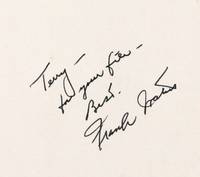
1994Best.-Nr. 68940Various places 1994. Frank Waters 1902-1995 was perhaps the preeminent writer of the American Southwest in the 20th century. His writings described the culture of the Southwest in all of its diversity - Anglo Hispanic and Native American. He wrote fiction history and interpretive studies. Terence A. Terry Tanner a friend of many in the book trade was a respected antiquarian book dealer and at the time of his death in 2003 was owner of the Chicago-based firm Hamill & Barker. Terry was born in Chicago in 1948 attended Knox College in Galesburg IL where he met the antiquarian book seller Clare Van Norman Sr. who introduced him to the book trade. When Terry graduated from Knox College in 1970 he moved back to Chicago where he found a job working as the office manager for Van Allen Bradley the rare book dealer and literary editor of the Chicago Daily News. Tanner next worked as an assistant to the distinguished antiquarian Kenneth Nebenzahl and in 1975 became an assistant to the well-known booksellers Frances Hamill and Margery Barker. He became the sole owner of their firm in 1987 following the death of Ms. Hamill Ms. Barker having died in 1980. Terry was introduced to the writings of Frank Waters by Morton Weisman of the Swallow Press in 1970. He continued purchasing books by Waters throughout the early and middle 1970's and near the end of that decade decide to undertake a descriptive bibliography of Waters' work. That bibliography was published by Meyerbooks of Glenwood Illinois in the late summer of 1983 as Frank Waters: A Bibliography with Relevant Selections from His Correspondence. This collection is the basis for that bibliography. The collection contains the first printing of every primary work published by Frank Waters from his first book published in 1930. Moreover every copy is present in the original dust jacket and was the product of continual upgrading. In addition the collection contains numerous later printings of all of Waters's books including some that are rarer than the first printings. For example while preparing his bibliography Terry was unable to locate a copy of the paperback printing of Diamond Head issued under the title Secret Affair. That printing finally was added to the collection. Frank Waters destroyed the manuscripts for his early books and those that exist for most of his other works are already in institutions. The Tanner collection contains the corrected carbon typescript of the manuscript for Leon Gaspard which is probably the only manuscript of Frank Waters in private hands. The Tanner collection must certainly rank among the very best collections of Frank Waters in private hands today. A detailed inventory with all the items listed according to Tanner's bibliography in chronological order is available on request. unknown