1,692 results
ref. 10526Chez Deterville. Imprimerie de A. Belin. 1817. 4 tomes en 4 volumes. Grand in-8°. Les volumes sont brochés, sous couverture muette d'époque, de couleur vieux-rose. 15 planches gravées hors texte en fin du dernier tome. Rare E.O. d'un des plus importants ouvrages de Cuvier.
1798ref. 871798 Paris, Baudouin, 1798 ; in-8 de xvi-710 pp., 14 pl., demi-basane, dos lisse orné, pièce rouge, tranches mouchetées (reliure de l'époque).
ref. 57151Paris, Baudoin, An 6 [1798], in-8, de XVI, 710 pages et 14 planches, basane fauve raciné de l'époque, dos lisse orné (accrocs au dos et coins émoussés), PREMIERE EDITION. 14 pl. h.t. gravées sur cuivre. Exposition des premiers éléments de la classification des animaux que l'auteur développera dans un autre ouvrage : le Règne animal. Rousseurs. Couverture rigide
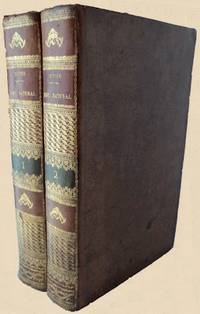
ref. 1006JC059POR Mr. CUVIER. TRADUZIDO EM PORTUGUEZ E OFFERECIDO A S. A. R. O PRINCIPE R. N. S. POR ANTONIO D'ALMEIDA CAVALLEIRO DA ORDEM DE CHRISTO CIRURGIÃO DA REAL CAMARA LENTE D'OPERAÇOENS NO HOSPITAL REAL DE S. JOZE EM LISBOA E MEMBRO EFFECTIVO DO REAL COLLEGIO DOS CIRURGIOENS DE LONDRES. LONDRES: IMPRESSO POR H. BRYER BRIDGE STREET BLACKFRIARS. Anno 1815. Obra em 2 volumes. In 8.º de 21x12 cm. Com xix 458 e 424 xxix págs. Encadernações da época inteiras de pele com finos ferros a ouro nas lombadas. Profusamente ilustrado com 14 litografias. O 2º volume apresenta um carimbo oleográfico de posse na folha de rosto. As folhas de rosto de ambos os volumes com leves vestígios de acidulação. Ilustrações. No 1º volume: 7 estampas litografadas de J. Walker com aspectos anatómicos que permitem a classificação dos mamíferos e aves. 1 tabela desdobrável com a classificação geral das classes dos animais 1 tabela desdobrável com a classificação dos mamíferos 1 tabela desdobrável com a classificação das aves 1 tabela desdobrável com a classificação dos répteis 1 tabela desdobrável com a classificação dos peixes. No 2º volume: 7 estampas litografadas de J. Walker com aspectos anatómicos que permitem a classificação de outros animais tais como insectos e inclusivamente dos corais. 1 tabela desdobrável com a classificação dos moluscos 1 tabela desdobrável coma classificação dos insectos 1 tabela com a classificação dos crustáceos 1 tabela desdobrável com a classificação dos zoófitos incluindo os corais. No final da obra apresentam-se 3 índices das classes ordens e géneros respectivamente em língua portuguesa em nomes latinos e em língua francesa. A importância desta obra reside exactamente nestes índices e em toda a nomenclatura portuguesa introduzida na obra que foi da inteira responsabilidade de Félix de Avelar Brotero. Deste modo a obra possui dois prefácios: o prefácio do tradutor António d´Almeida e o prefácio do nomenclador português Avelar Brotero que por ordem superior foi encarregado de juntar os nomes portugueses aos nomes franceses e latinos tarefa segundo o mesmo muito difícil devido ao estado da ciência em Portugal e ao período das Invasões Napoleónicas de que resultava não existirem nem obras portuguesas nem zoólogos em Portugal para esta tarefa. A ciência portuguesa tinha-se baseado no profundo conhecimento prático das espécies trazidas das colónias e na sua acumulação em colecções sendo arrumadas o melhor possível dentro das classificações lineanas. Nesta obra Brotero afirma que reviu corrigiu e anotou esta obra de Cuvier procurando não desfigurar a versão portuguesa com galicismos e efectuando uma investigação aos vocabulários portugueses. Esta obra de Zoologia publicada em 1797-98 em França foi a mais reputada na sua época tendo portanto a sua tradução para português resultado do interesse de António d´Almeida durante o período que residiu em Londres e do patrocínio régio através do embaixador português em Inglaterra - o Conde do Funchal que requereu os serviços de Félix Avelar Brotero. Inocêncio I 83 e II 262 ANTONIO DE ALMEIDA Comendador da Ordem de Cristo Cirurgião da Real Câmara Lente de operações no Hospital Real de S. José Membro do Real Colégio dos Cirurgiões de Londres etc. - Ignoro por agora o que diz respeito à sua naturalidade e data do nascimento constando-me apenas que era da província da Beira filho do Doutor José Diogo e de sua mulher D. Ana de Almeida. Morreu no Campo Grande próximo de Lisboa a 30 de Julho de 1822. Quadro Elementar da Historia dos Animauis por Mr. Cuvier traduzido em portuguez. Londres por H. Bryer 1815. 8.º gr. 2 volumes com estampas. - Esta tradução foi empreendida por conselho e a instâncias do Conde do Funchal embaixador em Londres onde Almeida também se achava naquele tempo. A nomenclatura portuguesa é toda do Doutor Brotero que dela se encarregou por ordem superior como ele próprio adverte em uma prefação colocada no princípio do tomo I. BROTERO: Afora estes trabalhos é sua a Nomenclatura portuguesa que fez para o Quadro elementar da Hist. natural dos Animaes de Cuvier traduzido por A. de Almeida. EN 2 volumes. In octavo. 21x12 cm. xix-458 and 424-xxix pp. Contemporary full leather binding with fine gold tooling on the spines. Profusely illustrated with 14 lithographs. The 2nd volume has an oleographic ownership stamp on the title page. The title pages of both volumes with light traces of acidulation. Illustrations. In the 1st volume: 7 lithographed prints by J. Walker with anatomical aspects allowing the classification of mammals and birds. 1 fold-out table with the general classification of the classes of animals 1 fold-out table with the classification of mammals 1 fold-out table with the classification of birds 1 fold-out table with the classification of reptiles 1 fold-out table with the classification of fishes. In the 2nd volume: 7 lithographed prints by J. Walker with anatomical aspects that allow the classification of other animals such as insects and even corals. 1 fold-out table with the classification of molluscs 1 fold-out table with the classification of insects 1 table with the classification of crustaceans 1 fold-out table with the classification of zoophytes including corals. At the end of the book there are three indexes of classes orders and types in Portuguese Latin names and French respectively. The importance of this work lies exactly in these indexes and in all the Portuguese nomenclature introduced in the work which was entirely the responsibility of Félix de Avelar Brotero. Thus the work has two prefaces: the preface by the translator António d"Almeida and the preface by the Portuguese nomenclator Avelar Brotero who 'by superior order was charged with joining the Portuguese names to the French and Latin names' a task according to him very difficult due to the state of science in Portugal and the period of the Napoleonic Invasions which resulted in there being neither Portuguese works nor zoologists in Portugal for this task. Portuguese science had been based on a deep practical knowledge of the species brought from the colonies and their accumulation in collections being 'arranged' as best as possible within the Linean classifications. In this work Brotero states that he revised corrected and annotated Cuvier"s work trying not to disfigure the Portuguese version with Gallicisms and carrying out research into Portuguese vocabularies. This work of Zoology published in 1797-98 in France was the most reputed in its time and its translation into Portuguese resulted from the interest of António d"Almeida during the period he lived in London and from the royal patronage through the Portuguese ambassador in England - the Count of Funchal - who requested the services of Félix Avelar Brotero. Inocencio I 83 and II 262 'ANTONIO DE ALMEIDA Commander of the Order of Christ Surgeon of the Royal Chamber Professor of Operations at the Royal Hospital of St. Joseph Member of the Royal College of Surgeons of London etc. - I don"t know for the moment what concerns his birthplace and date of birth but I only know that he was from the province of Beira son of Doctor José Diogo and his wife D. Ana de Almeida. He died in Campo Grande near Lisbon on July 30th 1822. Quadro Elementar da Historia dos Animais by Mr. Cuvier translated into Portuguese. London by H. Bryer 1815. 8th gr. 2 volumes with prints. - This translation was undertaken on the advice and at the instigation of the Count of Funchal ambassador in London where Almeida was also at the time. The Portuguese nomenclature is all by Dr. Brotero who was in charge of it by superior order as he himself warns in a foreword placed at the beginning of volume I. BROTERO: Besides these works is his Portuguese Nomenclature which he made for the elementary Table of the Natural History of Animals by Cuvier translated by A. de Almeida. Referências/References: Inocencio I 83 and II 262. Cordier BI. 1817. Pritzel 5637. Stafleu-C. 5038. Sousa da Câmara 1738. 'Estimada e pouco vulgar Esteemed and unusual.' M-16-D-31 hardcover
ref. 56395in French with translation sending her "the tickets for entry to the Museum of Natural History" at the Jardin du Roi in Paris now the Jardin des Plantes and saying "each ticket can be used for 4 persons" no place 1 side 8vo Friday 12th January light brown mark touching a short part of three lines all perfectly legible Translation Monsieur Cuvier has the honour to send Madame Campbell the tickets for entry to the Museum of Natural History for which she asked each ticket can be used for 4 persons. Friday 12th January 1826. Cuvier's Animal Kingdom 1817 classified living and fossil animals by their structure and his geological researches were summed up in his Revolutions of the Surface of the Globe 1825. In 1808 Napoleon appointed him President of the National University and he worked for public education all his life. unknown
1837ref. 74593G. Hendserson London 1837. hardback. very good condition rebound in brown cloth 2 volumes of text in one volume and 2 volumes of plates oin the other volume. no dust jackets. shipping via USPS G. Hendserson, London hardcover
1827ref. 40223Paris 1827. Cuvier Georges 1769-1832. Letter signed to Samuel H. Christie 1784-1865. Paris 29 October 1827. 1 sheet on letterhead of the Académie Royale des Sciences. 222 x 169 mm. Trimmed at head affecting printed letterhead but not the manuscript text. Very good. From the great French naturalist and zoologist Baron Cuvier whose work helped to establish the modern sciences of paleontology and comparative anatomy to British mathematician and physicist Samuel Hunter Christie who made important contributions to the study of magnetism. Cuvier was perpetual secretary of the Académie des sciences and his letter to Christie acknowledging Christie's donation of several of his papers on magnetism to the Académie is written in that capacity. "L'Académie Monsieur a reçu les ouvrages que vous avez bien voulu lui adresser extraits des transactions philosophiques . . . J'ai l'honneur de vous offrir les remerciemens de l'Académie et de vous témoigner en son nom tout le prix qu'elle attache à ces publications . . ." The Academy Sir received the books that you kindly send him excerpts from Philosophical Transactions. . . I am pleased to offer the thanks of the Academy and to express to you on its behalf of all the value it attaches to these publications . . . . unknown
1815ref. 57049Paris: Paris: Museum d’Histoire Naturelle 1815. Sammelband of 16 Articles Originally Appearing In The Annales Du Museum d’Histoire Naturelle. Hardcover. Good Solid Copy Penned Contents List Clean Contents Wear And At Extremities Stamp For Dr. Paul Sevres On Fep Some Foxing To Text and Occasional Pencil Anotations To Figures in Plates. Sm Quarto Contemporary Black Quarter Morocco With Four Raised Bands Marbled Boards and End Papers. Engraving Plates. 10.5 8.5 1.1 Articles Include: Memoire sur la Limace limax L. et le Colimacon helix L. Volume 7 1806. 45pp. 2 Lithograph Plates; Memoire sur L’Haliotide ou Oreille de mer sur le SSigaret sur legenre Patelle et ses demembremens Sawoir: LaFissurelle L’Emarginule la Crepidule la Navicelle et le Caboachon. enfin sur L’Oscabrion et la Pterotrachee n.d.39pp.3 Plates; Memoire sur l’animal de la lingule Lingula anatine lam. Vol. I 1802. 12pp.1 Plate; Memoire sur la Guze Doris. Vol. 4 1804. 27pp. 2 Plates; Memoire sur les Thalides thalia Brown et sur les Biphores Salpa Forskaohl. Vol. 4 1804. 23pp1 Plate; Memoire Concernant l’animal de l’Hyale.Vol.4 18i04. 10 pp. 1 Plate; Memoire sur la Scyllee. L.Eolide et le Glaucus avec des additions au Memoire sur la Tritonie. Vol. 6 1805 29 pp. 1 Plate; Memoire sur la Dolabelle sur la Testacelle et sur un nouveau genre de Mollusques a coquille cache nommee Parmacelle. Vol.5 1804. 10 PP. 1 Plate: Memoire sur L’onchidie Genre de Mollusques nus. voisin des Limaces et sur un espece nouvelle onchidium peronii nd. 14pp. 1 Plate; Memoire sure la Vivipare d’eau douce cyclostoma vivparum Draparn. Helix vivipara L. Sur quelques especes voisines Vol. 111808. 19pp.1 Plate; Memoire dur le grand Buccin de nos cotes buccinum undatum L. et sur son Anatomie. Vol.11 1808. 11pp. 1 Plate; Memoire sur le genre Thetys et sur son Anatomie nd.14pp. 1 Plate; Memoire sur la janthine et sur la phasianelle de M. Lamark. Vol. 111808. 15 pp. 1 Plates: Memoire sur les Acres ou Gasteropodes sans tentacules apparens. Vol.16 1810. 18pp. 1 Plate; Memoire sur les animaux des anatifes et des balanes Lam. Lepas L. et sur leur Anatomie. Vol.2 1815. 17 pp. 1 Plate 1802-1815 Paris: Museum d’Histoire Naturelle hardcover
1827ref. 40223Paris 1827. Cuvier Georges 1769-1832. Letter signed to Samuel H. Christie 1784-1865. Paris 29 October 1827. 1 sheet on letterhead of the Académie Royale des Sciences. 222 x 169 mm. Trimmed at head affecting printed letterhead but not the manuscript text. Very good. From the great French naturalist and zoologist Baron Cuvier whose work helped to establish the modern sciences of paleontology and comparative anatomy to British mathematician and physicist Samuel Hunter Christie who made important contributions to the study of magnetism. Cuvier was perpetual secretary of the Académie des sciences and his letter to Christie acknowledging Christie's donation of several of his papers on magnetism to the Académie is written in that capacity. "L'Académie Monsieur a reçu les ouvrages que vous avez bien voulu lui adresser extraits des transactions philosophiques . . . J'ai l'honneur de vous offrir les remerciemens de l'Académie et de vous témoigner en son nom tout le prix qu'elle attache à ces publications . . ." The Academy Sir received the books that you kindly send him excerpts from Philosophical Transactions. . . I am pleased to offer the thanks of the Academy and to express to you on its behalf of all the value it attaches to these publications . . . . unknown books
ref. 79162Paris G. Dufour et E. d'Ocagne 1822. 4to 31.5 x 23.5 cm. ix 428 pp.; one brightly hand-coloured geological map of the surroundings of Paris and 17 lithographed plates including one hand-coloured geological map of the basins of London and Paris. Publisher's orange-red mottled interim boards. = Rare much enlarged second edition of the Essai sur le géographie minéralogique. with 17 additional plates. Originally written by the French anatomist zoologist and palaeontologist Georges Léopold Chrétien Frédéric Dagobert Cuvier 1769-1832 and the French geologist Alexandre Brongniart 1770-1847; but this edition edited and expanded by Brongniart alone. Plate numbering is as follows: I.A.; II.A.; I.B.; II.B.; I.C.; II.C.; I.D.; II.D.; III-XI. Uncut. Front board detached; spine covervlargely perished. Some marginal soiling and occasional light spotting one plate more spotted but mostly clean. A very good copy. Ward and Carozzi 565. Not in Nissen. hardcover
ref. 10626-8170416655Paperback. New. Book Condition is in New Paperback Original Edition. Shipped Same Day. We do not ship APO and FPO. Will be dispatched fast. Please send me an email if you have any questions. 100% Satisfaction. paperback
2007ref. Star-9788170416654Anmol Publications Pvt Ltd 2007. Hardcover. New. Anmol Publications Pvt Ltd hardcover
1998ref. STM-9788126101092India: Anmol Publications Pvt. Ltd. 1998. Hardbound. Brand New. Book Condition:- Brand New. Secured Packaging. Fast DeliveryBookseller Inventory # 9788126101092 Anmol Publications Pvt. Ltd. hardcover
ref. 90743London Geo. B. Whittaker 1827 1st edition. Five Volumes. Hardback tall 8vo. 9.5 x 6 inches. In maroon full calf leather fine bindings diced and gilt paneled boards raised bands and gilt decorations to spines with twin black leather spine labels. Brown speckled page edges marbled endpapers. In very good condition. Covers rubbed some surface chips/nicks to leather on edges of boards. Spines and front of vol.5 faded. Also rear of vol.1 with some staining. Small binders label to corner of endpaper in v1. "W. Cater Launceston." Previous owners bookplates to endpapers "Rev.d Rich.D Gerveys Grylls Helston Cornwall." Some occasional minor handling marks else pages overall very clean and tight throughout. Barring some accumulated dust between top page edges. Colour plates all very clean and bright with lovely bright colouring. Else an very good set. 5 volumes: 352 513 468 498 & 391pp. Illustrated with 200 engraved plates 178 coloured and 23 in B&W. A comprehensive guide to the Animal Kingdom beginning with Man and the vertebrates. Based on the knowledge available in the late 19th century. Beautiful illustrations by Landseer. London, Geo. B. Whittaker, 1827 1st edition hardcover
1817ref. 20421Paris:: Chez Deterville 1817. First edition. contemporary quarter sheep gilt and marbled boards. Old stamped ownership signature on each front free endpaper; some light rubbing to the bindings. A very attractive set. 8vo. 15 engraved plates. PMM 276. Half-titles present. Chez Deterville, hardcover
1846ref. 1948Paris: Crochard et Cie 1846. Second expanded edition. PIONEERING ESTABLISHMENT OF THE SCIENCE OF COMPARATIVE ANATOMY. Eight volumes in 9 bindings 8 1/2 inches tall Vol. 4 is in 2 parts. Green quarter leather binding with gilt titles and compartments marbled paper covered boards patterned endpapers bookplate of NSR Maluf to each volume Vol. I i-xxxiii lithographic facsimile of letter from Cuvier 587 pp 1; Vol. II i-viii 726 pp; Vol. III 4 i-iv 760 pp; Vol. IV pt 1 i-xxvii 618 pp 4; Vol. IV pt 2 i-iv 691 pp 1; Vol. V i-viii 503 pp folding table; Vol. VI i-vii 557 pp 1 folding table; Vol. VII i-vii 1 656 pp; Vol. VIII i-xii. 848 pp. Covers corners spine ends worn light browning to pages the first blank and usually the half title of each volume have top edge corners clipped presumably to remove a signature not affecting text. Bindings tight pages unmarked very good in custom archival mylar covers. CONTENTS: Vol. I contains the principal discussion of Cuvier's famous theory of the correlation of parts- the functional relationship of each bodily organ to every other organ. Also considered are the organs of movement of vertebrate animals; Vol. II addresses the organs of movement of invertebrate animals and the osteology of the head; Vol. III considers the nervous system and sense organs; Vol. IV reviews the organs of mastication salivation and swallowing in vertebrate animals; Vol. V reviews the feeding organs of invertebrate animals; Vol. VI explores the nutritive fluid its reservoirs and the organs that set it in motion in the four types of the animal kingdom; Volume 7 the description of the organs of elaboration and purification of the nutritive fluid through respiration and urinary secretion; and Volume 8 the organs of generation and secretions the swim bladder of the fish and the organs of vocalization. GEORGES CUVIER 1769 – 1832 was a French naturalist and zoologist sometimes referred to as the "founding father of paleontology". Cuvier was a major figure in natural sciences research in the early 19th century and was instrumental in establishing the fields of comparative anatomy and paleontology through his work in comparing living animals with fossils. He expanded Linnaean taxonomy by grouping classes into phyla and incorporating both fossils and living species into the classification. He laid the foundations for a method of analysis and comparison applied to the entire animal kingdom and a new branch of natural history was born thanks to his scientific collaboration with Geoffroy Saint-Hilaire. This was based on the theory that anatomical and physiological characteristics of animals are molded by their environment. He established four major families: vertebrates mollusks arthropods and radiates. He was the first to apply the concept of an ecosystem viewing it as a vast network in which species interact with one another. GARRISON-MORTON No. 311 "Cuvier played a leading part in the development of paleontology and stimulated the study of comparative anatomy. He ranks with von Baer as one of the founders of modern morphology. The posthumous second edition offered here revised and expanded by Georges Cuvier's younger brother Georges-Frédéric Cuvier to 8 vols. appeared from 1835-1846." Crochard et Cie hardcover
1846ref. 1948Paris: Crochard et Cie 1846. Second expanded edition. PIONEERING ESTABLISHMENT OF THE SCIENCE OF COMPARATIVE ANATOMY. Eight volumes in 9 bindings 8 1/2 inches tall Vol. 4 is in 2 parts. Green quarter leather binding with gilt titles and compartments marbled paper covered boards patterned endpapers bookplate of NSR Maluf to each volume Vol. I i-xxxiii lithographic facsimile of letter from Cuvier 587 pp 1; Vol. II i-viii 726 pp; Vol. III 4 i-iv 760 pp; Vol. IV pt 1 i-xxvii 618 pp 4; Vol. IV pt 2 i-iv 691 pp 1; Vol. V i-viii 503 pp folding table; Vol. VI i-vii 557 pp 1 folding table; Vol. VII i-vii 1 656 pp; Vol. VIII i-xii. 848 pp. Covers corners spine ends worn light browning to pages the first blank and usually the half title of each volume have top edge corners clipped presumably to remove a signature not affecting text. Bindings tight pages unmarked very good in custom archival mylar covers. CONTENTS: Vol. I contains the principal discussion of Cuvier's famous theory of the correlation of parts- the functional relationship of each bodily organ to every other organ. Also considered are the organs of movement of vertebrate animals; Vol. II addresses the organs of movement of invertebrate animals and the osteology of the head; Vol. III considers the nervous system and sense organs; Vol. IV reviews the organs of mastication salivation and swallowing in vertebrate animals; Vol. V reviews the feeding organs of invertebrate animals; Vol. VI explores the nutritive fluid its reservoirs and the organs that set it in motion in the four types of the animal kingdom; Volume 7 the description of the organs of elaboration and purification of the nutritive fluid through respiration and urinary secretion; and Volume 8 the organs of generation and secretions the swim bladder of the fish and the organs of vocalization. GEORGES CUVIER 1769 – 1832 was a French naturalist and zoologist sometimes referred to as the "founding father of paleontology". Cuvier was a major figure in natural sciences research in the early 19th century and was instrumental in establishing the fields of comparative anatomy and paleontology through his work in comparing living animals with fossils. He expanded Linnaean taxonomy by grouping classes into phyla and incorporating both fossils and living species into the classification. He laid the foundations for a method of analysis and comparison applied to the entire animal kingdom and a new branch of natural history was born thanks to his scientific collaboration with Geoffroy Saint-Hilaire. This was based on the theory that anatomical and physiological characteristics of animals are molded by their environment. He established four major families: vertebrates mollusks arthropods and radiates. He was the first to apply the concept of an ecosystem viewing it as a vast network in which species interact with one another. GARRISON-MORTON No. 311 "Cuvier played a leading part in the development of paleontology and stimulated the study of comparative anatomy. He ranks with von Baer as one of the founders of modern morphology. The posthumous second edition offered here revised and expanded by Georges Cuvier's younger brother Georges-Frédéric Cuvier to 8 vols. appeared from 1835-1846." Crochard et Cie hardcover books
ref. 6128P., Baudouin, An 6 (1798), un volume in 8 relié en plein veau, dos orné de fers dorés, filets dorés sur les plats, toutes tranches dorées (reliure de l'époque), (une coiffe usée, un mors fendu mais solide, manque de papier d'origine dans la marge du feuillet 679 sans atteinte au texte), 16pp., 710pp., 14 PLANCHES
1817ref. RO80000899Deterville. 1817. In-8. Relié demi-cuir. Bon état, Couv. convenable, Dos frotté, Intérieur frais. 255 pages.15 planches. Planche 1et 2 tachées.. . . . Classification Dewey : 590-Zoologie
ref. 15903Paris, Crochard, Fortin, Masson , 1835 à 1846.
1798ref. 62600Paris, Baudouin, 1798, in-8, XVI-710 pp, 14 pl, Demi-basane blonde, dos lisse et orné, pièce de titre noire, Édition originale du premier ouvrage de Cuvier, fondé sur les lectures qu'il fit à l'école du Panthéon l'an précédent. Dans sa Notice historique sur les ouvrages et la vie de M. le baron Cuvier Duvernoy écrit les "immenses services que M. Cuvier a rendus à la partie systématique de l'histoire naturelle, en introduisant dans les classifications zoologiques la méthode de l'ensemble des rapports; en distribuant dans un mot, le règne animal... M. Cuvier publia en 1798 sous le titre Tableau élémentaire de l'histoire naturelle des animaux, le premier exemple de cette distribution, telle que son génie avait conçue". Bien complet. Les feuillets liminaires (préface et explication des figures), ainsi que les planches sont reliés dans le désordre. Charnières fendillées. Nissen n° 1012. Couverture rigide
ref. 67369Paris A. Belin 1819-1829. Large folio approximately 53 x 35 cm. Five plates with explanatory text leaves. Not bound as issued. = Rare part of a magnificent publication with fine large plates of mammals from all over the world. The authors Geoffroy Saint-Hilaire 1772-1844 and Fréderic Cuvier 1769-1832 were the leading authorities in mammalogy in the first half of the 19th century and the Histoire Naturelle des Mammifères is widely regarded as their magnum opus. This section contains the Australian marsupials - a very little-known group then. It includes "Le wumbat" wombat; "Kanguroo ou macrope géant" two plates one with the red kangaroo the other with the grey kangaroo; Kanguroo ou halmature thétis" probably a "wallaroo"; and "Phalanger de Cook" Australian ring-tailed possum. All as issued without stamps annotations or other markings. All text leaves and all plates uncut and untrimmed resulting in very large margins. Due to these large margins some edges a bit frayed or with minor tears. Two plates irregularly age-toned a few text pages spotted. In all a set in very good condition. Brunet II p. 1536; Nissen ZBI 1525; Casey Wood p. 354. unknown
1834ref. deckert33736bc5G. Henderson 1834-1837. Hardcover. Good. 3/4 leather boards with marble maroon and gold title labels on spine 4 volumes of text and 4 volumes and color amazing amount of plates book showing wear about edges but all tight pages all vg G. Henderson hardcover
1835ref. 38516Paris, Crochard, 1835-1846, in-8, 8 tomes en 9 vol; , T.1: XXXIII, (1bl), 585, (1)pp.; T.2: VIII, 726pp.; T.3: (4), IV, 760pp.; T.4-1: XXVII, (1bl), 628, (4)pp.; T.4-2: (4), 691, (1)pp.; T.5: VIII, 503, (1bl)pp, 1tabl.; T.6: VII, (1bl), 559, (1)pp, 1tabl.; T.7: VII, (1), 656pp.; T.8: X, demi-basane verte de l'époque, dos plats ornés d'un large motif romantique doré, tranches mouchetées, Seconde édition de cet ouvrage capital qui fut publié pour la première fois entre 1800 et 1805. Elle est ici corrigée, refondue et augmentée par Georges Louis Duvernoy professeur au Collège de France et Constant Duméril qui fut le premier à enseigner l'anatomie comparée en France. Georges Cuvier (1769-1832) l'a revue lui-même. Cuvier fut le fondateur de la paléontologie des vertébrés et qu'il fut le premier à mentionner les théories des types morphologiques. Le tome 1 contient les généralités et les organes du mouvement des animaux vertébrés ; le tome 2, les organes du mouvement des animaux sans vertèbres, et l'ostéologie de la tête ; le tome 3, le système nerveux et les organes des sens ; le tome 4, les organes de la mastication, de l'insalivation et de la déglutition des animaux vertébrés ; le tome 5, les organes de l'alimentation des mollusques, des animaux articulés et des zoophytes ; le tome 6, la description du fluide nourricier, de ses réservoirs et des organes qui le mettent en mouvement dans les quatre types du règne animal ; le tome 7, la description des organes de l'élaboration et de dépuration du fluide nourricier, par la respiration et la sécrétion urinaire; et le tome 8, les organes de la génération et des sécrétions, avec une leçon complémentaire des organes de relations. Bon exemplaire en dépit de quelques rousseurs habituelles du papier de cette époque. Ex dono autographe signé de l'éditeur Victor Masson à son ami le Dr Barth Couverture rigide