Cuvier, BaronBiblio.com

1690 risultati
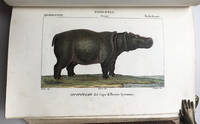
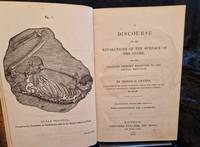
1837rif. 25143London: G. Henderson 1837. First edition. Hardcover. Very good overall. Full collection of the engravings from the four volume atlas neatly trimmed just outside the margin retains all printed text and beautifully laid out in an album complete with the title page. A full suite of plates for this edition a total of 435 plates Mammalia 48 Birds 67 Reptiles 30 Fishes 70 Insects 104 Arachnids 6 Crustaceans 38 Annelides 10 Molluscs 38 and Zoophytes 24. The classic work of the French naturalist Georges Cuvier 1769 - 1832 containing the results of his extensive research into the structure of living and fossil animals. Folio album 108 pp 4 plates laid down to a page marbled end papers. In an early binding quarter green buckram and dark green buckram boards. Covers slightly dusty the cloth spine intact with some cracks; small amateur cloth repair at front board. The plates at the last leaf with some toning otherwise bright and clean. G. Henderson hardcover
1804rif. 815London: Alexander Tilloch 1804. 1st Edition. BOUND FIRST EDITION OF A LETTER ON THE ATOMIC THEORY IN CHEMISTRY FROM JOHN DALTON to Alexander Tilloch founder of the journal in which this paper is published. Also included are papers of import by Gay-Lussac Biot and Cuvier. John Dalton 1766-1844 was an English chemist meteorologist and physicist best known for his pioneering work in the development of modern atomic theory the atomic theory in chemistry. "Dalton applied the Laws of Conservation of Mass and Definite Composition to explain his Atomic Theory. He developed the chemical theory in 1803 and told Thomas Thomson University of Edinburgh about it in 1804" Greenberg A Chemical History 172. This paper is Dalton's response to a conclusion the chemist and professor Thomas Thomson leveled regarding Dalton's Atomic Theory; specifically: in the 2nd edition of his influential A System of Chemistry Thomson wrote "that air is a chemical compound"; he then offered four reasons for his conclusion. Dalton believed that he had already well-proven "the absurdity of the notion of atmospherical air being a chemical compound of azotic and oxygens gases" Dalton On the Supposed 19 1804 p. 79. The object of the Dalton paper offered here then is to show the "insufficiency" of Thomson's four reasons; to do so Dalton debunks each of Thomson's four 'reasons' one by one. ALSO INCLUDED: An exceedingly rare first edition in English of Jean-Baptiste Biot's paper "Account of an Aerostatic Voyage" describing his landmark balloon ascent with Louis-Joseph Gay-Lussac. The scientific readings that Biot and Gay-Lussac took during their ascent established that the Earth's magnetic field extends into the atmosphere. "The ascent was notable in that it was undertaken entirely for scientific purposes. The primary purpose was to find whether the magnetic intensity of the earth decreased at great altitudes as had been suggested by Horace de Saussure's experiments in the Alps. From their experiments in which they timed the oscillations of a magnetized needle at various altitudes Biot and Gay-Lussac concluded that up to 4000 meters there was not change" DSB II p. 134-135. ALSO INCLUDED: "Osteological Description of the one-horned Rhinoceros" is the first English edition of the first part of an important paper by the celebrated zoologist and naturalist Georges Cuvier on the one-horned rhinoceros one-horned Indian rhinoceros; Rhinoceros unicornis. It has been said that Georges Cuvier possessed one of the finest minds in history. Almost single-handedly he founded vertebrate paleontology as a scientific discipline and created the comparative method of organismal biology an incredibly powerful tool. It was Cuvier who firmly established the fact of the extinction of past life forms. CONDITION & DETAILS: London: Alexander Tilloch. Complete volume. 8vo. 8.25 x 5.25 inches. 4 400 pages. Illustration: Nine copper-engraved plates with light to moderate age toning and foxing. Tightly and very solidly bound in contemporary quarter calf over marbled boards. Gilt-lettered and ruled at the spine. The leather on spine is a bit scuffed and the spine tips are rubbed. Binding is tight and sturdy and overall in very good condition. Interior: Title page is moderately foxed. Light to moderate foxing from preliminaries through page 20; moderate foxing on the final few plates. The remainder of interior including all papers of import is very clean. Very good condition. Alexander Tilloch hardcover
rif. 16104063like new. unknown
1837rif. Flo442Complete set of the plate volumes from the first Italian edition of the monumental French Dictionary of Natural Sciences 1240 finely engraved plates with splendid hand colouring numbered 1 to 1200 but with multiple bis plates The plates by Jean-Gabriel Prêtre worms and zoophytes shells insects and crustaceans birds mammals fish herpetology and Pierre Jean Francois Turpin botany. Newly engraved by Italian engravers Corsi Verico Cignozzi Luigi Giarre Stangli Bozza Zignoni etc. Includes many extinct fossil species and dinosaurs as well as recently extinct species such as the Bubal Hartebeest Alcelaphus buselaphus buselaphus auroch Bos urus quagga Equus quagga quagga Cuban red macaw Ara tricolor etc. Several critically endangered species such as the Screwhorn antelope Addax nasomaculatus and European eel Anguilla anguilla as well as endangered species including the Chinese forest musk deer Moschus berezovskii Indian rhino Rhinoceros unicornis Orang utan Pongo pygmaeus silvery gibbon Hylobates moloch polar bear Ursus maritimus white-fronted spider monkey Ateles belzebuth Green sea turtle Chelonia mydas etc. The original published in France from 1816-1830 was the work of well-known scholars including Frédéric Georges Cuvier Antoine Laurent de Jussieu Charles Dumont de Sainte-Croix André Marie Constant Duméril Anselme Gaëtan Desmarest Hippolyte Cloquet Henri-Marie Ducrotay de Blainville etc. This Italian translation was published in Florence from 1830 to 1850. All the plates directed by Pierre Jean Francois Turpin 1775-1840 one of the greatest botanical artists of the Napoleonic era along with Redoute and Bessa. When serving in the French army in Haiti in 1794 Turpin met botanist Pierre Antoine Poiteau and switched careers. His skill as an artist was recognized by botanists such as Poiret Humboldt Duhamel du Monceau and Candolle. Turpin provided the majority of the plates for Flore Medicale. Turpin drew all the botanical plates in this work along with his son who died tragically at age 18. Jean-Gabriel Prêtre 1768-1849 was a Swiss-French natural history painter who illustrated a large number of books for Cuvier Louis Pierre Vieillot René Primevère Lesson Comte de Lacépède Richard Achille and many other French zoologists. Half morocco spines with gilt title and volume labels in leather marble paper boards with a wood-grain pattern boards scuffed and worn. Some spotting to the index text pages at the front of each volume but most plates clean and bright on very white paper the fine stipple engravings with vivid colour. A few plates with childish colouring a few with large spots of foxing or age toning and one torn with loss of lower 3cm. Ex-libris bookplates of Periclis Staderini in all volumes. Bindings have been treated with a protective celloluse coating. V. Batelli e Figli hardcover
rif. 1108049613.Gpaperback. Good. Access codes and supplements are not guaranteed with used items. May be an ex-library book. paperback
rif. 1108049664.Gpaperback. Good. Access codes and supplements are not guaranteed with used items. May be an ex-library book. paperback
rif. 0265161037.Ghardcover. Good. Access codes and supplements are not guaranteed with used items. May be an ex-library book. hardcover
rif. 1022832816.Gpaperback. Good. Access codes and supplements are not guaranteed with used items. May be an ex-library book. paperback
rif. 1108058914.Gpaperback. Good. Access codes and supplements are not guaranteed with used items. May be an ex-library book. paperback
rif. 1361838906.Ghardcover. Good. Access codes and supplements are not guaranteed with used items. May be an ex-library book. hardcover
rif. 1361838965.Ghardcover. Good. Access codes and supplements are not guaranteed with used items. May be an ex-library book. hardcover
rif. 1361838949.Gpaperback. Good. Access codes and supplements are not guaranteed with used items. May be an ex-library book. paperback
rif. 1361838884.Gpaperback. Good. Access codes and supplements are not guaranteed with used items. May be an ex-library book. paperback
2003rif. __0415289238Routledge 2003. Hardcover. New. reprint edition. 332 pages. 9.25x6.25x1.00 inches. Routledge hardcover
rif. 102042639X.Ghardcover. Good. Access codes and supplements are not guaranteed with used items. May be an ex-library book. hardcover
rif. 1021916366.Gpaperback. Good. Access codes and supplements are not guaranteed with used items. May be an ex-library book. paperback
1829rif. 001966London: Whittaker Treacher and Arnot 1829. 1st Edition . Hardcover. Very Good. First Edition in English first thus. Small 8vo 2 pp261 complete with b/w frontis 3 full page woodcuts and 4 others within the text. Hardcover no dust jacket. Period full calf binding with 5 raised bands and gilt titles with decorative panels to spine in very good- condition with some shelf wear to top & tail of spine along with some rubbing to board edges. Inside some foxing to endpapers with all other pages with full marbled edge in very good clean and bright condition for its age. Baron G. Culvier was a French naturalist and zoologist sometimes referred to as the "founding father of paleontology". Cuvier is also remembered for strongly opposing theories of evolution believing there was no evidence for evolution but rather evidence for cyclical creations and destructions of life forms by global extinction events such as deluges and becoming the most influential proponent of catastrophism in geology in the early 19th century. A very nice copy of this very scarce foundational paleontology text. Whittaker, Treacher, and Arnot hardcover
1846rif. 1948Paris: Crochard et Cie 1846. Second expanded edition. PIONEERING ESTABLISHMENT OF THE SCIENCE OF COMPARATIVE ANATOMY. Eight volumes in 9 bindings 8 1/2 inches tall Vol. 4 is in 2 parts. Green quarter leather binding with gilt titles and compartments marbled paper covered boards patterned endpapers bookplate of NSR Maluf to each volume Vol. I i-xxxiii lithographic facsimile of letter from Cuvier 587 pp 1; Vol. II i-viii 726 pp; Vol. III 4 i-iv 760 pp; Vol. IV pt 1 i-xxvii 618 pp 4; Vol. IV pt 2 i-iv 691 pp 1; Vol. V i-viii 503 pp folding table; Vol. VI i-vii 557 pp 1 folding table; Vol. VII i-vii 1 656 pp; Vol. VIII i-xii. 848 pp. Covers corners spine ends worn light browning to pages the first blank and usually the half title of each volume have top edge corners clipped presumably to remove a signature not affecting text. Bindings tight pages unmarked very good in custom archival mylar covers. CONTENTS: Vol. I contains the principal discussion of Cuvier's famous theory of the correlation of parts- the functional relationship of each bodily organ to every other organ. Also considered are the organs of movement of vertebrate animals; Vol. II addresses the organs of movement of invertebrate animals and the osteology of the head; Vol. III considers the nervous system and sense organs; Vol. IV reviews the organs of mastication salivation and swallowing in vertebrate animals; Vol. V reviews the feeding organs of invertebrate animals; Vol. VI explores the nutritive fluid its reservoirs and the organs that set it in motion in the four types of the animal kingdom; Volume 7 the description of the organs of elaboration and purification of the nutritive fluid through respiration and urinary secretion; and Volume 8 the organs of generation and secretions the swim bladder of the fish and the organs of vocalization. GEORGES CUVIER 1769 – 1832 was a French naturalist and zoologist sometimes referred to as the "founding father of paleontology". Cuvier was a major figure in natural sciences research in the early 19th century and was instrumental in establishing the fields of comparative anatomy and paleontology through his work in comparing living animals with fossils. He expanded Linnaean taxonomy by grouping classes into phyla and incorporating both fossils and living species into the classification. He laid the foundations for a method of analysis and comparison applied to the entire animal kingdom and a new branch of natural history was born thanks to his scientific collaboration with Geoffroy Saint-Hilaire. This was based on the theory that anatomical and physiological characteristics of animals are molded by their environment. He established four major families: vertebrates mollusks arthropods and radiates. He was the first to apply the concept of an ecosystem viewing it as a vast network in which species interact with one another. GARRISON-MORTON No. 311 "Cuvier played a leading part in the development of paleontology and stimulated the study of comparative anatomy. He ranks with von Baer as one of the founders of modern morphology. The posthumous second edition offered here revised and expanded by Georges Cuvier's younger brother Georges-Frédéric Cuvier to 8 vols. appeared from 1835-1846." Crochard et Cie hardcover
rif. 1276617704.Gpaperback. Good. Access codes and supplements are not guaranteed with used items. May be an ex-library book. paperback
rif. 1278439943.Gpaperback. Good. Access codes and supplements are not guaranteed with used items. May be an ex-library book. paperback
rif. y111VOLUMEN QUARTUM Parisiis Colligebat Nicolaus Eligius Lemaire MDCCCXXVIII 1828 paperback 645 pages text in Latin a bit dishevelled but still in good reading order. Full refund if not satisfied. 24 hour despatch. Soft cover. Fair. paperback
rif. 1333065302.Gpaperback. Good. Access codes and supplements are not guaranteed with used items. May be an ex-library book. paperback
rif. 51-5714Paris Déterville 1812. 4 volumes. 4to. 21 x 27cm Later qtr goatskin with matching brown marbled boards. With 152 engraved plates of 154. Fine condition.Contents: T. 1. Discours preÌliminaire et la geÌographie mineÌralogique des environs de Paris.t. 2. Pachydermes des couches meubles et des terrains d'alluvion.t. 3. Os fossiles des environs de Paris.t. 4. Ruminans les onguiculeÌs et les reptiles fossiles .Vol. 1 includes Discours préliminaire in which Cuvier introduced the idea of geological ‘revolutions’ to explain mass extinctions of prehistoric species. Other papers include an essay on an Egyptian ibis mummy brought from Thebes during Napoleon's campaign in Egypt; and with Alexandre Brogniart 1770-1847 an updated version of Cuvier's important stratigraphical memoir of 1810 Essai sur la Géographie Minéralogique des Environs de Paris which contributed to the concept of faunal succession in rock strata of different periods. In Vol. 2 Cuvier describes species of pachyderms found in recent alluvial deposits including elephants mastodons rhinoceros hippopotamus and tapir. In Vol. 3 Cuvier's recalls the challenges of reconstruing fossils of different species. Vol. 4 concerns fossil horses and pigs bears hyenas and big cats and concludes by describing fossil sloths crocodiles turtles and marine dinosaurs.OCLC Number988198; Nissen ZBI 1011; BMNH Cat. I p. 409.Near the end of the eighteenth century scholars disputed whether fossils represented life forms that no longer existed or whether—as the Comte de Buffon at the Jardin des Plantes in Paris believed—the fossils found in Europe and America represented animals that had migrated to the tropics. Buffon argued that God would not have let his creations go extinct. In 1796 Cuvier presented a paper to the National Institute of Sciences and Arts in Paris in which he compared the anatomy of living and fossil elephants thus proving extinction to be a fact as the fossil elephants had not been seen by recent humans. In the following years Cuvier continued to document the extinction of animals such as the giant ground sloth the Irish elk and the American mastodon.Cuvier's research on extinct forms led him to investigate the causes of extinction. He proposed a catastrophist geological history of the earth. Édition originale de cet ouvrage important dans le domaine de la paléontologie. L'illustration se compose de 152 planches gravées sur 154 d'après les dessins de Cuvier et une très grande carte dépliante en couleurs "Carte géognostique des environs de Paris" Il s'agit d'un recueil d'articles que Cuvier fit paraître de 1795 à 1812 dans de nombreuses revues et en particulier dans les Annales du Muséum. Il s'ouvre sur un Discours préliminaire dans lequel l'auteur expose ses idées sur les cataclysmes qui ont bouleversé la terre en particulier le dernier qui coïncide avec le Déluge de la Bible. En français dans le texte 224. cartonnages frottés et usés manque 2 planches quelques feuillets et planches détachés intérieur très frais. Expertise by: François Giard Paris, Déterville, 1812 hardcover
1810rif. 79759Paris: Imperiale 1810. First Edition. hardcover. very good. xvi 394 1 pages. 8vo 1/2 brown calf rubbed. Paris: L'Imprimerie Imperiale 1810. Very good. Report on zoology chemistry meteorology and medicine by the noted zoologist and scientist. Imperiale unknown