4 270 résultats
1867réf. 39655Paris J.-B. Baillière 1867 in-8 broché, couverture imprimée
1756réf. P49502Lausanne, chez Marc-Mic. Bousquet 1756 viii + 343pp.+ frontispice , 1e édition, reliure plein cuir (dos à 5 nerfs, titre et décorations dorés au dos), 17cm., bel exemplaire de cette édition originale
1756viii + 343pp.+ frontispice , 1e édition, reliure plein cuir (dos à 5 nerfs, titre et décorations dorés au dos), 17cm., bel exemplaire de cette édition originale
1842réf. 1786Braunschweig, F. Vieweg und Sohn, 1842. XVI Seiten, 1 Bl., 342 Seiten, 1 Bl. Pappband der Zeit mit Rückenschild.
1841réf. 17715Paris Desloges 1841 In-16 Recueil factice in-16, 128, 128 128, 142, relié avec , physiologie de l'homme à bonnes fortunes, par Edouard Lemoine, physiologie du célibataire et de la vieille fille par L. Couailhac, physiologie des bals de Paris par Chicard et Balochard, Physiologie de l'employé par Balzac illustré de vignettes de M. Trimolet.
1713In 4° (23,5x17,3 cm); (10), 179, (3) pp. Legatura dei primissimi del novecento in piena pergamena rigida. Esemplare ancora in barbe e con ampi margini. Iniziali ornate. Conservati i fogli di guardia originali. Antica nota di possesso di "Antonio Laghi" al frontespizio che definisce questo esemplare esser appartenuto con tutta probabilità al celebre architetto bolognese, Antonio Maria Laghi (1676-1756). Non comune prima edizione di questa importante opera del celebre medico, anatomista e fisiologo originario di Crevalcore (Bologna), Marcello Malpighi. Quest'opera vide le stampe postuma solo grazie all'opera del medico veronese Girolamo Gaspari e all'interessamento di Antonio Vallisnieri. L'opera è particolarmente interessante per l'ampio spazio dedicato a riflessioni psichiatriche dedicate a varie malattie mentali. Opera non comune, in prima edizione in barbe, dalla provenienza celebre ed in ottime condizioni di conservazione. Cfr. BLAKE 285; Heirs of Hippocrates 575; HIRSCH IV, 110; PIANTANIDA 1949: "Pregiata e rara ediz. orig."; WALLER 6195; WELLCOME III, 284.
1904réf. 012291Jena, Gustav Fischer, 1904. IV, 130 S. Halbleinenband der Zeit. Der Mediziner und Zoologe Theodor Boveri (1862-1915) brachte zeitgleich mit W.S.Sutton die wiederentdeckten Mendelschen Vererbungsgesetze erstmals in Zusammenhang mit den zytologischen Forschungsergebnissen: "The Sutton-Boveri hypothesis" (Garrison/Morton 242.2). Ausgeschiedenes Bibliotheksexemplar: mehrfach gestempelt und der Rücken mit kleinem Signaturschildchen, insgesamt handelt es sich jedoch um ein ordentliches, noch gut erhaltenes Exemplar mit nur leichten Gebrauchsspuren.
1889réf. 29076Paris J.-B. Baillière 1889 fort vol. in-8 demi-chagrin fauve, dos à nerfs [Rel. moderne], mouillures à la fin
184130 cm, in grande 4°, 2 volumi, brossura editoriale con titoli entro ricca cornice tipografica, p. Vol. I: (12), 505, (3), IX tav. ; Vol. II: (2), 58, (2). Ritratto di Galvani su rame a piena pagina su disegno di Francesco Spagnoli ed incisione ad opera di Antonio Marchi. Un facsimile di una lettera, ed in fine al volume 9 belle tavole ripiegate con la raffigurazione degli esperimenti più noti del Galvani magistralmente impresse e disegnate dalla litografia Bettini. Edizione originale con numerosi studi scientifici ed anatomici inediti. Il secondo volume con le "aggiunte" è del 1842 e presenta un lieve alone che non disturba il testo. Nel complesso ottimo esemplare perfettamente preservato.I due volumi sono in barbe ed in parte intonsi, assai ben conservati entro veste editoriale originale.
1852réf. 012320Heidelberg und Leipzig, C. F. Winter 1852-1856, 1852. 3 Blatt, 458 S., 1 Blatt; X, 501 S. Halbleinenbände der Zeit. "Ludwig belonged to that remarkable group of German physiologists and teachers who in the latter half of the nineteenth century created modern physiology [...] His role as a teacher was enhanched still further by his Lehrbuch, the first modern text on physiology. The book was meant for students and made no attempt to define life or to elucidate 'vital forces' or 'biological principles'" (Dictionary of Scientific Biography VIII, 541). "Es giebt kaum ein Gebiet der Physiologie, das von Ludwig nicht mit wichtigen Untersuchungen und Entdeckungen bereichert worden ist. Wenn es ein Hauptverdienst der Medizin in der 2. Hälfte des 19. Jahrhunderts ist, mit der Inaugurierung der exakten Untersuchungsmethoden gleichzeitig die ältere hypothetische Lehre vom Vitalismus definitiv beseitigt zu haben, so gebührt ein umfassender Anteil hieran gerade Ludwig" (Pagel: Biograph. Lexikon hervorragender Ärzte, 1055). Ausgeschiedenes Bibliotheksexemplar: mehrfach gestempelt und der Rücken mit den Resten kleiner Signaturschildchen. Eingangs und am Ende stockfleckig (Band 2 etwas stärker) und die Einbände berieben, insgesamt handelt es sich jedoch trotz der Gebrauchsspuren um ein ordentliches, noch gut erhaltenes Exemplar.
1838réf. 012034Berlin, Reimer, 1838. VI, 41 S., 2 Tafeln. Etwas größerer neuerer Halbleinenband mit eingebundenem Umschlag der ursprünglichen Orig.-Broschur. Dissertation Rudolf Remaks (1815-1865), der sich 1847 mit einer Ausnahmegenehmigung König Friedrich Wilhelms IV. als erster jüdischer Privatdozent in Preußen habilitierte und epochemachende Arbeiten auf dem Gebiet der mikroskopischen Anatomie der Nerven, der Embryologie und der Elektrotherapie geleistet hat. "Remak was one of the greatest neurocytologists and his published works have withstood the test of time and scientific examination. His unsurpassed ability as a microscopist is well demonstrated in this doctoral thesis, written in Latin when he was only twenty-three years of age. In it he presented one of the fundamental truths of neurohistology by distinguishing between the gray postganglionic nerve fibers (Remark's fibers) and the white cerebrospinal nerves. He also demonstrated that the autonomic ganglia are the axones of nerve cells and are continuous with cells within the spinal cord" Heirs of Hippocrates 1818; Garrison/Morton 1262; Hirsch/Hübotter IV, 764. Das Titelblatt mit kleinem Namenszug, sonst schönes, gut erhaltenes, wenn auch etwas stockfleckiges Exemplar mit nur leichten Gebrauchsspuren.
réf. 3441P., Méquignon-Marvis, 1816-1817, 2 volumes in 8 reliés en demi-basane, dos ornés de fers dorés (reliures de l'époque), (coiffe du tome 2 usées quelques rousseurs, quelques manques de papier d'origine dans la marge de quelques feuillets sans perte de texte, petite tache d'encre à la p. 133 du tome 1)
réf. 552P., Brosson, An VIII (1800), un volume in 8 relié en pleine basane, dos orné de fers et filets dorés (reliure de l'époque), (légères épidermures sur les plats, 2 coins très légèrement émoussés, petite piqûre de vers sans gravité à la partie inférieure du dos et sur un plat de la taille d'une tête d'épingle), (3), 4pp., 449pp.
1828réf. 70981828 Paris, Sautelet, 1828. 2 volumes in-8 (21 x 13,5 cm) de 412 et 440 pages.Reliure d'époque XIX e , demi-veau fauve clair, dos lisse orné, fleurons à froid, roulettes dorées, plats et gardes de papier marbré, tranches marbrées, Très jolie reliure. Intérieurs trés propre , aucunes rousseurs ...
1849In 4°; 7 opere rilegate in un volume: 30 pp e 3 tav. fuori testo, 25, (1) pp. e 2 tav. fuori testo, 26 pp e 2 tav. fuori testo, 24 pp., 50 pp. e 3 tav. fuori testo, 72 pp. e 5 tav. fuori testo, 70 pp. e 9 (mal numerate 8) tav. fuori testo. Bella ed elegante legatura coeva in mezza pergamena con titolo e ricchissimi fregi in oro al dorso. Piatti foderati con carta marmorizzata azzurra coeva. Qualche insignificante macchiolina di foxing, uno strappetto senza perdita di materiale alla terza carta dell'ultima opera, ma nel complesso esemplare in ottime condizioni di conservazione ed in parte ancora a fogli chiusi. L'opera è arricchita da 7 belle dediche autografe di Calori al grande medico di origini francesi Benedetto Viale Prelà poste al frontespizio di ogni volume. Viale Prelà, nato a Bastia in Corsica, fu professore a La Sapienza e direttore del manicomio romano di Santa Maria della Pietà. Pioniere del metodo anatomo clinico nella pratica medica e nell'insegnamento, ebbe a sua volta come allievo e successore il grande medico e politico Guido Baccelli e fu anche valente chimico ed anche, curiosamente, archeologo applicando all'archeologia le sue conoscenze mediche e chimiche. L'opera qui presentata è una raccolta di prime edizioni in forma di testi singoli di importanti studi del grande medico ed anatomista bolognese nato a San Pietro in Casale nel 1806, Luigi Calori. Allievo di Francesco Mondini, Calori si laureò in anatomia nel 1829 all'Università di Bologna. In quegli anni di studio ebbe modo di conoscere numerosi esponenti della cultura italiana tra cui Gioachino Rossini. Divenne in seguito dissettore capo del Laboratorio di Anatomia umana della medesima università. Insegnò, dal 1835, Anatomia pittorica presso l'Accademia di belle arti di Bologna. Infine, nel 1844, gli fu assegnata la Cattedra di Anatomia umana dell'Università di Bologna che mantenne per 52 anni, fino al giorno della sua morte nel 1896. Fu inoltre: Direttore del museo anatomico bolognese dal 1850 al 1896; Preside della facoltà medica di Bologna negli anni 1869-72 e 1882-85; Magnifico Rettore dell'Università di Bologna nel 1876-77; socio onorario e poi più volte Presidente (1863-71, 1880-81, 1884-88) dell'Accademia delle Scienze; Presidente della Società Medica Chirurgica di Bologna nel 1856 e nel 1888. La produzione scientifica di Calori ha una mole enorme. La sua attenzione si è rivolta a numerosi settori dell'anatomia in particolare all'anatomia normale, alla patologica, alla teratologia, all'anatomia comparata, avvalendosi anche dell'aiuto di Cesare Bettini. Calori ha lasciato numerosissimi, preziosi, preparati e modelli che riempiono i musei universitari di anatomia normale, patologica e comparata. Una sua raccolta di teschi (più di duemila), datati dal Medioevo all'età contemporanea, è conservata nelle teche del corridoio d'ingresso degli Istituti di Anatomia, in via Irnerio 48. Le opere qui presentate sono studi di fisiologia e anatomia umana e animale comparata che raffrontano varie parti del corpo umano ed il loro corrispondente nell'anatomia veterinaria. Fra gli animali studiati e riportati nelle tavole: roditori, pipistrelli, ricci, tartarughe, gatti, cani ecc. Molto belle le grandi tavole fuori testo molte delle quali più volte ripiegate. L'ultima opera, illustrata da 9 gradi tavole raccoglie le osservazioni di calori su un "di un mostro umano doppio opo-ectodimo". Prime edizioni assai rare, con dedica autografa a celebre personaggio, in bella legatura ed in buone-ottime condizioni di conservazione.
réf. 100091A Paris, chez Guillaume Desprez, Imprimeur & Libraire du Roi et chez Jean Desessartz, Libraire, 1732, 1 volume in-4 de 260x180 mm environ, xxx-740 pages, (4) ff. ( fautes et omissions, approbations et privilège), plein veau marbrée cognac, dos à nerfs portant titres dorés sur pièce de titre en maroquin bordeaux, gardes marbrées, tranches jaspées, impression sur 2 colonnes. FEUILLET X, EN DOUBLE APRES LA TABLE. Edition originale complète des 4 planches dépliantes annoncées. Une tache sur la tranche supérieure, traces brunes sur le cuir sur la bordure supérieure, petits trous et galerie de vers sur un nerf, des épidermures, rousseurs et pages légèrement brunies, manque de papier sur un coin p. 671, manque la première garde blanche, deux angles un peu "tapés" sinon bon état.
1800réf. 1830Paris, Brosson und Gabon, an VIII, (1800). 3 Bll., IV, 449 Seiten. Mod. Pappband.
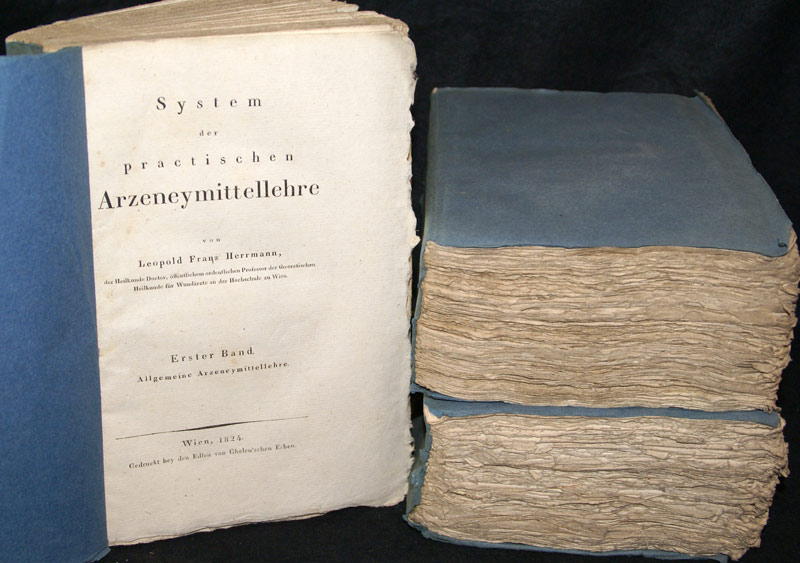
1824réf. STLA0051Wien, Ghelen 1824. gr.-8°, XV, 542 S.; XX, 938 S.; XVI, 1050 S.; Interimsbrosch., verstaubt, ungleicher Schnitt staubdunkel, zahlr. Randrisse, tlw. etw. stockfl. Bd. 1: Allgem. Arzeneymittellehre; Bd. 2 u. 3: Besondere Arzeneymittellehre. Wurzbach VIII,387; Hirsch-H. II,192; ÖBL II,292. H. (1785-1839), war Professor der Pathologie und Pharmazie in Wien.
1836réf. 1680Göttingen, Dieterich, 1836. Mit 17 mehrf. gefalt. lithogr. Tafeln. XXVI, 426 Seiten. Mod. Halbleinenband mit Rückenschild.
1826réf. 011240Neapoli, Ex Officina Bibliographica et Typographica M. DCCC. XXVI. - M. DCCC. XXVII. (1826-1827), 1826. VII, XVI, 295 S., 2 Blatt; 1 Blatt, 365 S. Halblederbände der Zeit. Das Titelblatt von Band I mit altem handschrifltichem Vermerk. Demenico Cotugno (1736-1822) genoß als Professor für Anatomie an der Universität Neapel und königlicher Leibarzt großes Ansehen. Die hier vorliegende posthume Ausgabe seiner Schriften bringt neben den gesammelten kleinen Beiträgen vor allem auch eine erweiterte Fassung seines ursprünglich 1764 erschienenes Hauptwerks "De Ischiade nervosa Commentarius", einer der wenigen Schriften, der Garrison-Morton gleich drei Einträge widmet (1382, 4204.2 und 4515) sowie seine Arbeit zur Anatomie des Innenohres "De aquaeductibus auris humanae internae" (1761, Garrison-Morton 1549): He "did make important contributions to the knowledge on the structure and function of the ear, including the discovery of the aural aqueducts. The naso-palatine nerve and the columes in the osseous spiral lamina are named after him." Seine "Abhandlung vom nervigen Hüftweh" (so der schöne Titel der deutschen Übersetzung von 1792) kommentieren die Heirs of Hippocrates "In this, perhaps his most important work, he differentiates arthritis from nervous sciatica, gives the first detailed description of cerebrospinal fluid, and shows that the congealed protein in the urine of a nephritic patient is a diagnostic sign" (1026). Bibliotheca Walleriana 2180. Außerdem enthalten die Bände noch "De sedibus variolarum Syntagma" (1771), "a lucid description of the anatomy and pathgology of smallpox pustules. It is regarded as one of the finest dermatological works of the eighteenth century" (Heirs 1027). Beide Bände mit Abklatsch eines entfernten Exlibris sowie neuerem Vorbesitzerstempel. Die Rücken berieben und das Porträt durch den Exlibris-Abklatsch fleckig, insgesamt handelt es sich jedoch um ein ordentliches, gut erhaltenes Exemplar mit nur leichten Gebrauchsspuren.
1837réf. 012319Coblenz, J. Hölscher 1837-1844, 1837. 2 Blatt, 741; 780 S. Dekorative Halblederbände von ca. 1890. Band 2 vorne mit eigenhändiger, persönlicher Widmung des Physiologen Max Verworn (1863-1921) aus seiner Göttinger Zeit für den italienischen Kollegen Silvestro Baglioni (1876-1957): "Herrn Sr. Silvestro Baglioni zur Nacheiferung des grossen Meisters Johannes Müller. Weihnachten 1902 Max Verworn." "The first modern systematic textbook on physiology, presenting an authorative and discerning survey of each aspect of the science" (Garrison/Morton 601). "The great classic of the nineteenth century in the field of physiology. Here he summarizes the advances of the preceding decades and successfully integrates the contributions of other fields, notably comparative chemistry, physics, and psychology. It is largely through this work that physiology emerged as a medical discipline" (Heirs of Hippocrates 1632). Band 1 erschien ursprünglich 1833-34 in zwei Abtheilungen und liegt hier in der 4., verbesserten Auflage von 1844 vor; die 3 Abtheilungen des 2. Bandes von 1837-40 als Erste Ausgabe. Jeweils mit neuerem Exlibris und die Titelblätter mit kleinem Namensstempel. Durchgängig etwas stockfleckig und mit geringen An- und Unterstreichungen in Kopierstift auf ca. 20 Seiten in Band 2. Trotz der leichten Gebrauchsspuren handelt es sich um ein insgesamt schönes, gut erhaltenes Exemplar des durch die Widmung Verworns getrüffelten Klassikers.
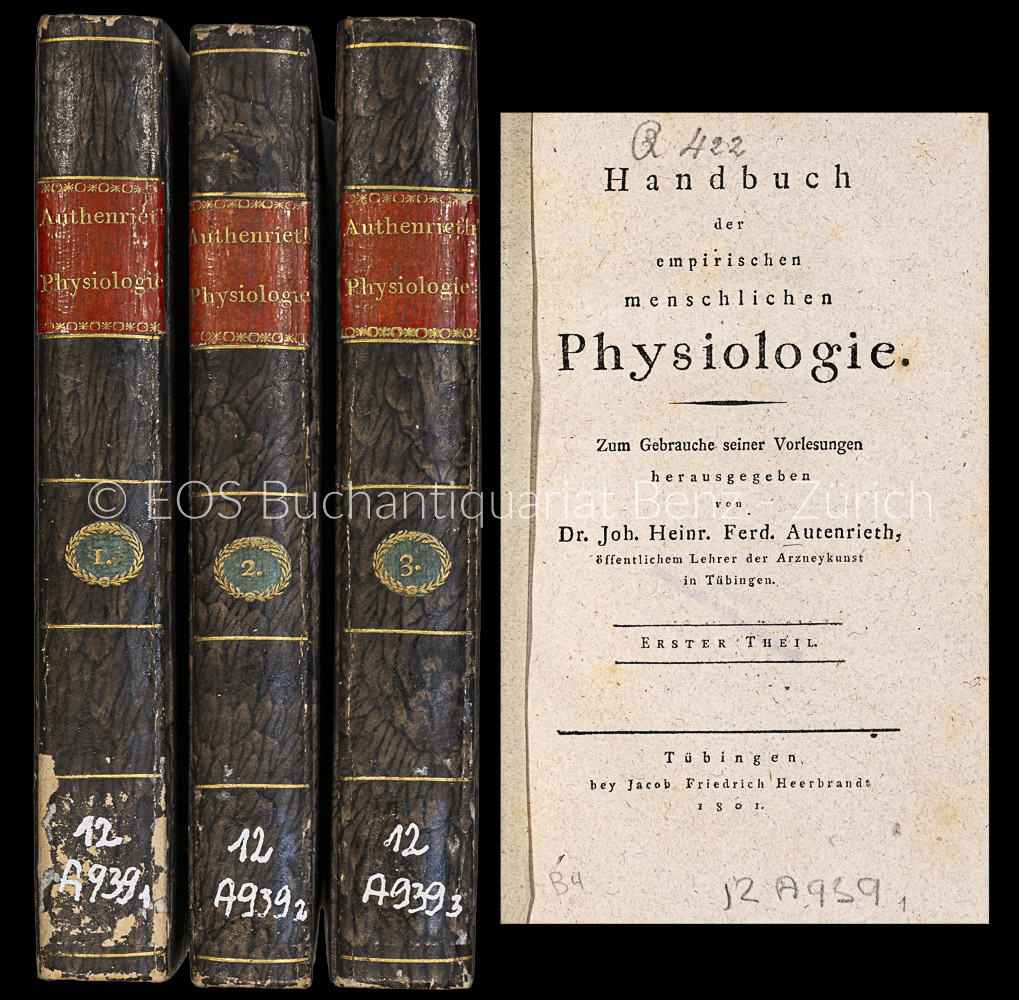
1801réf. 30438ABTübingen, Heerbrandt, 1801?02. 8°. XVI, 360 S.; (4), 364 S.; VIII, 396 S. + Wichtig: Für unsere Kunden in der EU erfolgt der Versand alle 14 Tage verzollt ab Deutschland / Postbank-Konto in Deutschland vorhanden +, A 3 Bände.
réf. 20802Fort in-4° (263 mm) polycopié, demi-maroquin vert sapin, dos à quatre nerfs encadrant l’auteur et le titre dorés ; [11] ff. liminaires, 379 ff. recto, 5 planches hors-texte, 11 tableaux dont 9 dépliants et 12 planches de tirages photographiques originaux.
1840réf. 43747Braunschweig, Friedrich Vieweg und Sohn, 1840. 8°. XII S., 352 S., 1 Bl. ?Berichtigungen?, Mod. marmor. Ppbd. im Stil d. Zt. m. etw. Rückenverg. u. goldgepr. Rückenschild.
1970I edizione, testi di André Berkaloff, Jacques Bourguet, Pierre Favard, Maxime Guinnebault, traduzione di Anna Maria Fuhrman Conti, brossura editoriale flessibile, illustrata, ingiallita, con fioritura, alcune piccole abrasioni ed usura alle punte, pagine con qualche sporadica fioritura ed arricchite da 169+7 illustrazioni e grafici nei testi. Numero pagine 315 USATO